http://www.facebook.com/v/10150257497405484
Guy Kawasaki says Foursquare should be very afraid. What do you say?
Thinks I find along the way
Guy Kawasaki says Foursquare should be very afraid. What do you say?

Hmmm. Not impressed. “Not available in your region” was my response when I loaded it up…
Though all of these platforms offer great potential opportunity for businesses, only Foursquare is large enough and commercial enough currently for businesses to consider using it as part of their digital strategy. Though they are emerging and growing rapidly, Gowalla’s scale and MyTown’s lack of a clear business focus keep them from being must-use applications like Facebook
and Twitter
Location is one of the hottest spaces around right now, however, so don’t be surprised if all of these players eventually command a large enough audience to have a significant business impact. The early location battles are over and Foursquare is the leader; however, the larger war for location dominance is far from finished.
Hey, Northeast Wisconsin! Want to grab your share of the summer FIB business? Check into Foursquare…
Social Media (or any other form of Marketing and Communications) won’t save a bad product, brand or service.
This may seem like an obvious statement out of the gates, but it is something that many brand managers don’t really wrap their heads around. If you love the TV show Mad Men (and who, in their right mind, doesn’t?) the subtext of the early days of advertising (and something that kept happening until very recently) was the ability for a brand to engage with a Madison Avenue type of advertising agency to help them turn a coal into a diamond. The germ of mass media advertising was about creating an allure or desire for products and over-selling them. Making them seem and feel bigger than they really were.
Social Media changed all of that… and more.
While advertising still works on creating this perceived desire, things do change when all voices (the brand, the advertising agency and the consumer) have an equalized platform. Any one individual with a gripe or with something nice to say can get to the top of the search engines or have their online social network share their story (in places like Twitter, Facebook, YouTube, etc…) so brands, products and services have to be able to deliver. In fact, with customer reviews (or peer reviews) individuals can affect a sales outcome right there where the “buy now” button lives.
Ultimately, your brands, products and services have to hold up to this very simple adage: “it is what it is and it does what it does.”
It’s great if it can do more (but if it could do more, you would probably say so in all of your marketing and communications), but it really doesn’t have to. So, when you use words like, “better, brighter, faster, 20% more, 40% off, etc…” you can disguise the true realities of the marketing initiative in the small print. Social Media is forcing companies to do away with that fine print. Seth Godin wrote brilliantly about how brilliant brands are the only way to go in his seminal best-selling business book, Purple Cow. While being remarkable should be every brand’s lighthouse, the conversation around what it takes and those who have actually done it eludes the majority of companies. Most companies still do make regular products for regular people (in fact, if everyone was able to create a Purple Cow, how would we know? We would probably need a phrase for something that is more remarkable than a Purple Cow – Purple Panda anyone?). Seth’s right, we need to get there, but most brands are falling woefully short of those purple pastures.
Social networks and blogs are changing how consumers find places and services, how and where they share their experiences, and eventually, where they will spend their time and money. Without an understanding of, and participation in, social networks, you can miss shaping and contributing to the decision-making process of those who define the success of your business.
While social media cheat-sheets and short cuts are available almost everywhere you look, the truth is that we have some work ahead of us. To help, I’ve assembled a list of five best practices to help you build, cultivate, and measure success in the new web right now.
Follow the ‘via’ link to go to the source…
Many of us are finding knowledge resources and networking opportunities in new places. My top professional development resource is now Twitter. It used to be my Google Reader but now my Twitter friends act as a filter (or curator) by sharing the best blog posts they’ve read about social media, association management and other topics that interest me.
I’ve first met more social media and association friends via blogs and Twitter than I have in real life. When I finally met some of them face-to-face it was more like a reunion than a first meeting, and the real life encounter definitely strengthened our relationship. However, there are many whom I’m still eager to meet in person and that desire drives many of my decisions about the events I choose to attend, both locally and nationally.
More and more associations are wisely nurturing online communities using social networking platforms like Facebook, Twitter and LinkedIn. The word ‘nurturing’ is key as a good community doesn’t just develop without care and feeding. Let’s jump ahead and imagine that you have developed an online community by providing valuable and interesting content (both yours and member-generated) and a platform for conversation and connecting. Now what?
Why not organize, or support and encourage your members to organize, face-to-face meet-ups for those who participate (or lurk) in your online communities? Have a Facebook after-hours, or a tweet-up (meeting of Twitter followers) or a LinkedIn meet-up. Give your members a way to strengthen those online relationships outside of your regularly scheduled programming.
Locally, Link Appleton and Link Greater Green Bay are doing a great job of this on LinkedIn. Check them out…
Starbucks’ Vice President of Brand, Content and Online, Chris Bruzzo, is on stage at the Mashable Media Summit today and he just revealed that last year’s Free Pastry Day was a whopping success, driving more than one million people to stores.
As we noticed, activity on social media sites like Twitter and Facebook became electric on the day of the event as the free pastry news spread in digital form. Bruzzo’s credits fans with the idea to use social media to drive new business, and his remarks confirm that the swell of social media activity drove customers to visit Starbucks stores in droves.
Bruzzo also speaks to the success of the company’s Tax Day green initiative to get customers to bring in their own tumblers in exchange for free coffee, which — like Free Pastry Day — was primarily promoted online via their Facebook Page. Also, the company’s MyStarbucks Idea has generated more than 80,000 ideas and Bruzzo credits Product Manager Brad Nelson for helping them tap into the power of Twitter.
Right now there’s no big brand better embracing social media than Starbucks. The coffee retailer has managed to dominate on Facebook, made news as the first company to offer a nationwide Foursquare deal, and was selected to try out Twitter’s Promoted Tweets ad platform before other advertisers will have the chance.
Though banks are uncomfortable with the concept, many are essentially in the retail business. In my area of the Southeastern US, Bank of America and Chase have a retail delivery network akin to quick-serve restaurants, pharmacies, and gas stations. There seems to be one on every corner.
Considering the current expansion of branch networks (mostly through merger & acquisition), it makes sense that a more engaging brand personality would be good for business.
That said, it was a refreshing surprise to read an article in US Banker’s May issue describing how North Shore Bank was experimenting with Foursquare and other social media channels to create brand awareness in the communities it serves.
The $1.8 Billion bank based in Brookfield, Wisconsin has a tech-savvy e-Business Coordinator, Tim Gluth who decided to contact the “mayors” of the bank’s 44 branches and offer them a $5 Subway gift card for their patronage. “Patronage” could be a stretch as the bank did not ask if the mayors were customers of the bank, they simply acknowledged their mentions of North Shore online to say “thank you”.
Mr. Gluth found the “Mayors” on Twitter and Facebook and made contact initially through those channels. The promotion was greeted with surprise and, from this perspective, was successful in establishing customer engagement. The bank has since carried on to sponsor local Tweet-Ups in support of the minor league baseball Timber Rattlers.
Social media people love them some grading tools–you know, the kind that show you what your Twinfluence or Twitter grade are, or how popular your blog is, or even how good your Foursquare “mojo” is.
So naturally they’re all going crazy for Vitrue’s “Social Page Evaluator” which allegedly reveals how much a Facebook page is worth…
Howes says LinkedIn is so powerful for a number of reasons, including:
- You can export your contact list into a file that you can keep and analyze.
- You can have an unlimited number of contacts.
- Its members are largely business professionals, many of whom are decision-makers.
Like any powerful tool, though, you have to put some thought into how you use LinkedIn, starting with your profile. And every profile, says Howes, must start with a keyword or two. For Howes, the word is “sports.” For you it could be “kitchen contractor,” “tax expert” or “French chef.” What’s important is that it gets at what you are all about.
That keyword needs to appear in five places in your profile:
- Headline
- Current experience
- Past experiences
- Summary
- List of specialties
Putting the keyword in those five places will help move you up in LinkedIn searches and help people who are looking for experts in your field find and connect with you, says Howes, who is often at the top of searches for “sports.”
In addition to putting your keyword in your summary, he says, you need to be sure that summary answers three important questions:
- Who are you?
- Who do you want to help?
- How are you going to help them?
Answer these questions and write them in a narrative format, not in formal bullet points as you would in a resume, Howes says. He gave more good tips and referred SMSS participants to check out free instructional videos on his website for more information.
I’ll admit that I often neglect LinkedIn for multiple reasons, but it’s still an important part of a balanced social media presence — especially where I live in Northeast Wisconsin! I believe it’s a more popular tool in some parts of the country than others. What do you think?
Information has leaked that Facebook is set to roll out location-based features for users and brands as soon as this month. According to Advertising Age, users could see location options any day now.
These features will include the ability to check in at various locations, including retail spots and restaurants. We’re unclear as to whether users will be able to add or customize their own locations, but we are fairly positive that this move will put Foursquare, Brightkite (
), Gowalla and other location-based services in an uncomfortable position.
Auren Hoffman has a great post on consuming vs. producing. He says…
“We are meant to be both creators and consumers. Today, however, most people consume far more then they create. Part of the reason for this is because being both a consumer and a creator at the same time is very difficult, and because goods and services have never been more accessible. But a healthy life is one that balances both creation and consumption.
When you consume you are often appreciating other’s work. You eat, watch movies, visit nice places, read books, and party. You vegetate to the sounds of your favorite musical artist on a wonderful couch while surfing Facebook on your beautifully designed laptop.
Creators do just the opposite: they strive to make something that others (or their future self) will appreciate. Creators toil, try different things, fail, and try again.” Source: Summation: creating beats consuming
…follow the link for the rest of his article.
It’s not hard to move from consuming content to producing content for your internet marketing. I’m working on a screencast to show you how Google’s Chrome, Shareaholic and Posterous can work together to help you make the transition from thinker to thought leader. Stay tuned…

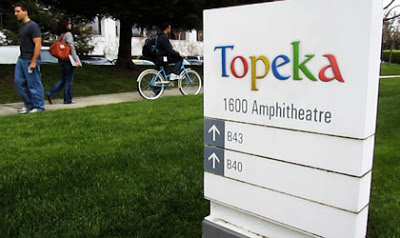 It will take a little while to get used to, but Google has changed it’s name to Topeka!
We didn’t reach this decision lightly; after all, we had a fair amount of brand equity tied up in our old name. But the more we surfed around (the former) Topeka’s municipal website, the more kinship we felt with this fine city at the edge of the Great Plains.
In fact, Topeka Google Mayor Bill Bunten expressed it best: “Don’t be fooled. Even Google recognizes that all roads lead to Kansas, not just yellow brick ones.”
For 150 years, its fortuitous location at the confluence of the Kansas River and the Oregon Trail has made the city formerly known as Topeka a key jumping-off point to the new world of the West, just as for 150 months the company formerly known as Google has been a key jumping-off point to the new world of the web. When in 1858 a crucial bridge built across the Kansas River was destroyed by flooding mere months later, it was promptly rebuilt — and we too are accustomed to releasing 2.0 versions of software after stormy feedback on our ‘beta’ releases. And just as the town’s nickname is “Top City,” and the word “topeka” itself derives from a term used by the Kansa and Ioway tribes to refer to “a good place to dig for potatoes,” we’d like to think that our website is one of the web’s top places to dig for information. Source: Google Reader (1000+)
Go to the source to read the rest of the article, and remember, Google is notorious for playing April Fools jokes…
Matt Silverman of Mashable does a much better job of explaining what I’ve been trying to tell you for years…
“Google Apps for business has a number of benefits over traditional business IT and desktop software. Using the full suite essentially places all of your data and entire workflow in the cloud, meaning you can access it all anywhere, any time, from any Internet connection.
At $50 per year per user, the fully integrated apps system is certainly cost-effective, and even adding the free versions of Gmail (Gmail), Calendar (Calendar Tweet), and Google Docs (Google Docs) into your workflow can keep your employees coordinated.
For more casual users, or even those who might not be acquainted with Google Apps, here’s a guide to how the software can benefit your small business.” Source: The Small Business Guide to Google Apps
Please go the source for his excellent overview…
![Reblog this post [with Zemanta]](https://i0.wp.com/img.zemanta.com/reblog_e.png)
Recently, a good friend of the blog told me about a tool called Xobni that integrates ‘contextual social media’ with your inbox…
“There are a number of email plugins that look to give you contextual information about the person you’re communicating with. The first one I tried (and arguably the best I’ve seen) is Xobni, an Outlook plugin.
There’s now a similar plugin available for Gmail users called Rapportive. Rapportive replaces the ads you normally see in the right-hand sidebar with a profile of the person you’re emailing with that is automatically generated by searching online services for your correspondent’s email address. Rapportive is only available to users that are using either Firefox or Chrome as their browser, since Firefox and Chrome have a plugin architecture.” Source: Rapportive replaces Gmail ads with useful social information
Need to get up to speed on Xobni?
“Xobni is a plugin for Outlook that adds advanced search and social functions to the email client. When we last looked at Xobni, the service indexed your email messages and created personal profiles for each of your contacts by automatically extracing phone numbers and loking users up on LinkedIn. Now Xobni has rolled out an update that adds integration with Skype, Facebook, Hoovers, and Yahoo! Mail.
Here’s how it works. You can search for email using the Xobni sidebar. When you click on a message, Xobni will pull up information about the sender, including information from Facebook, LinkedIn, and Hoovers. If your contact’s Skype profile or phone number are available, you can also initiate a call with the click of a button.
In addition to searching your Outlook mail, you can also have Xobni index your Yahoo! Mail, although in order to reply to messages you’ll need to login to the Yahoo! Mail web interface.” Source: Xobni brings Skype, Facebook, Yahoo! integration to Outlook
I use and recommend both of these technologies. Questions? Feedback? Comment, call or contact me to discuss how this applies to YOU…
Kevin Naze, one of my favorite outdoor writers, of the Green Bay Press Gazette writes…
Dave Nolan is a family man on a mission of faith.
While part of it includes finding a new career after an 18-year stint in the automotive industry ended when General Motors decided to stop making Saturns, another component to his master plan is getting more people to look beyond the world’s values.
“My dream job would be to have a career in sync with my passions — the outdoors partnered with the Christian ministry,” Nolan said. “My goal is to be the face of an organization and build relationships with an organization that shares the same passions.” Source: De Pere’s Nolan following a new path | greenbaypressgazette.com | Green Bay Press-Gazette
What thrills me most about this is knowing the backstory. You see, Dave is a client of e1evation, llc and a good friend to boot. I was with him when his job at Saturn was pulled out from under him and I’ve been there every step of the way as he has made his decision to follow his passion and follow God’s lead into a career in the ‘outdoors’…
Dave is using the good, fast and cheap tools I advocate to build his business. He’s still taking baby steps at Dave Nolan Outdoors, but he’s making all the right moves. Track his progress! This guy’s a thought leader who is going places and he’s partnering with e1evation, llc to make it happen…
It has been awhile since I wrote about tactic #8; using branded mail…
Today I’m going to talk about the third pillar of the e1evation system; promoting your online brand and reputation through the leveraging of homebases and outposts. Pillars 1 and 2 are ‘finding your passion’ and ‘publishing’. Once you’re publishing and you’ve found your voice, it’s time to promote your content through the use of social media outposts. Chris Brogan starts us off here…
“Social networks are great places to meet new people, to build new business relationships, and to learn about information from non-traditional sources. But another great way to use social networking sites is as an outpost. What do I mean by this? It turns out that people getting to know you on social networks might also find your content for the first time, and/or something you post to those networks might bring you an opportunity that wouldn’t immediately come to you in other ways. ” Source: Using Outposts in Your Media Strategy
I first noticed the power of leveraging social media outposts during my ‘reign’ as one of the top political bloggers in Wisconsin. I noticed during that time that if I would cross-post to Facebook or some other social media tool, that the post would get more traffic. Although this idea seemed original to me, I found that other great minds like Chris Brogan and Darren Rowse were already heading down this path… Continue reading “Tactic #9: Leverage the ‘homebases and outposts’ strategy”

Please consider this…
“Despite the buzz around location-based services, I have been ambivalent, if not skeptical about the technology.As much as social media has encouraged people to share information, I have not been convinced there is the same amount of enthusiasm for broadcasting your location.There’s the issue of privacy, as well as few “rewards” for telling the world your location.
In many respects, however, being unconvinced about the potential of location-based services has been like a Don Quixote-like experience, particularly when you’re an enthusiastic member of the social media community. The idea that you don’t really buy into the next new thing seems almost sacrosanct.
It was interesting and, to be honest, encouraging to read Joshua Brustein’s column in yesterday’s New York Times about whether the excitement surrounding location-based services is being driven by technology companies and investors, while consumers only seem modestly interested.
Brustein’s column came on the heels of a Pew Internet and American Life Project survey that discovered only 4% of Americans use location services like Foursquare and Gowalla, compared with 5% last May. Even among smartphone-toting 18 to 29-year-olds, only 8% use location-based services.
It may just be that location-based services won’t be widely embraced. Or it could be that location-based services have yet to find their sweet spot. However you want to explain it, the reality is location-based services have failed to live up to lofty expectations as social media’s next hot thing.
Perhaps Facebook’s entry into the market will change things, particularly if consumers are attracted to the link between the company’s Places and Deals services.
Or maybe not. It could be that most people have no use for location-based services despite the best efforts of companies and investors.
After all, you can lead a horse to water but you can’t make him drink” Source: Do Consumers Really Want Location-based Services? | Social Media Today
When I teach ‘curation’ as a form of blogging, I usually say that the author’s comment can be ‘yes, no or maybe so’. In this case, my response is a ‘maybe so’, but I’m leaning toward no. Let me tell you why…
Something like 87% of Americans have cell phones. Of that, 25% have smartphones. That number is projected to grow to 50% in 2011. The default mapping application on the two fastest growing platforms is Google Maps. Google just released a new product called Hotpot that makes it easy for patrons to write reviews directly on to Google Maps. Think about the implications. Say someone’s driving through Algoma, WI on their way to Door County and they’re looking for a place to grab a bite. They check Google Maps to see the options and as they try to decide, they check the reviews from Hotpot directly on Google Maps. Unfortunately, earlier that week someone had a rare bad experience at one of their choices. Do you think that won’t have an impact?
Michael Moon quoted Peter Drucker astutely in his book ‘Firebrands’ over a decade ago when he said that we’ve moved beyond the information age to the aged of ‘trusted relationships’. I believe that tech-savvy people with smartphones are going to change the face of American retail business by holding retailers accountable through mobile tools that allow them to report good or bad experiences immediately as they happen. These ‘trusted’ mobile ‘relationships’ will have the power to guide purchasing decisions at the mobile ‘point of sale’ like an endcap in a grocery store, directing potential customers to the ‘right’ place. Smart business owners will keep an eye on this trend…
 …could be just the help you’re looking for! Over 18 months ago, Seth Godin wrote this on his blog:
“Here are three things that are true: 1. Digital technology, especially computers and cell phones, can dramatically increase productivity. 2. More and more users of digital technology are small firms or individuals. 3. The vast majority of users of digital technology are totally lame in getting the most out of the investment of their time and money. “Oh, I didn’t know I could do that.” “You mean I don’t have to manually type my address book in by hand?” “There are graphs in Excel?” “Gmail is free?” Here’s what I haven’t found: people who charge $100 an hour to hear what you do and how you do it and then show you how to do it better. People who organize data and put it in the right place. People who overhaul the way small groups use technology so they can use it dramatically better. People who use copilot to take over a PC and actually rearrange it so that it works better.More examples: Teach people to back up. Show them how to check their email on the road. Help them understand how to use online networking when it’s appropriate (and warn them when it’s not). Show a restaurant how to use OpenTable to keep the place full, or to use a blog (with an RSS feed) to easily communicate with loyal customers. Teach a company to keep tabs on itself with Technorati.” Source: Seth’s Blog: A shortage of digital coaches
If you do a Google Search on the topic, note who is at the top of the list — your humble digital coach Todd Lohenry @ e1evation, llc! Once I securely log on to your computer [after you grant permission] using the technology described, I can help you with just about anything! See a quick demo here… https://www.youtube.com/watch?v=fJlASMkot34 Oh, and btw? I only charge $50 per hour… [btw, note the date on the post! The cost is now $99 per hour!]


 Bright, shiny objects!
You must be logged in to post a comment.