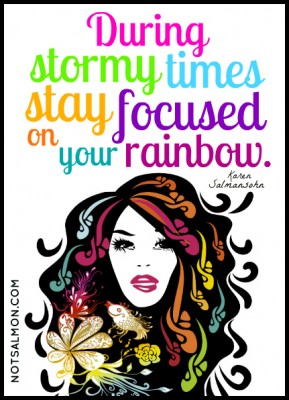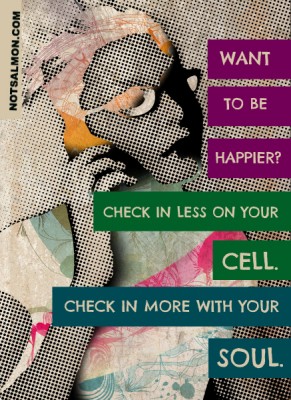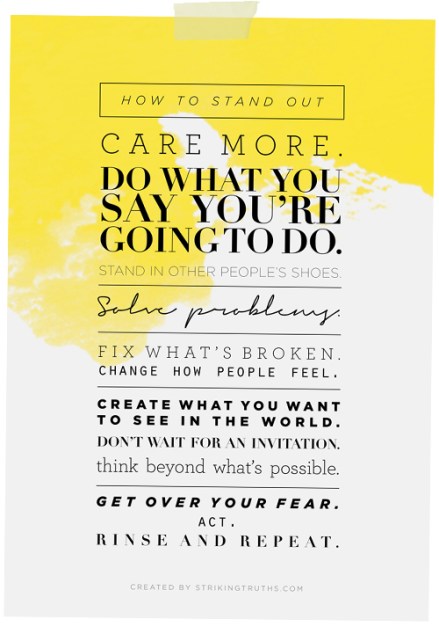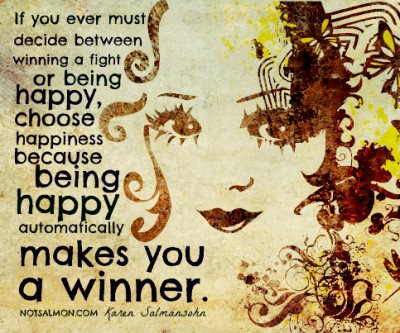
Why do I curate Karen Salmansohn’s [@notsalmon] ‘pattern interrupt’ posters so often?

Because they make me happy, plain and simple, and remind me of positive values. A mentor of mine once told me ‘never confuse the artist with the art’. In this case, however, it does not apply! Karen Salmansohn has mastered the art of pattern interrupts — positive flashcards — to remind me of what is truly important. Read her thoughts on her craft here:

“I believe that my posters work to inspire people to feel happier because they create what’s called “A Pattern Interrupt” – which is a proven psychological tool, recommended by practitioners of Neural Linguistic Programming, to help stop limiting beliefs.

If you saw the movie Shallow Hal, then you saw a Pattern Interrupt in action in that elevator scene – albeit a humorously reenacted example of a Pattern Interrupt. If you haven’t seen Shallow Hal, here’s a quickie synopsis: Tony and Jack get trapped in an elevator, and begin to talk about dating. Tony speedily discovers that Jack’s character engages in a limited thought pattern – stubbornly only dating stunning women for shallow reasons. Tony helps Jack to break his superficial thought pattern by surprising Jack with a clunk on his head – then shouting “Devils come out!” Sure enough, instantly a new mental window opens for Jack. He is now able to think about dating with a less shallow lens.

Other known methods for Pattern Interrupts have included: snapping a rubber band on your wrist, playing powerful music, being hit with unexpected comic relief, doing calming meditations, repeating positive affirmations – and reading an INSTANT HAPPY premium wall graphic! All these various Pattern Interrupts work like a “Thought Intervention” – creating a jiggling affect upon a person’s tightly held negative beliefs – then jumpstarting a new positive pattern of thought.

A Pattern Interrupt works in real life like this: Let’s say an event happens which puts you in a grumpy mood. If you’re not careful, your negative thoughts about this one solo circumstance can create a downward spiral, where you quickly go from merely thinking THIS ONE THING SUCKS to MY WHOLE DAY SUCKS to MY WHOLE LIFE SUCKS to THE WORLD SUCKS to DISTANT GALAXIES SUCK! Basically, without a Pattern Interrupt, a sad person can get grumpier, and an angry person can get grumblier!

There’s a famous Albert Einstein quote: “We can’t solve problems by using the same kind of thinking we used when we created them.” Well, Albert’s philosophy is a good explanation for why a Pattern Interrupt can snap you out of a negative thought loop. A Pattern Interrupt literally changes your brain’s energy state.

Here’s the neuroscientific scoop: MRI’s of the brain show that every time a person thinks angry thoughts or imagines worst-case scenarios, they literally send a surge of blood flowing into brain regions associated with depression and anger (the right prefrontal cortex) – thereby refueling depression and anger. Happily, MRI’s have also shown that when a person starts to think happy thoughts, they can send a surge of blood flowing into brain regions associated with happiness (the left prefrontal cortex) – thereby literally refueling your positivity.

Plus, recent studies on learning show that when you incorporate visuals into your learning process, you can better “record” a message into your permanent memory bank.

More of the neuroscientific scoop: When you put words within pictures, your brain immediately perks up in an effort to make sense of how/why these words relate to the picture – thereby stimulating more neuron activity. The more neurons you have firing up, the greater the chance that your brain is paying attention and recording what it is perceiving. This is why using flashcards with pictures help people to learn info better! Similarly, my INSTANT HAPPY posters work like Inspirational Flashcards – reminding you with a playful combo of stylish pictures and feisty words how best to live your happiest life!

I’ve joked in today’s uber-busy, espresso-chugging, hyper-active world, it’s often hard to find time to read an inspirational book – but – you always have time to read a poster.

Except, well, I’m not simply joking!” via Artwork – Karen Salmansohn.”

Click here to admire my collection and go to http://notsalmon.com to connect with her.

Constantly Feel Good About Yourself Using These 3 Steps

It is important that you feel good about yourself. More and more scientific evidence points towards a significant link between how you feel about yourself and your overall health and sense of well-being. Scientists have proven that feelings of inferiority have the capacity to pave the way to illness or disease. On the other hand, if you feel good about yourself, have a positive outlook, and maintain an active involvement in life, you’re more likely to be happy and healthy.

Our emotional state can be affected by a lot of things the environment we are in, the people we are with, the weather, the food we eat, how much sleep we’ve had, and so on. Feeling insecure, incapable and inadequate once in a while is part of being human, what matters is that you are able to make yourself feel better again.

If you feel as if you are currently in a state wherein you need some help on bolstering your feelings of self-worth, here are some ideas that you may find helpful:

Step 1: Reframe your identity

If you were asked to describe yourself, what would you say? What be the first adjectives that you would come out with? Experts say that a person’s self-worth can be assessed by the first five words that he would use to answer this question. If you answer with negative adjectives, then you would need to redefine how you think about yourself. Instead of focusing on the shortfalls in your life, bring to mind things that make you special.

For example, instead of branding yourself as a mere office worker, try looking at yourself as a great Mom or a great Dad. Pride yourself on your greatest achievements instead of highlighting flaws.

Step 2: Challenge negative self-talk

As we go about our daily lives, we constantly think about and interpret every situation that we encounter. It’s like we have this voice inside our head that talks us through everything. Psychologists call this inner voice “self-talk.” How this inner voice talks to us is based on our values, beliefs and our conscious and subconscious thoughts. If your self-talk is mostly negative, you will have a very hard time feeling good about yourself.

To correct negative self-talk, you need to learn to notice it as it happens, and consciously dispute and challenge these negative and irrational thoughts. Ask yourself questions like, “Are my thoughts factual?”, “Is this situation as bad as I am making out to be?” or “What can I do that will help me solve the problem?”. Make it a point to conquer self-defeating thoughts with positive and realistic thinking.

Step 3: Take time for yourself

In this world where everyone and everything seems to be in a rush, most of us don’t make ourselves a priority. Often we focus on catering to the needs of others and on being productive. Although it is good to take care of the people you love and fulfill your responsibilities at home and at work, you should not neglect your responsibility and obligation to yourself.

In the same way that you make others feel good when you take care of them, taking care of yourself will also bring about the same feelings. Make it a point that you allocate a certain amount of time each day for yourself to do things you love. Paying attention to yourself has been proven to improve self-esteem and feelings of self worth.

It is impossible for anyone to feel perfectly happy about who he is for their entire life. We are all bound to feel inferior or insecure every once in a while. Fortunately, our thoughts and feelings are not permanent and there are so many ways to love, accept and feel good about ourselves.” via Constantly Feel Good About Yourself Using These 3 Steps.

Just in case you missed this for 7/2/2012

  1. Maybe you know the drill here, maybe you don’t. Every day I share the best of what I find in my Google Reader that day. It’s amazing to me that even though I pull content from all over the internet, frequently it seems the Universe is acting in concert to emphasize a particular lesson. Today’s lesson? Starting over. Beginning. Letting go. Here’s the best of what I found this morning…
  2. “It’s easy to get lost in endless speculation. So today, release the need to know why things happen as they do. Instead, ask for the insight to recognize what you’re meant to learn.”

    – Caroline Myss

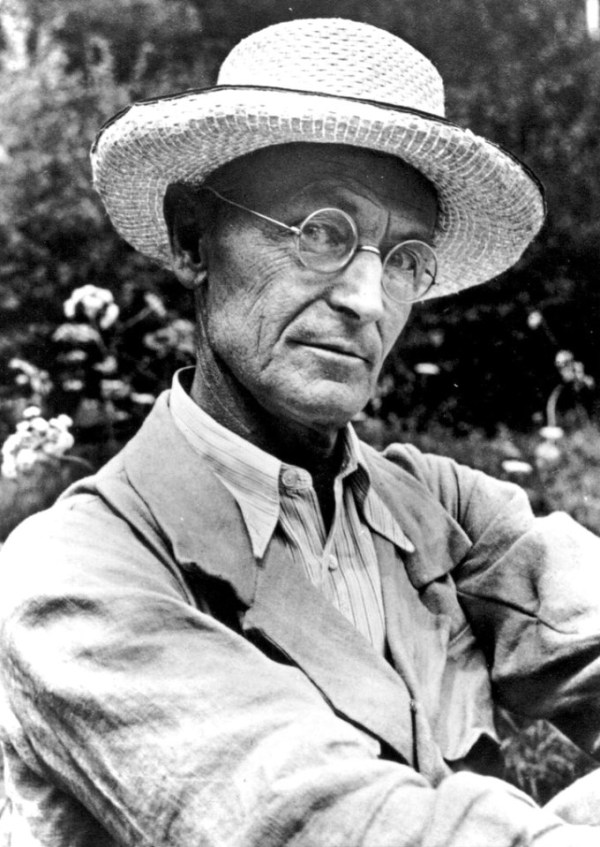
Happy birthday, Hermann Hesse!

I was a German language and literature major in college and went as far as my doctoral studies at University of Illinois before I took a ‘safer’ route. My plan was to become a world famous Hermann Hesse scholar and my dissertation would have explored the relationship between Hesse’s body of work and Hegel’s dialectic but alas. Here is his life in his own words:


I was born in Calw in the Black Forest on July 2, 1877. My father, a Baltic German, came from Estonia; my mother was the daughter of a Swabian and a French Swiss. My father’s father was a doctor, my mother’s father a missionary and Indologist. My father, too, had been a missionary in India for a short while, and my mother had spent several years of her youth in India and had done missionary work there.My childhood in Calw was interrupted by several years of living in Basle (1880-86). My family had been composed of different nationalities; to this was now added the experience of growing up among two different peoples, in two countries with their different dialects.

I spent most of my school years in boarding schools in Wuerttemberg and some time in the theological seminary of the monastery at Maulbronn. I was a good learner, good at Latin though only fair at Greek, but I was not a very manageable boy, and it was only with difficulty that I fitted into the framework of a pietist education that aimed at subduing and breaking the individual personality. From the age of twelve I wanted to be a poet, and since there was no normal or official road, I had a hard time deciding what to do after leaving school. I left the seminary and grammar school, became an apprentice to a mechanic, and at the age of nineteen I worked in book and antique shops in Tübingen and Basle. Late in 1899 a tiny volume of my poems appeared in print, followed by other small publications that remained equally unnoticed, until in 1904 the novel Peter Camenzind, written in Basle and set in Switzerland, had a quick success. I gave up selling books, married a woman from Basle, the mother of my sons, and moved to the country. At that time a rural life, far from the cities and civilization, was my aim. Since then I have always lived in the country, first, until 1912, in Gaienhofen on Lake Constance, later near Bern, and finally in Montagnola near Lugano, where I am still living.

Soon after I settled in Switzerland in 1912, the First World War broke out, and each year brought me more and more into conflict with German nationalism; ever since my first shy protests against mass suggestion and violence I have been exposed to continuous attacks and floods of abusive letters from Germany. The hatred of the official Germany, culminating under Hitler, was compensated for by the following I won among the young generation that thought in international and pacifist terms, by the friendship of Romain Rolland, which lasted until his death, as well as by the sympathy of men who thought like me even in countries as remote as India and Japan. In Germany I have been acknowledged again since the fall of Hitler, but my works, partly suppressed by the Nazis and partly destroyed by the war; have not yet been republished there.

In 1923, I resigned German and acquired Swiss citizenship. After the dissolution of my first marriage I lived alone for many years, then I married again. Faithful friends have put a house in Montagnola at my disposal.

Until 1914 I loved to travel; I often went to Italy and once spent a few months in India. Since then I have almost entirely abandoned travelling, and I have not been outside of Switzerland for over ten years.

I survived the years of the Hitler regime and the Second World War through the eleven years of work that I spent on the Glasperlenspiel (1943) [Magister Ludi], a novel in two volumes. Since the completion of that long book, an eye disease and increasing sicknesses of old age have prevented me from engaging in larger projects.

Of the Western philosophers, I have been influenced most by Plato, Spinoza, Schopenhauer, and Nietzsche as well as the historian Jacob Burckhardt. But they did not influence me as much as Indian and, later, Chinese philosophy. I have always been on familiar and friendly terms with the fine arts, but my relationship to music has been more intimate and fruitful. It is found in most of my writings. My most characteristic books in my view are the poems (collected edition, Zürich, 1942), the stories Knulp (1915), Demian (1919), Siddhartha (1922), Der Steppenwolf (1927) [Steppenwolf], Narziss und Goldmund. (1930), Die Morgenlandfahrt (1932) [The Journey to the East], and Das Glasperlenspiel (1943) [Magister Ludi]. The volume Gedenkblätter (1937, enlarged ed. 1962) [Reminiscences] contains a good many autobiographical things. My essays on political topics have recently been published in Zürich under the title Krieg und Frieden (1946) [War and Peace].

I ask you, gentlemen, to be contented with this very sketchy outline; the state of my health does not permit me to be more comprehensive.” via nobelprize.org

Happy birthday, Hermann! You made a profound impact on my life through your body of work…

Related articles

Just in case you missed this for 6/26/2012

  1. “Take up one idea. Make that one idea your life – think of it, dream of it, live on that idea. Let the brain, muscles, nerves, every part of your body, be full of that idea, and just leave every other idea alone. This is the way to success, that is way great spiritual giants are produced.”- Swami Vivekananda

    Mon, Jun 25 2012 13:14:54
  2. “I fear not the man who has practiced 10,000 kicks once, but I fear the man who has practiced one kick 10,000 times.”- Bruce Lee

    Mon, Jun 25 2012 13:14:59
  3. “The highest reward for a person’s toil is not what they get for it, but what they become by it.”- John Ruskin

    Mon, Jun 25 2012 13:14:52
  4. How many of us would presume to announce, “Well, I’m sober and I’m happy.  What more can I want, or do?  I’m fine just the way I am.”  Experience has taught us that the price of such smug complacency — or, more politely, self-satisfaction — is an inevitable backslide, punctuated sooner or later by a very rude awakening.  We have to grow, or else we deteriorate.  For us, the status quo can only be for today, never for tomorrow. Change we must;  we can’t stand still.  Am I sometimes tempted to rest on my laurels?”
    Mon, Jun 25 2012 13:14:59
  5. “There is no one giant step that does it. It’s a lot of little steps.”
    –Peter A. Cohen
    Mon, Jun 25 2012 13:14:56
  6. Be gentle with yourself, learn to love yourself, to forgive yourself, for only as we have the right attitude toward ourselves can we have the right attitude toward others.
    –Wilfred Peterson
    Mon, Jun 25 2012 13:14:54
  7. The true test of character is not how much we know how to do, but how we behave when we don’t know what to do.
    –John Holt
    Mon, Jun 25 2012 13:14:56
  8. However many holy words you read, However many you speak, What good will they do you, If you do not act upon them?
    –Buddha
    Mon, Jun 25 2012 13:14:52

Just in case you missed this for 6//25/2012

  1. “Learn to say ‘no’ to the good so you can say ‘yes’ to the best.”

    – John C. Maxwell

  2. It is good to have an end to journey towards, but it is the journey that matters, in the end.
    —Ursula K. LeGuin
  3. A man who has committed a mistake and doesn’t correct it is committing another mistake.
    –Confucius
  4. Don’t argue for other people’s weaknesses. Don’t argue for your own. When you make a mistake, admit it, correct it, and learn from it–immediately.
    –Stephen Covey
  5. Left to itself, nature takes ordinary garbage and transforms it into useful nutrients that help sustain life. It’s usually poor human action that makes garbage a problem.

    Our mental and emotional garbage takes the forms of bad memories, festering resentments, and useless regrets. We waste time berating ourselves and others about bad decisions and experiences that are behind us.

    The magic of the 12 Step program is that we can use it to transform this mental garbage into useful experience. A past mistake can become as asset when we share it with others. Pain and suffering can teach a lesson that helps all of us to grow. By forgiving others, a resentment can be turned into a friendship.

    I’ll resolve today not to worry about garbage any longer than it takes to identify it and release it to my Higher Power for transformation.

  6. Quote: When a man points a finger at someone else, he should remember that three of his fingers are pointing at himself.
    —Louis Nizer

    It’s so easy to blame others. Others are always making mistakes we can hide behind. That’s what blame is—hiding. When we blame others for our mistakes, we’re trying to hide our character defects.

    It’s nobody else’s fault that we act the way we do. It’s our fault. We’re responsible for our actions.

    And with the help of our Higher Power, we can change. We can turn over our character defects. Over time, we’re not afraid to learn about ourselves—even the parts we don’t like—because we want to know ourselves better.

    Prayer for the Day: I pray for help in facing my character defects.

    Action for the Day: I’ll think about the past week. I’ll list times I’ve used blame to hide from reality.

Powerlessness & Unmanageability

Melody Beattie writes:

Willpower is not the key to the way of life we are seeking. Surrender is.

“I have spent much of my life trying to make people be, do, or feel something they aren’t, don’t want to do, and choose not to feel. I have made them, and myself, crazy in that process,” said one recovering woman.

I spent my childhood trying to make an alcoholic father who didn’t love himself be a normal person who loved me. I then married an alcoholic and spent a decade trying to make him stop drinking.

I have spent years trying to make emotionally unavailable people be emotionally present for me. I have spent even more years trying to make family members, who are content feeling miserable, happy.

What I’m saying is this: I’ve spent much of my life desperately and vainly trying to do the impossible and feeling like a failure when I couldn’t. It’s been like planting corn and trying to make the seeds grow peas. Won’t work!

By surrendering to powerlessness, I gain the presence of mind to stop wasting my time and energy trying to change and control that which I cannot change and control. It gives me permission to stop trying to do the impossible and focus on what is possible: being who I am, loving myself, feeling what I feel, and doing what I want to do with my life.

In recovery, we learn to stop fighting lions, simply because we cannot win. We also learn that the more we are focused on controlling and changing others, the more unmanageable our life becomes. The more we focus on living our own life, the more we have a life to live, and the more manageable our life will become.

Today, I will accept powerlessness where I have no power to change things, and I’ll allow my life to become manageable.” via Daily Meditation ~ Powerlessness & Unmanageability – Miracles In Progress Codependents Anonymous Group.

Today, I am thinking about how to apply this to my in-laws…

My mother in law will never love me like a son and my sibling in laws will never treat me like a brother. Three years ago during the ‘summer of forgiveness’, I made amends and was forgiven and yet I remain in their ‘penalty box‘. I refuse to let myself in an close the lid on top of me. I refuse to play a role in their drama. If I’m not going to get what I need it’s not worth the work…

Powerlessness

Melody Beattie writes:

Willpower is not the key to the way of life we are seeking. Surrender is.

“I have spent much of my life trying to make people be, do, or feel something they aren’t, don’t want to do, and choose not to feel. I have made them, and myself, crazy in that process,” said one recovering woman.

“I spent my childhood trying to make an alcoholic father who didn’t love himself be a normal person who loved me. I then married an alcoholic and spent a decade trying to make him stop drinking.

“I have spent years trying to make emotionally unavail­able people be emotionally present for me.

“I have spent even more years trying to make family mem­bers, who are content feeling miserable, happy. What I’m saying is this: I’ve spent much of my life desperately and vainly trying to do the impossible and feeling like a failure when I couldn’t. It’s been like planting corn and trying to make the seeds grow peas. It won’t work!

“By surrendering to powerlessness, I gain the presence of mind to stop wasting my time and energy trying to change and control that which I cannot change and control. It gives me permission to stop trying to do the impossible and focus on what is possible: being who I am, loving myself, feeling what I feel, and doing what I want to do with my life.”

In recovery, we learn to stop fighting lions, simply because we cannot win. We also learn that the more we are focused on controlling and changing others, the more unmanage­able our life becomes. The more we focus on living our own life, the more we have a life to live, and the more manage­able our life will become.

Today, I will accept powerlessness where I have no power to change things, and allow my life to become manageable.” via June 20: Powerlessness.

Is This the Last Father’s Day?

Not the best picture of my ‘other dad’, but it will have to do…

The title comes from Randy Taran who writes:

My father is requesting that all family members come by… no, not for a typical family reunion, but for Father’s Day. They say that people sometimes get a sense about things, and I have a feeling that my dad knows the end is near.

I am not complaining. I have had the amazing good fortune of having him around for longer than most. He is 95.5 and pretty darn present.

It has me thinking about the various roles we play in life: child, parent, parent to our inner child, parent becomes child, and child becomes parent’s parent… it’s endless in all the possible permutations.

I recently asked my dad for his five top life lessons, and this seems like a perfect time to share them:

1. Lead your own life. Know who you are and be true to yourself.

2. Be satisfied with what you have. Don’t go looking to other people for validation or compare yourself to others — that goes nowhere.

3. Be very grateful for what you have. Appreciate everything, from nature to relationships to waking up another day. Looking at things with the right perspective allows you to see that what you have is all you need, and more.

4. It’s all about family. That is what is important, that everyone is happy and lives a good life.

5. Love is what matters most. After all the ups and down that life sends our way, after all the careers and hopes and dreams, what stands out and will always remain is love.

This may or may not be his last Father’s Day; he has surprised us before. No matter what, I will always cherish my dad’s life lessons and pass them on to my own children as the cycle continues. Happy Father’s Day to all.

For more by Randy Taran, click hereFor more on happiness, click herevia Randy Taran: Is This the Last Father’s Day?.

I curated this article for multiple reasons; not the least of which is that it makes me think about my father-in-law who is getting on in years. Throughout our marriage, my relationship with my in-laws has been strained for reasons too complicated to go into; only recently, however, I have gained a special appreciation for my father-in-law…

My ‘other Dad‘ is a recovering alcoholic who has been sober for almost 50 years. The more I dig into my own ’emotional sobriety’ and recovery from codependence, the more I appreciate him as a person and his contribution to the world — especially his example as he lives out the 12th step daily. Recently, when my wife was in Italy we connected a couple of times by phone and I had a chance to tell him for the first time that I loved him as a ‘dad’ — and I don’t say that lightly; dad is a title of honor in my life — and that I appreciate his example. There are things around ‘recovery’ that he gets that my first dad will never understand and I appreciate his testimony more with each passing day…

My second dad is now 79 and time is catching up with him. I cherish the help he has given me in my recovery and his lack of judgment toward me. Whether this is the last Father’s Day or the first of many we have in this ‘new’ relationship — God knows there are no guarantees in this life — I’m glad we had a chance to connect in his living years…

Own Your Day With A Morning Ritual

Curated from FinerMinds:

Morning Rituals are not difficult to define – it’s basically something you do every morning after you wake up, as part of your daily schedule. This alone may sound trivial, but you’d be amazed at how a simple ritual could impact the rest of your day, and ultimately – your life.

What’s awesome about morning rituals is that you’re in control of whatever you choose to incorporate into it. What matters is deciding why you want to add a ritual into your morning and how doing it repeatedly will boost your spirit. See it as the opening credits to your day’s TV show starring you as the main character. Are you a stage owner like X-Factor, quirky but witty like 30 Rock or part of a lively bunch like Modern Family?

Morning Rituals give you a reason to get out of bed in the morning, and helps to prepare you mentally and physically for the day’s tasks and challenges. It also plays as the more tolerable (and likable) sidekick to your alarm clock, helping you to develop the habit of waking up at a certain time every day and going through an enjoyable routine until you leave your house.

Morning rituals are about you, and, depending on how well you’ve allocated your time for it – are also about indulging in the luxury of not having to rush to work or wherever it is you have to be. Organization is key!

Don’t have a morning ritual yet? To develop your own and stick to it firstly pick an appropriate wake-up time. How long would you need before you have to surrender yourself to reality? Next, pick your objective for your ritual – do you want to use it as a mood lifter, as a mean to improve your health, an opportunity to catch up with or a hobby, or extra quality time with your family?

Test your new ritual for a week or two to make sure if it sits with your personality and your schedule, and if you are able to practice it consistently. Allow time to experiment with what works best. Here are some great ideas we found online for a little inspiration:

1. Welcome the day at sunrise. Even if you don’t have to be up that early, just drag yourself out of bed and watch the sunrise whilst absorbing the stillness around you. Use this opportunity to have your alone time with you and the universe. The first break of light, the slow wakening of traffic, the morning dew – bask in the moment and breathe in this start to a positive day.

2. Start the day healthy. Take advantage of the morning quiet to meditate, which will help you connect with yourself to better prepare your body and mind for the day. Or break into a quick sweat with some yoga or exercise. Morning exercise jumpstarts your metabolism and will instantly energize you, not to mention regulate your appetite so you can make better food choices and not fall to the hands of irregular eating and bad snacking. In fact, exercise can improve brain power and protect against memory loss as you age. And who said you needed a whole hour to meditate or exercise? 15 minutes is all you need!

3. Include your loved ones in the ritual. Snuggle up together with your children and exchange dreams from the night before. Engage in a loving or relaxing chat with your partner (you may need to encourage them to participate but it will be worth it!). Open the door and let your cat or dog in; they are always happy to greet you in the morning! Or even spend 10 minutes mentally planning the day ahead and ensuring that all family members and tasks are accounted for (we recently read Victoria Beckham left her son Brooklyn at home as she drove to his school to drop him off…)

4. Dance the grogginess away. Pick an anthem for yourself, put it on and dance around in your bedroom or anywhere in the house. Even if you don’t dance or sing along, a little background music is sure to put a little bounce or pep in your steps as you prepare for your day.

5. Take breakfast outside. Or by the window. Or wherever you can get a decent view. Sink your feet into the grass as you walk around your garden, sipping on a mug of coffee. Have your cereal on the porch. Walk to the nearest cafe to get a freshly baked pastry or a smoothie. Watch your neighborhood come to life, and you will come to life too ;)

Do you already have a morning ritual? If yes – share it with us! If you don’t have one yet, what do you think yours could be, and would you be willing to start it soon? We’re all ears, and eyes!” via FinerMinds

Just in case you missed this for 6/2/2012

  1. “All the knowledge I possess everyone else can acquire, but my heart is all my own.”

    – Johann Wolfgang Von Goethe

  2. toddlohenry
    ““Internet Home Improvement” with Todd ‘The Toolman’ Lohenry” http://bit.ly/JyKQaa Live at 15:00 CDST GMT-6 today!!!

Is Fear of Success Limiting Your Productivity?

English: Words associated with Fear

Most people will readily admit that they are afraid of failure.

But what about fear of success? Is it possible that you are afraid of success and it’s limiting what you want to do in life?

Do you often wonder why you are not as successful as you know you could be – or should be?

Do you blame it on circumstances? Time? Money? Or do you ever, gulp, blame it on yourself?

No way…right?

The truth is a lot of people are afraid of a lot of things. And there is lots of good advice out there to help you overcome many types of fears. But when it comes to success, most people who are afraid of it are not even aware of it.

So, how can you tell? How do you know if you’re one of those people who are afraid of success so you are unwittingly the one responsible for holding yourself back? CNN Money has a quiz you can take which includes the following questions:

  • Do you feel guilty about your own happiness if a friend tells you s/he is depressed?
  • Do you find yourself not telling others about your good luck so they won’t feel envious?
  • Do you have trouble saying no to people?
  • When you start a project do you suddenly find a bunch of others things you suddenly have to take care of?
  • Do you believe that people who look out for themselves are selfish?
  • Do you avoid asking for help because you’re afraid of bothering someone?

Did you answer “yes” to some of those questions? If you did, it’s entirely possible you’re afraid of success. But does it really matter? Is your fear really limiting you?

People who are afraid of achieving success can experience the following:

  • A noted lack of effort in achieving goals, personal, school, or financial
  • Self-destructive behavior
  • Inability to make decisions and choices
  • Lack of motivation
  • Underachievement
  • Belittling your achievements
  • Feeling guilty when you do succeed
  • Making the “wrong” choices to ensure you will not be happy and successful
  • General negativity

Clearly the answer is if you fear success then your life is less than it could be.

But what can you do? What can you do to overcome success-fear so you can get on with creating the life you want to live?” Get more here: Is Fear of Success Limiting Your Productivity?.

Just in case you missed this for 5/28/2012

  1. Todd’s tweets…

Expectations and being ‘right’

Great Expectations (1998 film)

Lately, I have been thinking a lot about the word ‘right’ in my life. In my professional life, I am a thought leader in the internet marketing space. I have strong opinions about ‘right’ and ‘wrong’ when it comes to strategy, tactics and tools. I am learning lately that being right or thinking I am right can lead to disastrous consequences…

I have found fertile thinking in this quote from Nietzsche; “You have your way. I have my way. As for the right way, the correct way, and the only way, it does not exist.” When I think I am right, I think I HAVE rights and expectations. I think I know, however, that there is only one place disappointment comes from; false expectations…

Ponder this:

“There are/can be many disapointments in life and sometimes they can’t be avoided. Living up to what we expect is a big one. Whether it be in someone else or in ourselves. Our expectations can be “too high” unreasonable or unrealistic. No one is perfect nor can they be in this crazy world.

Sometimes we expect more from a person than they are able to give..at a particular time. Sometimes we expect a person to do more than they are capable of doing, or to be more than they are capable of being. Therefore we are the ones who wind up getting frustrated, angry, hurt, impatient and disapointed. We are the ones effected by our own actions. We are the ones who set ourselves up for disapointments.

Sometimes our approach can be critical, overbearing and destructive. Even when we simply suggest something or give an opinion it does’nt go over well. It can be viewed as an attack on ones charactor even tho that was not the intention. This should never be taken personally because we all have things we are trying to cope with from our past and present situations and we shut down.

Even when we simply try to point something out to someone they can go into the defend mode, protective mode because they are not ready to deal with “the problem” yet. They are still battling with it therefore they are consumed by it and it has power over their well being. Everyone needs to be comfortable in their own skin. Like no body states in one of my comments below..it must be the right message, from the right source, at the right time, by the right person (edified properly) or it will not be received in the way it was intended to be received. Otherwise it can be misinterpreted.

Our expectations, opinions and suggestions can sometimes be veiwed as attacks on self worth and competency. Therefore conflict, separation and alienation occures and the door is shut on communication. Then our relationships are compromised. I watched Charles Stanley‘s program last Sunday and he ministered on how “Words” can have a profound, everlasting effect on us and our well being, our growth and our lives. They can have a tremendous effect and sometimes we say things we later regret.

No one can live up to anyone’s” standards. It’s not that what everyone is doing is right or that we don’t have a big heart in wanting whats best for them, it’s just that our expectations may be overwelming.

A lot of people feel like failures because they can’t live up to the expectations they put on themselves or that others put on them. We can make others feel like failures because of our expections being “To high”> Expecting too much. Too much attention can be put on expectations and not on acheivements/accomplishments.” via Expectations.

Thinking I have rights as a husband leads me to expectations and the expectations lead to disappointment and frustration. Somehow, focusing on being friends with my wife is making a radical difference in my life and happiness has come from leaving ‘right’ behind…

I heard Dr. Phil say “would you rather be happy or right”. I choose happy and as for right? It really doesn’t exist according to Nietszche and only leads to sad for me. What do you think about this?

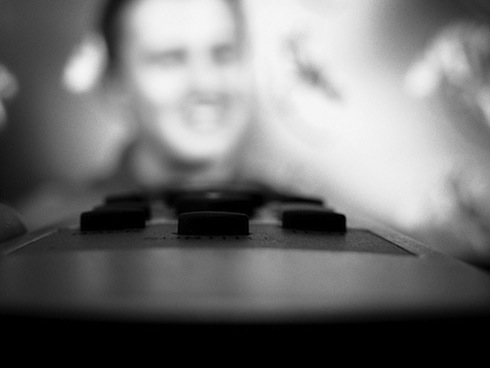
Channel Surfing

We’re always looking for something better. Something nicer or faster or newer or shinier or bigger. Something more. Something else.

The remote control made this kind of searching easier than ever. You can search a thousand channels without leaving your couch, flipping endlessly through channel after channel after channel until you find something better.

But television isn’t the only place in which we constantly search for something better. We flip through every aspect of our lives—food, relationships, entertainment, work—all the while looking for anything other than what’s in front of us.

The problem is that, in a world of unlimited choices, there actually is always something better somewhere on another channel. So, even when we find something we like—something we enjoy—it’s never enough, and we begin to yearn for something else.

The key, then, is to be happy with the channel you’re watching. If you’re not happy, take action, change the channel—work hard to change your situation. But once you find something you like, enjoy it. You needn’t search in perpetuity.

Once you enjoy your life, you will grow, and eventually the channel will change on its own. via The Minimalists | Channel Surfing.

“Happily Ever After” is Overrated

What about the happy now?

Forget dying and going to some blissful heaven.

Forget retiring and finally enjoying your life.

Forget about when you are enlightened and how good it will supposedly feel.

This moment is special. This is it.

Yet we often wait for some special occasion or reason to celebrate.

We often spend our lives striving to get to some destination that we think will make us happy.

Even when you get there is it all that it was promised to be?

What are you waiting for to be different in your life?

via “Happily Ever After” is Overrated « Positively Positive.

Create your day!

Mastin Kipp shares this today…

“The quality of your life is DIRECTLY related to the amount of uncomfortable conversations you are willing to have.

Authentic expression means telling the truth. Your truth. What you think. How you feel. What you make up about what something means. What you see. What you don’t see. What you want to understand. This is authentic expression.

Sometimes it means admitting when you are wrong. Sometimes it means saying no. Sometimes it means opening your heart; sometimes it means setting a boundary and walking away.

We know inside. We always know.

When we make the outside world, other people’s opinions or forms more important than trusting our intuition and expressing ourselves authentically, we start to get off track. If we do it long enough, we begin to believe that things will never change because we don’t trust ourselves enough to make the change.

Most people live unrealized lives because they are too afraid to express themselves authentically. It takes courage. Not everyone is going to like it. You may make some people mad, piss some people off and make others happy beyond measure.” via The Daily Love — Create your day!.

Here’s Why It’s VITAL To Be 100% Self-Approved!

Mastin Kipp at The Daily Love has some good thoughts I’d like to amplify today…

With the uneducated approach to life, we tend to seek outward for things that are within us. Goals, intentions, desires, etc. are all well and good, but if the motive for why we want them goes unexamined, we can keep ourselves in a form of bondage.

One of the great mistakes in life is living life as an “If, then” statement. “If I get X, then I’ll be happy.” The goal is to be happy now.

So are you happy now? And if not, why not? Continue reading “Here’s Why It’s VITAL To Be 100% Self-Approved!”

10 Simple Ways to Find Happiness

An emoticon with a smile. For more emoticons i...

Mmmmm. Good thoughts from Barton Goldsmith at Psychology Today…

“We all want to feel happy, and each one of us has different ways of getting there. Here are 10 steps you can take to increase your joie de vivre and bring more happiness into your life: Continue reading “10 Simple Ways to Find Happiness”

We’ve All Got Our Stuff – Some Of Us Just Hide It Better Than Others!

Good ‘stuff’ from Tony Meindl that I wanted to share with you…

Thinking that you are alone in your ‘stuff’ – your struggles, insecurities, hopes, fears and desires – is completely false. You think you’re alone because it’s scary to open yourself up to other people. We’re scared we’ll be judged or rejected or abandoned. Or that we’re freaks or messed up or flawed in some way no one else is. So everyone just puts on a happy face. As a result, the standards we hold ourselves to are often derived from media images that don’t exist in reality.

How many times are we fed a Hollywood fairytale about someone and it feels as if our lives are miserable in comparison? We often ignore the truth of that person’s life, which is sure to have been a series of emotional challenges, setbacks, insecurities, disappointments, heartaches, losses, joys, victories and breakthroughs. Just like all of us.

The media is selling personas. Don’t be fooled. Personas aren’t real. We equate celebrity with perfection. Becoming famous – through whatever means necessary – means we’re guaranteed the byproducts of fame: privileges, material abundance, adoration and happiness. In short, nirvana. But just because we “make it” or become famous or win a million dollars or star in America’s Next Top Fill-in-the-Blank doesn’t mean the “stuff” we have goes away.

One of the profound things about life is that it’s a great social equalizer. At some point, everyone has to face his or her stuff. But many of us get stuck in our stuff… feeling trapped. Alone. Hopeless.

But realizing you’re stuck is insight. Because without awareness, you can’t do anything about it. So the real work is learning how to get unstuck.

So how do we do that?

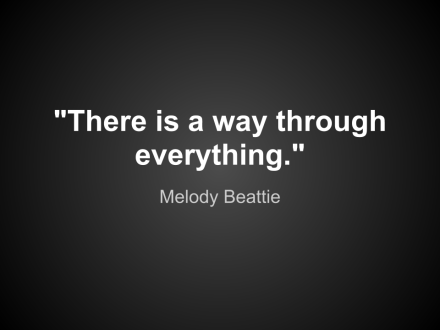
We keep going. We don’t give up. We stop measuring ourselves against fantasies. We open your hearts. We examine and re-examine the beliefs we hold.  About ourselves. About the things we’ve been taught. And about how we choose to see the world. To face head-on the things we most want to avoid. To know that we’re bigger than the set of circumstances we face or the abusive thoughts we hold about ourselves. To know we’re all worthy of love. To realize that the only way out of something is through, never around. And we’re all going through this thing called life together.

Source: We’ve All Got Our Stuff – Some Of Us Just Hide It Better Than Others!

…and then there are others that blog about their stuff! :-D Make it a great day…

Stand up to your fear of abandonment

Melody Beattie writes…

Many of us have a fear of abandonment. Some of us let it rule our lives. We’ll do anything just so that person doesn’t walk out and leave us alone.

I spent many years letting fear of abandonment control me. After a while, I finally wore out that belief. I just got sick and tired of worrying about whether I was good enough for that person.

Then a new thought set me free: If you don’t want to be my friend, or my lover, or my employer, I don’t want you in my life.

No more emotional blackmail. No more stress. No more having to second-guess what that other person is feeling.

Are you spending your time worried about someone leav­ing you? Does your fear of being abandoned leave you feel­ing like an underdog in your relationships? Let it go. Stand fast. And listen to what I’m about to tell you: If that person doesn’t want to be in your life, just let him or her leave. Do you want someone in your life who really doesn’t want to be there? Of course not. Let him or her go.

Once you adopt this belief, it’s easy to send the bad rela­tionships packing, and the good people want to stay.

God, help me believe that I deserve only the best of relationships.

Source: April 5: Stand Up to Your Fear of Abandonment | Language of Letting Go

Start a Blog at WordPress.com.

Up ↑