Letting the Cycles Flow

A beautiful monarch butterfly bears her transp...

Melody Beattie writes:

Life is cyclical, not static. Our relationships benefit when we allow them to follow their own natural cycles.

Like the tide ebbs and flows, so do the cycles in relation­ships. We have periods of closeness and periods of distance. We have times of coming together and times of separating to work on individual issues.

We have times of love and joy, and times of anger.

Sometimes, the dimensions of relationships change as we go through changes. Sometimes, life brings us new friends or a new loved one to teach us the next lesson.

That does not mean the old friend disappears forever. It means we have entered a new cycle.

We do not have to control the course of our relationships, whether these be friendships or love relationships. We do not have to satisfy our need to control by imposing a static form on relationships.

Let it flow. Be open to the cycles. Love will not disappear. The bond between friends will not sever. Things do not re­main the same forever, especially when we are growing and changing at such a rapid pace.

Trust the flow. Take care of yourself, but be willing to let people go. Hanging on to them too tightly will make them disappear.

The old adage about love still holds true: “If it’s meant to be, it will be. And if you love someone, let them go. If they come back to you, the love is yours.”

Today, I accept the cyclical nature of life and relationships. I will strive to go with the flow. I will strive for harmony with my own needs and the needs of the other person.” via June 15: Letting the Cycles Flow.

Enjoyment

Melody Beattie writes:

Life is not to be endured; life is to be enjoyed and embraced.

The belief that we must square our shoulders and get through a meager, deprived existence for far-off “rewards in Heaven” is a codependent belief.

Yes, most of us still have times when life will be stressful and challenge our endurance skills. But in recovery, were learning to live, to enjoy our life, and handle situations as they come.

Our survival skills have served us well. They have gotten us through difficult times — as children and adults. Our abil­ity to freeze feelings, deny problems, deprive ourselves, and cope with stress has helped us get where we are today. But we’re safe now. We’re learning to do more than survive. We can let go of unhealthy survival behaviors. We’re learning new, better ways to protect and care for ourselves. We’re free to feel our feelings, identify and solve problems, and give ourselves the best. We’re free to open up and come alive.

Today, I will let go of my unhealthy endurance and survival skills. I will choose a new mode of living, one that allows me to be alive and enjoy the adventure.” via June 14: Enjoyment.

Hanging on to Old Relationships

More Melody Beattie:

“We want to travel baggage-free on this journey. It makes the trip easier.

Some of the baggage we can let go of is lingering feelings and unfinished business with past relationships: anger; resentments; feelings of victimization, hurt, or longing.

If we have not put closure on a relationship, if we cannot walk away in peace, we have not yet learned our lesson. That may mean we will have to have another go-around with that lesson before we are ready to move on.

We may want to do a Fourth Step (a written inventory of our relationships) and a Fifth Step (an admission of our wrongs). What feelings did we leave with in a particular relationship? Are we still carrying those feelings around? Do we want the heaviness and impact of that baggage on our behavior today?

Are we still feeling victimized, rejected, or bitter about something that happened two, five, ten, or even twenty years ago?

It may be time to let it go. It may be time to open ourselves to the true lesson from that experience. It may be time to put past relationships to rest, so we are free to go on to new, more rewarding experiences.

We can choose to live in the past, or we can choose to finish our old business from the past and open ourselves to the beauty of today.

Let go of your baggage from past relationships.

Today, I will open myself to the cleansing and healing process that will put closure on yesterday and open me to the best today, and tomorrow, has to offer in my relationships.” Source: Hanging on to Old Relationships

Moving Forward

Melody Beattie writes:

Much as we would like, we cannot bring everyone with us on this journey called recovery. We are not being disloyal by allowing ourselves to move forward. We don’t have to wait for those we love to decide to change as well.
Sometimes we need to give ourselves permission to grow, even though the people we love are not ready to change. We may even need to leave people behind in their dysfunction or suffering because we cannot recover for them. We don’t need to suffer with them.
It doesn’t help.
It doesn’t help for us to stay stuck just because someone we love is stuck. The potential for helping others is far greater when we detach, work on ourselves, and stop trying to force others to change with us.
Changing ourselves, allowing ourselves to grow while others seek their own path, is how we have the most beneficial impact on people we love. We’re accountable for ourselves. They’re accountable for themselves. We let them go, and let ourselves grow.

Today, I will affirm that it is my right to grow and change, even though someone I love may not be growing and changing alongside me.

Source: Moving Forward – Language of Letting Go – SoberRecovery : Alcoholism Drug Addiction Help and Information

Codependency? What it is…

“Codependency (or codependence, interdependency ) is defined as a psychological condition or a relationship in which a person is controlled or manipulated by another who is affected with a pathological condition (as in an addiction to alcohol or heroin); and in broader terms, it refers to the dependence on the needs of or control of another.[1] It also often involves placing a lower priority on one’s own needs, while being excessively preoccupied with the needs of others.[2] Codependency can occur in any type of relationship, including family, work, friendship, and also romantic, peer or community relationships.[2] Codependency may also be characterized by denial, low self-esteem, excessive compliance, or control patterns.[2] Narcissists are considered to be natural magnets for the codependent.” Get more here: Codependency – Wikipedia, the free encyclopedia.

Wondering if this applies to you? Here are some questions that may help you decide

Basics of Codependency

Codependency: The Game

“Whether Codependency is developed in childhood or in adulthood the Codependent demonstrates a lack of trust in themselves. Because they are unable to fix what they see as other peoples problems they feel deficient. Because they believe the lies that a Dependent tells them after being challenged by the Codependent (who often correctly asses the situation in the first place) they learn not to trust their own judgement or intuition. This lack of trust in themselves often leads to them clinging on to those who cannot or will not love them back – often settling for too little. Codependents are also controlled by others and find it hard to resist when someone they grow tired of caring for says or does something that indicates things may change, that they will make more effort and behave how the Codependent expects. So they stick by the Dependent hoping things will be different this time.

Codependents deny their true feelings (fear, neediness, anger, ambivalence towards a Dependent) because they are afraid that they may have to acknowledge that they have to take an action that they really don’t want to take e.g. leaving the Dependent or face a truth that they do not want to face e.g. they can’t fix this problem, the Dependent is abusive etc. Denial of feelings leads to physical problems as the body starts to struggle with the effects of stress and anxiety e.g. high blood pressure, fatigue etc. or as often can happen the effects of substance abuse/food abuse that the Codependent practices in order to numb their emotional pain.

Codependents undertake in manipulative behaviour in the name of love and trying to help but in the end “We aren’t the people who ‘make things happen’. Co-dependents are the people who consistently, and with a great deal of effort and energy, try to force things to happen” Beattie pg. 76. Codependents don’t understand that they don’t have to control others and that any element of control means that the other person would normally have no interest in achieving the outcome the Codependent wants to achieve. They ignore the reality because they are frightened of what it really means for them. “People ultimately do what they want to do. They feel how they want to feel (or how they are feeling); they think what they want to think; they do the things they believe they need to do; and they will change only when they are ready to change. It doesn’t matter if they’re wrong and we’re right. It doesn’t matter if they’re hurting themselves. It doesn’t matter that we could help them if they’d only listen to, and cooperate with, us. IT DOESN’T MATTER” Beattie pg. 80-81.” via Basics of Codependency.

Responsibility

Melody Beattie writes:

Self care means taking responsibility for ourselves. Taking responsibility for ourselves includes assuming our true responsibilities to others. Sometimes, when we begin recovery, we’re worn down from feeling responsible for so many other people. Learning that we need only take responsibility for ourselves may be such a great relief that, for a time, we disown our responsibilities to others.
The goal in recovery is to find the balance: we take responsibility for ourselves, and we identify our true responsibilities to others.
This may take some sorting through, especially if we have functioned for years on distorted notions about our responsibilities to others. We may be responsible to one person as a friend or as an employee; to another person, we’re responsible as an employer or as a spouse. With each person, we have certain responsibilities. When we tend to those true responsibilities, we’ll find balance in our life.
We are also learning that while others aren’t responsible for us, they are accountable to us in certain ways.
We can learn to discern our true responsibilities for ourselves, and to others. We can allow others to be responsible for themselves and expect them to be appropriately responsible to us.
We’ll need to be gentle with ourselves while we learn.
Today, I will strive for clear thinking about my actual responsibilities to others. I will assume these responsibilities as part of taking care of myself.

Source: Language of Letting Go – June 10 – Responsibility – SoberRecovery : Alcoholism Drug Addiction Help and Information

Living Our Lives

Melody Beattie writes:

“Don’t stop living your life!

So often, when a problem occurs, inside or around us, we revert to thinking that if we put our life on hold we can posi­tively contribute to the solution. If a relationship isn’t work­ing, if we face a difficult decision, if we’re feeling depressed, we may put our life on hold and torment ourselves with obsessive thoughts.

Abandoning our life or routines contributes to the problem and delays us from finding the solution.

Frequently, the solution comes when we let go enough to live our life, return to our routine, and stop obsessing about the problem.

Sometimes, even if we don’t feel like we have let go or can let go, we can “act as if” we have, and that will help bring about the letting go we desire.

You don’t have to give up your power to problems. You can take your focus off your problem and direct it to your life, trusting that doing so will bring you closer to a solution.

Today, I will go on living my life and tending to my routine. I will decide, as often as I need to to stop obsessing about whatever is bothering me. If I don’t feel like letting go of a particular thing, I will “act as if” I have let go of it until my feelings match my behavior.” via June 9: Living Our Lives.

The Gift of Readiness

Melody Beattie writes:

“Were entirely ready to have God remove all these defects of character.” Step Six of Al-Anon.

We progress to the Sixth Step by working diligently, to the best of our ability, on the first Five Steps. This work readies us for a change of heart, openness to becoming changed by a Power greater than ourselves – God.

The path to this willingness can be long and hard. Many of us have to struggle with a behavior or feeling before we become ready to let it go. We need to see, over and over again, that the coping device that once protected us is no longer useful.

The defects of character referred to in Step Six are old survival behaviors that once helped us cope with people, life, and ourselves. But now they are getting in our way, and it is time to be willing to have them removed.

Trust in this time. Trust that you are being readied to let go of that which is no longer useful. Trust that a change of heart is being worked out in you.

God, help me become ready to let go of my defects of character. Help me know, in my mind and soul, that I am ready to let go of my self defeating behaviors, the blocks and barriers to my life.” via 6/6 Language of Letting Go – SoberRecovery : Alcoholism Drug Addiction Help and Information.

If you’re not the lead dog…

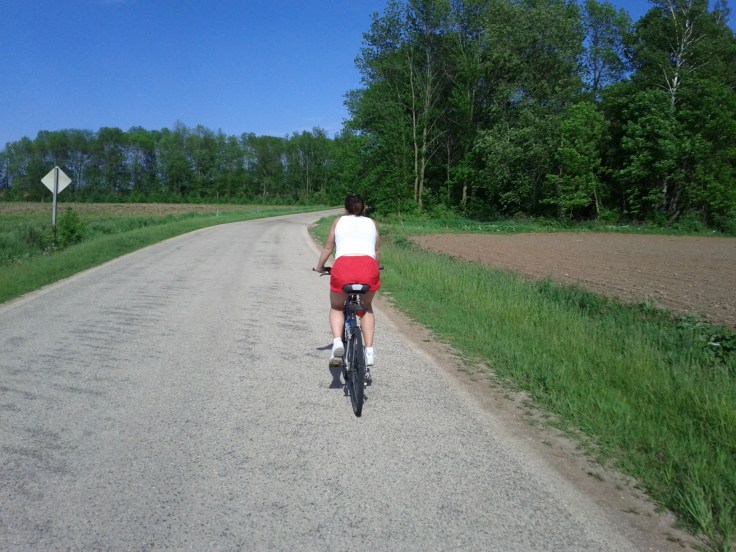
…the view never changes as they say — and sometimes, that’s OK! One of my biggest pleasures in life is watching my wife’s long lean legs as we ride and if she thinks she’s going faster than me, who am I to tell her different… :-D

What’s my point? I’m always thinking. Not always about the right things, but I’m always thinking. Yesterday, taking a bike ride with my wife, it occurred to me that having a healthy relationship is a lot like taking a bike ride with a friend…

Let me take you back a year to the first time I read “Codependent No More”. A friend had suggested I might [and that’s an understatement] suffer from codependency. As I read the book, I realized I was reading about me. I shared the book with my wife and she took her own lessons from it. As we drove to Illinois to celebrate my birthday with family and listening to some of our favorite love songs, we started to realize how deeply codependent so many love songs are and as a result, they affect our perspective of love. Here are some great examples of sappy love songs I’ve listened to for decades [sorry to pick on Bread, but they illustrate my point so well]…

So what’s the answer? For me it’s the analogy of the bicycle ride and this gets back to what I was saying about thinking too much some times and looking for lessons. The thought came upon me that love is less like walking hand in hand sometimes and more like taking a bike ride together. When you ride together, each person is responsible for their own equipment [oil your chain, inflate your tires, select your own gear] and their own ‘balance’ — you have to make sure you don’t fall off your own bike! You can’t hold up your partner and ride at the same time…

When my wife and I ride, we choose a general route or direction, but I can’t pedal her bike for her. We each have a different strategy for hills, etc. — sometimes I like to kick them in the butt by charging breathlessly up them; sometimes I drop into first gear and crawl up them — but the point is I have to drag my own butt up the hill and she has to get up there by herself. I do my work, she does hers and when you get to the top of the hill and pull out the water bottle it’s sweet to be together again…

Reading this you now know why I don’t write my own material often but this is a deep lesson for me that I wanted to document for myself…

For the Next 24 Hours…

Melody Beattie writes:

For the next twenty-four hours…

In recovery, we live life one day at a time, an idea requiring an enormous amount of faith. We refuse to look back—unless healing from the past is part of today’s work. We look ahead only to make plans. We focus on this day’s activity, living it to the best of our ability. If we do that long enough, we’ll have enough connected days of healthy living to make something valuable of our life.

…I pray for knowledge of Your will for me only,…

We surrender to God’s will. We stop trying to control, and we settle for a life that is manageable. We trust our Higher Power’s will for us—that it’s good, generous, and with direction. We’re learning, through trial and error, to separate our will from God’s will. We’re learning that God’s will is not offensive. We’ve learned that sometimes there’s a difference between what others want us to do and God’s will. We’re also learning that God did not intend for us to be codependent, to be martyrs, to control or caretake. We’re learning to trust ourselves.

…and the power to carry that through.

Some of recovery is accepting powerlessness. An important part of recovery is claiming the power to take care of ourselves. Sometimes, we need to do things that are frightening or painful. Sometimes, we need to step out, step back, or step forward. We need to call on the help of a Power greater than ourselves to do that. We will never be called upon to do anything that we won’t be empowered to do.

Today, I can call upon an energizing Power Source to help me. That Power is God. I will ask for what I need.

Beattie, Melody (2009-12-15). The Language of Letting Go (Hazelden Meditation Series) (pp. 122-123). Hazelden. Kindle Edition.

Affirm Yourself…

Cover of "The Language of Letting Go (Haz...

Melody Beattie writes:

Who or what do you want to become? A good parent? A sober, recovering person? A good girlfriend, boyfriend, or spouse? Do you want to become happy, peaceful, tolerant? Don’t wait until you’re successful to tell yourself you’re that. Start now by saying you are what you want to become instead of reinforcing the words I’m not. Yes, you have much to learn. Yes, there’s a ways to go on that path. And you may not be proficient at it, or an expert, yet. But you don’t have to be to say those two little words I am.

Help create the new part of your personality by using and affirming those powerful words I am. Then watch as a new part of yourself emerges.

God, help me use my creative powers to create a better, more fulfill­ing life. Help me use the words I am to create who you and I want me to be…

via April 23: Affirm Yourself | Language of Letting Go.

Are You Making Someone Else Your Higher Power?

Mastin Kipp writes:

A definition of interdependence is: “a reciprocal relation between interdependent entities.”

The key word here is: “reciprocal”. Interdependence can be thought of as a relationship where each party gives and receives from his or her own internal overflow. This is TOTALLY different than “codependence” which can be thought of as being “addicted to someone”.

Another way to look at it, spiritually, is this:

A codependent person makes someone else his or her Higher Power. An interdependent person knows that The Uni-verse is their Higher Power and keeps their focus on that, while choosing to be in a relationship with someone else who is also looking to The Uni-verse to fulfill them.” Get more here: Are You Making Someone Else Your Higher Power?.

If any of this gives you pause to think, you might want to take a look at Melody Beattie‘s book Codependent No More — it’s full of pratical thoughts, tools and tactics for taking codependency head on. You can download a free sample here. I first became aware of this issue in my life about a year ago but this book, the accompanying workbook and her meditation book “Language of Letting Go” have been helpful to me in overcoming codependency and having better relationships…

On being connected…

LOL. ‘Make me one with everything’…

What did the Buddhist monk say to the hot-dog vendor? Can you make me one with everything?

I was buckling my seat belt in the little Cessna one day, get­ting ready for flight training, when my instructor Rob turned to me.

“I just take a second when I strap myself in and tell myself I’m becoming one with the plane as I do,” Rob said. “It really helped me in the beginning when I was nervous and felt so separate from the airplane.”

What a great idea, I thought. That day turned into one of my most comfortable flying sessions. It reminded me of a lesson I had learned a while back.

For most of my life, I felt disconnected from things: from myself, from other people, from life. That feeling of separate­ness haunted me. It explains why I tried so desperately to attach myself codependently to people, places, and things.

Over the years, I began to see that my separateness was an illusion. The same energy, the same life force, that runs through all the universe runs through you and me, too.

We’re connected, whether we know it or not.

Nobody has to make you one with everything. You already are.

Let go of your illusion of separateness.

Connect yourself.

God, help me know my oneness with the world. Help me know how connected I really am so I don’t have to connect in ways that don’t work.

via April 15: Connect Yourself | Language of Letting Go.

Something else I like about Melody Beattie — she’s a pilot, or at least a student pilot…

Choices

Melody Beattie says:

“We have choices, more choices than we let ourselves see. We may feel trapped in our relationships, our jobs, our life. We may feel locked into behaviors — such as caretaking or controlling. Feeling trapped is a symptom of codependency.

When we hear ourselves say, “I have to take care of this person…”, “I have to say yes….” ,”I have to try to control that person…”, “I have to behave this way, think this way, feel this way…” we can know we are choosing not to see choices.

That sense of being trapped is an illusion. We are not controlled by circumstances, our past, the expectations of others or our unhealthy expectations for ourselves. We can choose what feels right for us, without guilt. We have options.

Recovery is not about behaving perfectly or according to anyone else’s rules. More than anything else; recovery is about knowing we have choices and giving ourselves the freedom to choose.” via Inspiration.

We have choices


Melody Beattie says:

“We have choices, more choices than we let ourselves see.

We may feel trapped in our relationships, our jobs, our life. We may feel locked into behaviors such as caretaking or controlling.

Feeling trapped is a symptom of codependency. When we hear ourselves say, I have to take care of this person . . . I have to say yes . . . I have to try to control that person . . . I have to behave this way, think this way, feel this way . . . we can know we are choosing not to see choices.

That sense of being trapped is an illusion. We are not controlled by circumstances, our past, the expectations of others, or our unhealthy expectations for ourselves. We can choose what feels right for us, without guilt. We have options.

Recovery is not about behaving perfectly or according to anyone else’s rules. More than anything else, recovery is about knowing we have choices and giving ourselves the freedom to choose.

Today, I will open my thinking and myself to the choices available to me. I will make choices that are good for me.” via Adult Children Anonymous.

Loving Ourselves Unconditionally

More Melody Beattie:

“Love yourself into health and a good life of your own.

Love yourself into relationships that work for you and the other person. Love yourself into peace, happiness, joy, success, and contentment.

Love yourself into all that you always wanted. We can stop treating ourselves the way others treated us, if they behaved in a less than healthy, desirable way. If we have learned to see ourselves critically, conditionally, and in a diminishing and punishing way, it’s time to stop. Other people treated us that way, but it’s even worse to treat ourselves that way now.

Loving ourselves may seem foreign, even foolish at times. People may accuse us of being selfish. We don’t have to believe them.

People who love themselves are truly able to love others and let others love them. People who love themselves and hold themselves in high esteem are those who give the most, contribute the most, and love the most.

How do we love ourselves? By forcing it at first. By faking it, if necessary. By acting as if. By working as hard at loving and liking ourselves as we have at not liking ourselves.

Explore what it means to love yourself.

Do things for yourself that reflect compassionate, nurturing, self love.

Embrace and love all of yourself – past, present, and future. Forgive yourself quickly and as often as necessary. Encourage yourself. Tell yourself good things about yourself.

If we think and believe negative ideas, get them out in the open quickly and honestly, so we can replace those beliefs with better ones.

Pat yourself on the back when necessary. Discipline yourself when necessary. Ask for help, for time; ask for what you need.

Sometimes, give yourself treats. Do not treat yourself like a pack mule, always pushing and driving harder. Learn to be good to yourself. Choose behaviors with preferable consequences – treating yourself well is one.

Learn to stop your pain, even when that means making difficult decisions. Do not unnecessarily deprive yourself. Sometimes, give yourself what you want, just because you want it.

Stop explaining and justifying yourself. When you make mistakes, let them go. We learn, we grow, and we learn some more. And through it all, we love ourselves.

We work at it, and then work at it some more. One day we’ll wake up, look in the mirror, and find that loving ourselves has become habitual. We’re now living with a person who gives and receives love, because that person loves him or herself. Self-love will take hold and become a guiding force in our life.

Today, I will work at loving myself. I will work as hard at loving myself as I have at not liking myself. Help me let go of self-hate and behaviors that reflect not liking myself. Help me replace those with behaviors that reflect self-love. Today, God, help me hold myself in high self-esteem. Help me know I’m lovable and capable of giving and receiving love.

From The Language of Letting Go by Melody Beattie ©1990, Hazelden Foundation. All rights reserved.” via the language of letting go | Tumblr.

Warning! Video: NSFW…

Sadness

Melody Beattie shares this:

“Ultimately, to grieve our losses means to surrender to our feelings.

So many of us have lost so much, have said so many good byes – have been through so many changes. We may want to hold back the tides of change, not because the change isn’t good, but because we have had so much change, so much loss.

Sometimes, when we are in the midst of pain and grief, we become shortsighted, like members of a tribe described in the movie Out of Africa.

“If you put them in prison,” one character said, describing this tribe, “they die.”

“Why?” asked another character.

“Because they can’t grasp the idea that they’ll be let out one day. They think it’s permanent, so they die.”

Many of us have so much grief to get through. Sometimes we begin to believe grief, or pain, is a permanent condition.

The pain will stop. Once felt and released, our feelings will bring us to a better place than where we started. Feeling our feelings, instead of denying or minimizing them, is how we heal from our past and move forward into a better future. Feeling our feelings is how we let go.

It may hurt for a moment, but peace and acceptance are on the other side. So is a new beginning.

God, help me fully embrace and finish my endings, so I may be ready for my new beginnings.” via Language of Letting Go – May 20 – Sadness – SoberRecovery : Alcoholism Drug Addiction Help and Information.

Codepedence is not just an issue for partners of addicts

I don’t normally curate this much content in one ‘swell foop’ as I like to say but Melody Beattie’s perspective on owning your own stuff and Mark Brower’s comments on same were so good I couldn’t find anything to exclude. Mark starts out and then quotes my ‘Language of Letting Go’ reading for today…
Many of us struggle with codependency. When addiction is present in a relationship, the old model was that the addict was “dependent” and his or her spouse was “codependent.” But today we know that usually both the addict and spouse struggle with codependency in its various forms.

Codependency happens when we lose touch with our sense of self, and become over-dependent on how other people are doing, and/or how they perceive us. Since we are not “okay” with ourselves, we have to work overtime to ensure that other people around us are doing okay, and/or that they feel good about us.

So we wind up tolerating things we shouldn’t tolerate, feeling responsible for things we shouldn’t feel responsible for, and compromising what we want simply in order to please someone else. This inevitably leads to distress and frustration, which causes the addict to move deeper into their addiction, and for the addict’s spouse to cope in other ways.

The issue of codependence is complicated for Christians, because it gets mixed up with our desire to love and serve other people. The Bible tells us to “consider others better than ourselves.” But the same Bible also tells us to love our neighbor as ourselves, which presupposes some sort of healthy self-regard. The Bible also portrays Jesus himself taking time away from the crowds – not being “nice” and doing what they want him to do – in order to rest and reconnect with God the Father.

The trick to living a recovery life in relationships with others is to know how to separate healthy love with unhealthy codependence.

Melody Beattie has been a great help for me over the years with her many books on this topic. One of her best books on this topic is a daily meditation book called “The Language of Letting Go.”

In another article on this blog, I wrote about codependence, and quoted at length from her book. But it’s so good and helpful that I want to quote some more! What follows are some excerpts about the issue of “Property Lines”:

A helpful tool in our recovery, especially in the behavior we call detachment, is learning to identify who owns what. Then we let each person own and possess his or her rightful property.

If another person has an addiction, a problem, a feeling, or a self-defeating behavior, that is their property, not ours. If someone is a martyr, immersed in negativity, controlling, or manipulative, that is their issue, not ours.

If someone has acted and experienced a particular consequence, both the behavior and the consequence belong to that person.

People’s lies, deceptions, tricks, manipulations, abusive behaviors, inappropriate behaviors, cheating behaviors, and tacky behaviors belong to them, too. Not us.

People’s hopes and dreams are their property. Their guilt belongs to them too. Their happiness or misery is also theirs. So are their beliefs and messages.

If some people don’t like themselves, that is their choice. Their choices are their property, not ours. What people choose to say and do is their business.

What is our property? Our property includes our behaviors, problems, feelings, happiness, misery, choices, and messages; our ability to love, care, and nurture; our thoughts, our denial, our hopes and dreams for ourselves. Whether we allow ourselves to be controlled, manipulated, deceived, or mistreated is our business.

In recovery, we learn an appropriate sense of ownership. If something isn’t ours, we don’t take it. If we take it, we learn to give it back. Let other people have their property, and learn to own and take good care of what’s ours.

Today, I will work at developing a clear sense of what belongs to me, and what doesn’t. If it’s not mine, I won’t keep it. I will deal with myself, my issues, and my responsibilities.

If you want to learn more about codependence, consider signing up for the Recovery Journey, an e-course for people in recovery from sexual struggles. If you are the partner of someone who struggles, note that we have a special module with materials just for the partners. You can learn more about this program at the website: http://recoveryjourney.com

Source: Codepedence is not just an issue for partners of addicts | sexualsanity.com

Codependence is a constant battle for me and it has made made my wife’s vacation in Italy even more difficult than the simple logistics of trying to run a business and hold down the fort with 4 boys while she’s gone but by the grace of God, with the help of Celebrate Recovery, my good friends Sandy and Steve and Melody Beattie’s good thoughts. we are winning on this trip! If these issues resonate with you, drop me a note below. I’ll be happy to share with you what I have…

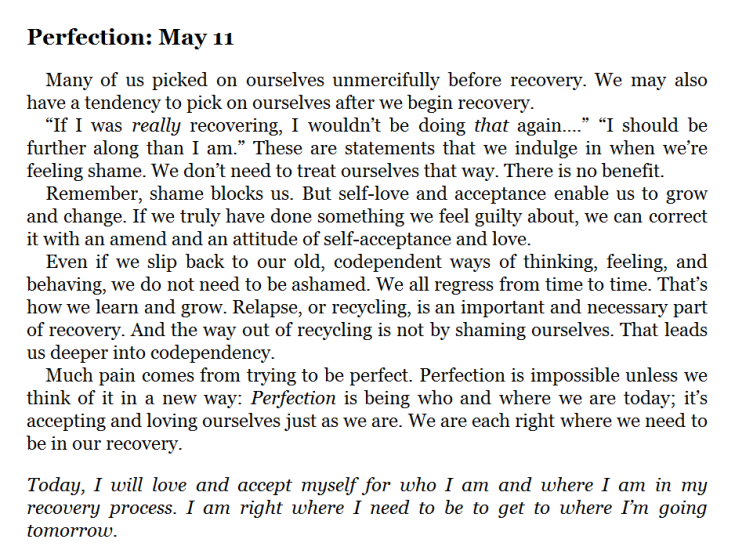
Perfection?

Another great perspective from Melody Beattie…

Melody Beattie

…on Taking One Day at a Time

More Melody Beattie…

“My best friend was going through some tough situations in her life. I was in the midst of a hard stretch too. We didn’t particularly like the things we had to do in our lives. We talked about our feelings and decided that what we were going through was necessary and important, even though we didn’t like it.We expressed gratitude for our lives.

“It’s still a dreadful time,” I said.

“Brutal,” she said. “I guess we’re back to the old one­ day-at-a-time approach. We’re so lucky. What do people do that haven’t learned that gem?”

There are times when we can look at the stretch ahead and like what we see. Taking life one day at a time is still a good idea, even when things are going well.

Taking life one day at a time can be particularly use­ful when the road ahead looks dreadful. We may not even know where to start with some challenges. That’s when taking life one day at a time is essential.

“I’ve been using alcohol and other drugs every day since I’ve been twelve years old,” I said to my counselor years ago in treatment. “Now you’re telling me I need to stay sober the rest of my life. Plus get a job. And a life. How am I going to do that?”

“One day at a time,” she said. She was right. Sometimes I had to take life one minute at a time or one hour at a time. And all these years later, it still works.

Value: Taking life one day at a time is the gem we’ll focus on this week.” via May 8.

Start a Blog at WordPress.com.

Up ↑