Why Self-Compassion Trumps Self-Esteem

Have you tried to pump up your self-esteem? Kristen Neff explains why it doesn’t work in the long run:

In this incredibly competitive society of ours, how many of us truly feel good about ourselves?

I remember once, as a freshman in college, after spending hours getting ready for a big party, I complained to my boyfriend that my hair, makeup, and outfit were woefully inadequate. He tried to reassure me by saying, “Don’t worry, you look fine.”

“Fine? Oh great, I always wanted to look fine . . .” Continue reading “Why Self-Compassion Trumps Self-Esteem”

The Chemicals of Care: How Self-Compassion Manifests in Our Bodies

Neff, Kristin_400Kristin Neff writes:

In my work I have defined self-compassion as having three main interacting components: self-kindness, a sense of common humanity and mindfulness. Self-kindness refers to the tendency to be caring and understanding with oneself rather than being harshly critical or judgmental. Instead of taking a cold “stiff-upper-lip” approach in times of suffering, self-kindness offers soothing and comfort to the self. Common humanity involves recognizing that all humans are imperfect, fail and make mistakes. It connects one’s own flawed condition to the shared human condition so that one can take greater perspective towards one’s personal shortcomings and difficulties. Mindfulness involves being aware of one’s painful feelings in a clear and balanced manner so that one neither ignores nor obsesses about disliked aspects of oneself or one’s life.

For the past decade or so I’ve been conducting research on self-compassion and have found that people who are compassionate to themselves are much less likely to be depressed, anxious and stressed and are much more likely to be happy, resilient and optimistic about their future. In short, they have better mental health.

The power of self-compassion is not just an idea; it’s very real and actually manifests in our bodies. When we soothe our own pain, we are tapping into the mammalian care-giving system. And one important way the care-giving system works is by triggering the release of oxytocin. Research indicates that increased levels of oxytocin strongly increase feelings of trust, calm, safety, generosity and connectedness and facilitates the ability to feel warmth and compassion for ourselves. Oxytocin is released in a variety of social situations, including when a mother breastfeeds her child, when parents interact with their young children or when someone gives or receives a soft, tender caress. Because thoughts and emotions have the same effect on our bodies whether they’re directed to ourselves or to others, this research suggests that self-compassion may be a powerful trigger for the release of oxytocin.

Self-criticism appears to have a very different effect on our body. The amygdala is the oldest part of the brain and is designed to quickly detect threats in the environment. When we experience a threatening situation, the fight-or-flight response is triggered: the amygdala sends signals that increase blood pressure, adrenaline and the hormone cortisol, mobilizing the strength and energy needed to confront or avoid a threat. Although this system was designed by evolution to deal with physical attacks, it is activated just as readily by emotional attacks — by ourselves or others. Recent research indicates that generating feelings of self-compassion actually decreases our cortisol levels. In one study conducted by Helen Rockliff and her colleagues, researchers asked participants to imagine receiving compassion and feeling it in their bodies. Every minute they were told things like, “Allow yourself to feel that you are the recipient of great compassion; allow yourself to feel the loving-kindness that is there for you.” It was found that the participants given these instructions had lower cortisol levels after the imagery than those in the control group. Participants also demonstrated increased heart rate variability afterwards. The safer people feel, the more open and flexible they can be in response to their environment, and this is reflected in how much their heart rate varies in response to stimuli. So you could say that by giving themselves compassion, participants’ hearts actually opened and became less defensive.

When we soothe our painful feelings with the healing balm of self-compassion, not only are we changing our mental and emotional experience, we’re also changing our body chemistry. An effective aspect of self-compassion practice, therefore, is to tap into our body’s self-healing system through physical sensations.

This means that an easy way to calm and comfort yourself when you’re feeling bad is through soothing touch. It seems a bit silly at first, but your body doesn’t know that. It just responds to the physical gesture of warmth and care, just as a baby responds to being held in its mother’s arms. Remember, physical touch releases oxytocin, reduces cortisol and calms cardiovascular stress. So why not try it? If you notice that you’re feeling tense, upset or self-critical, try giving yourself a warm hug, or tenderly stroking your arm or face, or gently rocking your body. What’s important is that you make a clear gesture that conveys feelings of love, care and tenderness. If other people are around, you can often fold your arms in a non-obvious way, gently squeezing yourself in a comforting manner. Notice how your body feels after receiving the hug or caress. Does it feel warmer, softer, calmer? It’s amazing how easy it is to tap into mammalian care-giving system and change your biochemical experience.

via Kristin Neff: The Chemicals of Care: How Self-Compassion Manifests in Our Bodies.

Why We Need to Have Compassion for Our Inner Critic

Kristin Neff writes:

We know how much it hurts. “I’m an idiot!” “I’m disgusting.” “No one will ever love me.” “What a lame-ass.”

So why do we do it? As soon as we ask ourselves this question, we often just pile on more self-criticism. “I’m such a bitch, even to myself.” “That’s why I’m such a loser, I’m always putting myself down.”

Don’t beat yourself up for beating yourself up in the vain hope that somehow it will help you stop beating yourself up. Instead, take a step back, and give your inner critic some slack. In its ineffective, counterproductive way, your inner critic is actually trying to keep you safe.

As humans we have two main evolved safety systems. The oldest and most quickly triggered is the threat defense system, which involves the amygdala. When we sense danger, our response is typically fight, flight, freeze, or submit: We turn and fight the threat, run like hell away from the threat, play dead in hopes the threat will pass, or show our bellies and hope the threat will be placated. These strategies are very successful for animals living in the wild, helping them to survive and pass on their genes. For humans, however, these responses often just make things worse. That’s because the threat we’re usually facing is a threat to our self-concept. We confuse our thoughts and representations of ourselves for our actual selves, meaning that when our self-image is under siege, we react as if our very existence is threatened. When this happens, our threat defense system uses the same strategies to stay safe:

Fight — we beat ourselves up emotionally, using cruel language to cut ourselves down.

Flight — we become anxious and restless, fleeing from ourselves by numbing out or using distractions like food or alcohol.

Freeze — we get stuck in rumination, thinking about our perceived inadequacies over and over again.

Submit — we admit that yes, we’re terrible, and accept all the harsh judgments we throw at ourselves.

More often than not we engage in some combination of all these strategies. Our stress levels go up as our amygdala activates our sympathetic nervous system (which arouses us so we can deal with threats) and floods our system with adrenaline and cortisol. And it’s a double whammy because when we criticize ourselves, we are both the attacker and the attacked. This type of chronic stress can eventually lead to anxiety and depression, undermining our physical and emotional wellbeing.

Still, it’s important to remember that when our inner critic attacks, at root it is trying to ward off danger. Marshal Rosenberg, author of the book Non-Violent Communication, says self-criticism is the “tragic expression of an unmet need.” It’s tragic because self-criticism makes us feel horrible and doesn’t effectively motivate productive change. (See my blog “The Motivational Power of Self-Compassion.”) But if we look closely — our inner critic cares. There is some safety need it is trying to meet. Our inner critic wants us to be happy, but doesn’t know a better way to go about it. Let’s say you criticize yourself for not going to the gym, calling yourself a “lazy slob.” At some level, your inner critic is reacting out of concern that if you don’t go to the gym you won’t be healthy, or that you’ll be rejected by others. We can be kind and compassionate to this part of ourselves, because at some level it has our best interests at heart. And believe it or not, by giving compassion to our inner critic, we are moving out of the threat defense system and into our other safety system.

As mammals, we also evolved the attachment/affiliation system as a survival strategy. Mammals have the innate capacity to be soothed by warmth and affection, meaning that our young are likely to stay near caregivers, be protected, and survive. The care-giving system deactivates the sympathetic nervous system (reducing cortisol) and activates the parasympathetic nervous system, which calms us down. This route to emotional safety is much more effective — reducing our stress and anxiety rather than exacerbating it. And it gives us the emotional balance needed to make wise decisions, including making behavioral changes if needed. (I write about self-compassion and the mammalian care-giving system in my blog “The Chemicals of Care.”)

So the next time you find yourself in the throws of harsh self-criticism, instead of beating yourself up for beating yourself up, thank your inner critic for its efforts, then try the strategy of giving yourself some compassion instead. It’s more effective, and a lot less painful!

Full story at: Kristin Neff: Why We Need to Have Compassion for Our Inner Critic.

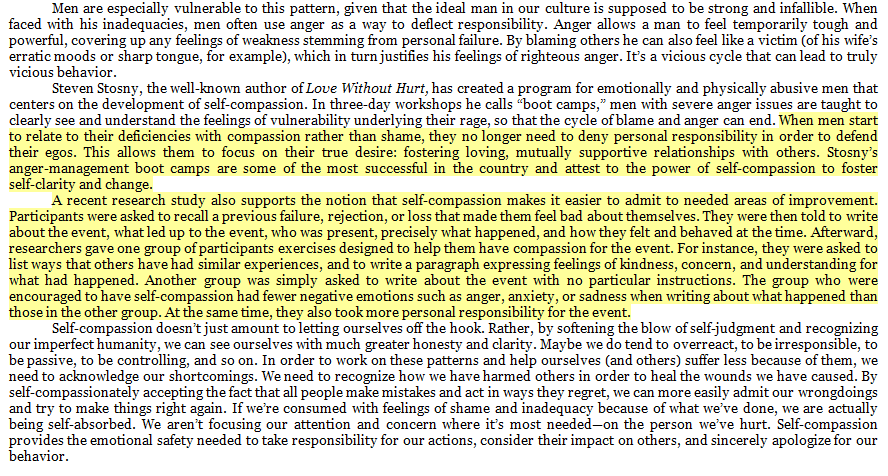
Another excerpt…

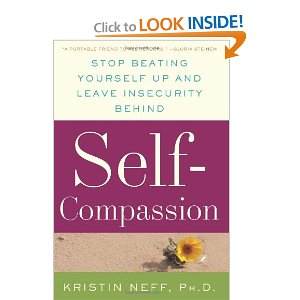
…from Kristen Neff’s book ‘Self-compassion’. Click image to enlarge…

ScreenClip
You can find Steven Stosny’s books here and his website here. If you’re not familiar with Kristen Neff, you can catch her bio and a few posts at HuffPo

Crazy Train

Funny. A year ago this time I thought I was doing well to know that I could get off the Crazy Train. Now, thanks to the works of Brene Brown, Tara Brach and Kristin Neff I am realizing I don’t have to react to every opportunity to get on the train; I can respond to those opportunities by sitting at the station and watching the Crazy Train go by. It may seem silly to you, but it’s a big revelation for me…

:-D

Todd Lohenry's avatarBright, shiny objects!

I’m not much of an Ozzy Osbourne fan but I heard the words to this song for the first time today and I actually thought it was quite good…

http://youtu.be/IeyN2YfAwas

Crazy,but that’s how it goes
Millions of people living as foes
Maybe it’s not too late
To learn how to love
And forget how to hate
Mental wounds not healing
Drivin’ me insane
I’m going off the rails on a crazy train
I’ve listened to preachers
I’ve listened to fools
I’ve watched all the dropouts
Who make their own rules
One person conditioned to rule and control
The media sells it and you live the role
Mental wounds still screaming
Driving me insane
I’m going off the rails on a crazy train
I know that things are going wrong for me
You gotta listen to my words
Yeah
Heirs of a cold war
That’s what we’ve become
Inheriting troubles I’m…

View original post 71 more words

Mindfulness…

What is it? According to Kristen Neff…

Click image to enlarge...
Click image to enlarge…

How has it helped me? By giving me the ability to respond rather than react… Continue reading “Mindfulness…”

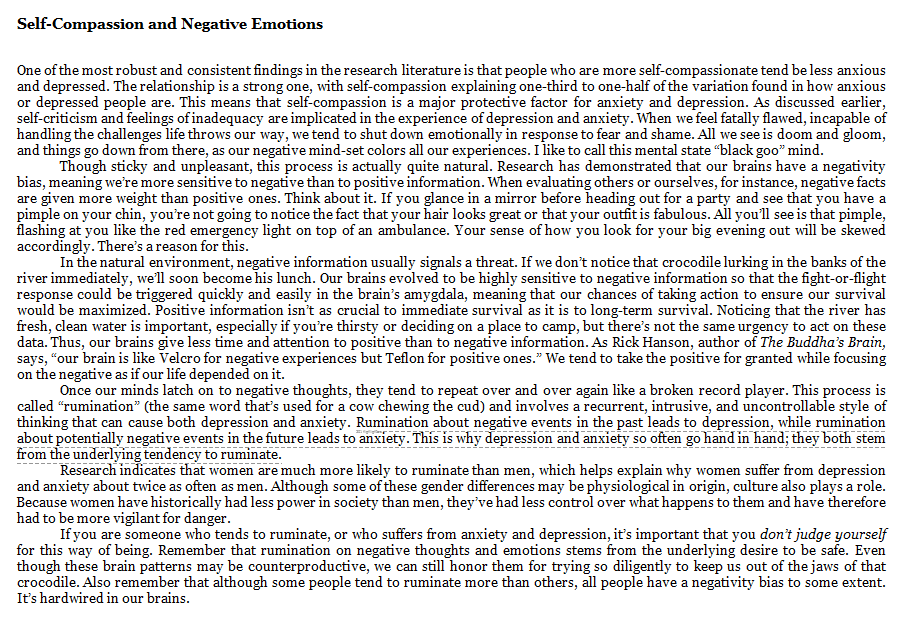
Self compassion and negative emotions…

Lately, I have been finding wisdom and refuge in Kristen Neff’s book Self-compassion [which I highly recommend!]. Here is a recent passage that resonated with me…

Click image to enlarge...
Click image to enlarge…

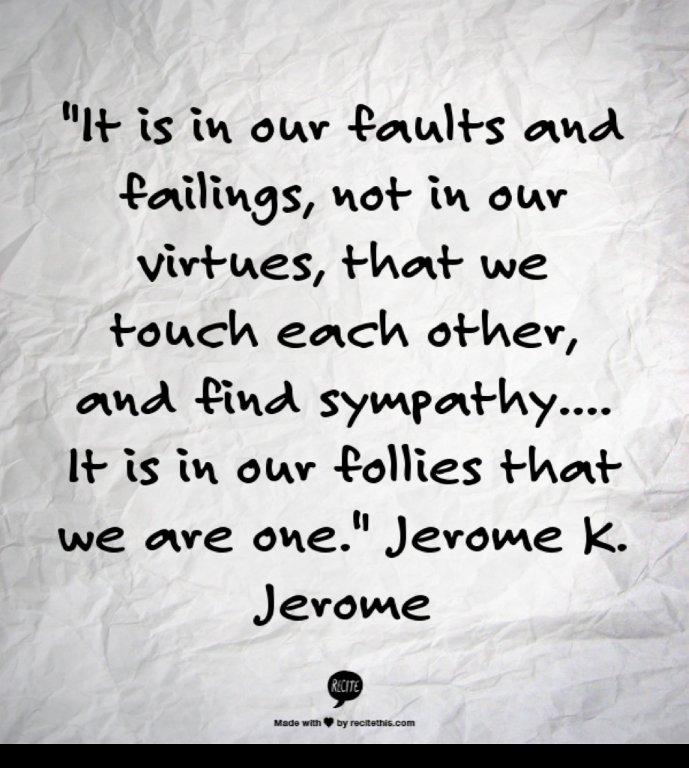
It is in our faults and failings…

Another great quote from Kristin Neff’s book “Self-compassion”…

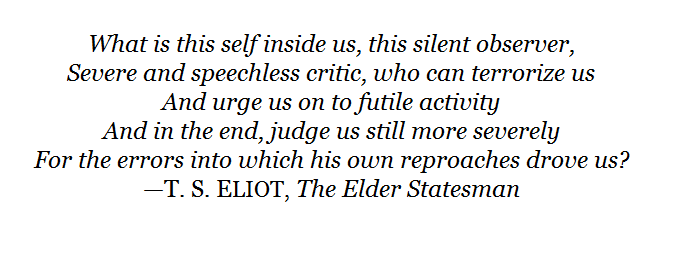
What is this self inside us…

A great quote from Kristen Neff’s book on self-compassion which I highly recommend…

41A4d+sT3wL._BO2,204,203,200_PIsitb-sticker-arrow-click,TopRight,35,-76_AA300_SH20_OU01_
Click the image to learn more…

The best of wholeheartedness for the week ending 3/9/2013

  1. “The secret of getting ahead is getting started. The secret of getting started is breaking your complex overwhelming tasks into small manageable tasks, and then starting on the first one.” -Mark Twain, legendary author.
  2. “When all your desires are distilled; You will cast just two votes: To love more, And be happy.”   – Hafiz
  3. “Opposition is a natural part of life. Just as we develop our physical muscles through overcoming opposition – such as lifting weights – we develop our character muscles by overcoming challenges and adversity.” -Stephen R. Covey, best-selling author and speaker.
  4. “Any time I am in resentment, I am not taking care of myself. I am blaming someone else for something I need to do.” “The higher the expectations, the lower the serenity. I try to keep my boundaries high, my expectations low, and my heart open.” -Anon
  5. “When you take charge of your life, there is no longer a need to ask permission of other people or society at large. When you ask permission, you give someone veto power over your life.” – Geoffrey F. Abert
  6. Todd’s tweets…
  7. Just added a great image in “Storypad” undefined
  8. ““When all your desires are distilled; You will cast just two votes: To love more, And be happy.”   – Hafiz” undefined
  9. ““All the ups and downs are grace in different wrappings, sent to refine consciousness. Say thanks to them all.”  …” undefined
  10. ““Opposition is a natural part of life. Just as we develop our physical muscles through overcoming opposition –…” undefined
  11. ““The secret of getting ahead is getting started. The secret of getting started is breaking your complex…” undefined
  12. @toddlohenry Thx for all the great tweets this a.m. Clipping them all with Evernote to read later!
  13. @SocialBro Hey guys! I have a @bufferapp customer here, @toddlohenry, and we have some questions. Is there an email addy we can contact? :)
  14. @jenpastiloff Something tells me I would have heard from you if I curated your content incorrectly. :-D
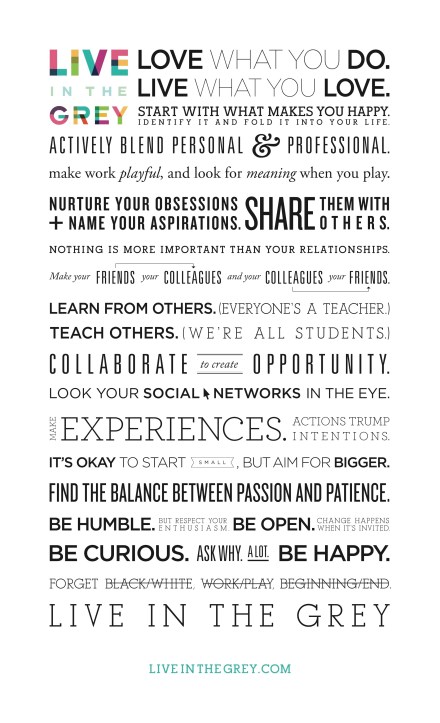
  15. @livegrey Love your site and what you’re doing and I’d like to do everything I can to promote your thinking…
  16. @toddlohenry Hi there Todd. Thanks for sharing our philosophy on your blog!
  17. @farhanadhalla Thanks for writing such good stuff. Hope all’s well…
  18. @barbmarkway Thanks for calling my attention to the event in the first place; Kristen Neff was AWESOME!!! I won’t take notes now… :-D
  19. Remember in Step Nine we were told to make direct amends wherever possible, but this generous principle should extend further. We…
  20. @toddlohenry I think it’s 100% diff. Reblog the heck out of me or quote me but give credit where credit is due. Respect, right? Thoughts?
  21. @toddlohenry reblogging credits the orig person. Knowingly Taking someone’s ideas and calling them your own lacks ethics
  22. “Smile, It Will Make You Look Better” undefined
  23. Just added a great image in “Storypad” undefined
  24. “The Key To Healing It Is Feeling It…” undefined
  25. @JenPastiloff How does copycatting differ from ‘reblogging’ or curating content according to fair use guidelines in your mind? Or does it?
  26. RT @steven_oriordan: Be mindful of your self-talk, it is a conversation with the Universe! #Universe #Selftalk #Quote
  27. Everyone is doing their best from their current state of consciousness…
  28. Your Best Secrets For A Good Night’s Sleep [feedly]…

Self-compassion…

Neff, Kristin_400Kristin Neff writes:

So what’s the answer? To stop judging and evaluating ourselves altogether. To stop trying to label ourselves as “good” or “bad” and simply accept ourselves with an open heart. To treat ourselves with the same kindness, caring, and compassion we would show to a good friend, or even a stranger for that matter. Sadly, however, there’s almost no one whom we treat as badly as ourselves.

Neff, Kristin. Self-Compassion: Stop Beating Yourself Up and Leave Insecurity Behind (Kindle Locations 105-108). William Morrow. Kindle Edition.

Continue reading “Self-compassion…”

Self-compassion; A Healthier Way of Relating to Yourself

I ‘discovered’ Dr. Kristin Neff’s work on self-compassion reading Brene Brown’s book ‘Daring Greatly’. What is it?

Here’s her TEDx talk on the topic:

Full story [including self-test] at: Self-compassion – A Healthier Way of Relating to Yourself.

New Year’s Stupidity

feat-craigharper.pngCraig Harper writes:

Waiting…

Despite the fact that New Year’s Resolutions rarely lead to lasting change, millions of Australians [and Americans for that matter. ed.] will sit on their hands for the next two weeks waiting for January 1 to roll around so they can magically change their lives. Good grief. What a stupid habit. We wouldn’t take a drug that failed 98% of the time, so why are we so committed to such an ineffective and irrational ritual? Authentic and lasting transformation has everything to do with courage, commitment, attitude and resilience and nothing to do with some number on a calendar.

Tell someone to start their new program (diet, gym regime, running program, etc.) on December 30 (for example) and they’ll look at you like you’re a total idiot. Why on earth would anyone do that? Tell that same person to start two days later (the day with an overwhelming failure rate) and they’ll enthusiastically nod in agreement because the first day of the new year is the ‘right day’ to start.

Wow.

As my dad says; never let the facts get in the way of a good story.

Here’s a crazy idea… if you’re serious about changing some aspect of your reality, then start your journey of transformation now. Stop looking for comfort, convenience and cop-outs and simply do what success demands – today. Forget about the calendar, tradition and the expectations of others and stop giving yourself an escape clause.” via New Year’s Stupidity.

http://youtu.be/sIHmty265Us

Timing…

Melody Beattie writes:

Wait until the time is right. It is self-defeating to postpone or procrastinate; it is also self-defeating to act too soon, before the time is right.

Sometimes, we panic and take action out of fear. Sometimes, we take untimely action for revenge or because we want to punish someone. We act or speak too soon as a way to control or force someone to action. Sometimes, we take action too soon to relieve feelings of discomfort or anxiety about how a situation will turn out.

An action taken too soon can be as ineffective as one taken too late. It can backfire and cause more problems than it solves. Usually, when we wait until the time is right – sometimes only a matter of minutes or hours – the discomfort dissolves, and we’re empowered to accomplish what we need to do.

In recovery, we are learning to be effective.

Our answers will come. Our guidance will come. Pray. Trust. Wait. Let go. We are being led. We are being guided.

Today, I will let go of my need to control by waiting until the time is right. When the time is right, I will take action.

Source: Just For Today Meditations » Daily Recovery Readings – November 12, 2012

How to Become Your Spouse’s Best Friend

Michael Hyatt writes:

What does marriage have to do with leadership? If you are married, everything. Nothing will undermine your effectiveness as a leader faster than a bad marriage. Your marriage is a living example of what it is like to be in a close relationship with you. This is why it is so important that leaders get this right if they want to influence others.

Unfortunately, we live in a culture that is very me-centered. Gail and I often talk to people who are frustrated with their spouses. Most of this stems from the fact that they are not getting what they think they need or what they think they should be getting.

I am not saying that it is wrong to give voice to your needs. I am saying that it is often an ineffective way to get them met, unless you first sow the seeds of giving and servanthood. (This is also good practice for being a leader in any sphere of life.)

Gail and I have been married for 33 years next month. We can both honestly say that we are one another’s best friends. We talk constantly, go on long walks together, and eat almost every meal together. We just love being in each other’s company.

But what if you don’t have this kind of relationship with your spouse? We work with enough couples to know that this kind of intimacy and friendship is rare.

But, honestly, we are not special. I don’t want to be naive, but I don’t think it is that difficult—if you are willing to make the investment.” Get more here: How to Become Your Spouse’s Best Friend | Michael Hyatt.

Becoming my wife’s best friend [still in process] is the best thing I have ever done. It is NOT difficult if you are willing to make the investment and it is breathing new life into a marriage that should have ended long ago. Dig deep into Michael Hyatt’s advice!

Start a Blog at WordPress.com.

Up ↑