How To Be A Supportive Partner (And What You Gain As A Result)

Shelly Bullard writes:

Sometimes we fail to support our partners in becoming the best versions of the of themselves because we’re scared of what that means for us. What if he wants something I don’t want? What if her desire takes her away from me?

We fear if he learns to fly, he might fly away. So we hold our partners back, sometimes without even knowing it. This strategy always backfires – it ends up holding our relationships back, as well.

But there’s a way to feel safe enough to support your partner to fly, and why doing so will take your relationship to new heights of love.

Get the rest of the article here: How To Be A Supportive Partner (And What You Gain As A Result)

I love Shelly’s writing — always powerful and prescient! You can find more of her stuff here


Emotional Abuse

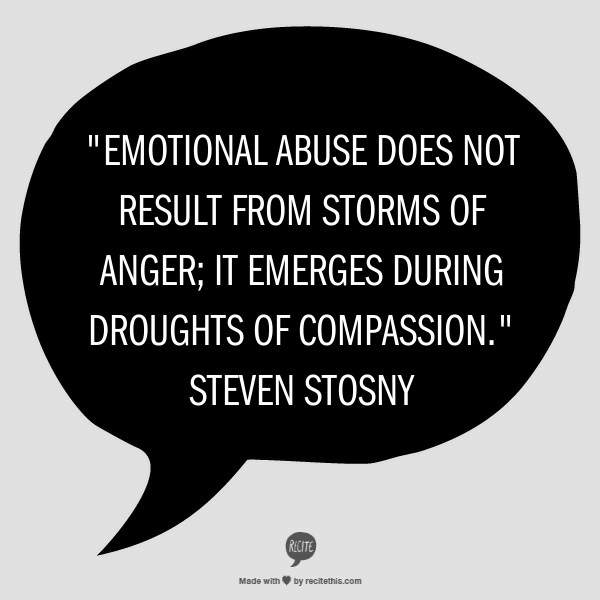
Merely refraining from abusive behaviors will do nothing to improve a relationship, though it may slow its rate of deterioration. To repair the harm done, there must be a corresponding increase in compassion on the part of the abuser. Abusers do not change by receiving compassion; they change by learning to give it. Emotional abuse does not result from storms of anger; it emerges during droughts of compassion.Steven Stosny writes:

Emotionally abusive behavior is anything that intentionally hurts the feelings of another person. Since almost everyone in intimate relationships does that at some time or other, emotionally abusive behavior must be distinguished from an emotionally abusive relationship, which is more than the sum of emotionally abusive behaviors. Continue reading “Emotional Abuse”

Accepting love…

Melody Beattie write:

Many of us have worked too hard to make relationships work; sometimes those relationships didn’t have a chance because the other person was unavailable or refused to participate.

To compensate for the other person’s unavailability, we worked too hard. We may have done all or most of the work. This may mask the situation for a while, but we usually get tired. Then, when we stop doing all the work, we notice there is no relationship, or we’re so tired we don’t care.

Doing all the work in a relationship is not loving, giving, or caring. It is self-defeating and relationship defeating. It creates the illusion of a relationship when in fact there may be no relationship. It enables the other person to be irresponsible for his or her share. Because that does not meet our needs, we ultimately feel victimized.

In our best relationships, we all have temporary periods where one person participates more than the other. This is normal. But as a permanent way of participating in relationships, it leaves us feeling tired, worn out, needy, and angry.’

We can learn to participate a reasonable amount, and then let the relationship find it’s own life. Are we doing all the calling? Are we doing all the initiating? Are we doing all the giving? Are we the one talking about feelings and striving for intimacy?

Are we doing all the waiting, the hoping, and the work?

We can let go. If the relationship is meant to be, it will be, and it will become what it is meant to be. We do not help that process by trying to control it. We do not help the other person, the relationship, or ourselves by trying to force it or by doing all the work.

Let it be. Wait and see. Stop worrying about making it happen. See what happens and strive to understand if that is what you want.

Today, I will stop doing all the work in my relationships. I will give myself and the other person the gift of requiring both people to participate. I will accept the natural level my relationships reach when I do my share and allow the other person to choose what his or her share will be. I can trust my relationships to reach their own level. I do not have to do all the work; I need only do my share.” Source: Just For Today Meditations – Maintaining A Life

Questions? Feedback?

“Yes” Doesn’t Count if you can’t say “No” – Why Clear Boundaries are Important in Intimate Relationships

English: A young woman and man embracing while...

I found this over at Psychology Today:

Most people think of an ideal romantic relationship as a union of two inseparable beings forged into one heart, one mind, and one dream. If either partner has a conflicting desire, he or she too often does not express it. They consciously or unconsciously choose to protect the fantasy of perfect compatibility, but may not realize the limitations that are wedded to that decision.
Eventual conflicts are not as noticeable early when relationships are new. The joy of new discovery and lustful connection often eclipse any disagreements that might arise. Newly-in-love partners too often do not want to know anything about each other that could threaten the perfection they cherish. Both may choose to leave well enough alone even if the result is incomplete or inauthentic communication. In the void of unexpressed conflicts, the partners often want to maintain the illusion of a perfect match.

“He finishes my sentences before I even know what I’m going to say.”

“She anticipates what I want before I tell her.”

“We agree on everything. It’s amazing.”

“It’s so easy to be together. We love all the same things.”

Sadly, those constructed realities of perfect compatibility cannot sustain over time. People cannot feel genuinely loved if their partners are not aware of the other’s core feelings and desires. They can only keep renewing their love if they can face their conflicts openly and work through them.

That requires that both partners are willing to follow these six principles:

They are able to say what they need from their partners

They know what they are able to offer

They honestly share those thoughts and feelings

They listen to their partner’s needs without becoming defensive

They have or are willing to learn the skills to negotiate their differences

They respect each other’s conflicting desires

To make these principles work, partners must be clear from the beginning of their relationship to set clear boundaries that they both agree to honor. Boundaries are like the borders between countries. They can be barriers to communication and cooperation, or viable interfaces for exchanging ideas and resources.

When beautifully used in intimate relationships, they are symbolic lines of demarcation that help partners understand their differences while they seek whatever ways are necessary to authentically connect. Only the acceptance of those known similarities and differences can keep partners truly validating their mutual needs.

Healthy boundaries should be fluid and openly susceptible to changes by either partner during any time in their relationship. They hopefully know or are willing to learn what is personally important to them and make every effort to share those thoughts with each other. By working together over time, they learn to quickly recognize when they are in agreement, when they need to negotiate, and when they must turn down a request that could destroy their personal integrity.” Get more here: “Yes” Doesn’t Count if you can’t say “No” – Why Clear Boundaries are Important in Intimate Relationships | Psychology Today.

Healthy Boundaries: A Good Practice

English: Slate fencing marking field boundarie...

Kristin Barton Cuthriell writes:

“Boundaries are those invisible lines that separate you from other people. When children grow up in families that practice healthy boundaries, these boundaries are typically passed down through generations. The same is true when individuals are raised in dysfunctional families that have no sense of healthy boundaries. These poor boundaries, too, are often passed down the generational line.

Poor boundaries are usually too rigid or too loose. Like a concrete wall, rigid boundaries keep people out. When a person is closed off with rigid boundaries, they do not allow themselves to become vulnerable, which makes true intimacy impossible.

People with loose boundaries have little fence or no fence at all. The separation between self and others is blurred. Individuals with loose boundaries do not have a clear sense of self. These people trust easily, disclose too much, have a difficult time setting limits, and often become enmeshed with others.

Healthy relationships require healthy boundaries. If you are aware that your personal boundaries are either too loose or too rigid, you can learn healthy boundaries.

The first step to change is recognizing that change is needed.  What you do not acknowledge, you do not change.

What is a healthy boundary? Take a look.” Get more here: Healthy Boundaries: A Good Practice – Let Life in Practices.

How to Create Healthy Boundaries

“An intimate relationship is one in which neither party silences, sacrifices, or betrays the self and each party expresses strength and vulnerability, weakness and competence in a balanced way.” Harriet Lerner

Setting boundaries is essential if we want to be both physically and emotionally healthy.

Creating healthy boundaries is empowering. By recognizing the need to set and enforce limits, you protect your self-esteem, maintain self-respect, and enjoy healthy relationships.

Unhealthy boundaries cause emotional pain that can lead to dependency, depression, anxiety, and even stress-induced physical illness. A lack of boundaries is like leaving the door to your home unlocked: anyone, including unwelcome guests, can enter at will. On the other hand, having too rigid boundaries can lead to isolation, like living in a locked-up castle surrounded by a mote. No one can get in, and you can’t get out.

What Are Boundaries?

The easiest way to think about a boundary is a property line. We have all seen “No Trespassing” signs, which send a clear message that if you violate that boundary, there will be a consequence. This type of boundary is easy to picture and understand because you can see the sign and the border it protects. Personal boundaries can be harder to define because the lines are invisible, can change, and are unique to each individual.

Personal boundaries, just like the “No Trespassing” sign, define where you end and others begin and are determined by the amount of physical and emotional space you allow between yourself and others. Personal boundaries help you decide what types of communication, behavior, and interaction are acceptable.” Get more here: How to Create Healthy Boundaries « Positively Positive.

Gossip

Cover

A second shot of Melody Beattie for today! The Universe must think I need it:

Intimacy is that warm gift of feeling connected to others and enjoying our connection to them.

As we grow in recovery, we find that gift in many, some­times surprising places. We may discover we’ve developed intimate relationships with people at work, with friends, with people in our support groups — sometimes with family members. Many of us are discovering intimacy in a special love relationship.

Intimacy is not sex, although sex can be intimate. Intimacy means mutually honest, warm, caring, safe relationships ­relationships where the other person can be who he or she is and we can be who we are — and both people are valued.

Sometimes there are conflicts. Conflict is inevitable. Some­times there are troublesome feelings to work through. Some­times the boundaries or parameters of relationships change. But there is a bond — one of love and trust.

There are many blocks to intimacy and intimate relation­ships. Addictions and abuse block intimacy. Unresolved fam­ily of origin issues prevent intimacy. Controlling blocks intimacy. Off balance relationships, where there is too great a discrepancy in power, prevent intimacy. Caretaking can block intimacy. Nagging, withdrawing, and shutting down can hurt intimacy.

So can a simple behavior like gossip — for example, gos­siping about another for motives of diminishing him or her in order to build up ourselves or to judge the person. To dis­cuss another person’s issues, shortcomings, or failures with someone else will have a predictable negative impact on the relationship.

We deserve to enjoy intimacy in as many of our relation­ships as possible. We deserve relationships that have not been sabotaged.

That does not mean we walk around with our heads in the clouds; it means we strive to keep our motives clean when it comes to discussing other people.

If we have a serious issue with someone, the best way to resolve it is to bring the issue to that person.

Direct, clean conversation clears the air and paves the way for intimacy, for good feelings about ourselves and our relationships with others.

Today, God, help me let go of my fear of intimacy. Help me strive to keep my communications with others clean and free from mali­cious gossip. Help me work toward intimacy in my relationships. Help me deal as directly as possible with my feelings.” via June 17: Gossip.

Relationship Martyrs

Are you a relationship martyr? Consider this:

Many of us have gone so numb and discounted our feelings so completely that we have gotten out of touch with our needs in relationships.

We can learn to distinguish whose company we enjoy, whether we’re talking about friends, business acquaintances, dates, or spouses. We all need to interact with people we might prefer to avoid, but we don’t have to force ourselves through long-term or intimate relationships with these people.

We are free to choose friends, dates, and spouses. We are free to choose how much time we spend with those people we can’t always choose to be around, such as relatives. This is our life. This is it. We can decide how we want to spend our days and hours. We’re not enslaved. We’re not trapped. And not one of us is without options. We may not see our options clearly. Although we may have to struggle through shame and learn to own our power, we can learn to spend our valuable hours and days with the people we enjoy and choose to be with.

God, help me value my time and life. Help me place value on how I feel being around certain people. Guide me as I learn to develop healthy, intimate, sharing relationships with people. Help me give myself the freedom to experiment, explore, and learn who I am and who I can be in my relationships.

Source: Daily Meditation ~ Relationship Martyrs – Miracles In Progress Codependents Anonymous Group

Discovering intimacy

Intimacy is that warm gift of feeling connected to others and enjoying our connection to them.

As we grow in recovery, we find that gift in many, sometimes surprising, places. We may discover we’ve developed intimate relationships with people at work, with friends, with people in our support groups – sometimes with family members. Many of us are discovering intimacy in a special love relationship.

Intimacy is not sex, although sex can be intimate. Intimacy means mutually honest, warm, caring, safe relationships – relationships where the other person can be who he or she is and we can be who we are – and both people are valued.

Sometimes there are conflicts. Conflict is inevitable. Sometimes there are troublesome feelings to work through. Sometimes the boundaries or parameters of relationships change. But there is a bond – one of love and trust.

There are many blocks to intimacy and intimate relationships. Addictions and abuse block intimacy. Unresolved family of origin issues prevents intimacy. Controlling blocks intimacy. Off balance relationships, where there is too great a discrepancy in power, prevent intimacy. Caretaking can block intimacy. Nagging, withdrawing, and shutting down can hurt intimacy. So can a simple behavior like gossip — for example, gossiping about another for motives of diminishing him or her in order to build up ourselves or to judge the person. To discuss another person’s issues, shortcomings, or failures with someone else will have a predictable negative impact on the relationship.

We deserve to enjoy intimacy in as many of our relationships as possible. We deserve relationships that have not been sabotaged. That does not mean we walk around with our heads in the clouds; it means we strive to keep our motives clean when it comes to discussing other people.

If we have a serious issue with someone, the best way to resolve it is to bring the issue to that person.

Direct, clean conversation clears the air and paves the way for intimacy, for good feelings about ourselves and our relationships with others.

Today, God, help me let go of my fear of intimacy. Help me strive to keep my communications with others clean and free from malicious gossip. Help me work toward intimacy in my relationships. Help me deal as directly as possible with my feelings.

via Adult Children Anonymous.

How To Have A PERFECT Relationship With EVERYONE!

English: A symbol for radical relationships. T...

A little Kute Blackson to start your day…

There are over 6 billion people on the planet. Each with their own unique personalities and expression.

Every person is in your life for a reason whether you see it or not. Each person is here to teach you something and has a gift for your soul’s evolution. Each person reflects some aspect of yourself that needs to be loved, forgiven, embraced or simply accepted.

The more you can accept and love yourself as you are.

The more you can accept and love those around you as they are.

The freer you will be.

Trying to change someone into your ideal version of who you would like them to be only creates suffering for you.

This is not in your control.

Let me repeat: This is NOT in your control.

Source: How To Have A PERFECT Relationship With EVERYONE!

Go to the source if you’d like more of Kute’s post and/or watch the video below…

Healthy Relationships

Icon from Nuvola icon theme for KDE 3.x.

I stumbled upon this this morning…

Communication is a key part to building a healthy relationship. The first step is making sure you both want and expect the same things — being on the same page is very important. The following tips can help you create and maintain a healthy relationship:

  • Speak Up. In a healthy relationship, if something is bothering you, it’s best to talk about it instead of holding it in.
  • Respect Your Partner. Your partner’s wishes and feelings have value. Let your significant other know you are making an effort to keep their ideas in mind. Mutual respect is essential in maintaining healthy relationships.
  • Compromise. Disagreements are a natural part of healthy relationships, but it’s important that you find a way to compromise if you disagree on something. Try to solve conflicts in a fair and rational way.
  • Be Supportive. Offer reassurance and encouragement to your partner. Also, let your partner know when you need their support. Healthy relationships are about building each other up, not putting each other down.
  • Respect Each Other’s Privacy. Just because you’re in a relationship, doesn’t mean you have to share everything and constantly be together. Healthy relationships require space.

Source: Healthy Relationships | www.loveisrespect.org

Go to the source if you’d like to know more…

Negotiating Conflicts

Negotiation

“Recovery is about more than walking away. Sometimes it means Learning to stay and deal. It’s about building and maintaining relationships that work.” Beyond Codependency

Problems and conflicts are part of life and relationships with friends, family, loved ones, and at work. Problem solving and conflict negotiation are skifis we can acquire and improve with time.

Not being willing to tackle and solve problems in relationships leads to unresolved feelings of anger and victimization, terminated relationships, unresolved problems, and power plays that intensify the problem and waste time and energy.

Not being willing to face and solve problems means we may run into that problem again. Some problems with people cannot be worked out in mutually satisfactory ways. Sometimes the problem is a boundary issue we have, and there is not room to negotiate.

In that case, we need to clearly understand what we want and need and what our bottom line is. Some problems with people, though, can be worked out, worked through, and satisfactorily negotiated. Often, there are workable options for solving problems that we will not even see until we become open to the concept of working through problems in relationships, rather than running from the problems.

To negotiate problems, we must be willing to identify the problem, let go of blame and shame, and focus on possible creative solutions. To successfully negotiate and solve problems in relationships, we must have a sense of our bottom line and our boundary issues, so we don’t waste time trying to negotiate nonnegotiable issues.

We need to learn to identify what both people really want and need and the different possibilities for working that out. We can learn to be flexible without being too flexible. Committed, intimate relationships mean two people are learning to work together through their problems and conflicts in ways that work in both people’s best interest.

Today, I will be open to negotiating conflicts I have with people. I will strive for balance without being too submissive or too demanding. I will strive for appropriate flexibility in my problem-solving efforts.

December 11: Negotiating Conflicts | Language of Letting Go

Focusing Away From Distractions

Your newsfeed on Facebook. That email you forgot to write. The text message from your ex. The model’s body on the cover of a magazine that you wish you had. The mountain of work stuff that won’t let you visit your parents this weekend. The shiny object over there! All of the aforementioned have something in common and they all serve the same purpose. They’re all distractions and you allow them to keep your focus away from what’s happening right in front of your eyes.

Everyday we allow excuses, complaints and stories to close the portal to the depth of intimacy in our lives. Intimacy, or lack thereof, can show up in every kind of relationship. Why do we use our decoys to keep it out of our space? Because we’re so terrified of being let down, abandoned, forgotten, overseen, discouraged or denied? Yes, we block intimacy on purpose and we’ve conditioned ourselves to do so for as long as we can remember.  If you think you’re being strategic about selecting the kind of intimacy that you let in, get ready for a wake up call. If your wall is up, nothing can get through. The walls we build aren’t made out of Swiss cheese.

The other night I was out to dinner with four of my closest girlfriends. I noticed some things that night that inspired my blog today:

We all had our cell phones on the table instead of in our purses. In the middle of our catching up, one of my friends got a text message. The screen of her smartphone lit up like a beacon in the distance. It caught all of our eyes in the lowly lit setting of the swanky restaurant. She grabbed her phone and became invested in her own little world for a couple minutes while the rest of us continued to chat. The pulling away of her energy from the intimacy of the present moment began a domino effect. Another one of my friends began scrolling through her text conversations… just because.

Another friend started talking about something that her ex boyfriend wrote on his Facebook wall and she couldn’t wait another moment to show it to us. While she waited for her Facebook app on her iPhone to update, my other friend said, “Shoot! I forgot to email my investor!” So she jumped on her phone to send him a quick email. My iPhone sat innocently on the table next to my empty bread plate, but I pushed the button to see if I had missed a text while everyone became invested in their handheld lifelines.

Yep, I missed one from a handsome young man I had lunch with the day before. I began to write back and then looked up at my dinner dates. We were ALL on our phones. “We’re RIDICULOUS! Look at us right now!” I said. We all laughed about it in the moment, but later that night I wondered why that has become even somewhat normal.

We all used shiny objects to take our attention away from being fully connected with each other. To truly be connected and invested with someone can feel risky and uncomfortable. What’s the longest you’ve looked into someone’s eyes? Staring contests end when someone smiles, laughs, looks away or blinks. If this were an easy thing to do, we wouldn’t call it a contest. Looking into the windows of another being’s soul can stir up a lot of stuff on both sides of that looking glass. Since we’re all reflections of each other, connecting with someone on that level also makes us look inside of us. Not only do we block intimacy from others, we also avoid getting truly intimate with ourselves. What you see in the people before you is exactly how you’re showing up to them.

Start a Blog at WordPress.com.

Up ↑