Beware the The Ides of March

Beliefnet: Beliefnet Top Features

via The Ides of March: Julius Caesar.

American Minute for February 6th; Ronald Reagan

Click image to enlarge…

Bill Federer writes:

A graduate of Eureka College, IL, 1932, he announced for radio stations in Iowa.

He married Jane Wyman and had children Maureen and Michael.

He was a Captain in the U.S. Army Air Corp during World War II, then became an actor, appearing in over 50 films.

He was President of the Screen Actors Guild, switched from Democrat to Republican, and became Governor of California.

His second marriage, to Nancy Davis, 1952, had children Patti and Ron.

His name was Ronald Reagan, born FEBRUARY 6, 1911, and died June 5, 2004. Continue reading “American Minute for February 6th; Ronald Reagan”

Slow Down!

“Beware the barrenness of a busy life.”  ~Socrates

via We Are All Creative: Slow Down to Connect with Yourself | Tiny Buddha.

American Minute for January 8th; The Battle of New Orleans

English: Andrew Jackson - 7 th President of th...

I think this is one of the most fascinating stories in American history and the whole think could have been avoided by one text message [which of course couldn’t happen at the time]:

Though the War of 1812 was effectively over two weeks earlier with the signing of the Treaty of Ghent, December 24, 1814, news had not yet reached New Orleans.

On January 8, 1815, in the last battle of the War of 1812, nearly 10,000 British soldiers advanced under cover of darkness and heavy fog, intending to surprise General Andrew Jackson’s Tennessee and Kentucky sharpshooters, aided by French pirate Jean Lafitte and his men.

As the British neared, the fog suddenly lifted and in just a half hour 2,042 British were killed or wounded, while there were only 71 American casualties.

General Andrew Jackson wrote on January 26, 1815, to Robert Hays regarding the victorious Battle of New Orleans:

“It appears that the unerring hand of Providence shielded my men from the shower of balls, bombs, and rockets, when every ball and bomb from our guns carried with them a mission of death.”

General Jackson told his aide-de-camp Major Davezac of his confidence before the Battle:

“I was sure of success, for I knew that God would not give me previsions of disaster, but signs of victory. He said this ditch can never be passed. It cannot be done.”

Andrew Jackson wrote to Secretary of War James Monroe, February 17, 1815:

“Heaven, to be sure, has interposed most wonderfully in our behalf, and I am filled with gratitude, when I look back to what we have escaped.”

The Treaty of Ghent was ratified by the U.S. Senate, February 16, 1815.

All British troops were immediately brought back to Europe as Napoleon had escaped from the Island of Elba, February 26, 1816.

For one hundred days, events in Europe cascaded toward the massive Battle of Waterloo.

President James Madison proclaimed for the United States a National Day of Thanksgiving Devout Acknowledgment to Almighty God on March 4, 1815.

via American Minute for January 8th.

albert-einstein-simple-quote1

Einstein said “things must be made as simple as possible but no simpler”. This thinking inspires every aspect of my workflow and the tools I select for myself and my clients. With that in mind, here are the 20% of the tools that yield more than 80% of my results…

Einstein said “things must be made as simple as possible but no simpler”. With that in mind, here are the 20% of the tools that yield more than 80% of my results…

http://storify.com/e1evation/top-content-marketing-tools-for-2012

American Minute for January 3rd

Emanuel Leutze's depiction of Washington's att...

Frederick the Great of Prussia called these ten days “the most brilliant in the world’s history.”

After winning the Battle of Trenton, Christmas night, George Washington’s small force met General Cornwallis‘ 8,000 man British army.

The night before the battle, Washington left his campfires burning and silently marched his army around the back of the British camp at Princeton, New Jersey.

At daybreak, JANUARY 3, 1777, Washington attacked, capturing three regiments of British troops. Enthusiasm swept America. Yale President Ezra Stiles stated in an Election Address before the Governor and General Assembly of Connecticut:

“In our lowest and most dangerous state, in 1776 and 1777, we sustained ourselves against the British Army of 60.000 troops, commanded by…the ablest generals Britain could procure throughout Europe, with a naval force of 22,000 seamen in above 80 men-of-war.

Who but a Washington, inspired by Heaven, could have conceived the surprise move upon the enemy at Princeton-or that Christmas eve when Washington and his army crossed the Delaware?”

Ezra Stiles continued:

“The United States are under peculiar obligations to become a holy people unto the Lord our God.”

via American Minute for January 3rd.


The Top 10 Tiny Buddha Insights from 2012

Lori Deschene at Tiny Buddha is one of my favorite bloggers. Here’s her ‘best of 2012’ post: The Top 10 Tiny Buddha Insights from 2012 | Tiny Buddha.

American Minute for December 23rd; The American Crisis

After the Continental Army was driven out of New Jersey, an article titled “The American Crisis” was published in the Pennsylvania Journal, DECEMBER 23, 1776.

Written by an aide-de-camp to General Nathanael Greene named Thomas Paine, General Washington ordered it read to the troops:

“These are the times that try men’s souls. The summer soldier and the sunshine patriot will, in this crisis, shrink from the service of his country…

Tyranny, like hell, is not easily conquered; yet we have this consolation with us that the harder the conflict, the more glorious the triumph.”

Thomas Paine continued:

“What we obtain too cheap, we esteem too lightly….Heaven knows how to put a price upon its goods; and it would be strange indeed if so celestial an article as freedom should not be highly rated…

God Almighty will not give up a people to military destruction…who have so earnestly…sought to avoid the calamities of war.”

Paine concluded:

“The whole English army, after ravaging the kingdom of France, was driven back…by a few broken forces headed by a woman, Joan of Arc.

Would that heaven might inspire some Jersey maid to spirit up her countrymen…

‘Show your faith by your works,’ that God may bless you…I thank God, that I fear not.”

via American Minute for December 23rd.

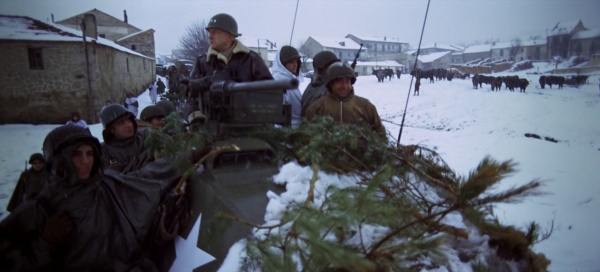
American Minute for December 22nd; Battle of the Bulge

600px-Patton-m2b

The Nazis amassed three armies for an enormous attack against the Allies in the Ardennes Forest and soon surrounded the 101 Airborne Division in southern Belgium, demanding their surrender.

U.S. General Anthony McAuliffe answered in one word: “Nuts.”

This response confused the Nazi commander, causing him to hesitate.

Marching to the rescue was the U.S. Third Army, but it was hindered due to bad weather.

General Patton directed Chaplain O’Neill to compose a prayer for his 250,000 troops to pray:

“Almighty and most merciful Father, we humbly beseech Thee, of Thy great goodness, to restrain these immoderate rains…Hearken to us as soldiers who call upon Thee…Establish Thy justice among men and nations.”

The weather cleared and the Allies counterattacked.

In his order, DECEMBER 22, 1944, General Eisenhower stated:

“By rushing out from his fixed defenses the enemy may give us the chance to turn his great gamble into his worst defeat.

So I call upon every man, of all the Allies, to rise now to new heights of courage…with unshakable faith in the cause for which we fight, we will, with God’s help, go forward to our greatest victory.”

Two days later President Franklin Roosevelt stated:

“It is not easy to say ‘Merry Christmas’ to you, my fellow Americans, in this time of destructive war…

We will celebrate this Christmas Day in our traditional American way…because the teachings of Christ are fundamental in our lives…the story of the coming of the immortal Prince of Peace.”

via American Minute for December 22nd.

American Minute for December 21st

Cover of "John Newton (Men of Faith)"

“Amazing grace! How sweet the sound,

That saved a wretch like me!

I once was lost, but now am found,

Was blind, but now I see.”

These were the words of John Newton, a former slave ship captain, who died DECEMBER 21, 1807.

At age 11, his mother died and he went to sea with his father.

He fell in love with Mary Catlett while on shore leave, but overstaying his visit, he missed his ship’s departure and was pressed by a gang onto the HMS Harwich.

His reckless behavior caused him to be traded to a slave ship.

While on a West African plantation buying slaves, his employer enslaved him.

He was rescued, but continued his immoral life, deriding Christians with blasphemy that shocked even sailors.

During a storm that nearly sank them, he first prayed.

He read Thomas a Kempis’ ‘Imitation of Christ,’ left the slave-trade and became a minister, preaching the rest of his life against slavery.

Having encouraged William Wilberforce to end slavery in England, his tombstone read,

“John Newton, Clerk,

once an infidel and libertine,

a servant of slaves in Africa,

was, by the rich mercy

of our Lord and Saviour Jesus Christ,

preserved, restored, pardoned,

and appointed to preach the faith

he had long labored to destroy.”

via American Minute for December 21st.


American Minute for December 16th; The Boston Tea Party

boston-tea-party-3
Bill Federer writes:

The British passed taxes on the American colonies, stifling the economy:

1764 Sugar Act-taxing sugar, coffee, wine;

1765 Stamp Act-taxing newspapers, contracts, letters, playing cards and all printed materials; and the

1767 Townshend Acts-taxing glass, paints, paper.

Beginning in 1768, British troops quartered in American homes.

When citizens gathered in protest, March 5, 1770, British troops fired into crowd, killing five, in what was called “the Boston Massacre.”

Just three years later, in 1773, the British passed yet another tax, the “Tea Act.”

While American merchants paid taxes, British allowed the East India Tea Company to sell a half million pounds of tea in the Colonies with no taxes, giving them a monopoly by underselling American merchants.

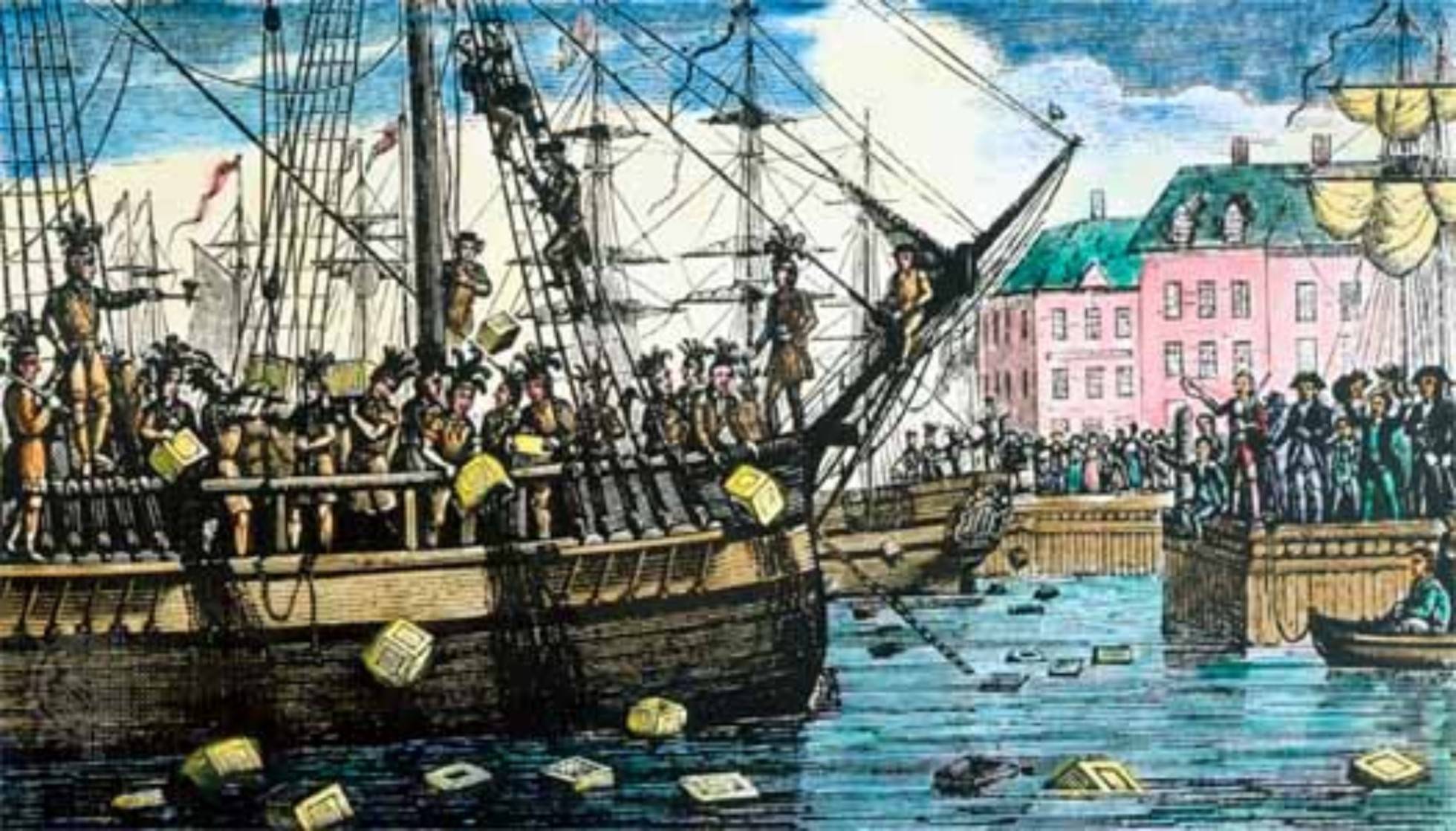
The citizens of Boston had enough, and on DECEMBER 16, 1773, led by Samuel Adams, a band of patriots called Sons of Liberty, disguised themselves as Mohawk Indians, left the South Meeting House toward Griffin’s Wharf, boarded the ships Dartmouth, Eleanor and Beaver, and threw 342 chests of tea into the harbor.

This was called the Boston Tea Party.

The men of Marlborough, Massachusetts, declared:

“Death is more eligible than slavery. A free-born people are not required by the religion of Jesus Christ to submit to tyranny, but may make use of such power as God has given them to recover and support their liberties…

We implore the Ruler above the skies that He would bare His arm…and let Israel go.”

via American Minute for December 16th.

Your Story?

NSRW Thomas Alva Edison
Craig Harper writes:

Once upon a time, JK Rowlings was an unknown, unpublished, impoverished author.
Once upon a time, Thomas Edison was a telegraph operator with three months of formal education.
Once upon a time, Stephen Spielberg made 8 mm films and charged local kids 25 cents to watch.
Once upon a time, I was a fat kid who got picked last for every sporting team.

You’ll never have more potential than you do right now but you will have less time.

What’s the next chapter of your story?

Source: Your Story?

1894 : Annie Oakley

America’s first rockstar:

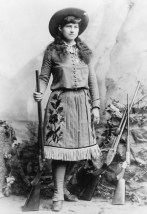
Annie Oakley (1860 – 1926) was an American sharpshooter and exhibition shooter. Oakley’s amazing talent and timely rise to fame led to a starring role in Buffalo Bill’s Wild West show, which propelled her to become the first American female superstar.

Oakley’s perhaps most famous trick is being able to repeatedly split a playing card, edge-on, and put several more holes in it before it could touch the ground, using a .22 caliber rifle, at 90 feet.

Retronaut via 1894 : Annie Oakley.

http://www.youtube.com/watch?feature=player_embedded&v=eAmnQvMHlRs

American Minute for November 7th

, American religious figure.

He wanted to be a baseball player, but after attending a revival at age 16, his life changed.

He has addressed crowds around the world and is unprecedented in having friendships with U.S. Presidents Truman, Eisenhower, Kennedy, Johnson, Nixon, Ford, Carter, Reagan, Bush, Clinton and Bush.

His name is Billy Graham, born NOVEMBER 7, 1918.

At a news conference, March 21, 1956, President Eisenhower stated:

“This is what I see in Billy Graham – A man who clearly understands that any advance in the world has got to be accompanied by a clear realization that man is, after all, a spiritual being.”

Ronald Reagan introduced Billy Graham at a California rally, saying:

“Why is a representative of government here? To welcome with humble pride a man whose mission in life has been to remind us that in all our seeking…the answer to each problem is to be found in the simple words of Jesus of Nazareth, who urged us to love one another.”

Upon receiving the Congressional Gold Medal in 1996, Billy Graham said:

“As we face a new millennium, I believe America has gone a long way down the wrong road. We must turn around…If ever we needed God’s help, it is now.” via American Minute for November 7th.

NASA remembers Neil Armstrong

There’s something wonderful about knowing that the first man to step on the moon was also known for having car trouble, but that’s only one of the touching sentiments expressed in this video made by NASA in memory of the late Neil Armstrong.” via NASA remembers Neil Armstrong – Holy Kaw!.

Armstrong walks on moon; This Day in History — 7/20/1969

I saw it as it happened!

At 10:56 p.m. EDT, American astronaut Neil Armstrong, 240,000 miles from Earth, speaks these words to more than a billion people listening at home: “That’s one small step for man, one giant leap for mankind.” Stepping off the lunar landing module Eagle, Armstrong became the first human to walk on the surface of the moon.

The American effort to send astronauts to the moon has its origins in a famous appeal President John F. Kennedy made to a special joint session of Congress on May 25, 1961: “I believe this nation should commit itself to achieving the goal, before this decade is out, of landing a man on the moon and returning him safely to Earth.” At the time, the United States was still trailing the Soviet Union in space developments, and Cold War-era America welcomed Kennedy’s bold proposal.

In 1966, after five years of work by an international team of scientists and engineers, the National Aeronautics and Space Administration (NASA) conducted the first unmanned Apollo mission, testing the structural integrity of the proposed launch vehicle and spacecraft combination. Then, on January 27, 1967, tragedy struck at Kennedy Space Center in Cape Canaveral, Florida, when a fire broke out during a manned launch-pad test of the Apollo spacecraft and Saturn rocket. Three astronauts were killed in the fire.

Despite the setback, NASA and its thousands of employees forged ahead, and in October 1968, Apollo 7, the first manned Apollo mission, orbited Earth and successfully tested many of the sophisticated systems needed to conduct a moon journey and landing. In December of the same year, Apollo 8 took three astronauts to the dark side of the moon and back, and in March 1969 Apollo 9 tested the lunar module for the first time while in Earth orbit. Then in May, the three astronauts of Apollo 10 took the first complete Apollo spacecraft around the moon in a dry run for the scheduled July landing mission.

At 9:32 a.m. on July 16, with the world watching, Apollo 11 took off from Kennedy Space Center with astronauts Neil Armstrong, Edwin Aldrin Jr., and Michael Collins aboard. Armstrong, a 38-year-old civilian research pilot, was the commander of the mission. After traveling 240,000 miles in 76 hours, Apollo 11 entered into a lunar orbit on July 19. The next day, at 1:46 p.m., the lunar module Eagle, manned by Armstrong and Aldrin, separated from the command module, where Collins remained. Two hours later, the Eagle began its descent to the lunar surface, and at 4:18 p.m. the craft touched down on the southwestern edge of the Sea of Tranquility. Armstrong immediately radioed to Mission Control in Houston, Texas, a famous message: “The Eagle has landed.”

At 10:39 p.m., five hours ahead of the original schedule, Armstrong opened the hatch of the lunar module. As he made his way down the lunar module’s ladder, a television camera attached to the craft recorded his progress and beamed the signal back to Earth, where hundreds of millions watched in great anticipation. At 10:56 p.m., Armstrong spoke his famous quote, which he later contended was slightly garbled by his microphone and meant to be “that’s one small step for a man, one giant leap for mankind.” He then planted his left foot on the gray, powdery surface, took a cautious step forward, and humanity had walked on the moon.

“Buzz” Aldrin joined him on the moon’s surface at 11:11 p.m., and together they took photographs of the terrain, planted a U.S. flag, ran a few simple scientific tests, and spoke with President Richard M. Nixon via Houston. By 1:11 a.m. on July 21, both astronauts were back in the lunar module and the hatch was closed. The two men slept that night on the surface of the moon, and at 1:54 p.m. the Eagle began its ascent back to the command module. Among the items left on the surface of the moon was a plaque that read: “Here men from the planet Earth first set foot on the moon–July 1969 A.D–We came in peace for all mankind.”

At 5:35 p.m., Armstrong and Aldrin successfully docked and rejoined Collins, and at 12:56 a.m. on July 22 Apollo 11 began its journey home, safely splashing down in the Pacific Ocean at 12:51 p.m. on July 24.

There would be five more successful lunar landing missions, and one unplanned lunar swing-by, Apollo 13. The last men to walk on the moon, astronauts Eugene Cernan and Harrison Schmitt of the Apollo 17 mission, left the lunar surface on December 14, 1972. The Apollo program was a costly and labor intensive endeavor, involving an estimated 400,000 engineers, technicians, and scientists, and costing $24 billion (close to $100 billion in today’s dollars). The expense was justified by Kennedy’s 1961 mandate to beat the Soviets to the moon, and after the feat was accomplished ongoing missions lost their viability.

via Armstrong walks on moon — History.com This Day in History — 7/20/1969.

As long as you’ve read this far, here’s a bonus funny story that unfortunately never happened…

How to Not Let Words Hurt You

The echoes of what someone else has said about you keeps repeating over and over in your head. You can’t seem to shut it out.The worst part is, it has made you upset or extremely angered by that person who said those mean things about you. That’s all you feel and think about all day. Your day is ruined. Has this ever happened to you?” Get the answer here: How to Not Let Words Hurt You.

Thomas Jefferson and John Adams die; This Day in History 7/4/1826

Benjamin Franklin, John Adams and Thomas Jeffe...
Benjamin Franklin, John Adams and Thomas Jefferson writing the Declaration of independence (1776) were all of British descent. (Photo credit: Wikipedia)

On this day in 1826, former Presidents Thomas Jefferson and John Adams, who were once fellow Patriots and then adversaries, die on the same day within five hours of each other.

Thomas Jefferson and John Adams were the last surviving members of the original American revolutionaries who had stood up to the British empire and forged a new political system in the former colonies. However, while they both believed in democracy and life, liberty and the pursuit of happiness, their opinions on how to achieve these ideals diverged over time.

Adams preceded Jefferson as president (1797-1800); it was during this time that their ideas about policy-making became as distinct as their personalities. The irascible and hot-tempered Adams was a firm believer in a strong centralized government, while the erudite and gentile Jefferson believed federal government should take a more hands-off approach and defer to individual states’ rights. As Adams’ vice president, Jefferson was so horrified by what he considered to be Adams’ abuse of the presidency–particularly his passage of the restrictive Alien and Sedition Acts of 1798–that he abandoned Adams and Washington for his estate at Monticello. There, he plotted how to bring his Republican faction back into power in the presidential election of 1800. After an exceptionally bitter campaign, in which both parties engaged in slanderous attacks on each other in print, Jefferson emerged victorious. It appeared the former friends would be eternal enemies.

After serving two presidential terms (1801-1809), Jefferson and Adams each expressed to third parties their respect the other and their desire to renew their friendship. Adams was the first to break the silence; he sent Jefferson a letter dated January 1, 1812, in which he wished Jefferson many happy new years to come. Jefferson responded with a note in which he fondly recalled when they were fellow laborers in the same cause. The former revolutionaries went on to resume their friendship over 14 years of correspondence during their golden years.

On July 4, 1826, at the age of 90, Adams lay on his deathbed while the country celebrated Independence Day. His last words were Thomas Jefferson still survives. He was mistaken: Jefferson had died five hours earlier at Monticello at the age of 82.” via Thomas Jefferson and John Adams die — History.com This Day in History — 7/4/1826.

History.com fails to mention that they both died 50 years to the day after signing the original Declaration of Independence

A Fourth of July channeling of Thomas Jefferson

English: Portrait of Thomas Jefferson, founder...

Paul Brandus writes:

“We hold these truths to be self-evident, that all men are created equal, that they are endowed by their Creator with certain unalienable Rights, that among these are Life, liberty and the pursuit of Happiness.”

Thomas Jefferson’s glorious sentence from his Declaration of Independence — arguably the most influential sentence in the history of the English language — holds true to this day, and remains a beacon to all who cherish or yearn for the human rights he espoused. Abraham Lincoln considered that specific passage one of the most important things he ever read, and regarded it as the bedrock of his political philosophy.

Jefferson believed that the Declaration was his greatest accomplishment — even more so than being president of the United States. In fact, gaze upon his gravestone at Monticello (appropriately adorned with nickels left by visitors), and you wouldn’t even know that he was president:

“Here was buried Thomas Jefferson, Author of the Declaration of American Independence, of the Statute of Virginia for religious freedom, Father of the University of Virginia.” via A Fourth of July channeling of Thomas Jefferson – The Week.

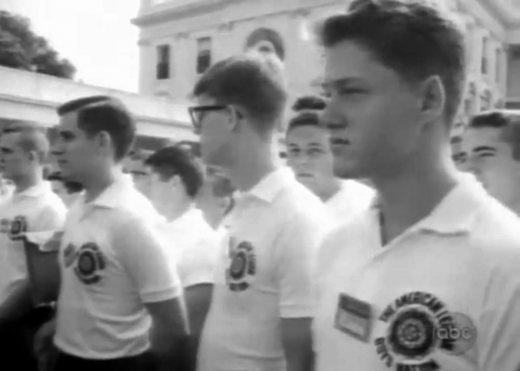
Teenage Bill Clinton meets JFK, 1963

via Retronaut. Get more here: Teenage Bill Clinton meets JFK, 1963.

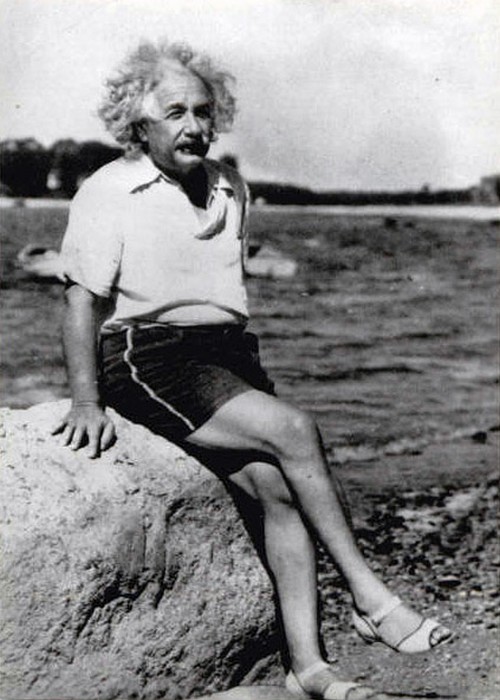
Einstein on the Beach, 1939

Words fail me right now. Retronaut. Get more here: Einstein on the Beach, 1939.

Start a Blog at WordPress.com.

Up ↑