“Your emotions are crucial to your ability to adapt to the challenges of your daily life. When you feel good, you’re able to shrug off even the most burdensome of tasks, but when you’re miserable, you view even an enjoyable activity with a sense of gloom and doom. Emotions also affect our relationships with others. If a friend tells you a tragic story and you react by snickering instead of looking sad or concerned, you’ll seem rude and insensitive. On the other hand, if you frown when you should smile at your friend’s jokes, you’ll cause offense for different reasons.
Flying off the handle to a minor annoyance can make you seem hyper or even unbalanced. Conversely, if you react with undue glee to a relatively minor piece of good news, people will also question your maturity and stability. Babies are allowed to shriek with pleasure or howl with rage but as adults, we’re expected to rein in the outward show of our feelings.
If you need more convincing about the role of emotions in our ability to succeed or fail in facing life’s challenges, think about some of the famous people whose careers have been undone by the improper show of their feelings. In the primary run up to the 2004 presidential election, Howard Dean’s candidacy ended virtually overnight after his “YAAAAHHH” moment became an overnight Internet sensation. Edmund Muskie, in the 1972 primary season, committed a similar political gaffe in which he shed tears after winning the New Hampshire primary (though he claimed they were snowflakes shimmering in the morning light). Ironically, tears are all the rage in the post-2000 political world. Hillary Clinton wasn’t considered sympathetic enough until her eyes misted over while answering a voter’s question (again in New Hampshire!), but many pundits used this against her to question her sincerity. Then there’s the sentimental carryings-on of House Republican leader John Boehner, whose tear ducts seem on constant overdrive.” Get more here: The Complete Guide to Understanding Your Emotions | Psychology Today.
Related articles
- Resentment (thelittletexasturtle.wordpress.com)
Crossed fingers and coercion
I first became aware of the international ‘sign of coercion’ when I saw this picture in 2005…
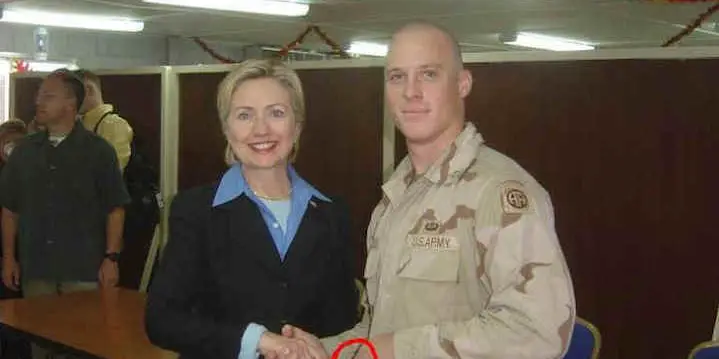
Here’s the backstory;
“The picture shows that this soldier has been thru Survival School and learned his lessons well. He’s giving the sign of “coercion” with his left hand. These hand signs are taught in survival school to be used by POW’s as a method of posing messages back to our intelligence services who may view the photo or video. This guy was obviously being coerced into shaking hands with Hillary Clinton. It’s ironic how little she knew that he would so inform us about the photo—perhaps because she’s never understood our military to begin with.” Source: Picture of a U.S. soldier shaking hands with Hillary Clinton but not happy about it-Truth!

All of this to explain my current Facebook profile picture. I lost a bet to my son’s girlfriend’s father last year when the Packers lost to the Lions 0-7. He was kind enough to purchase the hat for the picture, so at least it didn’t cost me anything except my pride and a few hundred Facebook friends in Green Bay…
As good as the Lions are playing this season, I think we’ll still end up having the last laugh in February. In the meantime, I’ve got a great hat that actually fits — hard for me to come by — that I can use for mucking the stalls, etc., when I’m working on the farm…
 Bright, shiny objects!
You must be logged in to post a comment.