How To Be A Supportive Partner (And What You Gain As A Result)

Shelly Bullard writes:

Sometimes we fail to support our partners in becoming the best versions of the of themselves because we’re scared of what that means for us. What if he wants something I don’t want? What if her desire takes her away from me?

We fear if he learns to fly, he might fly away. So we hold our partners back, sometimes without even knowing it. This strategy always backfires – it ends up holding our relationships back, as well.

But there’s a way to feel safe enough to support your partner to fly, and why doing so will take your relationship to new heights of love.

Get the rest of the article here: How To Be A Supportive Partner (And What You Gain As A Result)

I love Shelly’s writing — always powerful and prescient! You can find more of her stuff here


Awakening Now

recite-7524--1882573445-15un02

At this moment [which is all I have and all I am] this seems to me to be the most beautiful poem I have ever read:

Why wait for your awakening?

The moment your eyes are open, seize the day.

Would you hold back when the Beloved beckons?

Would you deliver your litany of sins like a child’s collection of sea shells, prized and labeled?

“No, I can’t step across the threshold,” you say, eyes downcast.

“I’m not worthy” I’m afraid, and my motives aren’t pure.

I’m not perfect, and surely I haven’t practiced nearly enough.

My meditation isn’t deep, and my prayers are sometimes insincere.

I still chew my fingernails, and the refrigerator isn’t clean.

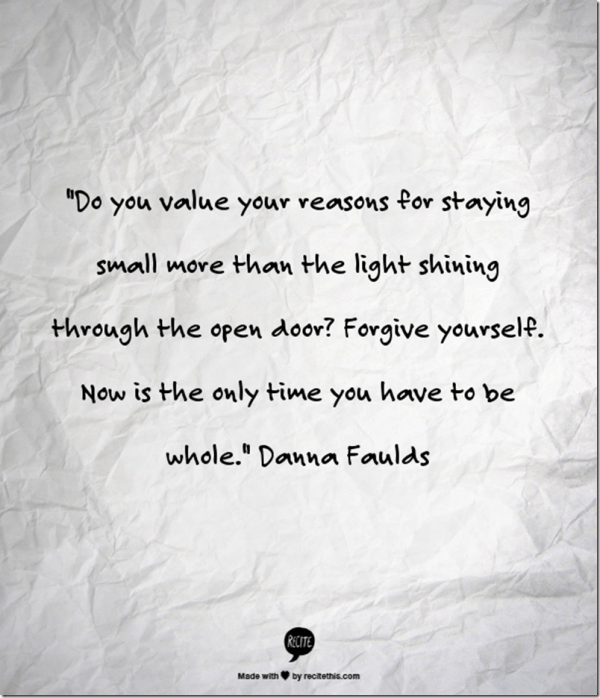
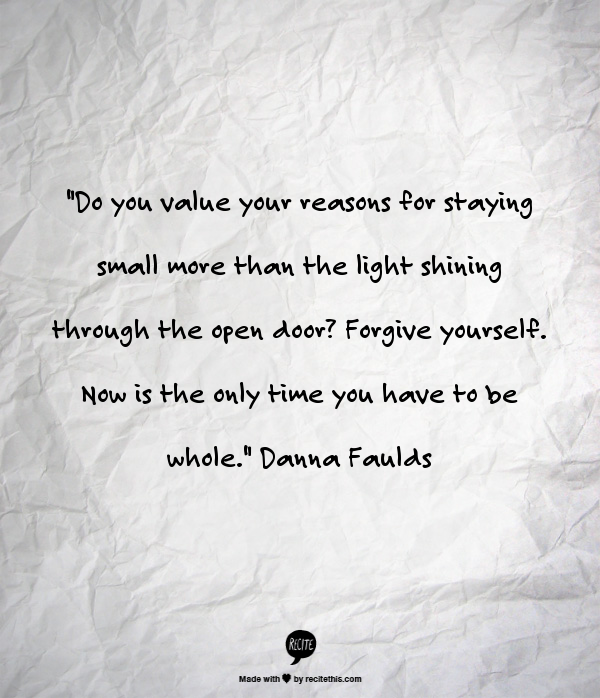
“Do you value your reasons for staying small more than the light shining through the open door?

Forgive yourself.

Now is the only time you have to be whole.

Now is the sole moment that exists to live in the light of your true Self. Perfection is not a prerequisite for anything but pain.

Please, oh please, don’t continue to believe in your disbelief.

This is the day of your awakening.

Source: Awakening Now by Danna Faulds | The Moksha Devi

If this poem resonates with you as well, here are two Tara Brach meditations on self-compassion that I’d like to share with you. “All I plead with you is this” she says “make love of yourself perfect”…

Listen here:

Segment 1: 2011-03-23-Part-1-Healing-Power-of-Self-Compassion

Segment 2: 2011-03-30-Part-2-Healing-Power-of-Self-Compassion

Does Self-Esteem Function as an Emotional Immune System?

Interesting perspective from Dr. Guy Winch:

People usually wish they had higher self-esteem because they want to feel more confident and assured. But having higher self-esteem can do much more for us than simply boost our confidence. A variety of studies have begun to demonstrate that self-esteem can endow us with a layer of emotional resilience when we encounter common psychological injuries such as rejection and failure, as well as insulate us from stress and anxiety. The picture these studies are painting implies that in many ways our self-esteem functions very much like an emotional immune system.

Self-Esteem as an Emotional Immune System

Although experts are still debating what self-esteem actually is (defining such constructs is always tricky in psychology research), we do know quite a bit about what it does. In terms of its general behavior, our self-esteem fluctuates from day to day and sometimes, from hour to hour—much as our physical immune system does. When we’re having a ‘good self-esteem day’, we not only feel different about ourselves but we respond differently to stresses from our environment.

Source: Does Self-Esteem Function as an Emotional Immune System? | Psychology Today

Go to the source to get the rest of his thinking on the topic, especially his thoughts on How to Boost Self-Esteem and Enhance Your Emotional Immune System

You’re probably a dog…

English: sleeping dog

“Yes, we have these great ideals about how we’ve supposed to be […] we don’t have to pretend that our irritablity is not there or compare it unfavorably with our ideal version of ourselves. We could simply take a breath and say, “This is how I am — this is anger, this is fear, this is irritation.” […] In that regard I would like to read to you my new favorite little piece: “If you can sit quietly after difficult news, if in financial downturns you remain perfectly calm, if you can see your neighbors travel to fantastic places without a twinge of jealousy, if you can happily eat whatever is put on your plate and fall asleep after a day of running around without a drink or a pill, if you can always find contentment just where you are, you are probably a dog.”

Meditation Health Benefits: What The Practice Does To Your Body

Meredith Melnick writes:

We hear it all the time: Meditation can improve our creative thinking, our energy, stress levels and even our success. Prominent artists, businessmen and politicians cop to the practice. Would it work for you?

“It did to my mind what going to the gym did to my body — it made it both stronger and more flexible,” said Dr. Hedy Kober, a neuroscientist who who studies the effects of mindfulness meditation, which she has practiced for 10 years, at her lab at Yale University. She admitted during a TED Talk that she started meditating to deal with a break up, but found that it helped her handle stress and unpleasant feelings in all areas of her life.

Studies show that meditation is associated with improvement in a variety of psychological areas, including stress, anxiety, addiction, depression, eating disorders and cognitive function, among others. There’s also research to suggest that meditation can reduce blood pressure, pain response, stress hormone levels and even cellular health. But what does it actually do to the body?

Continue reading “Meditation Health Benefits: What The Practice Does To Your Body”

6 Ways To Reconnect With Your Most Powerful Self

@AmandaLeCe had a post on @mindbodygreen this morning that was so good, I decided you needed to see the whole thing right here:

Between all the tasks, people and activities competing for our attention every day, it’s so easy to get lost in the routine and lose touch of our most powerful, loving selves. Before we know it, we’re acting out of habit or are glued to the computer. The following are some ways I get real, and come back to myself:
Continue reading “6 Ways To Reconnect With Your Most Powerful Self”

Clearing…

forest-clearing-33-1366x768

Do not try to save

the whole world

or do anything grandiose.

Instead, create

a clearing

in the dense forest

of your life

and wait there

patiently,

until the song

that is your life

falls into your own cupped hands

and you recognize and greet it.

Only then will you know

how to give yourself

to this world

so worthy of rescue.

via Martha Postlewaite | Oasis.

Boarded cabin within the Wyre Forest, En

Boarded cabin within the Wyre Forest, England.

http://bit.ly/13iOKiK

Which wolf will you feed?

For most of my life, I have been a bitter, resentful, angry person. The story that I tell myself is that I came by it honestly. I’m a classic case of a person who suffered early childhood trauma around abandonment and rejection issues and much of my life has been spent in trying to get the people in my life now to make up for the things done by the people in my past. When this plan didn’t work [for reasons that are obvious to me now] I reacted with resentment and anger; first toward myself and then toward others… Continue reading “Which wolf will you feed?”

The Questions Coaches Say You Need To Be Asking Yourself

Leigh Newman writes:

Ellie Gordon, a personal and executive life coach, helps us figure out what we really need to be thinking about when we’re looking for lasting, hard-to-make change.

1. Can I Replace The Word ‘Afraid’ With The Word ‘Alert’?
“An artist client recently introduced me to this question,” says Gordon, “and it quickly proved effective at dealing with fear.” Fear, as most of us know, is the biggest obstacle to change. Sometimes our fears are authentic (“My husband is going to leave me because he’s having an affair!”) and sometimes they are inauthentic (“My house is going to blow down even though it’s made out of brick, I have a new roof, and the wind isn’t blowing!”). Either way, we usually try to dismiss our exclamation-pointed feelings as silly, ignore them altogether or blow them up to such a hellacious magnitude that we can’t move, breathe, sleep or… well… live. Continue reading “The Questions Coaches Say You Need To Be Asking Yourself”

There Is Nothing Missing…

JenPastiloffSimpleReminders-850x567[1]

Beautiful soul Jennifer Pastiloff shares:

I feel like I’m about to write copy for an antidepressant commercial. Are you depressed? Trouble sleeping? Find you can’t focus? Find you’re feeling down when you have no real reason to, and, in fact, anyone would think you’re insane for admitting it?

I’ve been struggling lately. And it’s a little overwhelming.

That’s what I have done. Or what I want to do. Try to put down some of my load: in a parking lot, in a blog post. Anywhere, really.

I suffer from depression. Or I have suffered. Which is it? Past tense? Present?

Let me be frank: I’m slipping a little lately. So is it present tense? Do I acknowledge it, then shift my thoughts, creating new mantras, such as, “I am happy! I am free of depression!” or do I sit quietly on this airplane and contemplate it?

What does that even mean — depressed? Is it something I’ve been told (yes!) or something I know deep in the labyrinth of my body, in my DNA (also yes)?

For as long as I can remember, I’ve felt a certain sadness I could never explain to anyone: a dead part inside of me that made me pretend I was sick and stay home from school (even in kindergarten) so I could eat cream cheese and olive sandwiches and watch TV with my mom. During college, I would leave NYU during the weekends to go home to Cherry Hill, NJ, an hour and a half ride on the Peter Pan Bus, so I could be at home, safe from the slick world of New York City and from feeling anything except hunger. Perhaps that’s how I fell in love with anorexia; it allowed me to stop feeling such nothingness. I replaced nothingness with anxiety and hunger, but I no longer felt depressed.

The point is, my life is pretty great. I’m happily married. I’m successful. I’m healthy. So, what is it? What is this demon?

Go to the source of this quote: There Is Nothing Missing: The Epiphany That Helps Me Cope With Depression

I’ve been learning a lot about ‘nothing’ along these lines lately as in ‘nothing is wrong with me anymore‘ and now ‘there is nothing missing’; both good mindful meditations…

You Are What You Focus On: The Strength of An Unstoppable Mindset

The FinerMinds teams shares this:

“It’s not what happens to you, it’s what you do about it.” – W Mitchell

Not many people have been as unfortunate as W Mitchell – or so it would seem.

He’s been involved in two separate serious accidents – one of which left him with burns covering most of his body, and the other that left him wheelchair-bound for life.

As a result of such disabilities, many would give up. But because of his firm belief that success is not dictated by what life deals to you, but by what you do with the challenges you’re dealt, W Mitchell re-trained himself to fly a plane, become a famous international speaker and an environmental lobbyist.

In this 4-minute video, he reinforces the fact that we become what we focus on, and how once he started focusing on how powerful and innovative he was, he not only changed his life – but the life of those around him.

Go to the source of this quote: You Are What You Focus On: The Strength of An Unstoppable Mindset

Be Yourself: No More, No Less

Be Yourself: No More, No Less
Michael Woolson writes:

Be yourself. It’s a statement that people often dismiss as something doting mothers say, but it is actually a very poignant piece of advice.


For instance, have you ever seen a guy who’s trying to be more than what he is? He’s fifty-five, driving a sports car, wearing designer clothing that someone half his age would wear, trying to pick up twenty year olds, and showing off his face lift or hair plugs. It’s like he’s saying, “I’m not old, bald, or okay-looking. I’m a hot, rich, thick-haired, young stallion.” The truth is that he’s not fooling anyone. Wouldn’t your opinion of him be more favorable if he accepted his real age and appearance? This is an extreme example, but almost everyone does it on some level. If you’re an okay-looking person, be an okay-looking person. I know, how dare I say something like that. But the truth is that we are only beautiful when we stand firmly in what we truly are. Continue reading “Be Yourself: No More, No Less”

Why Self-Compassion Trumps Self-Esteem

Have you tried to pump up your self-esteem? Kristen Neff explains why it doesn’t work in the long run:

In this incredibly competitive society of ours, how many of us truly feel good about ourselves?

I remember once, as a freshman in college, after spending hours getting ready for a big party, I complained to my boyfriend that my hair, makeup, and outfit were woefully inadequate. He tried to reassure me by saying, “Don’t worry, you look fine.”

“Fine? Oh great, I always wanted to look fine . . .” Continue reading “Why Self-Compassion Trumps Self-Esteem”

Emotional Abuse

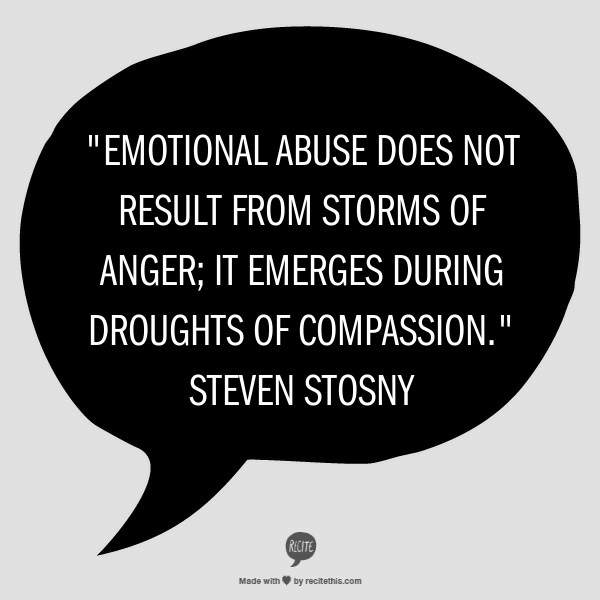
Merely refraining from abusive behaviors will do nothing to improve a relationship, though it may slow its rate of deterioration. To repair the harm done, there must be a corresponding increase in compassion on the part of the abuser. Abusers do not change by receiving compassion; they change by learning to give it. Emotional abuse does not result from storms of anger; it emerges during droughts of compassion.Steven Stosny writes:

Emotionally abusive behavior is anything that intentionally hurts the feelings of another person. Since almost everyone in intimate relationships does that at some time or other, emotionally abusive behavior must be distinguished from an emotionally abusive relationship, which is more than the sum of emotionally abusive behaviors. Continue reading “Emotional Abuse”

Love Yourself First!

…and remember to practice self-compassion this weekend!

Why We Need to Have Compassion for Our Inner Critic

Kristin Neff writes:

We know how much it hurts. “I’m an idiot!” “I’m disgusting.” “No one will ever love me.” “What a lame-ass.”

So why do we do it? As soon as we ask ourselves this question, we often just pile on more self-criticism. “I’m such a bitch, even to myself.” “That’s why I’m such a loser, I’m always putting myself down.”

Don’t beat yourself up for beating yourself up in the vain hope that somehow it will help you stop beating yourself up. Instead, take a step back, and give your inner critic some slack. In its ineffective, counterproductive way, your inner critic is actually trying to keep you safe.

As humans we have two main evolved safety systems. The oldest and most quickly triggered is the threat defense system, which involves the amygdala. When we sense danger, our response is typically fight, flight, freeze, or submit: We turn and fight the threat, run like hell away from the threat, play dead in hopes the threat will pass, or show our bellies and hope the threat will be placated. These strategies are very successful for animals living in the wild, helping them to survive and pass on their genes. For humans, however, these responses often just make things worse. That’s because the threat we’re usually facing is a threat to our self-concept. We confuse our thoughts and representations of ourselves for our actual selves, meaning that when our self-image is under siege, we react as if our very existence is threatened. When this happens, our threat defense system uses the same strategies to stay safe:

Fight — we beat ourselves up emotionally, using cruel language to cut ourselves down.

Flight — we become anxious and restless, fleeing from ourselves by numbing out or using distractions like food or alcohol.

Freeze — we get stuck in rumination, thinking about our perceived inadequacies over and over again.

Submit — we admit that yes, we’re terrible, and accept all the harsh judgments we throw at ourselves.

More often than not we engage in some combination of all these strategies. Our stress levels go up as our amygdala activates our sympathetic nervous system (which arouses us so we can deal with threats) and floods our system with adrenaline and cortisol. And it’s a double whammy because when we criticize ourselves, we are both the attacker and the attacked. This type of chronic stress can eventually lead to anxiety and depression, undermining our physical and emotional wellbeing.

Still, it’s important to remember that when our inner critic attacks, at root it is trying to ward off danger. Marshal Rosenberg, author of the book Non-Violent Communication, says self-criticism is the “tragic expression of an unmet need.” It’s tragic because self-criticism makes us feel horrible and doesn’t effectively motivate productive change. (See my blog “The Motivational Power of Self-Compassion.”) But if we look closely — our inner critic cares. There is some safety need it is trying to meet. Our inner critic wants us to be happy, but doesn’t know a better way to go about it. Let’s say you criticize yourself for not going to the gym, calling yourself a “lazy slob.” At some level, your inner critic is reacting out of concern that if you don’t go to the gym you won’t be healthy, or that you’ll be rejected by others. We can be kind and compassionate to this part of ourselves, because at some level it has our best interests at heart. And believe it or not, by giving compassion to our inner critic, we are moving out of the threat defense system and into our other safety system.

As mammals, we also evolved the attachment/affiliation system as a survival strategy. Mammals have the innate capacity to be soothed by warmth and affection, meaning that our young are likely to stay near caregivers, be protected, and survive. The care-giving system deactivates the sympathetic nervous system (reducing cortisol) and activates the parasympathetic nervous system, which calms us down. This route to emotional safety is much more effective — reducing our stress and anxiety rather than exacerbating it. And it gives us the emotional balance needed to make wise decisions, including making behavioral changes if needed. (I write about self-compassion and the mammalian care-giving system in my blog “The Chemicals of Care.”)

So the next time you find yourself in the throws of harsh self-criticism, instead of beating yourself up for beating yourself up, thank your inner critic for its efforts, then try the strategy of giving yourself some compassion instead. It’s more effective, and a lot less painful!

Full story at: Kristin Neff: Why We Need to Have Compassion for Our Inner Critic.

Be Here Now: How Major Surgery Changed My Outlook

herbs-spring-energy[1]

Harper Spero shares this story:

I grew up in a family that strongly believes in the concept “be here now,” a saying from spiritual teacher Ram Dass, and though my family isn’t a religious one, it still resonates deeply with us. 

It was January 2012, and over the past three months I’d developed a severe cough—similar to what one gets after a three-pack-a-day habit. In those 12 weeks my general practitioner had diagnosed me with bronchitis and pneumonia, and prescribed three medications and inhalers, none of which did anything for me. My mom, like any incredible Jewish mother, kept mentioning that it was time to call the doctor for further review. Continue reading “Be Here Now: How Major Surgery Changed My Outlook”

10 Things to Remind Yourself on a Daily Basis

Madison Sonnier writes:

Bad days can be extremely overpowering sometimes. When we’re having a bad day, everything feels wrong and the day seems to get even worse as we sink further into frustration and despair. By the end of the day, all we want to do is pull the covers up over our heads and block it all out.

When I clawed my way out of a depressive phase last year, it was a daily challenge to keep myself from falling back into that phase again. I had to go through a process of re-building my self-esteem and re-evaluating my life. But there were days when I was not very successful with these things and the negative thoughts that stayed with me for so long would interfere again. Continue reading “10 Things to Remind Yourself on a Daily Basis”

Finding Peace and Joy When Dealing with Pain and Loss

recite-18383-1677882087-g93e6vFull story at: Finding Peace and Joy When Dealing with Pain and Loss | Tiny Buddha.


Simple Truth to a Richer, Deeper, Lasting Relationship

How to Have Enriching RelationshipsHealing thoughts from Jeff Cannon:

When a relationship becomes a one-way way street, it ends up at a dead end sooner or later. Learn to keep the traffic flowing both ways with conversation, forgiveness and mindful awareness to keep your relationship growing well into the future. It all starts with that inner conversation you have with yourself. Be aware of it, and find how easy it is to nurture your relationship in the direction you want it to go. Continue reading “Simple Truth to a Richer, Deeper, Lasting Relationship”

Start a Blog at WordPress.com.

Up ↑