
Don’t Give Up Your Dreams!


Tommy Rosen

had such a good post at the The Daily Love today that I had to grab the whole think [no, that’s not a typo! I’m being intentional] for you:

Don’t you give up your dreams. Spend your life in pursuit of them. It does not matter which ones come true and which ones don’t. The point is you will have lived a life pursuing what meant the most to you. We can look around us and see countless reasons to despair and also countless reasons to persevere.

Focus your attention on the things that make life worth living. Look at publications that uplift you. Read spiritual books that inspire you. If you watch television and movies, try to expose yourself to heart-opening, thought-provoking media. For goodness sakes, do not read the newspaper. We already know that the human condition is full of challenges. There is no need to compound those challenges by focusing our attention en masse upon the worst parts of our society. If you cannot let that go because you feel that your livelihood is connected to it, then be disciplined in what you read so that you only ingest the parts that you must and you will limit the negative effect upon your life.

Look for sources of information, which contain hope, love and possibility within them. Work to make your life better. Work to help the people around you and to make their lives better. If everyone did that, we would have a world of peace in a few weeks.

Be unapologetic in your positivity even in the face of dire circumstances. Even when it seems that there is no way out, insist that there is one and that you just cannot see it at that moment. Though you may not have an answer now, be secure in the knowledge that there is an answer to every question you can ask. You may need to develop patience to wait out periods of “darkness”. Know that the light always comes.

Do not misunderstand the Human condition and how difficult it is. It is challenging to be a human being because of the interplay between our own desires and the rules of The Uni-verse. We die, for example. That’s a tough one for us. We lose loved ones and must navigate through sadness, anger, jealousy and grief. These things are not a theory. We all experience them and we are here, in part, to support each other as we go through the hardest parts of our lives.

We are also here to celebrate each other. To look upon another person’s success with excitement and awe is a blessing. Do not let jealousy and envy overcome you. Be excited for other people who find success and, inspired by their example, continue to pursue the things that mean the most to you. Think how you feel when watching an Olympic athlete win a gold medal. Do you sit there thinking, “Wow, I can’t believe it is not me up there,” or are you in awe of the discipline that it must have taken for that person to get to that place. For me, it is inspiring to see someone obtain excellence, even mastery in something. That makes me want to become excellent at the things I am working on. Though we may never obtain mastery, it is our pursuit of mastery that matters.

When you do experience negative emotions regarding other people’s accomplishments, deal with them in the moment. How? See how your emotions are directly related to some work within yourself that still needs to be addressed. When you encounter envy, take it to mean that there is something you are being asked to do that you are not yet doing. It is the Uni-verse’s way of nudging you to put you “on task” and it actually has nothing to do with the person or situation you are envious of. With patience and humility, you can acknowledge someone else’s successes while at the same time using the feeling of envy to fuel your own efforts.

Do not be misguided in this world. Learn how to listen to your own heart. Develop an inner compass through the ancient practices of yoga, meditation and prayer. Learn about yourself. This will require you to be quiet and to focus your attention within. You will need to spend some time alone. This does not mean time in front of the television, computer or even lost in a book. I am speaking about time spent in quiet reflection, prayer and meditation. Do you know how to do these things? If you do not, then take some time to learn. The story of my life can be summed up as follows: on those days when I meditated and practiced yoga, I felt connected to what really mattered. On those days when I did not meditate or practice, I felt less connected to what really mattered. I do not know how to put this any more plainly. Start your practice today and you will find that the pursuit of your dreams, in and of itself, will become a wonderful, magical journey that is worth living for.
I say these things to you as a recovered drug addict who had lost myself completely to hardcore drug addiction.

There was a time when I could not imagine a day without using drugs. I was not really living. Each day was another experience of just how powerless I was to do anything of value for myself much less others. I wanted to stop and a thousand times I made that commitment, but it only resulted in more sadness and frustration.

Yet, somehow, even in the midst of my worst drug abuse, I never gave up my hope of learning to live a better life. I had no idea how this was to happen, but I still wanted it deep within. What I was missing was the pathway, support and love I needed to get better from the profound, unseen things that plagued me. When I was blessed with the right teachers and the willingness to listen to them, the light flooded into my heart and I found recovery.

Don’t give up your dreams no matter what happens. Keep trying. Keep looking. Persevere. Bring whatever positivity you can to the struggle and it will build upon itself. As the famous poet, Rainer Maria Rilke wrote, “Live your questions now, and perhaps even without knowing it, you will live along some distant day into your answers.”

Source: Don’t Give Up Your Dreams!


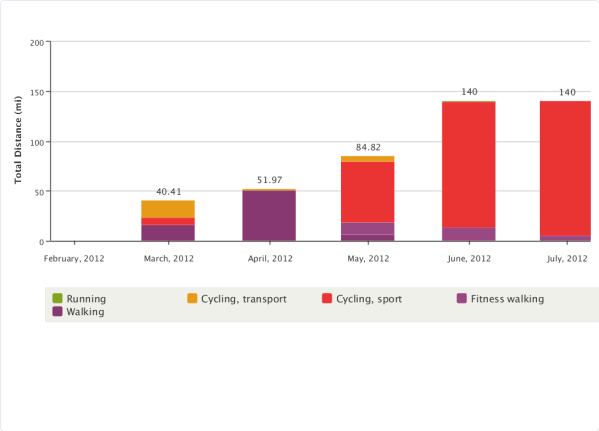
Thanks to @endomondo…

…as of the 20th of the month I’ve already equaled my workout mileage for last month and tripled my output over March [although that is a walking vs bicycle thing]. I’m pushing for 200 miles this month. What’s your goal?

Click image to enlarge…

…and thanks, Endomondo! These metrics really motivate me for some reason…

How To Stop Cravings: Banishing Unhealthy Snacking

via Stepcase Lifehack. Read the article here: How To Stop Cravings: Banishing Unhealthy Snacking.

Why America Is Obese

Why America Is Obese (Infographic).

Let It Go: Switching Off Your Inner Chatter

Letting go

Don’t you hate those days where you can’t turn off the negative internal chatter in your head? When you wake up in the morning and the very thing that was circling around in your head the night before is there to greet you with a big nudge, and not even a coffee?

This negative chatter can really impact your productivity throughout the day and ruin your ability to live in the moment. It’s only natural that we worry about circumstances in our lives, we wouldn’t be human if we didn’t. However, when these thoughts consume our heads to the point where we find it difficult to concentrate on anything else, it’s important you have a coping mechanism in place to try and get you through the day.

When it comes to decluttering the head and letting go of what’s worrying you, we found some really practical tips in 7 Ways To Let Go Of What’s Ailing You. The article explains that while we may not be able to solve the problem on the spot, there are many ways we can try and let it go of it for the time being.

“Letting go doesn’t mean ignoring the problem. It simply means that you realize that there is nothing you can do about the issue right now, and rather than having it consume your life with stress and anxiety you are going to put it aside until you are in a position where you can deal with it.”

One of our favorite tips in the article is the visualization exercise. If you’re not used to visualizing, this may seem a little strange to start off with, however, this method can be very effective as it puts you in a position of control to deal with the problem, even if it’s just in your head. For example:

“Imagine the thing that is bothering you, and then visualize placing it in a balloon and watching it float away.”

You’ll be surprised by how therapeutic this exercise can be and the ability for it to free your mind.

If this method isn’t for you, another helpful tip is to write your thoughts down. If you feel the anxiety building in the morning before you’ve even entered the shower, sit down and freely write your thoughts, paying little attention to the need for it to make sense.

The aim is to release everything from your mind, no matter how illogical your thoughts may seem, and write for as long as it takes to get everything out. You’ll be surprised how easily and quickly the words fall to the page when they come from the heart – it’s almost as if the brain is relieved it has an opportunity to freely unload. Even if writing isn’t your forte, this is a very easy exercise which you can turn into a daily practice.

Do you use a technique to turn off the internal chatter running around in your head? Or perhaps you have several depending how severe the issue is? Tell us about your favorite method and how effective it is at “letting thoughts go”. via Let It Go: Switching Off Your Inner Chatter.

Limit Screen Time, Limit Sitting

Leo Babauta writes:

One of the hazards of our modern lifestyle is our tendency to become more and more addicted to staring at screens, and more and more sedentary.

We look at laptops and desktop computers, iPhones and Androids and iPads and iPods, TVs and movie screens, play video games, watch videos, surf the web, socialize online, work online. And we’re sitting the whole time.

I’m a victim of this as much as anyone else. My family and I are drifting toward this lifestyle, and while I’m no Luddite, I do believe that we should live less as victims and more consciously.

Too much screen time means less active time, less personal socializing, less focus on the present, less time for cooking healthy food, less time reading novels, painting, making music, making time for the ones you love. And too much sitting means fewer years on your life.

So what’s a better way?

Limits.

Limit how much screen time you have each day. Limit your sitting to short periods with breaks in between.

I realize that many people have jobs that require them to have a minimum amount of computer time, and probably mostly sitting. So I don’t recommend a certain number, only that you figure out a limit and work with that.

What I’ve Been Doing

Though I’ve set limits for myself in the past, I’ll admit that they’ve eroded in recent months, so that my screen time has grown over time. And not just for me — for my wife and kids. So recently Eva and I set limits for ourselves, and we’ve been working with them.

We find them to be great. I find daily limits to be a better balance than going on week-long or month-long digital sabbaticals, which aren’t realistic for many people.

Here’s an example:

  • We set a limit of either 4 or 5 hours of total screen time a day. (We haven’t figured out what’s best yet, still experimenting.)
  • That total is broken into 30-minute chunks. So if it’s 5 hours total, that’s 10 chunks of 30 minutes.
  • At the start of a 30-minute chunk, I set a computer timer and put a tally mark on a text document, so I know how many chunks I’ve used today. When the bell rings, I close my laptop.
  • After the 30-minute chunk, I take a break of at least 30 minutes. I try to get up and move, stretch, play with the kids, get outside. I also often read a novel. The moving is good for my body, and helps me to think.
  • If I have things I want to look up online, or write online, I’ll just make a note of it and do it when I start my next 30-minute chunk.

This isn’t the only way to do it — you’ll have to find the limit that works for you, and the chunk size that works for you. But the idea is to set limits, and to break the total up into pieces so you’ll take breaks and do other things.

Benefits of the Limits

We’ve loved it: we’re reading more books, spending more personal time with each other and the kids, getting more chores done, exercising more, playing outside more.

It also means that because we have a limit, we have to figure out the best way to use that time. We have to make choices — what’s worthy of our limited time, and what isn’t? This means more conscious use of our time.

We haven’t instituted the limits with the kids yet, though we have been talking to them about it and getting them thinking about what would work best for them. And we do tell them to take breaks from devices throughout the day, so they’ll do other things.

For the kids, this has meant they have more unstructured, imaginative play, more reading, more art and music, more activity. Kids get addicted to screens just as much as adults do, and it’s not a healthy thing for them. We’re trying to teach them ways to live a healthy lifestyle, which is a lesson with lifelong benefits.

We’ve found this lifestyle to be healthier, better for relationships, better for our peace of mind. And to me, that means it’s something work keeping.

More reading:

via Limit Screen Time, Limit Sitting.

Slow-and-Steady Wins the Race: Especially with Diet and Weight

Terese Katz writes:

When it comes to exercise, too, slow and steady promises results. Fitness journalist Gretchen Reynolds recently reviewed several large-scale exercise studies. It was “slow or average” paced jogging, moderate exercise like walking or cycling, that proved most beneficial. These regimes, and not high-intensity running, for example, improved health factors most consistently. So here, sticking with what’s manageable, and not necessarily pressing yourself for more and more, may serve you well in the long run.

The moral of these findings could be summed up with some words from a Harvard Health Letter summarizing decades or research on changing unhealthy behavior: “Change is a process, not an event.” “It can take a few rounds.” “You should keep trying.” “Any effort you make in the right direction is worthwhile.” People who’ve kept weight off, or stopped a gorging habit, or built a solid exercise routine will usually echo these sentiments. In your frustration, when weight loss seems stuck, or when you feel you just can’t get it right, take heart from knowing that you still may be forging change.

Often we don’t realize we’re “forging” at all. If you’ve stopped and started a hundred diets, though, chances are you’ve discovered a thing or two that actually does work for you, even if the overall schemes did not. For example, you may not have kept your Weight Watchers pounds off, but maybe you’ve incorporated the idea of “budgeting” so that’s it’s now part of your automatic thinking. You may ask yourself “Can I afford this?”, as you approach the make-your-own-sundae party. Maybe you’ve learned that a food log will pull you back to a more mindful eating stance.

Or, perhaps you found the ultra-low-carb diet impossible. However, you’ve retained the idea of keeping certain carbs low—like maybe those in white breads or pasta. Or perhaps when fat-free fell by the wayside, you at least kept up an awareness of fat content, and the extra calories they bring.” Read the rest of the article here: Slow-and-Steady Wins the Race: Especially with Diet and Weight | Psychology Today.

“Yes” Doesn’t Count if you can’t say “No” – Why Clear Boundaries are Important in Intimate Relationships

English: A young woman and man embracing while...

I found this over at Psychology Today:

Most people think of an ideal romantic relationship as a union of two inseparable beings forged into one heart, one mind, and one dream. If either partner has a conflicting desire, he or she too often does not express it. They consciously or unconsciously choose to protect the fantasy of perfect compatibility, but may not realize the limitations that are wedded to that decision.
Eventual conflicts are not as noticeable early when relationships are new. The joy of new discovery and lustful connection often eclipse any disagreements that might arise. Newly-in-love partners too often do not want to know anything about each other that could threaten the perfection they cherish. Both may choose to leave well enough alone even if the result is incomplete or inauthentic communication. In the void of unexpressed conflicts, the partners often want to maintain the illusion of a perfect match.

“He finishes my sentences before I even know what I’m going to say.”

“She anticipates what I want before I tell her.”

“We agree on everything. It’s amazing.”

“It’s so easy to be together. We love all the same things.”

Sadly, those constructed realities of perfect compatibility cannot sustain over time. People cannot feel genuinely loved if their partners are not aware of the other’s core feelings and desires. They can only keep renewing their love if they can face their conflicts openly and work through them.

That requires that both partners are willing to follow these six principles:

They are able to say what they need from their partners

They know what they are able to offer

They honestly share those thoughts and feelings

They listen to their partner’s needs without becoming defensive

They have or are willing to learn the skills to negotiate their differences

They respect each other’s conflicting desires

To make these principles work, partners must be clear from the beginning of their relationship to set clear boundaries that they both agree to honor. Boundaries are like the borders between countries. They can be barriers to communication and cooperation, or viable interfaces for exchanging ideas and resources.

When beautifully used in intimate relationships, they are symbolic lines of demarcation that help partners understand their differences while they seek whatever ways are necessary to authentically connect. Only the acceptance of those known similarities and differences can keep partners truly validating their mutual needs.

Healthy boundaries should be fluid and openly susceptible to changes by either partner during any time in their relationship. They hopefully know or are willing to learn what is personally important to them and make every effort to share those thoughts with each other. By working together over time, they learn to quickly recognize when they are in agreement, when they need to negotiate, and when they must turn down a request that could destroy their personal integrity.” Get more here: “Yes” Doesn’t Count if you can’t say “No” – Why Clear Boundaries are Important in Intimate Relationships | Psychology Today.

Healthy Boundaries: A Good Practice

English: Slate fencing marking field boundarie...

Kristin Barton Cuthriell writes:

“Boundaries are those invisible lines that separate you from other people. When children grow up in families that practice healthy boundaries, these boundaries are typically passed down through generations. The same is true when individuals are raised in dysfunctional families that have no sense of healthy boundaries. These poor boundaries, too, are often passed down the generational line.

Poor boundaries are usually too rigid or too loose. Like a concrete wall, rigid boundaries keep people out. When a person is closed off with rigid boundaries, they do not allow themselves to become vulnerable, which makes true intimacy impossible.

People with loose boundaries have little fence or no fence at all. The separation between self and others is blurred. Individuals with loose boundaries do not have a clear sense of self. These people trust easily, disclose too much, have a difficult time setting limits, and often become enmeshed with others.

Healthy relationships require healthy boundaries. If you are aware that your personal boundaries are either too loose or too rigid, you can learn healthy boundaries.

The first step to change is recognizing that change is needed.  What you do not acknowledge, you do not change.

What is a healthy boundary? Take a look.” Get more here: Healthy Boundaries: A Good Practice – Let Life in Practices.

The Grass Is Greener Somewhere Else . . . NOT!

Tony Meindl shares some great insight here:

The grass is greener syndrome.

If you suffer from it, it’s yet another way of postponing your life. Putting the things you desire on the back burner. When we covet another person’s journey, we think if only we had what they had, our life would be more fun. Or more exciting. Or more magical.

Your life already is magical.

We’re just not awake to it, so it feels as if we’re moving around in a monochromatic haze while everyone else seems to be living in Technicolor.

That’s the illusion.

The truth is that your grass is very green. It’s lush and tropical and exotic and fertile and full of possibilities. But it requires you to fully embrace it. All of it. Even the stuff you don’t like, because actually, that’s the stuff that becomes the catalyst for change.

That stuff is your grass’s fertilizer. It’s the essential stuff needed for your growth and expansion. And it holds the potential to unlock the doors you’ve shut to the things you’re seeking:  your joy, your passion, your peace of mind, your self-acceptance.

We can never get to where we’d like to be except by starting in the place we’re currently residing – emotionally, psychologically, spiritually. There’s no escaping you.

Wherever you are, there you are.

We can move to another city, or get another girlfriend or change jobs, but the common denominator in all these experiences is you.

So if you don’t like where you are, then change who you are. But don’t think that being somewhere else, or having a different lover or having a career like someone else is the answer.

The transformation occurs from the inside out. Not the outside in.

Start with your stuff. And watch how green your grass will grow.

Source: The Grass Is Greener Somewhere Else . . . NOT!

I’ve always heard that the grass is greener where you water it! Take care of your own lawn today…

Insisting on the Best

Melody Beattie writes:

We deserve the best life and love has to offer, but we are each faced with the challenge of learning to identify what that means in our life. We must each come to grips with our own understanding of what we believe we deserve, what we want, and whether we are receiving it.

There is only one place to start, and that is right where we are, in our current circumstances. The place we begin is with us.

What hurts? What makes us angry? What are we whining and complaining about? Are we discounting how much a particular behavior is hurting us? Are we making excuses for the other person, telling ourselves we’re “too demanding”?

Are we reluctant, for a variety of reasons, especially fear, to tackle the issues in our relationships that may be hurting us? Do we know what’s hurting us and do we know that we have a right to stop our pain, if we want to do that?

We can begin the journey from deprived to deserving. We can start it today. We can also be patient and gentle with ourselves as we travel in important increments from believing we deserve second best, to knowing in our hearts that we deserve the best, and taking responsibility for that.

Today, I will pay attention to how I allow people to treat me, and how I feel about that. I will also watch how I treat others. I will not overreact by taking their issues too personally and too seriously; I will not under react by denying that certain behaviors are inappropriate and not acceptable to me.” Source: Language of Letting Go – July 16 – SoberRecovery : Alcoholism Drug Addiction Help and Information

The 21 Best Organic Snacks

I’m not sure about the integrity of this list; there’s not a raw vegetable in sight! Seems to be mostly packaged foods but if that’s your thing, you can get more here: healthy snacks list | The 21 Best Organic Snacks | Rodale News.

Family Buttons

Melody Beattie writes:

“I was thirty five years old the first time I spoke up to my mother and refused to buy into her games and manipulation. I was terribly frightened and almost couldn’t believe I was doing this. I found I didn’t have to be meant. I didn’t have to start an argument. But I could say what I wanted and needed to say to take care of myself. I learned I could love and honor myself, and still care about my mother – the way I wanted to – not the way she wanted me to.” –Anonymous

Who knows better how to push our buttons than family members? Who, besides family members, do we give such power?

No matter how long we or our family members have been recovering, relationships with family members can be provocative.

One telephone conversation can put us in an emotional and psychological tailspin that lasts for hours or days.

Sometimes, it gets worse when we begin recovery because we become even more aware of our reactions and our discomfort. That’s uncomfortable, but good. It is by beginning this process of awareness and acceptance that we change, grow, and heal.

The process of detaching in love from family members can take years. So can the process of learning how to react in a more effective way. We cannot control what they do or try to do, but we can gain some sense of control over how we choose to react.

Stop trying to make them act or treat us any differently. Unhook from their system by refusing to try to change or influence them.

Their patterns, particularly their patterns with us, are their issues. How we react, or allow these patterns to influence us, is our issue. How we take care of ourselves is our issue.

We can love our family and still refuse to buy into their issues. We can love our family but refuse their efforts to manipulate, control, or produce guilt in us.

We can take care of ourselves with family members without feeling guilty. We can learn to be assertive with family members without being aggressive. We can set the boundaries we need and want to set with family members without being disloyal to the family.

We can learn to love our family without forfeiting love and respect for ourselves.

Today, help me start practicing self care with family members. Help me know that I do not have to allow their issues to control my life, my day, or my feelings. Help me know it’s okay to have all my feelings about family members, without guilt or shame.

Source: Detachment – Cyber Recovery Social Network Forums – Alcohol and Drug Addiction Help/Support

Go to the source for additional self-care thoughts on attachment and detachment.

Does Gratitude Matter in Marriage?

Susan Heitler, Ph.D. writes:

“Please” and “thank you” often come out of our mouths automatically. How can we use true gratitude and thankfulness to cultivate healthy relationships?

Gratitude is “the quality of being thankful; readiness to show appreciation for and to return kindness.”

As children we’re taught to say “thank you” automatically in return for a favor. On this surface level, we are taught that gratitude is an appropriate social response.

At the same time, on a more complex level, gratitude is a way of being. When we truly feel gratitude, we experience heartfelt awe and appreciation for the goodness of something outside ourselves. Having gratitude towards someone or something means respecting its value and treasuring how unique, beautiful, or indispensable it is.

New studies support the idea that gratitude is an integral part of healthy relationships. As marriages move past the honeymoon stage, couples go from appreciating and loving every little detail about each other to taking each other for granted. Amie Gordon, a psychologist from U.C. Berkeley, blames this for the downfall of many relationships: ”You get used to having [your spouse] in your life and forget why you chose to be with them.” We become deadened to our spouse’s special qualities and instead focus on things that annoy us about them. These doldrums leave couples confused and discouraged: “Maybe the man they married isn’t so great after all…What happened to the spark in our relationship?…What do we do now?”

Dr. Gordon’s study in the Journal of Personality and Social Psychology explores the role of gratitude and appreciation in maintaining long and healthy relationships. In the study, 50 committed couples were given a week to fill out appreciation journals. On days when one partner reported feeling more appreciated, he or she tended to appreciate his or her partner more the next day.

Couples who had ongoing reciprocal appreciation were less likely to break up in the next nine months and even reported being more committed at the end of that time. The researchers concluded that a nourishing cycle of encouragement and appreciation provides extra incentive to maintain our relationships. In other words, when we appreciate our partners, we develop trust and respect. When we feel appreciated, we feel needed and encouraged.

In the second part of the study, Gordon’s researchers observed how couples of all ages–from 18 to 60–communicated appreciation. The team noticed that “highly appreciative” pairs tended to use body language and response skills to show that they valued their spouses. Foremost of these was a Power of Two favorite skill: active listening. When their partner spoke, appreciative spouses leaned in, made eye contact, and responded thoughtfully to what they were saying. They made it clear that they were listening to and digesting what their spouse said, thereby showing that they valued their spouse’s opinion. Appreciative couples also used touch and physical encouragement such as handholding or an encouraging pat on the leg.

This study observed the healthy relationships benefits of naturally appreciate couples. The flipside is that some couples are not naturally appreciative. It can be incredibly discouraging to not feel appreciated–you may even feel like your marriage is over. Luckily, our behavior and thoughts are malleable; just as we fell out of patterns of love and gratitude, we can grow back into them.

The key to sparking healthy relationships with gratitude is to take the initiative: “Instead of just waiting for the other person to make you feel good, you can jumpstart that cycle and take it into your own hands by focusing on what’s good in your relationship,” says Dr. Gordon. Start with small and easily achievable goals, such as giving your spouse five compliments a day, or simply smiling at her more often.

Gratitude is a skill that you cultivate—nurture it in yourself, and soon your will see positivity radiate back at you.

Source: Does Gratitude Matter in Marriage? | Psychology Today

Make fat pay!

Get out there and make your fat cry this weekend!!! ..MOTIVATION POSTER: Make fat pay.. «.

The Nine Healthiest Alcoholic Drinks

Among the 9?

Guinness

Ingredients: Magic and Unicorn kisses

Guinness used to have a slogan: “Guinness is good for you!” Well, it really kinda is. First off, despite how thick it is, its way lower in calories than you think—128 calories per 12 ounces. Not bad. Because its made from more whole grains than lager especially mega-brewery stuff, its full of nutrients. In fact, its been shown to have similar antioxidant properties to red wine. Want more? In 2003, the University of Wisconsin discovered that consuming Guinness may help the reduce of blood clots and heart problems.” Get the rest here: The Nine Healthiest Alcoholic Drinks.

Is He Worth It? Six Questions to Ask When Sacrificing in Relationships

What about ‘is she worth it?’ Despite the slant, I think this is worth a read if you’re asking yourself this question:

We must all face situations in our close relationships that require us to make a sacrifice. Perhaps, your spouse receives a big promotion, and it requires that you quit your job and move across the country. Or your boyfriend wants you to miss an important work event to attend his family reunion. Maybe you and your wife get jobs in different cities and must decide who has to make the long commute. For me, it was deciding whether to apply to graduate programs in areas that weren’t near where my husband (then boyfriend) was working. When faced with these situations, what information do we use to decide whether or not to make the sacrifice? In addition to consulting the pros and cons list, there are also important questions we should be asking ourselves. Below, I suggest six questions that might help when deciding whether or not making a sacrifice is right for you.” Get the answer here: Is He Worth It? Six Questions to Ask When Sacrificing in Relationships | Psychology Today.

Grilling Brussels Sprouts!

Gotta try this recipe! Grilling BS! « Rantings of an Amateur Chef.

Couples 911 – LaShelle’s Top 3 Tips for Couples

Taylor Duvall shares this:

I have followed CNVC Trainer LaShelle Lowe-Charde for years now and feel so grateful for learning how I typically ‘react’ in my long term relationships and how I can break any habitual pattern.  Her main focus is supporting couples and watch my interview with her on YouTube to hear her top 3 tips:

  • Spend a designated time each day focused on each other.
  • Share even small appreciations as often as possible.
  • Develop a language of feeling and needs to communicate what’s in our heart (what we want) not what’s wrong.

She also shares her relationship saving request and why once we ‘get’ the floor, we tend to go on and on…” via Couples 911 – LaShelle’s Top 3 Tips for Couples | The Center for Nonviolent Communication.

Here are a couple of bonus videos from LaShelle…

See Your Imperfect Self As Precious

Leslie Becker-PhelpsLeslie Becker-Phelps writes:

As a therapist, I am often faced with people who struggle with feeling essentially flawed in some way. They are quick to take responsibility for their errors or to blame themselves for problems with friends. And, they experience their struggles, mistakes, and imperfections as proof that they are lesser as a person.

As I listen to them, I know that when they look in the mirror, they do not see the value in them that I see. It is this negative self-perception that is the real source of their torture, not the daily issues that loom so large for them. Being overweight, shy, depressed, or socially awkward may cause them great pain; but I see this pain as a distress that requires caring – not condemnation. Making mistakes at work or becoming upset with your children is just part of life. After all, there’s a reason that “It’s only human” has come to be an expression. No one – and I mean no one – handles everything well all the time. And everyone – and, again, I mean everyone – has things they really struggle with.” Get more here: See Your Imperfect Self As Precious | Psychology Today.

Is Your Life “Bucket” Leaking?

A plastic yellow bucket.

“Each of has a psychological “bucket.”

It’s our inner reservoir of positive energy that enables us to engage other people with good will, kindness, consideration, generosity, care and concern, acceptance, and respect.

And all of our buckets are leaky, to some extent or other.

At those times when our buckets are pretty well topped up, and not leaking very much, we feel good about ourselves and we’re likely to act in ways other people experience as “nourishing” – we help them feel good about themselves.

And when our internal buckets get leaky, we’re more inclined to treat others in ways they experience as “toxic” – we say and do things that cause them to feel offended, insulted, ignored, devalued, disrespected, unappreciated, or unloved.

Most of us manage to keep our buckets fairly well topped up, most of the time. Some days we’re more “up” than others, but over the long run most of us realize the value of expressing this positive energy to those around us.” Get the rest here: Is Your “Bucket” Leaking? | Psychology Today.

Start a Blog at WordPress.com.

Up ↑