“You cannot force someone to want to change their behavior. After all, they are not just “behaviors” to the person suffering from the disorder — they are coping mechanisms they have used all their life.” John M. Grohol, Psy.D.
Kreger, Randi; Mason, Paul (2010-01-01). Stop Walking on Eggshells: Taking Your Life Back When Someone You Care About Has Borderline Personality Disorder (p. 15). New Harbinger Publications, Inc.. Kindle Edition.
‘Experts’ say it takes between 21 and 30 days to create a new habit. There are many great tools — Habitforge is one that comes to mind — that can help you set a goal and stick to it using technology. The ‘Pick Four’ methodology by Zig Ziglar and curated by Seth Godin is another that comes to mind. What do you use to create and keep health habits…
Christine Hassler has a real beauty of a post today that I grabbed in its entirety for you…
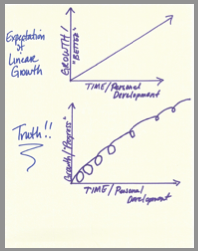
One of my pet peeves about the personal growth industry is that there is a lot of expectation placed on consistently making positive changes. The promise is that over time as we do our work, we gradually and continuously “get better” (whatever “better” means). What often isn’t addressed is that our learning and growth isn’t linear. It’s not a straight shot from an “aha” moment to being totally transformed.
Please don’t torture yourself by buying into the misunderstanding that your growth needs to be straight up. That’s a lot of pressure – and also not possible. Growth is more fluid. And over time the lows (or perceived backtracking) we experience become shorter in duration and the length of time in between them becomes longer. I drew this picture for you to illustrate what I am talking about:
The original image was kinda small; I think this is still legible…
The human experience is about contrast and sometimes the best way we learn is when we take a few steps that feel backwards. Often when we have a big “aha” so much to the extent that we feel transformed, the Universe will bring us a situation that feels very similar to past experiences. Often people get frustrated and think, “This again? I thought I learned this already!” That may be accurate; you may have learned the lesson and now the Universe is bringing you an amazing opportunity to practice the learning so that you can fully integrate it. I give some examples of this in today’s video.
If you feel like you are backtracking in your own behavior, choices, or feelings rest assured you are not flunking life. You learned from my UPdate last week that only about 95% of our processing power is conscious so there is a lot of subconscious programming that you are working through. Your so-called issues and programmed responses got implemented decades ago so it may take some time before you totally shift something. So if you find yourself slipping into old habits, reactions, behaviors or choices that you thought were behind you, cut yourself some slack.
Growth is a process not an event. You can’t upgrade yourself like you do your iPhone.
When you perceive yourself taking steps backwards, that does not mean change is not occurring. You may take ten steps forward and then eight steps back. But the next time you will take eleven steps forward and only seven steps back. You are making progress!! Whatever you do, just keep going. And forgive yourself! This is super duper important. Nothing will hold you back more than judging yourself and allowing your inner critic to have its way with you. Immediately say to yourself, “I forgive myself for judging myself for back-tracking. I’m doing the best I can.” Then re-commit to your vision and intentions and keep going.
Here are some of the points she makes I think are worthy of review…
“It’s not a straight shot from an “aha” moment to being totally transformed.”
“Only about 95% of our processing power is conscious so there is a lot of subconscious programming that you are working through”; this is why we say in Celebrate Recovery that we don’t claim perfection, only progress…
“Growth is a process not an event. You can’t upgrade yourself like you do your iPhone.” As a tech guy, there have been many times I have wished I could upgrade myself like hardware. If only I could reformat my brain and delete all the old Beatles‘ lyrics! I’d have so much more room! I do think, however, you CAN upgrade your thinking. There is an old computer programming acronym GIGO; Garbage In, Garbage Out. It applies to thinking and food as well…
And finally, this bears repeating…
“Nothing will hold you back more than judging yourself and allowing your inner critic to have its way with you. Immediately say to yourself, “I forgive myself for judging myself for back-tracking. I’m doing the best I can.” Then re-commit to your vision and intentions and keep going.”
And perhaps the most important lesson of all? Go easy on yourself and practice ‘self-forgiveness’…
Unless you’re eating organic meat, you’re getting a mouthful of antibiotics with every burger, fried chicken wing, or turkey sandwich you eat. The Food and Drug Administration (FDA) estimates that 80 percent of the antibiotics used in this country are fed to farm animals or slipped into the animals’ drinking water to promote growth and protect the creatures against the diseases that thrive in the filthy living conditions they are raised in. And most of those are given when the animals aren’t even sick.
That has to stop, say the 200 farmers, food producers, physicians, and scientists who signed on to two letters last week vehemently urging the FDA to put the brakes on the rampant overuse of these vital drugs in animals raised for food.” via The Danger in Your Meat | Rodale News.
If you’ve been reading health magazines and websites for any length of time, you’ve read a litany of reasons why soda is bad for you. It’s nothing but sugar water. It’s devoid of any nutritional value. It leads to obesity and diabetes. But we’ve dug up nine other disturbing facts about what soda does to your body, besides packing on the pounds, that don’t get much attention in broader discussions about soda and its impact on your health.” Get more here: via facts about soda | 9 Disturbing Side Effects of Soda | Rodale News.
No, I don’t mean a clogged kitchen sink or a shower stall that empties slowly.
I’m talking about allowing people, places and things to slowly and insidiously creep in and begin sucking the soul, energy, life force – and resources – out of us. No matter how many years ago we learned about not being codependent, it can still happen to us. Again.
Drain Pain occurs so slowly and subtly, we may not see it happening. Following you’ll find a list of symptoms and the remedy for each:
We leave our bodies – disconnect from ourselves. We’re experts at fleeing the body. We hover around ourselves doing everything except feeling what we feel and valuing ourselves. When this happens, we often feel numb, confused and afraid. We may also feel emotional (generalized) pain. The thoughts that accompany this condition include: I CAN’T STAND THIS ANYMORE. IT, HE, SHE OR THEY IS OR ARE DRIVING ME INSANE. This means it’s boundary-setting time again.
We complain about the same thing, behavior or person or problem for days, weeks, months or years but nobody hears us. The cure for this means listening to ourselves.
We know that something’s wrong but we aren’t sure what it is (because we’re not listening to ourselves). When we mention the problem to the Drainer(s) — the people or institutions in the first symptom above — they look at us askance and reassure us that nothing is wrong except us – who we are, how we feel and what we think is going on just isn’t occurring, they insist. Remember the story from the first Language of Letting Go, about the scene in a movie where a wife catches her husband in his pickup truck? He’s parked at the drive-in movie theatre all cuddled up and kissing with another woman. When the wife confronts him about having this affair, he denies it vehemently while the other woman sits there kissing his neck, arm, hand and more. “What are you going to believe?” the infidel asks his wife. “Me or what you think you see?” Crazy as that sounds, it can easily describe us when we’re in codependent mode.
We feel tired, unfocused and somewhat like a Boxer looks (the dog, not Mohammed Ali) when it’s chasing not a tail, but the remnants of one before the vet clipped or docked it. We’re caught up in trying to do the impossible. It’s time to assess what we can and can’t change and then put energy into assessing and solving the right problem – the real issue that’s going on.
We feel increasingly angry at the people, places or things in our personalized list in the first symptom above, but as soon as we feel anger we also start to feel guilt. The guilt’s not real. It’s the codependent guilt that’s followed us around for most of our life. The guilt yammers about how there must be something wrong with us because the other person wouldn’t do that — whatever that is. We wonder what’s wrong with us for feeling this angry and then decide that the problem is us. ZZZZZT. Wrong answer. Solution? Look in the mirror and tell ourselves that who we are is okay.
Of all the signals that someone’s manipulating or lying to us, feeling cruddy and confused after our interactions with this person or institution — if they’ll stand still long enough to talk to us — ranks highest and indicates that it’s time to open our eyes, shake off the denial dust and start a self-care revival.” This is a long post. You can get the rest here: Drain Pain | Melody Beattie.
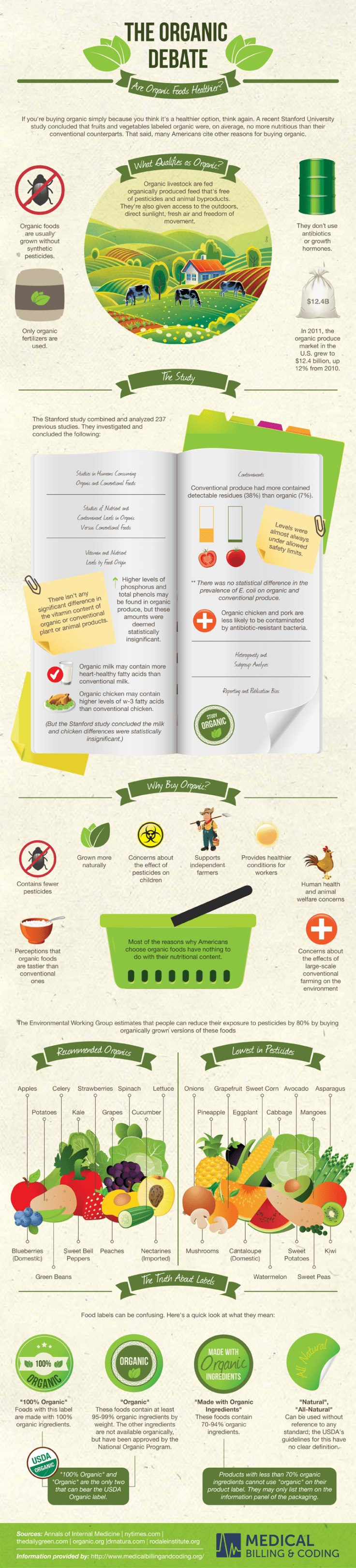
A highly publicized study by Stanford University researchers published in the Annals of Internal Medicine revealed key findings that proponents and critics of organic growing have been hotly debating. Day-one reports by mainstream media tended to lead with the finding that organic food doesn’t appear to be any more nutritious than conventionally grown produce and meat.
Another key finding, which likely didn’t make as many headlines because it’s practically common sense, is that food raised organically comes to us with less pesticide and chemical residue.
Is a well-washed locally grown apple better for me than a bag of “organic” corn chips? Of course. But it’s an apples-and-oranges comparison. The New York Times pointed out the real comparison: Are you better off paying more for organically grown strawberries, a fruit a nutritionist I once interviewed called a “pesticide sponge.”
The study found no difference in nutritional value of organic versus conventionally grown strawberries, but it did report a higher pesticide level in the conventionally grown version, and that’s the point that seems to be the jumping-off place for most of the disagreement. The Times reported that the study found that residue in conventional fruits, vegetables and meat was “almost always under the allowed safety limits.”
Opponents of organic and paying higher prices for pesticide-free food interpret that finding to mean conventional food is perfectly safe, while organic fans and food-safety advocates call that interpretation dangerous.
Deirdre Imus, founder and president of The Deirdre Imus Environmental Health Center, took a more cynical view, writing for Fox News that the focus on equivalent nutrition “is a dangerous misinterpretation of information and worse, a potential ploy to encourage consumers to buy conventionally grown produce for the sole purpose of marginalizing the organic food industry.”
Debate became so heated that Christine Laine, editor-in-chief of the Annals of Internal Medicine, explained the journal’s standards to the Los Angeles Times and stood by the science. Laine said the study was unusual because of “not only the amount of interest but the fact that it’s been sustained, and the vitriol among the critics of the study. Certainly, with other things we’ve published, people have had different views of the results, but they don’t typically call for the paper to be retracted.”
In the wake of the study, WebMD contributor and registered dietitian Maryann Tomovich Jacobsen wrote “5 Mistakes People Make When Choosing Organic,” including assuming all ingredients are healthy if they’re labeled “organic.” “The key is to know why you are buying organic, and to remember that it is just one piece of the ‘health’ puzzle.”
I used to be a total perfectionist, but I have had a total change of heart. I’ve learned that it isn’t worth it to be consumed with the little things, or sweat the small stuff as they say. I no longer bicker with my husband or kids about the stupid stuff. I’ve incorporated a progress over perfection philosophy throughout my life—from how I live to what I teach to my fitness followers.
Perfection is unachievable. It often leads to disappointment and it can set you up for failure. Strive for progress, not perfection.
I now call myself a recovering perfectionist and there are so many benefits to letting go of perfection.
You can be less concerned about what others think of you. I am less worried about what others think about me as long as I’m proud of my behavior. I don’t have to look perfect or act perfect. It is liberating to let go of what other people think. Start to value your own opinion more than anyone else’s. Your confidence will soar when you alone determine how you should feel about you.
Teach your kids progress over perfection. I want my kids to escape the whole perfectionist pursuit, so as long as they are giving their best effort, I am happy. I want my kids to be hard workers and caring citizens, to acknowledge their weaknesses, admit when they are wrong, and strive to be better and improve where they can—progress over perfection.
By letting go of perfectionism, you can stop procrastinating. Fear of making a mistake can keep people stuck. Some people may not even take step one on something they want to accomplish for fear of not doing it flawlessly. Perfection stalls progress. What if you flipped perfection on its head and gave yourself permission that it’s okay to fail miserably, but you are just going to try anyway. I guarantee if try, you will make progress. Just give it your best and have some compassion for yourself if you aren’t flawless.
Giving up on perfection doesn’t mean you work less hard. I work hard at my job, my family and my relationships; I just don’t expect or need perfection anymore.” via Forget Perfection: Strive Toward Progress.
…in the time it takes to listen to one song. How? Planking…
I do the exercise in the middle of the video, 3 sets of 30 seconds each with 30 seconds in between to recover. Seriously, it looks simply but planking is more powerful than situps and it won’t hurt your back, either. I had back surgery 20 years ago and situps do more damage than good but planking changes everything from the way I walk to the way I sit and everything works better when I do so why don’t you get down on the floor and get started. Thank me in the comments! :-D
Dubbed as having the strength of coffee, the health benefits of tea, and the euphoria of chocolate, it’s no wonder South American’s have been drinking yerba mate tea for centuries.
This wonder drink, which is made from the leaves of the South American rainforest holly tree (Ilex Paraguariensis), contains caffeine, heobromine and theopylline. It’s also the national drink in Paraguay, Uruguay, Southern Brazil and Argentina (where it’s consumed by the truckloads, out doing coffee 6-1).
But besides providing a somewhat euphoric punch, it has the health properties to rival even the greenest of teas!
“Control, or lack thereof, is one of the greatest sources of suffering.”
Maggie Lyon writes:
For someone like me, whom I affectionately call a control freak in recovery, with a chaotic walking-on-eggshells childhood, it is obvious why I became (in my teens) so obsessed with having maniacal control over all aspects of my environment. At age sixteen, the most obvious place to start was with my body.
If you haven’t read or heard by now, I became a major anorexic at this time. This brutally domineering mindset lasted on and off in bouts well into my twenties. I’d be lying to say its creepy little ways didn’t present in more feeble moments (and when I got severely ill) in my early thirties.
Anorexia is, of course, all about control, and it has, in various moments, thoroughly taken over my life by leeching out into arenas far beyond what went into my mouth. There have literally been times when I couldn’t stomach any kind of mess. If something didn’t fit into my intense vision of perfection, it got tossed, and fast.” Get the rest here: Life Is Messy « Positively Positive.



















 Bright, shiny objects!
You must be logged in to post a comment.