Just in case you missed this for 6/15/2012

  1. “I align myself with people who support my growth. If you meet someone whose soul is not aligned with yours, send them love and move along.”

    – Dr. Wayne Dyer

Letting the Cycles Flow

A beautiful monarch butterfly bears her transp...

Melody Beattie writes:

Life is cyclical, not static. Our relationships benefit when we allow them to follow their own natural cycles.

Like the tide ebbs and flows, so do the cycles in relation­ships. We have periods of closeness and periods of distance. We have times of coming together and times of separating to work on individual issues.

We have times of love and joy, and times of anger.

Sometimes, the dimensions of relationships change as we go through changes. Sometimes, life brings us new friends or a new loved one to teach us the next lesson.

That does not mean the old friend disappears forever. It means we have entered a new cycle.

We do not have to control the course of our relationships, whether these be friendships or love relationships. We do not have to satisfy our need to control by imposing a static form on relationships.

Let it flow. Be open to the cycles. Love will not disappear. The bond between friends will not sever. Things do not re­main the same forever, especially when we are growing and changing at such a rapid pace.

Trust the flow. Take care of yourself, but be willing to let people go. Hanging on to them too tightly will make them disappear.

The old adage about love still holds true: “If it’s meant to be, it will be. And if you love someone, let them go. If they come back to you, the love is yours.”

Today, I accept the cyclical nature of life and relationships. I will strive to go with the flow. I will strive for harmony with my own needs and the needs of the other person.” via June 15: Letting the Cycles Flow.

Enjoyment

Melody Beattie writes:

Life is not to be endured; life is to be enjoyed and embraced.

The belief that we must square our shoulders and get through a meager, deprived existence for far-off “rewards in Heaven” is a codependent belief.

Yes, most of us still have times when life will be stressful and challenge our endurance skills. But in recovery, were learning to live, to enjoy our life, and handle situations as they come.

Our survival skills have served us well. They have gotten us through difficult times — as children and adults. Our abil­ity to freeze feelings, deny problems, deprive ourselves, and cope with stress has helped us get where we are today. But we’re safe now. We’re learning to do more than survive. We can let go of unhealthy survival behaviors. We’re learning new, better ways to protect and care for ourselves. We’re free to feel our feelings, identify and solve problems, and give ourselves the best. We’re free to open up and come alive.

Today, I will let go of my unhealthy endurance and survival skills. I will choose a new mode of living, one that allows me to be alive and enjoy the adventure.” via June 14: Enjoyment.

Hanging on to Old Relationships

More Melody Beattie:

“We want to travel baggage-free on this journey. It makes the trip easier.

Some of the baggage we can let go of is lingering feelings and unfinished business with past relationships: anger; resentments; feelings of victimization, hurt, or longing.

If we have not put closure on a relationship, if we cannot walk away in peace, we have not yet learned our lesson. That may mean we will have to have another go-around with that lesson before we are ready to move on.

We may want to do a Fourth Step (a written inventory of our relationships) and a Fifth Step (an admission of our wrongs). What feelings did we leave with in a particular relationship? Are we still carrying those feelings around? Do we want the heaviness and impact of that baggage on our behavior today?

Are we still feeling victimized, rejected, or bitter about something that happened two, five, ten, or even twenty years ago?

It may be time to let it go. It may be time to open ourselves to the true lesson from that experience. It may be time to put past relationships to rest, so we are free to go on to new, more rewarding experiences.

We can choose to live in the past, or we can choose to finish our old business from the past and open ourselves to the beauty of today.

Let go of your baggage from past relationships.

Today, I will open myself to the cleansing and healing process that will put closure on yesterday and open me to the best today, and tomorrow, has to offer in my relationships.” Source: Hanging on to Old Relationships

Moving Forward

Melody Beattie writes:

Much as we would like, we cannot bring everyone with us on this journey called recovery. We are not being disloyal by allowing ourselves to move forward. We don’t have to wait for those we love to decide to change as well.
Sometimes we need to give ourselves permission to grow, even though the people we love are not ready to change. We may even need to leave people behind in their dysfunction or suffering because we cannot recover for them. We don’t need to suffer with them.
It doesn’t help.
It doesn’t help for us to stay stuck just because someone we love is stuck. The potential for helping others is far greater when we detach, work on ourselves, and stop trying to force others to change with us.
Changing ourselves, allowing ourselves to grow while others seek their own path, is how we have the most beneficial impact on people we love. We’re accountable for ourselves. They’re accountable for themselves. We let them go, and let ourselves grow.

Today, I will affirm that it is my right to grow and change, even though someone I love may not be growing and changing alongside me.

Source: Moving Forward – Language of Letting Go – SoberRecovery : Alcoholism Drug Addiction Help and Information

Sadness

Grief

Melody Beattie via:

“Ultimately, to grieve our losses means to surrender to our feelings.

So many of us have lost so much, have said so many good-byes, have been through so many changes. We may want to hold back the tides of change, not because the change isn’t good, but because we have had so much change, so much loss.

Sometimes, when we are in the midst of pain and grief, we become shortsighted, like members of a tribe described in the movie Out of Africa.

“If you put them in prison;’ one character said, describ­ing this tribe, “they die:’

“Why?” asked another character.

“Because they can’t grasp the idea that they’ll be let out one day. They think it’s permanent, so they die:’

Many of us have so much grief to get through. Sometimes we begin to believe grief, or pain, is a permanent condition.

The pain will stop. Once felt and released, our feelings will bring us to a better place than where we started. Feeling our feelings, instead of denying or minimizing them, is how we heal from our past and move forward into a better future. Feeling our feelings is how we let go.

It may hurt for a moment, but peace and acceptance are on the other side. So is a new beginning.

God, help me fully embrace and finish my endings, so I may be ready for my new beginnings.” via June 11: Sadness.

Solving Problems

Melody Beattie writes:

“Shame is the first feeling that strikes me whenever I, or someone I love, has a problem;’ said one recovering woman.

Many of us were raised with the belief that having a problem is something to be ashamed of.

This belief can do many damaging things to us. It can stop us from identifying our problems; it can make us feel alien­ated and inferior when we have, or someone we love has, a problem. Shame can block us from solving a problem and finding the gift from the problem.

Problems are a part of life. So are solutions. People have problems, but we, and our self-esteem, are separate from our problems.

I’ve yet to meet a person who didn’t have problems to solve, but I’ve met many who felt ashamed to talk about the problems they actually had solved!

We are more than our problems. Even if our problem is our own behavior, the problem is not who we are — it’s what we did.

It’s okay to have problems. It’s okay to talk about problems at appropriate times, and with safe people. It’s okay to solve problems.

And we’re okay, even when we have, or someone we love, has a problem. We don’t have to forfeit our personal power or our self-esteem. We have solved exactly the problems we’ve needed to solve to become who we are.

Today, I will let go of my shame about problems.” via June 10: Solving Problems.

Responsibility

Melody Beattie writes:

Self care means taking responsibility for ourselves. Taking responsibility for ourselves includes assuming our true responsibilities to others. Sometimes, when we begin recovery, we’re worn down from feeling responsible for so many other people. Learning that we need only take responsibility for ourselves may be such a great relief that, for a time, we disown our responsibilities to others.
The goal in recovery is to find the balance: we take responsibility for ourselves, and we identify our true responsibilities to others.
This may take some sorting through, especially if we have functioned for years on distorted notions about our responsibilities to others. We may be responsible to one person as a friend or as an employee; to another person, we’re responsible as an employer or as a spouse. With each person, we have certain responsibilities. When we tend to those true responsibilities, we’ll find balance in our life.
We are also learning that while others aren’t responsible for us, they are accountable to us in certain ways.
We can learn to discern our true responsibilities for ourselves, and to others. We can allow others to be responsible for themselves and expect them to be appropriately responsible to us.
We’ll need to be gentle with ourselves while we learn.
Today, I will strive for clear thinking about my actual responsibilities to others. I will assume these responsibilities as part of taking care of myself.

Source: Language of Letting Go – June 10 – Responsibility – SoberRecovery : Alcoholism Drug Addiction Help and Information

Letting Go

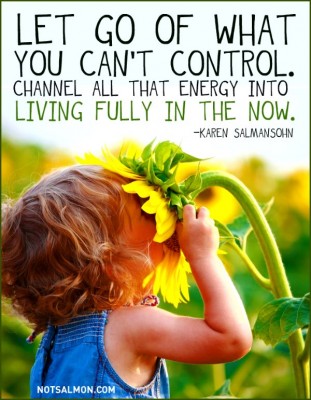
“There are some things we can control, like what we eat and whether or not we choose to exercise. We can choose how we treat others and how we allow them to treat us. Basically, we can control our actions and reactions and that’s about all.

The most important lesson I learned is that living in fear (aka: control) is not really living at all. It’s more like tiptoeing around life (when you’re not flat-out running away from it). It was empowering to give up the “power” I thought I had.” Get more here: Letting Go | notsalmon.

Panic

Yup! More Melody Beattie:

“Few situations – no matter how greatly they appear to demand it – can be bettered by us going beserk.” Codependent No More

Don’t Panic!

If a swimmer was crossing a great lake, then suddenly focused too heavily on the distance remaining, he might start to flounder and go under – not because he couldn’t swim, but because he became overwhelmed by panic.

Panic, not the task, is the enemy.

Many of us have moments when we feel crowded and overwhelmed. We have times when we feel like we cannot possibly accomplish all that needs to be done.

We may be facing a task at work, an improvement in ourselves, or change in our family life.

For a moment, it is helpful to look forward and envision the project. It is normal, when we look ahead at what needs to be done, to have moments of panic. Feel the fear, then let it go. Take our eyes off the future and the enormity of the task. If we have envisioned the goal, it will be ours. We do not have to do everything today, or at once.

Focus on today. Focus on the belief that all is well. All we need to do to reach our goal is to focus on what presents itself naturally, and in an orderly way, to us today. We shall be empowered to accomplish, peacefully, what we need to get where we want to be tomorrow.

Panic will stop this process. Trust and guided action will further it. Breathe deeply. Get peaceful. Trust. Act as guided, today.

We can get back on track by treading water until we regain our composure. Once we feel peaceful, we can begin swimming again, with confidence. Keep the focus simple, on one stroke, one movement at a time. If we can make one movement, we have progressed. If we get tired, we can float – but only if we are relaxed. Before we know it, we shall reach the shore.” via THE RECOVERY PROCESS: Panic.

Living Our Lives

Melody Beattie writes:

“Don’t stop living your life!

So often, when a problem occurs, inside or around us, we revert to thinking that if we put our life on hold we can posi­tively contribute to the solution. If a relationship isn’t work­ing, if we face a difficult decision, if we’re feeling depressed, we may put our life on hold and torment ourselves with obsessive thoughts.

Abandoning our life or routines contributes to the problem and delays us from finding the solution.

Frequently, the solution comes when we let go enough to live our life, return to our routine, and stop obsessing about the problem.

Sometimes, even if we don’t feel like we have let go or can let go, we can “act as if” we have, and that will help bring about the letting go we desire.

You don’t have to give up your power to problems. You can take your focus off your problem and direct it to your life, trusting that doing so will bring you closer to a solution.

Today, I will go on living my life and tending to my routine. I will decide, as often as I need to to stop obsessing about whatever is bothering me. If I don’t feel like letting go of a particular thing, I will “act as if” I have let go of it until my feelings match my behavior.” via June 9: Living Our Lives.

Boundaries


Can I go a single day without quoting Melody Beattie? I don’t think so!

“Sometimes, life and people seem to push and push. Be­cause we are so used to pain, we may tell ourselves it doesn’t hurt. Because we are so used to people controlling and manipulating us, we may tell ourselves there is something wrong with us.

There’s nothing wrong with us. Life is pushing and hurting to get our attention. Sometimes, the pain and pushing are pointing toward a lesson. The lesson may be that we’ve be­come too controlling. Or maybe were being pushed to own our power to take care of ourselves. The issue is boundaries.

If something or somebody is pushing us to our limits, that’s exactly what’s happening: we’re being pushed to our limits. We can be grateful for the lesson that’s here to help us explore and set our boundaries.

Today, I will give myself permission to set the limits I want and need to set in my life.” via June 8: Boundaries.

The Gift of Readiness

Melody Beattie writes:

“Were entirely ready to have God remove all these defects of character.” Step Six of Al-Anon.

We progress to the Sixth Step by working diligently, to the best of our ability, on the first Five Steps. This work readies us for a change of heart, openness to becoming changed by a Power greater than ourselves – God.

The path to this willingness can be long and hard. Many of us have to struggle with a behavior or feeling before we become ready to let it go. We need to see, over and over again, that the coping device that once protected us is no longer useful.

The defects of character referred to in Step Six are old survival behaviors that once helped us cope with people, life, and ourselves. But now they are getting in our way, and it is time to be willing to have them removed.

Trust in this time. Trust that you are being readied to let go of that which is no longer useful. Trust that a change of heart is being worked out in you.

God, help me become ready to let go of my defects of character. Help me know, in my mind and soul, that I am ready to let go of my self defeating behaviors, the blocks and barriers to my life.” via 6/6 Language of Letting Go – SoberRecovery : Alcoholism Drug Addiction Help and Information.

Detachment means “freedom from emotion”

The Way You Make Me Feel
The Way You Make Me Feel (Photo credit: Wikipedia)

Letting someone else’s behavior determine how we feel at every turn is irresponsible. Our emotions should be determined by us, not by someone else. But no doubt we have spent years confusing the boundaries that separate us from other people. Whether at work or at home, we have too often let someone else’s “insanity” affect how we behave and how we feel.

At first, it may seem insensitive not to react to others’ problems or negative behavior. We may fear they’ll think we simply don’t care about them. Learning that it is far more caring to let other people handle their own lives takes time and patience. But with practice, it will begin to feel comfortable. In fact, in time it will feel freeing and wonderful.

I will work on detachment today, knowing that in time the rewards will come. 

Attack shame!

Melody Beattie writes:

“Shame can hold us back, hold us down, and keep us staring at our feet.” Beyond Codependency

Watch out for shame.

Many systems and people reek of shame.  They are controlled by shame and may want us to play their game with them.  They may be hoping to hook us and control us through shame.

We dont have to fall into their shame.  Instead, we’ll take the good feelings self, acceptance, love, and nurturing.

Compulsive behaviors, sexually addictive behaviors, overeating, chemical abuse, and addictive gambling are shame-based behaviors.  If we participate in them, we will feel ashamed.  Its inevitable.  We need to watch out for addictive and other compulsive behaviors because those will immerse us in shame.

Our past, and the brainwashing we may have had that imposed original shame upon us, may try to put shame on us.  This can happen when were all alone, walking through the grocery store or just quietly going about living our life.  Dont think.  Dont feel.  Dont grow or change.  Dont be alive.  Dont live life.  Be ashamed!

Be done with shame.  Attack shame.  Go to war with it.  Learn to recognize it and avoid it like the plague.

Today, I will deliberately refuse to get caught up in the shame floating around in the world.  If I cannot resist it, I will feel it, accept it, then be done with it as quickly as possible.  God, help me know that its OK to love myself and help me refuse to submit to shame.  If I get off course, help me learn to change shame into guilt, correct the behavior, and move forward with my life in immediate self-love.” via Adult Children Anonymous.

Honesty

Melody Beattie writes:

“Admitted to God, to ourselves, and to another human being the exact nature of our wrongs.” Step Five of Al Anon

Talking openly and honestly to another person about our­selves, in an attitude that reflects self-responsibility, is critical to recovery.

It’s important to admit what we have done wrong to others and to ourselves. Verbalize our beliefs and our behaviors. Get our resentments and fears out in the open.

That’s how we release our pain. That’s how we release old beliefs and feelings. That’s how we are set free. The more clear and specific we can be with our Higher Power, our­selves, and another person, the more quickly we will experience that freedom.

Step Five is an important part of the recovery process. For those of us who have learned to keep secrets from ourselves and others, it is not just a step — it is a leap toward becom­ing healthy.

Today I will remember that it’s okay to talk about the issues that bother me. It is by sharing my issues that I will grow beyond them. I will also remember that it’s okay to be selective about those in whom I confide. I can trust my instincts and choose someone who will not use my disclosures against me, and who will give me healthy feedback.” via June 5: Honesty.

For the Next 24 Hours…

Melody Beattie writes:

For the next twenty-four hours…

In recovery, we live life one day at a time, an idea requiring an enormous amount of faith. We refuse to look back—unless healing from the past is part of today’s work. We look ahead only to make plans. We focus on this day’s activity, living it to the best of our ability. If we do that long enough, we’ll have enough connected days of healthy living to make something valuable of our life.

…I pray for knowledge of Your will for me only,…

We surrender to God’s will. We stop trying to control, and we settle for a life that is manageable. We trust our Higher Power’s will for us—that it’s good, generous, and with direction. We’re learning, through trial and error, to separate our will from God’s will. We’re learning that God’s will is not offensive. We’ve learned that sometimes there’s a difference between what others want us to do and God’s will. We’re also learning that God did not intend for us to be codependent, to be martyrs, to control or caretake. We’re learning to trust ourselves.

…and the power to carry that through.

Some of recovery is accepting powerlessness. An important part of recovery is claiming the power to take care of ourselves. Sometimes, we need to do things that are frightening or painful. Sometimes, we need to step out, step back, or step forward. We need to call on the help of a Power greater than ourselves to do that. We will never be called upon to do anything that we won’t be empowered to do.

Today, I can call upon an energizing Power Source to help me. That Power is God. I will ask for what I need.

Beattie, Melody (2009-12-15). The Language of Letting Go (Hazelden Meditation Series) (pp. 122-123). Hazelden. Kindle Edition.

Letting Go of Being Right

Happy

“How many times have you heard the question, “would you rather be right, or happy?”

It’s always made me a little nuts. Because quite frankly, most times I say, “right, please.” I’ve recently had a change of heart in this matter and hope you will oblige me in exploring the idea of choosing happiness.

Isn’t that funny, I actually have to try to choose happiness.

I used to believe that “right” was an irrefutable fact, thereby making everything and everyone else “wrong.” It seemed to me that “happy” went hand-in-hand with “ignorance is bliss,” and I was not about to wear the dunce cap. So, with my talons firmly embedded in whatever position or idea I was holding, I stood my ground.

In hindsight, I can see that I was simply engaged in black-and-white thinking.

I often encourage my clients in psychotherapy to try to live in the gray. There are a million shades of gray on the spectrum of white to black, and each provides a much richer telling of a story that is hardly ever as clear as this or that. So, when I looked a bit more closely, I saw that “right vs. happy” wasn’t so much about getting crowned the winner or loser, a genius or fool; it was more about my flawed thinking and my desire to feel like I was in control. Yes, that illusion that so many of us want to sink our talons into: Control.

As I reframe the debate of “right vs. happy” to “the illusion of control vs. acceptance / surrender / taking it all a little less seriously,” I can start to see the value in choosing the latter.

Ken Wilber said, “Sometimes you need to allow things to hurt you more, but bother you less.”

Let’s unpack that a little. Why would we want to choose “hurt?” Well, if we are letting go of being right, hurt might mean that we have to grieve. Maybe it’s grieving the idea that we have control and facing our vulnerability. Maybe it’s grieving the dream that never had a chance to be, our attachment to it, and all that we thought it would afford. In this case, we weren’t actually right in the moment, we wanted to eventually be right. It was more of an, “I’ll show you” kind of right.

When we engage in the grieving process—in letting go, the loss no longer has such a tight grip. We can move into the cyclical process of death and rebirth. We can open up to new ideas and experiences. Once this occurs, we are certainly “bothered less.” The unmetabolized grief isn’t gnawing on you like a monkey on your back, and you’re not working so hard to deny its existence. You’ve faced it, taken away its power, and given yourself some choices. And at this point, you are probably a little more “happy.”

Let’s take a moment to define happy in this context. I’m not talking about winning-the-lottery happy, or people-doing-what-you-want-them–to-do happy. Those are external things that we can’t do much about. I’m talking about acceptance happy—where we aren’t in opposition to our own lives. I’m talking about contentment happy. I know, it’s not as flashy as winning the lottery, but trust me, it’s much more attainable and sustainable.

So, the next time your talons are firmly embedded in the position you are holding, see how much grief it is causing you and consider letting it go. Think of it as a social experiment. Perhaps you’ll start with something small, like where to meet your friend for lunch. You may know for certain that the best deli is on the corner of Smith Street, but do you really want to argue that point? I imagine that connecting with a friend about what really matters is much more enjoyable, and far more important.

And when it comes to the bigger stuff, know that you are not alone in having a hard time letting go. We all struggle in this regard. Perhaps you can start with a simple intention to do it differently, knowing that is enough to start the process of moving towards less rigidity, more flow, and ultimately more “happy.” via A Million Shades of Gray: Letting Go of Being Right « Positively Positive.

Perfection

Melody Beattie writes:

Many of us picked on ourselves unmercifully before recov­ery. We may also have a tendency to pick on ourselves after we begin recovery.

“If I was really recovering, I wouldn’t be doing that again…:’ “I should be further along than I am:’ These are statements that we indulge in when were feeling shame. We don’t need to treat ourselves that way. There is no benefit.

Remember, shame blocks us. But self-love and acceptance enable us to grow and change. If we truly have done some­thing we feel guilty about, we can correct it with an amend and an attitude of self-acceptance and love.

Even if we slip back to our old, codependent ways of think­ing, feeling, and behaving, we do not need to be ashamed. We all regress from time to time. That’s how we learn and grow. Relapse, or recycling, is an important and necessary part of recovery. And the way out of recycling is not by sham­ing ourselves. That leads us deeper into codependency.

Much pain comes from trying to be perfect. Perfection is impossible unless we think of it in a new way: Perfection is being who and where we are today; it’s accepting and lov­ing ourselves just as we are. We are each right where we need to be in our recovery.

Today, I will love and accept myself for who I am and where I am in my recovery process. I am right where I need to be to get to where I’m going tomorrow.” via June 2: Perfection | Language of Letting Go.

Just in case you missed this for 5/30/2012

  1. Todd’s tweets…

Let go and let God

Melody Beattie writes:

A friend was experiencing some financial difficulties. He was getting to the point of despair. “I don’t know what to do,” he said.

“Why don’t you ask God?” I said.

“I couldn’t do that. I’ve already asked God too many times to bail me out.”

“I don’t mean ask God to bail you out,” I said. “Ask God to show you what to do.”

“I never thought of that,” he said.

We all have access to the greatest resource in the world. We don’t have to sign up, register, or pay dues. Wherever we are, whatever we’re facing, all we need to do is ask our Higher Power what to do next. Why is it that the simplest things in life can be the hardest things to do?

Application: Got financial problems? Relationship problems? Facing a quandary in life? Stepping into the vast wilderness called the unknown? If we’ve run out of our own answers, it is time to ask for guidance. Or better yet, we can ask for guidance before running out of our own resources. Asking for guidance—for knowledge of God’s Will for us and the power to carry that out—is a good thing to do as needed and each day.” via May 30.

Start a Blog at WordPress.com.

Up ↑