Take responsibility for your life and choices

Melody Beattie writes:

When we are soul searching, be it for the smaller or larger decisions we face during the day, we can learn to ask, is this good for me?… Is this what I really want?… Is this what I need?…Does this direction feel right for me?…or am I succumbing to the control and influence that I sometimes allow others to have over me?

It is not unhealthy selfishness to question if something is good for us. That is an old way of thinking. To ask if something is good for us is a healthy behavior, not to be ashamed of, and will probably work out in the other person’s best interests too.

We shall not wander down a selfish path of self-indulgence by asking if a thing is good for us. We shall not stray from God’s intended plan, God’s highest good, by asking if a thing is good for us. By asking ourselves this simple question, we participate in directing our life toward the highest good and purpose; we own our power to hold ourselves in self-esteem.

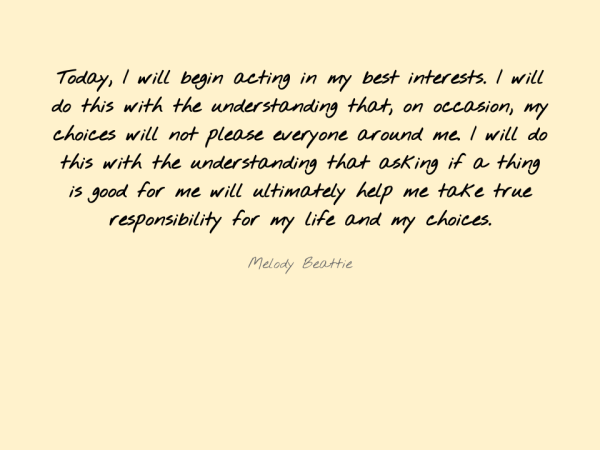
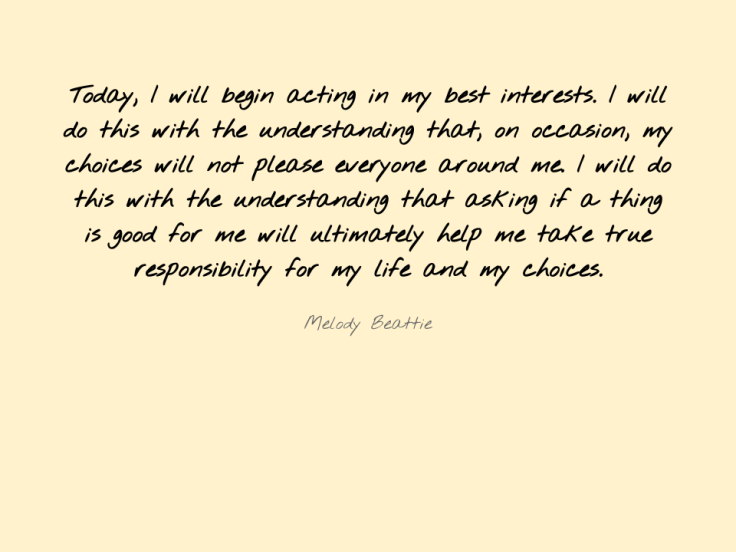
Today, I will begin acting in my best interests. I will do this with the understanding that, on occasion, my choices will not please everyone around me. I will do this with the understanding that asking if a thing is good for me will ultimately help me take true responsibility for my life and my choices.” via Just For Today Meditations – Daily Recovery Readings – September 14, 2012.

Self approval


Melody Beattie writes:

Most of us want to be liked. We want other people to think of us as nice, friendly, kind, and loving. Most of us want the approval of others.

Since childhood, some of us have been trying to get approval, trying to get people to like us and think highly of us. We may be afraid people will leave us if they disapprove of our actions. We may look for approval from people who have none to give. We may not know that we’re lovable now and can learn to approve of ourselves.

In order to live happily, to live consistently with the way our Higher Power wants us to live, and to tap into a way of life that is in harmony with the universe, we need to let go of our extreme need for approval. These unmet needs for approval and love from our past give others control over us today. These needs can prevent us from acting in our best interest and being true to ourselves.

We can approve of ourselves. In the end, that’s the only approval that counts.

Today, I will let go of my need for approval and my need to be liked. I will replace them with a need to like and approve of myself. I will enjoy the surprise I find when I do this. The people who count, including myself, will respect me when I am true to myself.” via Just For Today Meditations – Daily Recovery Reading – September 10, 2012.


The lesson may be a test

Sometimes, problems and challenges come to move us to the next place in our lives. Sometimes, they come to challenge and reinforce what we already know and believe.

Maybe that problem in your life has come along to teach you something new.

Maybe it’s an opportunity to remember and practice what you already know to be true.

Push against the problem. Push your ideals and beliefs against what’s going on. Examine what you think, believe, and feel. Stay open to change. But remember that, sometimes, it’s not about changing what you believe. It’s an opportunity for you to validate yourself and your beliefs.

We’re not always learning something new. Sometimes, the lesson is to remember and trust what we already know.

God, help me to be open to change, help me also to stand fast by my beliefs when they are right.” via Just For Today Meditations » Blog.

Discover what works for YOU

http://www.amazon.com/gp/product/B0030UDW9I/ref=as_li_ss_tl?ie=UTF8&camp=1789&creative=390957&creativeASIN=B0030UDW9I&linkCode=as2&tag=makrai-20More Melody Beattie!

“Enroll in this weight loss program and you’ll lose thirty pounds in five days!” “Come to this free seminar and after spending one hundred dollars on books you’ll be a millionaire!”

There is no quick fix, no panacea that will work for every person. Success rarely happens overnight or in five days. Even the Twelve Steps are only suggestions. Although proven to work, the details and decisions about how we apply those Steps in our lives are left to each one of us.

And few things happen overnight, except the beginning of a new day.

Listen to your mentors. Examine what’s been tried and true, and has worked and helped countless others along their paths. The Twelve Steps are one of those approaches. But don’t be taken in by false claims of overnight success and instant enlightenment along your path.

True change takes time and effort, especially when we’re changing and tackling big issues. We can often get exactly the help we need at times from a therapist, book, or seminar– the best things in life really are free and available to each one of us. The Twelve Steps, again, qualify in this area.

Discover what works for you.

Trust that you’ll be guided along your path and receive exactly the help and guidance you need. Then give it time.

There really isn’t an easier, softer way.

God, give me permission to tackle my problems.” via Just For Today Meditations – Daily Recovery Readings – September 9, 2012.

YOU Are Responsible for Your Happiness

Español: Paulo Coelho

Silvia Mordini wrote:

Only you are responsible for your Happiness ROI. And no matter what challenges you face, you can always choose to assume the best. As Paulo Coelho reminds us in The Alchemist, “The secret of life is to fall seven times and to get up eight times.” Just try it for a week: assume the best, and feel the abundance of joy that comes as a result of seeing more. Love yourself, love your day, love your life! “We will only understand the miracle of life fully when we allow the unexpected to happen. Every day, God gives us the sun — and also one moment in which we have the ability to change everything that makes us unhappy. Every day, we try to pretend that we havent perceived that moment, that it doesnt exist — that today is the same as yesterday and will be the same as tomorrow. But if people really pay attention to their everyday lives, they will discover that magic moment. It may arrive in the instant when we are doing something mundane, like putting our front-door key in the lock; it may lie hidden in the quiet that follows the lunch hour or in the thousand and one things that all seem the same to us. But that moment exists–a moment when all the power of the stars becomes a part of us and enables us to perform miracles.”  – Paulo Coelho in By The River Piedra I Sat Down and Wept” via YOU Are Responsible for Your Happiness.

See it Simple


God, if I’m complicating a task or making it too big and unmanage­able in my mind, help me to simplify what I see.

Melody Beattie writes:

“It’s too much,” I said to my instructor. “Jumping out of a plane is too much for my mind to comprehend.”

“Then keep it simple,” he said. “Break it down into parts. You have the ride up, where you practice relaxing, your exit, your free-fall time; then you deploy your parachute. Then you decide if it’s working or if you need to go to plan B. Next set up your landing pattern. When you get near the ground, pull your strings and flare.”

I could handle the steps, but the big picture of jumping out of an airplane was too much to envision. But exiting, falling stable, pulling, and flaring were simple parts that felt man­ageable. My mind could comprehend these simple tasks.

You may never make a skydive. Or maybe you will. But there’s a lot of things in life that seem like too much if we try to see them all as one big thing. I never thought I could stay sober and drug-free for twenty-seven years. But with God’s help and the help of the program, I believed I could refrain from using drugs and alcohol for twenty-four hours. Then the next day, I got up and believed the same thing again.

There have been times I didn’t think I could start my life over. But I could get up in the morning and do the things I thought best for that day.

Are you facing something now in your life that feels too overwhelming? Then simplify it. Break it down into manage­able parts until you can see how simple it is.

God, if I’m complicating a task or making it too big and unmanage­able in my mind, help me to simplify what I see.” via September 5: See it Simple.

In The End


Live Life Quotes, Love Life Quotes, Live Life Happy

via In The End.


The Things We Think About


Live Life Quotes, Love Life Quotes, Live Life Happy

via The Things We Think About.


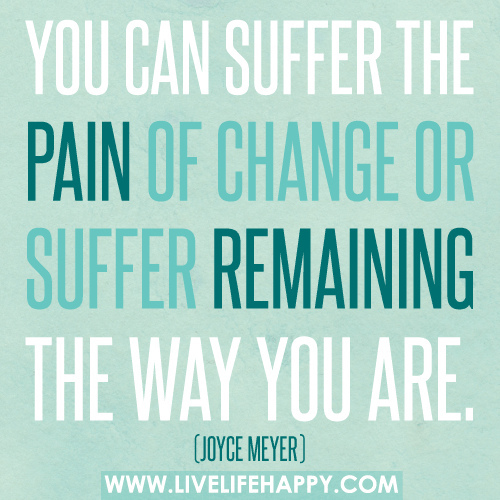
You Can Suffer The Pain, or…

Live Life Quotes, Love Life Quotes, Live Life Happy

via You Can Suffer The Pain.

Celebrate

Melody Beattie writes:

Take time to celebrate.

Celebrate your successes, your growth, your accomplish­ments. Celebrate you and who you are.

For too long you have been too hard on yourself. Others have spilled their negative energy — their attitudes, beliefs, pain — on you. It had nothing to do with you! All along, you have been a gift to yourself and to the Universe.

You are a child of God. Beautiful, a delight, a joy. You do not have to try harder, be better, be perfect, or be anything you are not. Your beauty is in you, just as you are each moment.

Celebrate that.

When you have a success, when you accomplish something, enjoy it. Pause, reflect, rejoice. Too long you have listened to admonitions not to feel good about what you have done, lest you travel the downward road to arrogance.

Celebration is a high form of praise, of gratitude to the Creator for the beauty of God’s creation. To enjoy and celebrate the good does not mean that it will be taken from you. To celebrate is to delight in the gift, to show gratitude.

Celebrate your relationships! Celebrate the lessons from the past and the love and warmth that is there today. Enjoy the beauty of others and their connection to you.

Celebrate all that is in your life. Celebrate all that is good. Celebrate you!

Today, I will indulge in the joy of celebrating.” via August 26: Celebrate | Language of Letting Go.

Self care

Melody Beattie writes:

“When will we become lovable?  When will we feel safe?  When will we get all the protection, nurturing, and love we so richly deserve?  We will get it when we begin giving it to ourselves.”Beyond Codependency

The idea of giving ourselves what we want and need can be confusing, especially if we have spent many years not knowing that it’s okay to take care of ourselves.  Taking our energy and focus off others and their responsibilities and placing that energy onto ourselves and our responsibilities is a recovery behavior that can be acquired.  We learn it by daily practice.

We begin by relaxing, by breathing deeply, and letting go of our fears enough to feel as peaceful as we can.  Then, we ask ourselves:  What do I need to do to take care of myself today, or for this moment?

What do I need and want to do? What would demonstrate love and self-responsibility?

Am I caught up in the belief that others are responsible for making me happy, responsible for me?  Then the first thing I need to do is correct my belief system.  I am responsible for myself.

Do I feel anxious and concerned about a responsibility I’ve been neglecting?  Then perhaps I need to let go of my fears and tend to that responsibility.

Do I feel overwhelmed, out of control?  Maybe I need to journey back to the first of the Twelve Steps.

Have I been working too hard?  Maybe what I need to do is take some time off and do something fun.

Have I been neglecting my work or daily tasks?  Then maybe what I need to do is get back to my routine.

There is no recipe, no formula, no guidebook for self-care.  We each have a guide, and that guide is within us.  We need to ask the question:  What do I need to do to take living responsible care of myself?  Then, we need to listen to the answer.  Self-care is not that difficult.  The most challenging part is trusting the answer, and having the courage to follow.

Today, I will focus on taking care of myself.  I will trust myself and God to guide me in this process.” via Blog Archives – help and hope ministry.

Asking for What We Need


Melody Beattie writes:

Decide what it is you want and need, and then go to the person you need it from and ask for it.

Sometimes, it takes hard work and much energy to get what we want and need. We have to go through the pains of identifying what we want, then struggle to believe that we deserve it. Then, we may have to experience the disappointment of asking someone, having the person refuse us, and figuring out what to do next.

Sometimes in life, getting what we want and need is not so difficult. Sometimes, all we need to do is ask.

We can go to another person, or our Higher Power, and ask for what we need.

But because of how difficult it can be, at times, to get what we want and need, we may get trapped in the mind set of believing it will always be that difficult. Sometimes, not wanting to go through the hassle, dreading the struggle, or out of fear, we may make getting what we want and need much more difficult than it needs to be.

We may get angry before we ask, deciding that we’ll never get what we want, or anticipating the “fight” we’ll have to endure. By the time we talk to someone about what we want, we may be so angry that we’re demanding, not asking; thus our anger triggers a power play that didn’t exist except in our mind.

Or we may get so worked up that we don’t ask–or we waste far more energy than necessary fighting with ourselves, only to find out that the other person, or our Higher Power, is happy to give us what we want.

Sometimes, we have to fight and work and wait for what we want and need. Sometimes, we can get it just by asking or stating that this is what we want. Ask. If the answer is no, or not what we want, then we can decide what to do next.

Today, I will not set up a difficult situation that doesn’t exist with other people, or my Higher Power, about getting what I want and need. If there is something I need from someone, I will ask first, before I struggle.” via Just For Today Meditations » Blog.


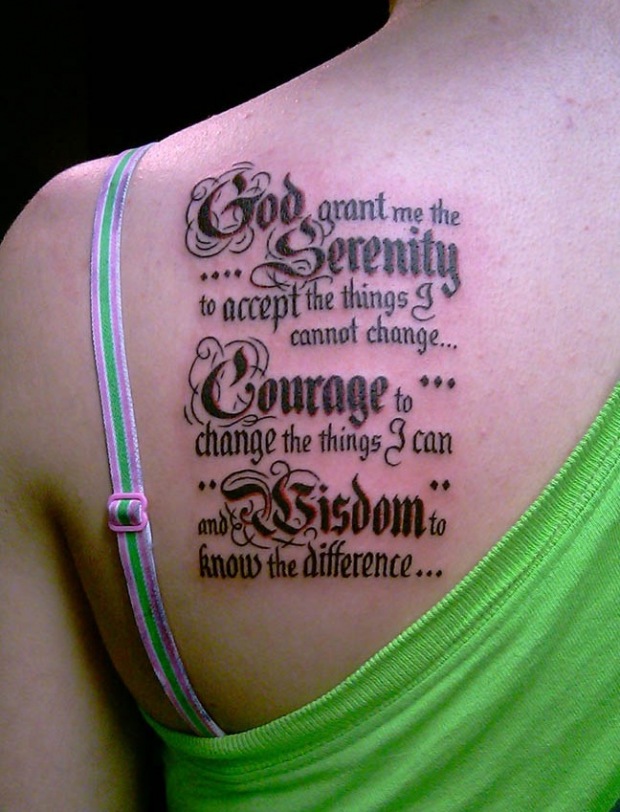
The Serenity Prayer

let’s talk about tattooing the serenity prayer on yourself « Stamp Tramps.

Inspired? Want more tattoo ideas? Click here

Letting Go

Melody Beattie writes:

“For those of us who have survived by controlling and surrendering, letting go may not come easily.” Beyond Codependency

In recovery, we learn that it is important to identify what we want and need. Where does this concept leave us? With a large but clearly identified package of currently unmet wants and needs. We’ve taken the risk to stop denying and to start accepting what we want and need. The problem is, the want or need hangs there, unmet.

This can be a frustrating, painful, annoying, and sometimes obsession-producing place to be.

After identifying our needs, there is a next step in getting our wants and needs met. This step is one of the spiritual ironies of recovery. The next step is letting go of our wants and needs after we have taken painstaking steps to identify them.

We let them go, we give them up – on a mental, emotional, spiritual, and physical level. Sometimes, this means we need to give up. It is not always easy to get to this place, but this is usually where we need to go.

How often I have denied a want or need, then gone through the steps to identify my needs, only to become annoyed, frustrated, and challenged because I don’t have what I want and don’t know how to get it. If I then embark on a plan to control or influence getting that want or need met, I usually make things worse. Searching, trying to control the process, does not work. I must, I have learned to my dismay, let go.

Sometimes, I even have to go to the point of saying, “I don’t want it. I realize it’s important to me, but I cannot control obtaining that in my life. Now, I don’t care anymore if I have it or not. In fact, I’m going to be absolutely happy without it and without any hope of getting it, because hoping to get it is making me nuts – the more I hope and try to get it, the more frustrated I feel because I’m not getting it.”

I don’t know why the process works this way.

I know only that this is how the process works for me. I have found no way around the concept of letting go.

We often can have what we really want and need, or something better. Letting go is part of what we do to get it.

Today, I will strive to let go of those wants and needs that are causing me frustration. I will enter them on my goal list, then struggle to let go. I will trust God to bring me the desires of my heart, in God’s time and in God’s way.” via Just For Today Meditations » Blog.

Letting Go


Melody Beattie writes:

Stop trying so hard to control things. It is not our job to control people, outcomes, circumstances, and life. Maybe in the past we couldn’t trust and let things happen. But we can now. The way life is unfolding is good. Let it unfold.

Stop trying so hard to do better, be better, and be more. Who we are and the way we do things is good enough for today.

Who we were and the way we did things yesterday was good enough for that day.

Ease up on ourselves. Let go. Stop trying so hard.

Today, I will let go. I will stop trying to control everything. I will stop trying to make myself be and do better, and I will let myself be.” via Just For Today Meditations » Blog.


As A Flower To The Sun

Curated from Steve McSwain @ Mindful Living on Huffingtonpost.com who writes:
2012-07-24-flowersinsun.jpg

Benjamin Whichcote said, “The human soul is to God as a flower is to the sun; it opens at its approach; it shuts when it withdraws.”

Today, I will approach the sun; I will open to all that is divine. And the approach? Well, it’s just a simple acknowledgement, perhaps a thought, the awareness of desire, attention to a tiny inclination. It’s like magic really. There is no effort whatsoever.

It was Jesus who purportedly said, “Look at the flowers of the field … they neither toil nor spin … and yet, your heavenly father sees them … knows them” (Matthew 6).

No flower ever struggled to open to the sun. It simply turns and looks — and then, it freely shares its color and fragrance with the world.

How beautiful. I think I’ll be the same. Why must I make knowing God into a struggle? Why would I allow the religion within which I was raised continue to hound me inside my head with a catalogue of reminders of what I must do in order to be? No, instead, I’ll lay aside that narrow conditioning and just do nothing but be. I feel such freedom when I’m doing less and being more — more of who I am: a beautiful human flower, simply and effortlessly, opening to the sun.

Ah, that’s it for me. Which reminds me of something Thomas Merton once whispered: “As soon as a person” — that’s me and perhaps you, too — “As soon as a person is inclined to be with God” — as I am and, again, perhaps you are, too — “As soon as a person is inclined to be with God, they are … no matter where they are … in the monastery, in the city, in the woods.”

“Furthermore,” he continued, “Just when it would seem as if he (or, she) is in the middle of his journey” — and, for me, that’s like, most of the time — “Know this: he has actually arrived at his destination already.”

Already? You mean, I’m there now? In the sun? That this thought of God, this inclination for God that I feel from time to time, that’s all it takes and I’m in full bloom already?

Wow! What a Divine thought! Thank you Thomas. Thank you Whichcote. How could I not thank you? Whisper more, my friends. And do so often, this and every day. I’ll be listening for your reminders.

Will you, too? Yes, you, reading this. Can you lay aside the need to judge, to critique, to complain, to express your disapproval and so, temporarily suspend the insatiable need to evaluate the world — to fix, as if you could, what’s wrong with it? Can you release, at least for now, the impulsive need to see who’s reading what you’ve written, commenting on what you’ve labored over? Can you stop doing long enough to simply be? To look? To listen? To blossom?

I have to remind myself of this often, driven as I am to produce, to please, to proclaim, to complain, to impress, to make certain I’m heard, read and, mostly, admired by somebody — anybody. Even a critic and his criticism is better than nothing.

Today, however, I intend to do nothing. Instead, I plan to listen, to observe, to be open to perspectives other than my own, to watch for the divine reminders. They’re everywhere. But they usually come as whispers and are easily missed.

The same is true for you. Know that the sun is shining and you, my friend, are blossoming into Life itself. You are the color on the canvas of creation that creates what’s beautiful about this world. You are the fragrance that makes all things better. You are the flower that blooms and, in the end, what else could possibly matter more?” via Steve McSwain: As A Flower To The Sun”
Get Back Into Harmony With YOU!

Cover of "As a Man Thinketh (Family Inspi...

“Good thoughts and actions can never produce bad results; bad thoughts and actions can never produce good results. This is but saying that nothing can come from corn but corn, nothing from nettles but nettles. Men understand this law in the natural world, and work with it, but few understand it in the mental and moral world, and they, therefore; do not cooperate with it. Suffering is always the effect of wrong thought in some direction. It is an indication that the individual is out of harmony with himself, with the Law of his being. The sole and supreme use of suffering is to purify, to burn out all that is useless and impure.”

– James Allen, page 9 from his book “As A Man Thinketh”. Allen was a philosophical writer of British nationality known for his inspirational books and poetry.” via Today’s Quotes: Get Back Into Harmony With YOU!.

“Yes” Doesn’t Count if you can’t say “No” – Why Clear Boundaries are Important in Intimate Relationships

English: A young woman and man embracing while...

I found this over at Psychology Today:

Most people think of an ideal romantic relationship as a union of two inseparable beings forged into one heart, one mind, and one dream. If either partner has a conflicting desire, he or she too often does not express it. They consciously or unconsciously choose to protect the fantasy of perfect compatibility, but may not realize the limitations that are wedded to that decision.
Eventual conflicts are not as noticeable early when relationships are new. The joy of new discovery and lustful connection often eclipse any disagreements that might arise. Newly-in-love partners too often do not want to know anything about each other that could threaten the perfection they cherish. Both may choose to leave well enough alone even if the result is incomplete or inauthentic communication. In the void of unexpressed conflicts, the partners often want to maintain the illusion of a perfect match.

“He finishes my sentences before I even know what I’m going to say.”

“She anticipates what I want before I tell her.”

“We agree on everything. It’s amazing.”

“It’s so easy to be together. We love all the same things.”

Sadly, those constructed realities of perfect compatibility cannot sustain over time. People cannot feel genuinely loved if their partners are not aware of the other’s core feelings and desires. They can only keep renewing their love if they can face their conflicts openly and work through them.

That requires that both partners are willing to follow these six principles:

They are able to say what they need from their partners

They know what they are able to offer

They honestly share those thoughts and feelings

They listen to their partner’s needs without becoming defensive

They have or are willing to learn the skills to negotiate their differences

They respect each other’s conflicting desires

To make these principles work, partners must be clear from the beginning of their relationship to set clear boundaries that they both agree to honor. Boundaries are like the borders between countries. They can be barriers to communication and cooperation, or viable interfaces for exchanging ideas and resources.

When beautifully used in intimate relationships, they are symbolic lines of demarcation that help partners understand their differences while they seek whatever ways are necessary to authentically connect. Only the acceptance of those known similarities and differences can keep partners truly validating their mutual needs.

Healthy boundaries should be fluid and openly susceptible to changes by either partner during any time in their relationship. They hopefully know or are willing to learn what is personally important to them and make every effort to share those thoughts with each other. By working together over time, they learn to quickly recognize when they are in agreement, when they need to negotiate, and when they must turn down a request that could destroy their personal integrity.” Get more here: “Yes” Doesn’t Count if you can’t say “No” – Why Clear Boundaries are Important in Intimate Relationships | Psychology Today.

The Grass Is Greener Somewhere Else . . . NOT!

Tony Meindl shares some great insight here:

The grass is greener syndrome.

If you suffer from it, it’s yet another way of postponing your life. Putting the things you desire on the back burner. When we covet another person’s journey, we think if only we had what they had, our life would be more fun. Or more exciting. Or more magical.

Your life already is magical.

We’re just not awake to it, so it feels as if we’re moving around in a monochromatic haze while everyone else seems to be living in Technicolor.

That’s the illusion.

The truth is that your grass is very green. It’s lush and tropical and exotic and fertile and full of possibilities. But it requires you to fully embrace it. All of it. Even the stuff you don’t like, because actually, that’s the stuff that becomes the catalyst for change.

That stuff is your grass’s fertilizer. It’s the essential stuff needed for your growth and expansion. And it holds the potential to unlock the doors you’ve shut to the things you’re seeking:  your joy, your passion, your peace of mind, your self-acceptance.

We can never get to where we’d like to be except by starting in the place we’re currently residing – emotionally, psychologically, spiritually. There’s no escaping you.

Wherever you are, there you are.

We can move to another city, or get another girlfriend or change jobs, but the common denominator in all these experiences is you.

So if you don’t like where you are, then change who you are. But don’t think that being somewhere else, or having a different lover or having a career like someone else is the answer.

The transformation occurs from the inside out. Not the outside in.

Start with your stuff. And watch how green your grass will grow.

Source: The Grass Is Greener Somewhere Else . . . NOT!

I’ve always heard that the grass is greener where you water it! Take care of your own lawn today…

Jeremiah 17:5-10

Cover for a NIV Bible

Trust in your higher power, not in the people around you!

5 This is what the Lord says:

“Cursed is the one who trusts in man,

who draws strength from mere flesh

and whose heart turns away from the Lord.

6 That person will be like a bush in the wastelands;

they will not see prosperity when it comes.

They will dwell in the parched places of the desert,

in a salt land where no one lives.

7 “But blessed is the one who trusts in the Lord,

whose confidence is in him.

8 They will be like a tree planted by the water

that sends out its roots by the stream.

It does not fear when heat comes;

its leaves are always green.

It has no worries in a year of drought

and never fails to bear fruit.”

9 The heart is deceitful above all things

and beyond cure.

Who can understand it?

10 “I the Lord search the heart

and examine the mind,

to reward each person according to their conduct,

according to what their deeds deserve.” via Jeremiah 17 NIV | YouVersion.

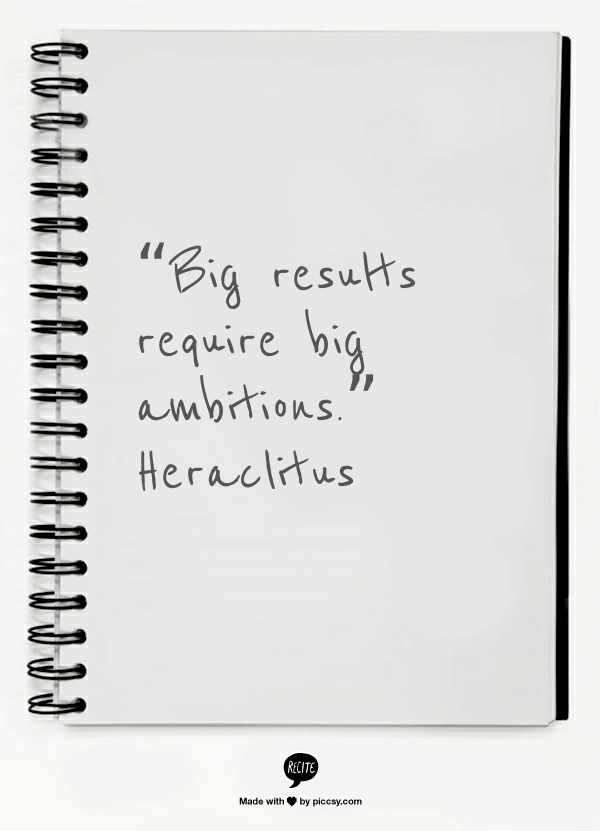
Big results require big ambitions

BrainyQuote via Big results require big ambitions.  – Heraclitus.

Start a Blog at WordPress.com.

Up ↑