recite-13571-359909591-17ah4zh

A forgiving heart…

Tara Brach writes:

Self-aggression, whether it’s low key blame or deep condemnation, prevents us from intimacy with others and discovering the truth and wholeness of our Being. This talk explores how we can release self-blame, and free ourselves to access our natural warmth and creativity in responding to our world.

Why ALL are equal in front of the law & an apology from one Christian

I find this post from Mastin Kipp thought provoking:

BUT, as a lover of Jesus, it breaks my heart to see so many “Christians” hate so many people. I believe to be a Christian simply means to try your best to be Christ-like, and all that means is to be as LOVING as possible. I have a tattoo of a cross on my left arm and it says on it only two words, “Be Love”. It’s my constant reminder that no matter what path we walk in the world, Love is always the bottom line. And Love has many different forms.

I believe that there is no stopping an idea whose time has come, and the time for marriage equality has come.

Jesus didn’t say, “Love the sinner, hate the sin” – he simply said above all else, “Love your neighbor as yourself.” So on behalf of all Christians, please accept my apology if any of us have made you feel hated, judged or criticized for who you were born to be – be it gay, straight or anything else.

You were made perfectly. You are perfect. And as so many stand in judgment, perhaps you could give them a little dose of Jesus and simply utter the prayer “Forgive them Father, they know not what they do.”

Go to the source of this quote to read his entire post: Why ALL are equal in front of the law & an apology from one Christian.

Mastin Kipp
Continue reading “Why ALL are equal in front of the law & an apology from one Christian”

Why Forgiveness Doesn’t Work and How to Change That

“Forgiveness does not change the past, but it does enlarge the future.” ~Paul Boese

Get the answer here: Why Forgiveness Doesn’t Work and How to Change That | Tiny Buddha.

Revenge

Melody Beattie writes:

No matter how long we’ve been recovering, no matter how solid our spiritual ground, we may still feel an overwhelming desire at times to punish, or get even, with another person.

We want revenge.

We want to see the other person hurt the way he or she has hurt us. We want to see life deal that person just rewards. In fact, we would like to help life out.

Those are normal feelings, but we do not have to act on them. These feelings are part of our anger but it’s not our job to deal justice.

We can allow ourselves to feel the anger. It is helpful to go one step deeper and let ourselves feel the other feelings – the hurt, the pain, the anguish. But our goal is to release the feelings, and be finished with them.

We can hold the other person accountable. We can hold the other person responsible. But it is not our responsibility to be judge and jury. Actively seeking revenge will not help us. It will block us and hold us back.

Walk away. Stop playing the game. Unhook. Learn your lesson. Thank the other person for having taught you something valuable. And be finished with it. Put it behind, with the lesson intact.

Acceptance helps. So does forgiveness – not the kind that invites that person to use us again, but a forgiveness that releases the other person and sets him or her free to walk a separate path, while releasing our anger and resentments. That sets us free to walk our own path.

Today, I will be as angry as I need to be, with a goal of finishing my business with others. Once I have released my hurt and anger, I will strive for healthy forgiveness – forgiveness with boundaries. I understand that boundaries, coupled with forgiveness and compassion, will move me forward.” via Just For Today Meditations – Daily Recovery Readings – September 16, 2012.

Top Ten Rules for Being Human

Mastin Kipp writes:

Rule One – You will receive a body. Whether you love it or hate it, it’s yours for life, so accept it. What counts is what’s inside.

Rule Two – You will be presented with lessons. Life is a constant learning experience, which every day provides opportunities for you to learn more. These lessons are specific to you, and learning them ‘is the key to discovering and fulfilling the meaning and relevance of your own life’.

Rule Three – There are no mistakes, only lessons. Your development towards wisdom is a process of experimentation, trial and error, so it’s inevitable things will not always go to plan or turn out how you’d want. Compassion is the remedy for harsh judgment – of ourselves and others. Forgiveness is not only divine – it’s also ‘the act of erasing an emotional debt’. Behaving ethically, with integrity, and with humour – especially the ability to laugh at yourself and your own mishaps – are central to the perspective that ‘mistakes’ are simply lessons we must learn.

Rule Four – The lesson is repeated until learned. Lessons repeat until learned. What manifest as problems and challenges, irritations and frustrations are more lessons – they will repeat until you see them as such and learn from them. Your own awareness and your ability to change are requisites of executing this rule. Also fundamental is the acceptance that you are not a victim of fate or circumstance – ‘causality’ must be acknowledged; that is to say: things happen to you because of how you are and what you do. To blame anyone or anything else for your misfortunes is an escape and a denial; you yourself are responsible for you, and what happens to you. Patience is required – change doesn’t happen overnight, so give change time to happen.

Rule Five – Learning does not end. While you are alive there are always lessons to be learned. Surrender to the ‘rhythm of life’, don’t struggle against it. Commit to the process of constant learning and change – be humble enough to always acknowledge your own weaknesses, and be flexible enough to adapt from what you may be accustomed to, because rigidity will deny you the freedom of new possibilities.

Rule Six – “There” is no better than “here”. The other side of the hill may be greener than your own, but being there is not the key to endless happiness. Be grateful for and enjoy what you have, and where you are on your journey. Appreciate the abundance of what’s good in your life, rather than measure and amass things that do not actually lead to happiness. Living in the present helps you attain peace.

Rule Seven – Others are only mirrors of you. You love or hate something about another person according to what love or hate about yourself. Be tolerant; accept others as they are, and strive for clarity of self-awareness; strive to truly understand and have an objective perception of your own self, your thoughts and feelings. Negative experiences are opportunities to heal the wounds that you carry. Support others, and by doing so you support yourself. Where you are unable to support others it is a sign that you are not adequately attending to your own needs.

Rule Eight – What you make of your life is up to you. You have all the tools and resources you need. What you do with them is up to you. Take responsibility for yourself. Learn to let go when you cannot change things. Don’t get angry about things – bitter memories clutter your mind. Courage resides in all of us – use it when you need to do what’s right for you. We all possess a strong natural power and adventurous spirit, which you should draw on to embrace what lies ahead.

Rule Nine – Your answers lie inside of you. Trust your instincts and your innermost feelings, whether you hear them as a little voice or a flash of inspiration. Listen to feelings as well as sounds. Look, listen, and trust. Draw on your natural inspiration.

Rule Ten – You will forget all this at birth. We are all born with all of these capabilities – our early experiences lead us into a physical world, away from our spiritual selves, so that we become doubtful, cynical and lacking belief and confidence. The ten Rules are not commandments, they are universal truths that apply to us all. When you lose your way, call upon them. Have faith in the strength of your spirit. Aspire to be wise – wisdom the ultimate path of your life, and it knows no limits other than those you impose on yourself.” via Today’s Quotes: RULES for being HUMAN!.

Powerlessness & Unmanageability

Melody Beattie writes:

Willpower is not the key to the way of life we are seeking. Surrender is.

“I have spent much of my life trying to make people be, do, or feel something they aren’t, don’t want to do, and choose not to feel. I have made them, and myself, crazy in that process,” said one recovering woman.

I spent my childhood trying to make an alcoholic father who didn’t love himself be a normal person who loved me. I then married an alcoholic and spent a decade trying to make him stop drinking.

I have spent years trying to make emotionally unavailable people be emotionally present for me. I have spent even more years trying to make family members, who are content feeling miserable, happy.

What I’m saying is this: I’ve spent much of my life desperately and vainly trying to do the impossible and feeling like a failure when I couldn’t. It’s been like planting corn and trying to make the seeds grow peas. Won’t work!

By surrendering to powerlessness, I gain the presence of mind to stop wasting my time and energy trying to change and control that which I cannot change and control. It gives me permission to stop trying to do the impossible and focus on what is possible: being who I am, loving myself, feeling what I feel, and doing what I want to do with my life.

In recovery, we learn to stop fighting lions, simply because we cannot win. We also learn that the more we are focused on controlling and changing others, the more unmanageable our life becomes. The more we focus on living our own life, the more we have a life to live, and the more manageable our life will become.

Today, I will accept powerlessness where I have no power to change things, and I’ll allow my life to become manageable.” via Daily Meditation ~ Powerlessness & Unmanageability – Miracles In Progress Codependents Anonymous Group.

Today, I am thinking about how to apply this to my in-laws…

My mother in law will never love me like a son and my sibling in laws will never treat me like a brother. Three years ago during the ‘summer of forgiveness’, I made amends and was forgiven and yet I remain in their ‘penalty box‘. I refuse to let myself in an close the lid on top of me. I refuse to play a role in their drama. If I’m not going to get what I need it’s not worth the work…

Rebuilding Trust After Being Hurt

Letting Go

“When mistrust comes in, love goes out.” ~Irish saying.

An old friend of mine felt betrayed by her boyfriend, but chose not to leave him. Instead, she made him pay for it over and over again.

Through subtle digs and less subtle slights, she repeatedly expressed that she felt contempt for him. But instead of forgiving or walking away, she stayed behind a wall of resentment.

Soon he started responding in kind, until their relationship became a container for mutual silent bitterness. It was two people sharing a suffocating space, overwhelmed by the weight of everything they didn’t say.

I suspect many of us can relate to that feeling of clinging to a grievance. In at least one of our relationships, we’ve felt angry and indignant, and despite wanting to forgive, we just couldn’t.

I know I’ve been there before.

It’s not easy to forget when someone breaks your trust, especially if you fear it might be broken again, but holding onto doubt is a surefire way to suffer.

Little hurts worse than the suspicion that someone else might hurt you.

This isn’t the kind of thing you can just brush off through positive thinking. You can’t make yourself feel trusting by telling yourself you should be, or rationalizing away your feelings.

The reality is it takes time and effort to trust again. It takes the courage to acknowledge how you feel and willingness from the other person to hear and honor it. It takes a mutual commitment to move beyond what happened instead of reliving and rehashing.

But most importantly, it requires you to believe in the goodness of the person who hurt you.

You have to believe someone can treat you with respect and consideration—even if it takes you a while to get there—or else you’ll never let your guard down. That’s a painful place to be.

The thing about being defensive is that everything becomes a battle, and no one ever wins.

Of course this doesn’t mean we can ever know for certain that someone won’t hurt us again. The only way we can know if we’re able to trust someone is by first giving them trust.

That means we need to ask ourselves: Is this relationship worth that risk?

Is it worth feeling vulnerable?

Is it worth letting go of the story?

And if it’s worth it, what would it look like to give trust, starting right now?

via Tiny Wisdom: Rebuilding Trust After Being Hurt | Tiny Buddha: Wisdom Quotes, Letting Go, Letting Happiness In.

Buddha on gratitude…

English: The moment of revealing four noble tr...“Let us rise up and be thankful, for if we didn’t learn a lot today, at least we learned a little, and if we didn’t learn a little, at least we didn’t get sick, and if we got sick, at least we didn’t die; so, let us all be thankful.”  Buddha. via Buddha on gratitude……..

Who And What Are You Attracting?

I love Kute Blackson’s energy and insights. Today’s is no exception:

You attract to you in life who you are.

The experiences and people of your life are an incredible mirror showing you where you are today in your consciousness.

So you are constantly in relationship with yourself. The real relationship is with aspects of yourself that you attract to you in the physical, in the form of the partner and experiences that are in front of you at any given moment.

Take a moment to look at who and what you are attracting.

Do you like what you see? Are there any repetitive patterns?

To the degree you are willing to be responsible for your current reality and the people you attract is the degree to which you will be free and have the power to change your reality.

You are not a victim…

Regardless of what might have happened in your past or what someone might have done to you.

You have a choice in this moment to choose what your experience of yourself and life will be today. You have a choice as to how you will respond and live your present and future.

Playing victim doesn’t serve you in any way. It just keeps you small and powerless. Who you are is so much more.

Sometimes we hold onto being a victim out of feeling right that we were wronged. Staying stuck in victimhood is simply giving away your power to the person that you have perceived hurt you.

Is it really worth it?

Nothing is worth your freedom.

Nothing.

Life is too short and precious. Every second wasted is a moment you will never get back.

Trust that if any wrong is done to you, it is not your job to “right” it. The Uni-verse will rebalance all actions. You cannot cheat the Uni-verse. When you retaliate with anger, resentment or vindictiveness, you simply end up hurting yourself. And it certainly won’t bring you real joy.

It takes real courage to forgive and let go. It takes real courage to take responsibility for your inner experience, especially when someone has wronged or hurt you.

So how much freedom do you want to experience?

You choose.

Relationship is a great mirror in life.

Many of us want a relationship out there, with a special person, but we’re not even in relationship with ourselves. We want someone out there to give us something, to love us in a certain way, to accept us unconditionally, but we’re not giving that to ourselves.

It has to start with YOU. This is the foundation. This is the key.

In order to attract the right person and relationship into your life you must be the right person with yourself. That’s what you can control. You can’t control others behaviors out there, but you can control taking an honest look at yourself and seeing what the blocks, wounds, insecurities, resentments and fears are inside of you, and releasing them. The more you release, the more in alignment you become with your authentic self, and as a result the more life will reflect this back to you.

As you heal and transform what no longer serves you, you access your innate wholeness. From there, not only will you be able to feel differently within yourself, you will be attracted and attracting differently based on who you have become. No longer seeking to get love from the outside, but living in touch with the love that you are inside.

This is the power you have.

So remember this:

1- Take responsibility for your inner and outer experiences.
2- Learn your lessons from life.
3- Forgive yourself and the others involved.
4- Let go and trust the Uni-verse.
5- Envision your inspired future letting that pull you forward.

You are born to be the best you can be and evolve into the highest expression that your soul is seeking to become in this lifetime.

Focus on what is real, important and brings you more joy.

You are Infinite.

Love. Now.” Source: Who And What Are You Attracting?
…on The Difference Between Forgiving and Forgetting

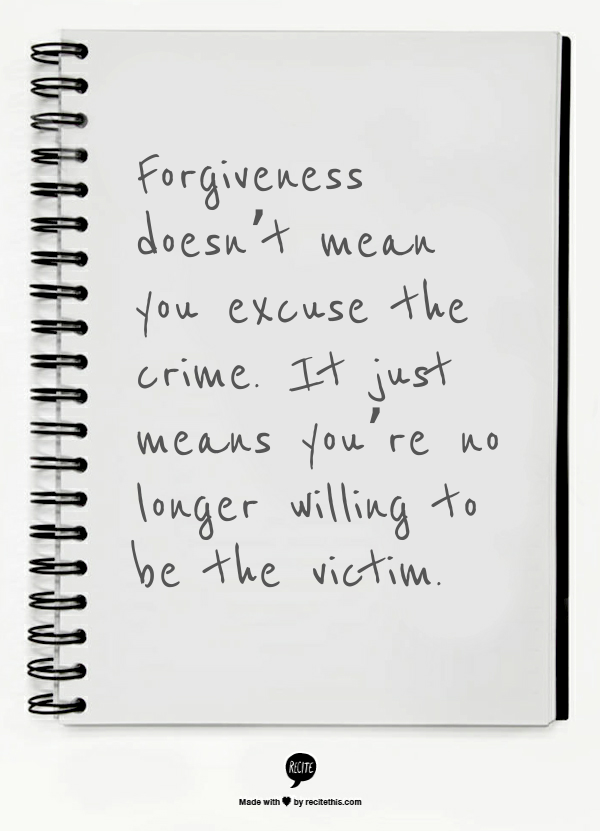
“Some people think it’s holding that makes one strong. Sometimes it’s letting go.” ~ Unknown. Go to the source: The Difference Between Forgiving and Forgetting | Tiny Buddha: Wisdom Quotes, Letting Go, Letting Happiness In.

“Forgiveness”

I don’t care if you don’t like rap music! Listen and read along — this is good stuff…

Here’s How To End Suffering Once And For All

Love On The Rocks...lol

Mastin Kipp of The Daily Love shares this…

I am not saying that painful things in your past didn’t happen, but what I am saying is that they no longer have to be painful. And it’s not as easy as changing your mind once or twice. It takes work, and reps, like in the gym. But if you try and try enough over time, new life and new meaning can emerge.

One of the best ways I know how to do this is to take ourselves out of our own story and step into the thoughts, feelings and beliefs of the person who hurt us. Not so we can make right what they did, but so we can begin to understand the painful event from their point of view.

As I have guided clients through this process, the outcomes have been amazing. Forgiveness on a whole new level of themselves and others. And of VERY traumatic events.

The point of forgiveness is not to make right what happened, but to bring a new sense of empathy and compassion to all involved – this includes you.

The best way to get back at people who have hurt us is to forgive them, because that is how we break the bond over the painful event. And from there, when we step into their shoes of how they must have been thinking and feeling, we begin to understand that their actions were not truly against us, but a request for Love or Significance in a very messed up way; that was the best way that they knew how to at that time.

Source: Here’s How To End Suffering Once And For All!

Go to the source if you’d like the rest of his perspective on the issue…

10 Ways to Ask Your Wife for Forgiveness

Husband And Wife

One thing men are very talented at is getting into trouble – especially when they are husbands. Sometimes we’re thoughtless, sometimes we’re forgetful, sometimes we’re selfish, sometimes we’re downright mean. More often than not we get ourselves in deep water because we are – quite simply – clueless.

Regardless of how we got there, trouble is a place we need to vacate, and fast. We need grace, we need understanding and we need forgiveness.

Forgiveness is a sweet and a beautiful thing. But forgiveness can neither be earned nor demanded – it has to be given, as a gift. However, rather than skulk around in hiding, there are a number of things All Pro Dads can do to facilitate the conditions in which forgiveness might possibly thrive.

It’s important to remember that you’re not so much trying to get out of trouble as you are working to heal the relationship. That’s something that requires self-evaluation and humility. So try these 10 Ways to ask your wife for forgiveness…

Unfortunately, I need this now. Follow the ‘via’ link above along with me to get the 10 ways…

Do You Forgive Yourself?

Rembrandt – “The Return of the Prodigal Son
Image via Wikipedia

We often talk about the importance of forgiveness and resentment release, release resentment, and make peace with what others have hurt us in the past. But what to forgive the person who unwittingly to blame more?

This person is the one you wake up and spend every moment of every day. It is the person most worthy of your love, understanding and forgiveness radical. Obviously, that person is you. Can you forgive?

As sure as you’re alive to read the words on this page, you hurt someone and you have been hurt by someone at some point in their lives. Part of his anger over it can permanently damage inside. It’s barely recognizable, unless you know what you’re looking for. Do you like the sense of wonder, freedom and invincibility fallen by the wayside, replaced by a disguised unforgiveness, fear self-doubt, anxiety, feelings of inadequacy or depression?

If you do not let them get to the last, is the time. There is nothing in the past for you, you can not change what you do. Whatever you want to do something else, let him go. You have the best you can do with what you had, you know and where you were in your life at that time.

You have complete control over how, where, on the effects of this. This is a new day. Do the best you can do. You will not always get it quite right, but that’s okay. Forgive yourself and start again.

That were not put on this earth to make everything perfect at all times in your life. In fact, life is just the opposite. The journey of life is full of unexpected twists and turns and sometimes unpleasant. Too bad and cause problems, to make bad decisions and experience the effects of other bad decisions. But you do not have to do is get stuck. Guilt serves no purpose other than to keep, then release. You live and learn. Forgive those who hurt you, and most importantly, forgive yourself.

Before proceeding with the rest of your day, I encourage you to take a long time now to repeat (5-20 times) my favorite positive affirmation of forgiveness:

I totally and unreservedly apologize to myself.

Use this daily affirmation. Tape to your mirror, your desk or dashboard of your car. Use it as a reminder to live like you’re in this for more than the past.

Your job in life is to recreate yourself and your life story every day, but how to change history if they do not move in the next chapter?

Stop reliving the past and start creating today. My friend … please fully forgive you.

5 Traits of a Good Marriage

Hindu marriage ceremony from a Rajput wedding.
Image via Wikipedia

Drs. Les and Leslie Parrott, say in their book, When Bad Things Happen to Good Marriages, that there are 5 traits of a healthy, life-long marriage: ownership, hope, empathy, forgiveness, and commitment. Here is a summary of each of those characteristics.

1. Ownership: Taking Responsibility

Often, couples believe their problems are the result of the other person’s actions.  It’s easy to avoid responsibility for our problems by blaming someone else.  But in the long-haul, admitting mistakes and owning up to our part of the problem is the single most powerful predictor of turning something bad into something good. Couples need to realize that it’s not who’s wrong, but what’s wrong that counts.

2. Hope:  Believing that Good Ultimately Triumphs

The foundation of hope is belief.  We must believe that the kind of marriage we want is possible.  Hope keeps love alive.  Stop hoping and marriage dies.

3. Empathy:  Walking in your Spouse’s Shoes

A spouse must be aware of what their spouse is feeling and what’s behind that feeling.  Empathy involves both the head and the heart. Many of us do one or the other pretty well; we either feel our partner’s pain with our heart, or we try to solve their problem with our head.  To do both can be a challenge.  But that is what empathy is all about.

4. Forgiveness:  Healing the Wounds

In a good marriage, both husbands and wives are quick to ask for forgiveness and to grant forgiveness. The simple words, “I was wrong. Will you please forgive me?” are magical in marriage. Forgiveness was designed to heal the deepest wounds of a human heart.

5. Commitment: Loving for Life

No matter how long a couple has been married, commitment may be the most effective tool good marriages use in battling bad things. Without commitment and the trust it engenders, marriages would have little hope of lasting.

In the face of difficulty, the key is to stay committed to your spouse and work together. Sit down with your spouse tonight and discuss how you are doing in each of these categories.

As the Apostle Paul said “Not that I have already obtained all this, or have already arrived at my goal, but I press on to take hold of that for which Christ Jesus took hold of me.” I’m struggling with many of these issues right now, trying to do the right thing with my wife despite manipulation from her family. Don’t they realize we have enough drama in our lives without more from their Karpman Drama Triangle?! Apparently not — the problem is that other people are unmanageable and the only thing I can manage is me…

To forgive…

“To forgive is to set a prisoner free and discover that the prisoner was you.”

– Lewis B. Smedes, was a best-selling and renowned Christian author. 

Start a Blog at WordPress.com.

Up ↑