Into the great unknown…

Melody-Beattie.pngMelody Beattie writes:

“When I go into the Unknown. I immediately start making lists,” one man said.

We each respond differently to loss, letting go. and the Unknown. We may try to fill up the vacuum immediately with something else. That usually doesn’t work, at least not well.

Try to he as present as you can for what you’re going through.

Action: Protect yourself. You’re vulnerable now. Do the simple. easy things that need to be done, one task at a time, even if nothing feels completely right. Remember the basics of self-care. Eat. Sleep. Shower. Get plenty of rest. Talk to trusted friends. Express what you’re feeling at the moment the best that you can.

We may vacillate between anger, rage, guilt, and sadness when we’re letting go. And then we may go numb and nor be able to think clearly. Don’t worry about that; your ability to think clearly will return. Don’t do anything that hurts yourself or anyone else. That won’t help. It’ll make things worse. Lists may help us stay on track.

Try not to see the big picture right nom It probably hasn’t been shown to you yet.” via December 3.

Accepting love…

Melody Beattie write:

Many of us have worked too hard to make relationships work; sometimes those relationships didn’t have a chance because the other person was unavailable or refused to participate.

To compensate for the other person’s unavailability, we worked too hard. We may have done all or most of the work. This may mask the situation for a while, but we usually get tired. Then, when we stop doing all the work, we notice there is no relationship, or we’re so tired we don’t care.

Doing all the work in a relationship is not loving, giving, or caring. It is self-defeating and relationship defeating. It creates the illusion of a relationship when in fact there may be no relationship. It enables the other person to be irresponsible for his or her share. Because that does not meet our needs, we ultimately feel victimized.

In our best relationships, we all have temporary periods where one person participates more than the other. This is normal. But as a permanent way of participating in relationships, it leaves us feeling tired, worn out, needy, and angry.’

We can learn to participate a reasonable amount, and then let the relationship find it’s own life. Are we doing all the calling? Are we doing all the initiating? Are we doing all the giving? Are we the one talking about feelings and striving for intimacy?

Are we doing all the waiting, the hoping, and the work?

We can let go. If the relationship is meant to be, it will be, and it will become what it is meant to be. We do not help that process by trying to control it. We do not help the other person, the relationship, or ourselves by trying to force it or by doing all the work.

Let it be. Wait and see. Stop worrying about making it happen. See what happens and strive to understand if that is what you want.

Today, I will stop doing all the work in my relationships. I will give myself and the other person the gift of requiring both people to participate. I will accept the natural level my relationships reach when I do my share and allow the other person to choose what his or her share will be. I can trust my relationships to reach their own level. I do not have to do all the work; I need only do my share.” Source: Just For Today Meditations – Maintaining A Life

Questions? Feedback?

Dreams

Melody Beattie writes:

I want a new home. a great job. and lots of money” one man said.

“What practical steps are you taking to help that happen?” I asked.

“I’m not very good at practical steps,” he said. “But I’m an expert at dreams.”

It’s important to fantasize. but if you want your fantasies to materialize. you have to take practical steps. Turn dreams into achievable written goals.

It takes courage to go for what we want. Giving some­thing our all. then failing, is a risk. Anyone I know who has accomplished anything of value has failed on the road to success.

Challenge: The hardest thing about going for our goals, hopes, and dreams can be fighting off that part of us that says, “What’s the use?” Ordinary people can accomplish extraordinary things when they make a choice to do something, then surrender to God’s Will.” via October 25.

Holding Your Own

Melody Beattie writes:

Trust yourself. Trust what you know.

Sometimes, it is hard to stand in our own truth and trust what we know, especially when others would try to convince us otherwise.

In these cases, others may be dealing with issues of guilt and shame. They may have their own agenda. They may be immersed in denial. They would like us to believe that we do not know what we know; they would like us not to trust ourselves; they would prefer to engage us in their nonsense.

We don’t have to forfeit our truth or our power to others. That is codependency.

Believing lies is dangerous. When we stop trusting our truth, when we repress our instincts, when we tell ourselves there must be something wrong with us for feeling what we feel or believing what we believe, we deal a deadly blow to our self and our health.

When we discount that important part of ourselves that knows what is the truth, we cut ourselves off from our center. We feel crazy. We get into shame, fear, and confusion. We can’t get our bearings when we allow someone to pull the rug from under us.

This does not mean that we are never wrong. But we are not always wrong.

Be open. Stand in our truth. Trust what you know. And refuse to buy into denial, nonsense, bullying, or coercion that would like to take you off course.

Ask to be shown the truth, clearly – not by the person trying to manipulate or convince you, but by yourself, your Higher Power, and the Universe.

Today, I will trust my truth, my instincts, and my ability to ground myself in reality. I will not allow myself to be swayed by bullying, manipulating, games, dishonesty, or people with peculiar agendas.” via Just For Today Meditations – Maintaining A Life.

Revenge

Melody Beattie writes:

No matter how long we’ve been recovering, no matter how solid our spiritual ground, we may still feel an overwhelming desire at times to punish, or get even, with another person.

We want revenge.

We want to see the other person hurt the way he or she has hurt us. We want to see life deal that person just rewards. In fact, we would like to help life out.

Those are normal feelings, but we do not have to act on them. These feelings are part of our anger but it’s not our job to deal justice.

We can allow ourselves to feel the anger. It is helpful to go one step deeper and let ourselves feel the other feelings – the hurt, the pain, the anguish. But our goal is to release the feelings, and be finished with them.

We can hold the other person accountable. We can hold the other person responsible. But it is not our responsibility to be judge and jury. Actively seeking revenge will not help us. It will block us and hold us back.

Walk away. Stop playing the game. Unhook. Learn your lesson. Thank the other person for having taught you something valuable. And be finished with it. Put it behind, with the lesson intact.

Acceptance helps. So does forgiveness – not the kind that invites that person to use us again, but a forgiveness that releases the other person and sets him or her free to walk a separate path, while releasing our anger and resentments. That sets us free to walk our own path.

Today, I will be as angry as I need to be, with a goal of finishing my business with others. Once I have released my hurt and anger, I will strive for healthy forgiveness – forgiveness with boundaries. I understand that boundaries, coupled with forgiveness and compassion, will move me forward.” via Just For Today Meditations – Daily Recovery Readings – September 16, 2012.

Take responsibility for your life and choices

Melody Beattie writes:

When we are soul searching, be it for the smaller or larger decisions we face during the day, we can learn to ask, is this good for me?… Is this what I really want?… Is this what I need?…Does this direction feel right for me?…or am I succumbing to the control and influence that I sometimes allow others to have over me?

It is not unhealthy selfishness to question if something is good for us. That is an old way of thinking. To ask if something is good for us is a healthy behavior, not to be ashamed of, and will probably work out in the other person’s best interests too.

We shall not wander down a selfish path of self-indulgence by asking if a thing is good for us. We shall not stray from God’s intended plan, God’s highest good, by asking if a thing is good for us. By asking ourselves this simple question, we participate in directing our life toward the highest good and purpose; we own our power to hold ourselves in self-esteem.

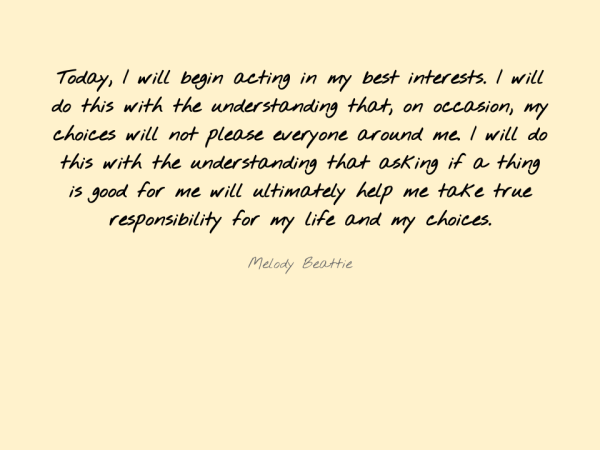
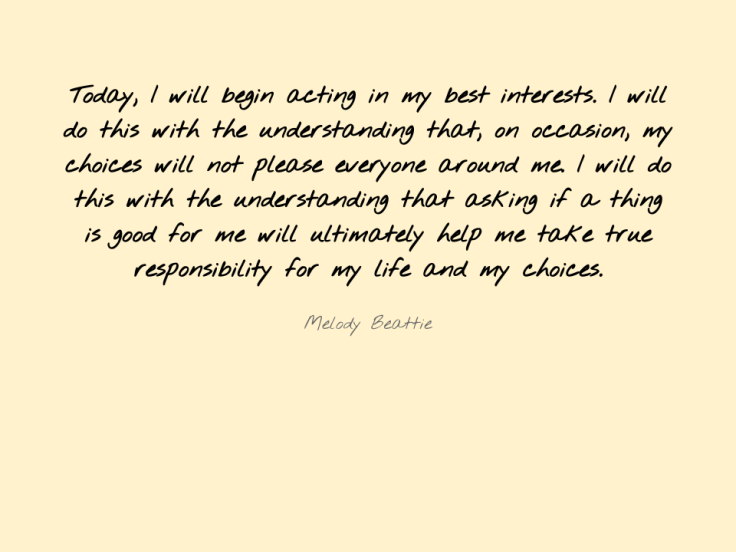
Today, I will begin acting in my best interests. I will do this with the understanding that, on occasion, my choices will not please everyone around me. I will do this with the understanding that asking if a thing is good for me will ultimately help me take true responsibility for my life and my choices.” via Just For Today Meditations – Daily Recovery Readings – September 14, 2012.

Conflict and Detachment

Melody Beattie writes:

In a relationship, there are those wonderful times when things go smoothly for both people, and neither person needs to focus too heavily on the concept of detachment. But there are those challenging times when one person is in crisis or changing – and we need to detach.

Then there are stressful cycles when both people in a relationship are in the midst of dealing with intense issues. Both are needy and neither has anything to give.

These are times when detachment and taking care of ourselves are difficult.

It is helpful, in these moments, to identify the problem. Both people are in the midst of dealing and healing. Neither has much to give, at least at the moment. And both are feeling particularly needy.

That is the problem.

What’s the solution?

There may not be a perfect solution. Detachment is still the key, but that can be difficult when we need support ourselves. In fact, the other person may be asking for support rather than offering it.

We can still work toward detachment. We can still work through our feelings. We can accept this as a temporary cycle in the relationship, and stop looking to the other person for something he or she cannot give at the moment.

We can stop expecting ourselves to give at the moment as well.

Communication helps. Identifying the problem and talking about it without blame or shame is a start. Figuring out alternative support systems, or ways to get our needs met, helps.

We are still responsible for taking care of ourselves – even when we are in the best of relationships. We can reasonably expect conflicts of need and the clashing of issues to occur in the most loving, healthy relationships.

It is one of the cycles of love, friendship, and family.

If it is a healthy relationship, the crisis will not go on endlessly. We will regain our balance. The other person will too. We can stop making ourselves so crazy by looking for the other person to be balanced when he or she isn’t.

Talk things out. Work things out. Keep our expectations of other people, our relationships, and ourselves healthy and reasonable.

A good relationship will be able to sustain and survive low points. Sometimes we need them, so we can both grow and learn separately.

Sometimes, people who are usually there for us cannot be there for us. We can find another way to take care of ourselves.

Today, I will remember that my best relationships have low points. If the low point is the norm, I may want to consider the desirability of the relationship. If the low point is a temporary cycle, I will practice understanding for myself and the other person. God, help me remember that the help and support I want and need does not come in the form of only one person. Help me be open to healthy options for taking care of myself, if any normal support system is not available.” via Just For Today Meditations – Daily Recovery Readings – September 11, 2012.

Self approval


Melody Beattie writes:

Most of us want to be liked. We want other people to think of us as nice, friendly, kind, and loving. Most of us want the approval of others.

Since childhood, some of us have been trying to get approval, trying to get people to like us and think highly of us. We may be afraid people will leave us if they disapprove of our actions. We may look for approval from people who have none to give. We may not know that we’re lovable now and can learn to approve of ourselves.

In order to live happily, to live consistently with the way our Higher Power wants us to live, and to tap into a way of life that is in harmony with the universe, we need to let go of our extreme need for approval. These unmet needs for approval and love from our past give others control over us today. These needs can prevent us from acting in our best interest and being true to ourselves.

We can approve of ourselves. In the end, that’s the only approval that counts.

Today, I will let go of my need for approval and my need to be liked. I will replace them with a need to like and approve of myself. I will enjoy the surprise I find when I do this. The people who count, including myself, will respect me when I am true to myself.” via Just For Today Meditations – Daily Recovery Reading – September 10, 2012.


The lesson may be a test

Sometimes, problems and challenges come to move us to the next place in our lives. Sometimes, they come to challenge and reinforce what we already know and believe.

Maybe that problem in your life has come along to teach you something new.

Maybe it’s an opportunity to remember and practice what you already know to be true.

Push against the problem. Push your ideals and beliefs against what’s going on. Examine what you think, believe, and feel. Stay open to change. But remember that, sometimes, it’s not about changing what you believe. It’s an opportunity for you to validate yourself and your beliefs.

We’re not always learning something new. Sometimes, the lesson is to remember and trust what we already know.

God, help me to be open to change, help me also to stand fast by my beliefs when they are right.” via Just For Today Meditations » Blog.

Asking for What We Need


Melody Beattie writes:

Decide what it is you want and need, and then go to the person you need it from and ask for it.

Sometimes, it takes hard work and much energy to get what we want and need. We have to go through the pains of identifying what we want, then struggle to believe that we deserve it. Then, we may have to experience the disappointment of asking someone, having the person refuse us, and figuring out what to do next.

Sometimes in life, getting what we want and need is not so difficult. Sometimes, all we need to do is ask.

We can go to another person, or our Higher Power, and ask for what we need.

But because of how difficult it can be, at times, to get what we want and need, we may get trapped in the mind set of believing it will always be that difficult. Sometimes, not wanting to go through the hassle, dreading the struggle, or out of fear, we may make getting what we want and need much more difficult than it needs to be.

We may get angry before we ask, deciding that we’ll never get what we want, or anticipating the “fight” we’ll have to endure. By the time we talk to someone about what we want, we may be so angry that we’re demanding, not asking; thus our anger triggers a power play that didn’t exist except in our mind.

Or we may get so worked up that we don’t ask–or we waste far more energy than necessary fighting with ourselves, only to find out that the other person, or our Higher Power, is happy to give us what we want.

Sometimes, we have to fight and work and wait for what we want and need. Sometimes, we can get it just by asking or stating that this is what we want. Ask. If the answer is no, or not what we want, then we can decide what to do next.

Today, I will not set up a difficult situation that doesn’t exist with other people, or my Higher Power, about getting what I want and need. If there is something I need from someone, I will ask first, before I struggle.” via Just For Today Meditations » Blog.


Letting Go

Melody Beattie writes:

“For those of us who have survived by controlling and surrendering, letting go may not come easily.” Beyond Codependency

In recovery, we learn that it is important to identify what we want and need. Where does this concept leave us? With a large but clearly identified package of currently unmet wants and needs. We’ve taken the risk to stop denying and to start accepting what we want and need. The problem is, the want or need hangs there, unmet.

This can be a frustrating, painful, annoying, and sometimes obsession-producing place to be.

After identifying our needs, there is a next step in getting our wants and needs met. This step is one of the spiritual ironies of recovery. The next step is letting go of our wants and needs after we have taken painstaking steps to identify them.

We let them go, we give them up – on a mental, emotional, spiritual, and physical level. Sometimes, this means we need to give up. It is not always easy to get to this place, but this is usually where we need to go.

How often I have denied a want or need, then gone through the steps to identify my needs, only to become annoyed, frustrated, and challenged because I don’t have what I want and don’t know how to get it. If I then embark on a plan to control or influence getting that want or need met, I usually make things worse. Searching, trying to control the process, does not work. I must, I have learned to my dismay, let go.

Sometimes, I even have to go to the point of saying, “I don’t want it. I realize it’s important to me, but I cannot control obtaining that in my life. Now, I don’t care anymore if I have it or not. In fact, I’m going to be absolutely happy without it and without any hope of getting it, because hoping to get it is making me nuts – the more I hope and try to get it, the more frustrated I feel because I’m not getting it.”

I don’t know why the process works this way.

I know only that this is how the process works for me. I have found no way around the concept of letting go.

We often can have what we really want and need, or something better. Letting go is part of what we do to get it.

Today, I will strive to let go of those wants and needs that are causing me frustration. I will enter them on my goal list, then struggle to let go. I will trust God to bring me the desires of my heart, in God’s time and in God’s way.” via Just For Today Meditations » Blog.

Accepting powerlessness

Back to back Melody Beattie! Here she writes:

Since I’ve been a child, I’ve been in an antagonistic relationship with an important emotional part of myself: my feelings. I have consistently tried to ignore, repress, or force my feelings away. I have tried to create unnatural feelings or force away feelings that were present.

I’ve denied I was angry, when in fact I was furious. I have told myself there must be something wrong with me for feeling angry, when anger was a reasonable and logical response to the situation.

I have told myself things didn’t hurt, when they hurt very much. I have told myself stories such as “That person didn’t mean to hurt me.” . . . “He or she doesn’t know any better.” . . . “I need to be more understanding.” The problem was that I had already been too understanding of the other person and not understanding and compassionate enough with myself.

It has not just been the large feelings I have been at war with; I have been battling the whole emotional aspect of myself. I have tried to use spiritual energy, mental energy, and even physical exertion to not feel what I need to feel to be healthy and alive.

I didn’t succeed at my attempts to control emotions. Emotional control has been a survival behavior for me. I can thank that behavior for helping me get through many years and situations where I didn’t have any better options. But I have learned a healthier behavior – accepting my feelings.

We are meant to feel. Part of our dysfunction is trying to deny or change that. Part of our recovery means learning to go with the flow of what we’re feeling and what our feelings are trying to tell us.

We are responsible for our behaviors, but we do not have to control our feelings. We can let them happen. We can learn to embrace, enjoy, and experience – feel – the emotional part of ourselves.

Today, I will stop trying to force and control my emotions. Instead, I will give power and freedom to the emotional part of myself.” via Just For Today Meditations » Blog.

Owning Our Power

Melody Beattie to the rescue!

Don’t you see? We do not have to be so victimized by life, by people, by situations, by work, by our friends, by our love relationships, by our family, by our feelings, our thoughts, our circumstances, and ourselves.

We are not victims. We do not have to be victims. That is the whole point!

Yes, admitting and accepting powerlessness is important. But that is the first step, an introduction to this business of recovery. Later, comes owning our power. Changing what we can. This is as important as admitting and accepting powerlessness. And there is so much we can change.

We can own our power, wherever we are, wherever we go, whomever we are with. We do not have to stand there with our hands tied, groveling helplessly, submitting to whatever comes along. There are things we can do. We can speak up. Solve the problem. Use the problem to motivate ourselves to do something good for ourselves.

We can make ourselves feel good. We can walk away. We can come back on our terms. We can stand up for ourselves. We can refuse to let others control and manipulate us.

We can do what we need to do to take care of our selves. That is the beauty, the reward, the crown of victory we are given in this process called recovery. It is what it is all about!

If we can’t do anything about the circumstance, we can change our attitude. We can do the work within: courageously face our issues so we are not victimized. We have been given a miraculous key to life.

We are victims no more unless we want to be.

Freedom and joy are ours for the taking, for the feeling, for the hard work we have done.

Today, I will remind myself as often as necessary that I am not a victim, and I do not need to be victimized by whatever comes my way. I will work hard to remove myself as a victim, whether that means setting and enforcing a boundary, walking away, dealing with my feelings, or giving myself what I need. God, help me let go of my need to feel victimized.” via Just For Today Meditations » Blog.

Letting Go


Melody Beattie writes:

Stop trying so hard to control things. It is not our job to control people, outcomes, circumstances, and life. Maybe in the past we couldn’t trust and let things happen. But we can now. The way life is unfolding is good. Let it unfold.

Stop trying so hard to do better, be better, and be more. Who we are and the way we do things is good enough for today.

Who we were and the way we did things yesterday was good enough for that day.

Ease up on ourselves. Let go. Stop trying so hard.

Today, I will let go. I will stop trying to control everything. I will stop trying to make myself be and do better, and I will let myself be.” via Just For Today Meditations » Blog.


Detachment breaks the bond

Santa Maria degli Angeli (Assisi)

“Joy fixes us to eternity and pain fixes us to time. But desire and fear hold us in bondage to time, and detachment breaks the bond.” Simone Weil.

We live both in the material realm and the spiritual. In our material dimension we seek material pleasures, inherent in which is pain. Our human emotions are tied to our material attachments, and joy, at its fullest, is never found here. Real joy lies outside of the material dimension while living fully within us too, in the secret, small place inside where we always know that all is well.

We are on a trip in this life. And our journey is bringing us closer to full understanding of joy with every sorrowful circumstance. When you or I are one with God, have aligned our will with the will of God, we know joy. We know this, fully, that all is well. No harm can befall us.

Each circumstance in the material realm is an opportunity for us to rely on the spiritual realm for direction, security, and understanding. As we turn within, to our spiritual nature, we will know joy.

Every day in every situation I have an opportunity to discover real joy. It’s so close and so ready for my invitation.” via Just For Today Meditations » Daily Recovery Readings – June 28, 2012.

Success and achievement

English: Maslow's hierarchy of needs. Resized,...

“We fear our highest possibility (as well as our lowest one). We are generally afraid to become that which we can glimpse in our most perfect moments.” Abraham Maslow

In our daily lives, we may dream of success and achievement. We strive and compete in the workplace. We go to meetings and do our part on each Step in the program searching for better lives. When success comes, we are faced with a new problem we could not have expected. It comes as an outcome of some hard work, some good luck, and some help from our friends. It is frightening to have a good thing in our lives and not be in control of it.

We are just as powerless over our successes as we are over the worst of our behaviors. We can only be faithful to our duties and ourselves. The successes, which flow from our work, come and go. Since we can’t nail them down, they may make us feel insecure. Many a man has destroyed his moment of success because he couldn’t stand the powerless feeling. We must return to our program and allow success to rise and fall, as it will.

Today, I turn to my Higher Power for help in accepting success.” via Just For Today Meditations » Daily Recovery Readings – June 28, 2012.

When Things Don’t Work

Melody Beattie writes:

Frequently, when faced with a problem, we may attempt to solve it in a particular way. When that way doesn’t work, we may continue trying to solve the problem in that same way.

We may get frustrated, try harder, get more frustrated, and then exert more energy and influence into forcing the same solution that we have already tried and that didn’t work.

That approach makes us crazy. It tends to get us stuck and trapped. It is the stuff that unmanageability is made of.

We can get caught in this same difficult pattern in relationships, in tasks, in any area of our life. We initiate something, it doesn’t work, doesn’t flow, we feel badly, then try the same approach harder, even though it’s not working and flowing.

Sometimes, it’s appropriate not to give up and to try harder. Sometimes, it’s more appropriate to let go, detach, and stop trying so hard.

If it doesn’t work, if it doesn’t flow, maybe life is trying to tell us something. Life is a gentle teacher. She doesn’t always send neon road signs to guide us. Sometimes, the signs are more subtle. Something not working may be a sign!

Let go. If we have become frustrated by repeated efforts that aren’t producing desired results, we may be trying to force ourselves down the wrong path. Sometimes, a different solution is appropriate. Sometimes, a different path opens up. Often, the answer will emerge more clearly in the quietness of letting go than it will in the urgency, frustration, and desperation of pushing harder.

Learn to recognize when something isn’t working or isn’t flowing. Step back and wait for clear guidance.

Today, I will not make myself crazy by repeatedly trying solutions that have proven themselves unsuccessful. If something isn’t working, I will step back and wait for guidance.” via Just For Today Meditations » Daily Recovery Readings – June 28, 2012.

Denouncing

“There is nothing as easy as denouncing. It don’t take much to see that something is wrong, but it takes some eyesight to see what will put it right again.” Will Rogers.

We come to this day with a choice of whether to be for something or against it. Shall we put energy into what we seek and admire or shall we give our energy to opposition and resistance of what we dislike? If someone asks a favor, we have a choice to resent and resist the intrusion or to engage with the person and see where it might lead. If a project we are working on is frustrating, we can wallow in criticizing it or try to get a clearer picture of what will work and what we want.

Criticizing may be a helpful first stage in learning, but it is seductive because it holds little risk and we feel safe doing it. In that comfort we forget to go forward to create what we really want. Our negative energy, when we are seduced by it, creates negative results. When we look back upon today, we will admire those choices that risked creating something positive.

Today, I will not give my energy to denouncing but to creating what I believe is worthwhile.” via Just For Today Meditations » Daily Recovery Readings – June 30, 2012.

Where is God?

“God is near me (or rather in me), and yet I may be far from God because I may be far from my own true self.” C. E. Roll.

Our relationship with God and our relationship with ourselves are always interwoven. Sometimes we feel disconnected from ourselves or emotionally flat. We may block the flow of communication with our deeper selves by trying to evade a difficult or painful truth. At those times we grope for some kind of contact and may even ask, “Where is God?”

God is always with us, but sometimes we are the missing party. In the past, most of us were deeply alienated from ourselves and from our Higher Power. Our first moments of spiritual awakening may have been when we saw how far we were from our true selves. This honest message from ourselves to ourselves was painful but was also a re-contact with the truth that made it possible to find God.

I need not ask where God is because God is loving and always near. I only need to ask, “Where am I?” via Just For Today Meditations » Daily Recovery Readings – June 26, 2012.

Surviving Slumps

Melody Beattie writes:

A slump can go on for days. We feel sluggish, unfocused, and sometimes overwhelmed with feelings we can’t sort out. We may not understand what is going on with us. Even our attempts to practice recovery behaviors may not appear to work. We still don’t feel emotionally, mentally, and spiritually as good as we would like.

In a slump, we may find ourselves reverting instinctively to old patterns of thinking, feeling, and behaving, even when we know better. We may find ourselves obsessing, even when we know that what we’re doing is obsessing and that it doesn’t work.

We may find ourselves looking frantically for other people to make us feel better, the whole time knowing our happiness and well being does not lay with others.

We may begin taking things personally that are not our issues, and reacting in ways we’ve learned all to well do not work.

We’re in a slump. It won’t last forever. These periods are normal, even necessary. These are the days to get through. These are the days to focus on recovery behaviors, whether or not the rewards occur immediately. These are sometimes the days to let ourselves be and love ourselves as much as we can.

We don’t have to be ashamed, no matter how long we’ve been recovering. We don’t have to unreasonably expect “more” from ourselves. We don’t ever have to expect ourselves to live life perfectly.

Get through the slump. It will end. Sometimes, a slump can go on for days and then, in the course of an hour, we see ourselves pull out of it and feel better. Sometimes it can last a little longer.

Practice one recovery behavior in one small area, and begin to climb uphill. Soon, the slump will disappear. We can never judge where we will be tomorrow by where we are today.

Today, I will focus on practicing one recovery behavior on one of my issues, trusting that this practice will move me forward. I will remember that acceptance, gratitude, and detachment are a good place to begin.” via Just For Today Meditations » Daily Recovery Readings – June 26, 2012.

Confusion

English: Dry Garden in Ryoanji (Kyoto, Japan) ...

“Imagine a sculpture

You work on every day.

If you stop, the beauty

Will slowly go away.”

What if you were at work on a beautiful sculpture but your material reverted or decayed if you ever ceased to progress? This is the unfortunate nature of spiritual efforts.

You can never stop trying to purify yourself, improve yourself, strengthen yourself, and cultivate the sacred that is inside you. If you do well one day, that is good. But if you cease your efforts, you will slide backward. That is why you must strive on every level, from the physical to the mental to the spiritual. Your vigilance must never flag. Your determination must never waver.

Paradoxically, there is nothing to achieve. It is only our minds that convince ourselves that we must do something. We are already pure, already sacred. But we live in a polluted world, we have egotistical thoughts that constantly divide us from the true Tao, and we cannot remain forever in a pure state and still function in the world. If you attained the higher levels of Tao, you would appear to an outsider as if in a trance, and it would be impossible to interact with others. So if you are trying to be spiritual in today’s world, you must never cease striving to keep yourself pure. Once you are not with Tao, you must constantly struggle with the impurity of the world.” via Just For Today Meditations » Daily Recovery Readings – June 25, 2012.

Start a Blog at WordPress.com.

Up ↑