ParadoxicalProductivity: The Director’s Cut, the first 17

Brussel sprouts

Nicholas Bate offers these tips:

1: Send Less E-Mail. Get less e-mail.

2: Tidy Up. Gain clarity.

3: Fewer People. Faster, focused and easier.

4: Use A Wall Planner Not Your Phone To Plan. The future, not just today.

5: You KNOW the problem: (1) Wake Up (2) Look Up (3) Get Real

6: Stand Up. Gain determination.

7: You Don’t Need To Be Nice. Polite, loyal and on time definitely. But this ain’t kindergarten.

8: Put the work in at the start. For an easy life later on.

9: Take A Break. It activates higher brain where the best work is always done.

10: Start at the end. Start with the result you want and work backwards.

11: Work Hard To Maintain The Relationship. Productive business needs trusting relationships.

12: Make Small, Big. And Big, Small. Get perspective/get a plan.

13: Know Your Rhythm. Follow your rhythm rather than just the Siren’s call of pure urgency.

14: Re-claim your unique advantage. Stop & Think.

15: Hands & Heart. Engage both.

16: Be Here Now. Once you have decided, give it 110%

17: Love Mondays. It sets the tone for the week.

The detail here.

Bonus 1:  Professionalism 101

Bonus 2: How To Be Brilliant

Bonus 3: How To Be Brilliant at Business

via ParadoxicalProductivity: The Director’s Cut, the first 17.

Sadly, no mention of exercise and healthy eating. Perhaps those things are so obvious that Nicholas didn’t think it was necessary to put on this list. So, call me ‘master of the obvious’, but you’ll not likely be able to even touch this list if you aren’t eating healthily and exercising every day. Reference this post from yesterday

Intelligence Follows the Wheel

English: Exercise wheel for a small rodent, di...

I ran across some interesting research the other day that I wanted to take a few moments to share here. For years scientists have known that giving mice “enriched” environments makes the mice smarter. They would put in colorful toys, tunnels, exercise wheels, etc. and mice who lived in the “enriched” environments performed better on tests than the mice in the non-enriched cages. Finally some scientists started trying to figure out exactly what it was in the enriched environment’s was making the mice smart.

It turned out it wasn’t the colorful balls or toys. it all came down to the exercise wheel. Even though the mice loved the toys the thing that made them smart was running on the wheel. The intelligence followed the exercise wheel–not the toys.

This has some interesting implications for people who want to perform at their peak mental capabilities. Maybe exercise is the one of the best ways to invest your time in getting smarter.” via Intelligence Follows the Wheel | Productivity501.

How to Drink More Water (and Why You Should)

“Water is the driving force of all nature” Leonardo da Vinci

Do you want a really simple way to improve your health and productivity? Here’s a free and easy way to stay healthy and get more done which doesn’t involve apps or planners, gyms or diets.

Drink more water.

They say our bodies are made up of 70% water, so it goes without saying that we need to drink enough water to maintain a healthy balance. Most of us know we should drink more water — but do you remember the reasons why? Here are reminders of some of the many benefits of drinking water and how we can easily create the habit of consuming more water on a daily basis.” Get more here: How to Drink More Water (and Why You Should).

ParadoxicalProductivity: The First 14


Nicholas Bate writes…

“1: Send Less E-Mail. Get less e-mail.

2: Tidy Up. Gain clarity.

3: Fewer People. Faster, focused and easier.

4: Use A Wall Planner Not Your Phone To Plan. The future, not just today.

5: You KNOW the problem: (1) Wake Up (2) Look Up (3) Get Real

6: Stand Up. Gain determination.

7: You Don’t Need To Be Nice. Polite, loyal and on time definitely. But this ain’t kindergarten.

8: Put the work in at the start. For an easy life later on.

9: Take A Break. It activates higher brain where the best work is always done.

10: Start at the end. Start with the result you want and work backwards.

11: Work Hard To Maintain The Relationship. Productive business needs trusting relationships.

12: Make Small, Big. And Big, Small. Get perspective/get a plan.

13: Know Your Rhythm. Follow your rhythm rather than just the Siren’s call of pure urgency.

14: Re-claim your unique advantage. Stop & Think.

The detail here.

Bonus 1:  Professionalism 101

Bonus 2: How To Be Brilliant

Bonus 3: How To Be Brilliant at Business” via ParadoxicalProductivity, Director’s Cut: The First 14.

Just in case you missed this for 6/2/2012

  1. “All the knowledge I possess everyone else can acquire, but my heart is all my own.”

    – Johann Wolfgang Von Goethe

  2. toddlohenry
    ““Internet Home Improvement” with Todd ‘The Toolman’ Lohenry” http://bit.ly/JyKQaa Live at 15:00 CDST GMT-6 today!!!

Just in case you missed this for 5/31/2012

  1. Todd’s tweets…

Just in case you missed this for 5/30/2012

  1. Todd’s tweets…

Is Fear of Success Limiting Your Productivity?

English: Words associated with Fear

Most people will readily admit that they are afraid of failure.

But what about fear of success? Is it possible that you are afraid of success and it’s limiting what you want to do in life?

Do you often wonder why you are not as successful as you know you could be – or should be?

Do you blame it on circumstances? Time? Money? Or do you ever, gulp, blame it on yourself?

No way…right?

The truth is a lot of people are afraid of a lot of things. And there is lots of good advice out there to help you overcome many types of fears. But when it comes to success, most people who are afraid of it are not even aware of it.

So, how can you tell? How do you know if you’re one of those people who are afraid of success so you are unwittingly the one responsible for holding yourself back? CNN Money has a quiz you can take which includes the following questions:

  • Do you feel guilty about your own happiness if a friend tells you s/he is depressed?
  • Do you find yourself not telling others about your good luck so they won’t feel envious?
  • Do you have trouble saying no to people?
  • When you start a project do you suddenly find a bunch of others things you suddenly have to take care of?
  • Do you believe that people who look out for themselves are selfish?
  • Do you avoid asking for help because you’re afraid of bothering someone?

Did you answer “yes” to some of those questions? If you did, it’s entirely possible you’re afraid of success. But does it really matter? Is your fear really limiting you?

People who are afraid of achieving success can experience the following:

  • A noted lack of effort in achieving goals, personal, school, or financial
  • Self-destructive behavior
  • Inability to make decisions and choices
  • Lack of motivation
  • Underachievement
  • Belittling your achievements
  • Feeling guilty when you do succeed
  • Making the “wrong” choices to ensure you will not be happy and successful
  • General negativity

Clearly the answer is if you fear success then your life is less than it could be.

But what can you do? What can you do to overcome success-fear so you can get on with creating the life you want to live?” Get more here: Is Fear of Success Limiting Your Productivity?.

Just in case you missed this for 5/22/2012

A daily roundup of interesting stuff that didn’t quite make it as a blog post on its own.

  1. A massive wagon train, made up of 1,000 settlers and 1,000 head of cattle, sets off down the Oregon Trail from Independence, Missouri. Known as the “Great Emigration,” the expedition came two years after the first modest party of settlers made the long, overland journey to Oregon.After leaving Independence, the giant wagon train followed the Sante Fe Trail for some 40 miles and then turned northwest to the Platte River, which it followed along its northern route to Fort Laramie, Wyoming. From there, it traveled on to the Rocky Mountains, which it passed through by way of the broad, level South Pass that led to the basin of the Colorado River. The travelers then went southwest to Fort Bridger, northwest across a divide to Fort Hall on the Snake River, and on to Fort Boise, where they gained supplies for the difficult journey over the Blue Mountains and into Oregon. The Great Emigration finally arrived in October, completing the 2,000-mile journey from Independence in five months.In the next year, four more wagon trains made the journey, and in 1845 the number of emigrants who used the Oregon Trail exceeded 3,000. Travel along the trail gradually declined with the advent of the railroads, and the route was finally abandoned in the 1870s.
    Mon, May 21 2012 16:47:52
  2. The current season of Springtime and it varied holidays that have themes of new beginnings, new life, freedom from old bondages and the potential for resurected aspirations provide the external prompts for each of us to self-reflect and re-work our life plans.
    Sun, May 20 2012 13:06:16
  3. I’ve always found it easy to start my day healthy. Greek yogurt and fresh fruit are incredibly satisfying at 8 a.m., punctuated by a carefully crafted cup of black coffee that revs my brain. But by 8 p.m., everything changes. I’m a ravenous satyr, craving the flesh of fatty charred meats and the comforting toasty bite of calorie-laden IPAs. Melted cheese has a particular flare that would nauseate my 8-a.m. self, and the same could be said about anything fried or coated in buffalo sauce.
    Sun, May 20 2012 13:02:29
  4. Top Tweets…

  5. toddlohenry
    I just ousted Lain S. as the mayor of Algoma High School on @foursquare! http://4sq.com/csmBZH
    Mon, May 21 2012 18:28:17
  6. toddlohenry
    ““Have you ever felt at a loss when you needed to draw the line with someone?Have you put yourself at a disadvantage w… http://bit.ly/KgdyzW
    Mon, May 21 2012 15:40:23

Three Habits You Can Break or Create Today

Book Cover

“When you woke up this morning, what did you do first? Did you hop in the shower, check your email, or grab a doughnut? What did you say to your kids on the way out the door? Salad or hamburger for lunch? When you got home, did you put on your sneakers and go for a run, or pour yourself a drink and eat dinner in front of the television?

Most of the choices we make each day may feel like the products of well-considered decision making, but they’re not. They’re habits. And though each habit means relatively little on its own, over time the meals we order, what we say to our kids each night, and how often we exercise have enormous impacts on our health, productivity, financial security, and happiness.

In the last decade, our understanding of the neurology of habit formation has been transformed. We’ve learned how habits form — and why they are so hard to break.

As a result, we now know how to create good habits and change bad ones like never before.

At the core of every habit is a neurological loop with three parts: a cue, a routine, and a reward.” Go to the source: Charles Duhigg: Three Habits You Can Break or Create Today. There’s valuable information on understanding cues, routines and rewards…

Dont Wait 7

Good thoughts from Nicholas Bate on procrastination…

  1. For creativity. Start producing. Produce wildly. Write, paint, draw, construct, think, innovate, team, brainstorm, project. Something worthwhile, something creative will be produced.
  2. For the right time. Start now. Now is the perfect time. Things can only, things will only, get tougher. Start.
  3. For love. Start looking. Love is always out there. In the most surprising places.
  4. For a lucky break. Work hard, very hard. Then luck will come a-tumbling your way.
  5. For motivation. Haha. Start and then you will get motivated.
  6. For his/her call. They are either keen or they are not. Give them another chance, then move on.
  7. For productivity. Decide what needs to be done: now. Start.”

via Dont Wait 7.

Google Tasks

I normally post my tech tips over at my business blog but this one will help with your personal productivity if you’re a Gmail — and you should be — user…Chrome Web Store – Google Tasks (by Google)

Easily add and manage your tasks from Chrome in one of three ways:

* Simply type “t Your new task” into the Chrome Omnibar to easily add a task from whatever web page you’re on.

* Click the Tasks icon to add a task, see your tasks and task lists and mark a task as completed

* Highlight text on any web page, right click and add that text to a new task.

Tasks are visible everywhere that you can see your Google Tasks – in Gmail, Calendar, iGoogle, Mobile and via the Google Tasks API.

This extension has been released as an example of the Google Tasks API, and can be viewed and contributed to at https://code.google.com/p/google-tasks-chrome-extension

Please note that if you sign into multiple Google accounts you should ensure that the first account you sign into is the account you wish to use when managing Tasks via this extension.

Fifty ways to boost your productivity

Category:Educational research

Nicholas Bate shares his 50 ways to boost productivity

  1. Don’t hold stuff in your head.
  2. Keep your head clear and use your head for thinking: decisive, critical, imaginative.
  3. Use paper/screen for ‘holding’ your list of what needs attention.
  4. Our greatest asset is where we place our attention.  Bear in mind we live in an exciting world where our attention is constantly ‘pulled’ to another place.
  5. To be productive is to maintain attention on what is important in the face of continuous distraction.
  6. And what needs attention is not just urgent, but what is important and thus often apparently not urgent e.g. health.
  7. Thus: ask what is important?
  8. Firstly by referencing the compass points of your life….
  9. Thus: your business/career
  10. Thus: your health
  11. Thus: your relationships
  12. Thus: your finances
  13. Capture these on you attention list.
  14. Secondly by stretching your planning horizon…
  15. Every day, ask what’s important tomorrow?
  16. Every week, ask what’s important next week?
  17. Every month, ask what’s important next month?
  18. Every quarter, ask what’s important next quarter?
  19. Every year, ask what’s important next year?
  20. Capture these to on your attention list.
  21. And finally anything which is burning and urgent; add these to your list.
  22. But the more you do 8 and 14 above…
  23. The fewer will be generated by  21.
  24. Every end-of-the-working-day review your list and decide what does need attention: create your daily list.
  25. Don’t try and do everything…

via Fifty Ways To Boost Your Productivity – Nicholas Bate.

Follow the ‘via’ link above if you’d like the remaining 25 ways. Before you go, however, I’d like to call your attention to a post and a couple of screencasts I’ve done on a tool called Evernote that I use in conjunction with a ‘philosophy’ called Getting Things Done [GTD] to help implement Nicholas’ first 6 ways…

http://youtu.be/_vaGNnCuc4s
http://youtu.be/Py-X0GIlRrU
http://youtu.be/e4ySRRUB_8I

The Unpredictable Freedom and Sweetness of Chaos

English: Product icon for MindView mind mappin...

I’m going to share a productivity, planning and organizational hack that will change your life. It will yield some unpredictable results, but if you approach it the right way, it could bring some of the most amazing work of your life, along with freedom, joy, exhilaration.

What’s this miraculous hack?

It’s a simple one: let go. Let go of control and allow yourself to be swept away by the powerful currents of life. Let go of planning and embrace not know what will happen. Let go of productivity and be open to new ideas, new opportunities, spontaneous creativity.

via » The Unpredictable Freedom and Sweetness of Chaos :zenhabits.

Go to the source if you’d like the rest of Leo’s perspective on this. Me? I’m going to have to ponder this a little more…

Decluttering your mental clutter

Minimalist Mac OS X Desktop

Good stuff from Ryan Nicodemus at The Minimalists

Those voices inside your head won’t be quiet. All you can hear is your boss telling you to have those reports done by Friday or your daughter reminding you that there’s soccer practice this Saturday or a parent’s voice telling you that they’re going to need you to help them drop off their car at the mechanic’s.

Most of us have somewhere to be each day, not to mention the everyday fire drills we get put through at work or at home. It can feel very overwhelming, and our minds can get noisy. Some of us even have echoes of voices from experiences of many years ago.

How do you deal with all of that internal mental clutter?

Mental clutter is something I’ve worked on my entire life. I used to feel like, no matter what, I constantly had some sort of mental clutter—I always had something going on in my mind. If it wasn’t something new causing that anxious cluttered feeling, it was something from the past creeping back into the present to haunt me. Some days were worse than others, but it was there every day.

And then, after fixing several other parts of my life, I was able to cut down on the mental clutter…

Source: The Minimalists | Decluttering Your Mental Clutter

Go to the source if you want to know more about the parts Ryan fixed. Me? I am a huge fan of David Allen and his “Getting Things Done” principles and I use a tool called Evernote to get things out of my head and into a foolproof system where I will never lose them. You can read my take on these ideas over at my business blog…

Related articles from http://e1evation.com

Want to experience peace of mind? Blogger David Kanigan and I both advocate learning Getting Things Done [GTD] principles and tools to help accomplish that objective. Follow the ‘reblogged’ link to read his post…

Live & Learn's avatarLive & Learn

From David Allen, author of Getting Things Done, Productive Living, March 2012:

“If you want to have the feeling of freedom regularly, you’ve got to get used to it. Literally.

What’s the greatest obstacle to living in the relaxed state of mind that is possible with the methods I coach? People simply aren’t used to it. Anything your nervous system experiences as unique or unusual will likely be “rejected” unconsciously in short order, because it is not in the comfort zone.

People are more comfortable being uncomfortable than being comfortable, if they have been uncomfortable for an extended period of time. It’s simply an ingrained pattern, and familiarity is more comfortable than novelty. Most people have for so long experienced the gnawing sense of anxiety about all the un-captured and un-clarified “work” of their life, that’s what they’re used to. Then, no matter how clean and in control they…

View original post 224 more words

7 Little Things That Make Life Effortless

Pelican cleaning itself
Image via Wikipedia
Leo Babauta writes this morning…
1. Do less. This is my productivity mantra, and it’s counterintuitive. I actually don’t believe in productivity, but instead believe in doing the important things. Do less, and you’ll force yourself to choose between what’s just busywork, and what really matters. Life then becomes effortless, as you accomplish big things while being less busy.

2. Having less is lighter. Start asking yourself if you really need everything you have, or if you just have it out of fear. Start to let go of what you have, so it doesn’t own you. And then, as you have less, you feel lighter. It’s wonderful.

3. Let the little things go. People who struggle often fight over little things. We obsess over things that don’t really matter. We create resistance instead of letting things glide off us. Let the little things go, breathe, and move on to the important things.

4. Clean as you go. I haven’t written about this for a long time, but early in the life of Zen Habits I wrote about the habit of cleaning as you go. Instead of letting the cleaning pile up, put things away when you’re done. Wash your bowl. Wipe the counters clean as you pass them. Sweep up dirt when you notice it. By cleaning a little bit at a time, as you make messes, cleaning up becomes a breeze, and it’s never difficult. By the way, this applies to everything in life, not just cleaning.

5. Make small, gradual changes. Most people are too impatient to follow this advice — they want to do everything at once. We have so many changes to make, but we don’t want to wait a year for it all to happen. As a result, we often fail, and then feel crappy about it. Or we don’t start at all, because so many big changes is intimidating and overwhelming. I’ve learned the hard way that small changes are incredibly powerful, and they last longer. Gradual change leads to huge change, but slowly, and in a way that sticks. And it’s effortless.

6. Learn to focus on the things that matter. This is implied in the items above, but it’s so important I have to emphasize it. Swimming (or any physical activity for that matter) is best done when you do only the motions that matter, and eliminate the extraneous motions. Stop thrashing, start becoming more efficient and fluid. You do this by learning what matters, and cutting out the wasted activity.

7. Be compassionate. This makes dealing with others much more effortless. It also makes you feel better about yourself. People like you more, and you improve the lives of others. Make every dealing with another human being one where you practice compassion.

Follow the ‘via’ link above for the rest of his thoughts on the topic…

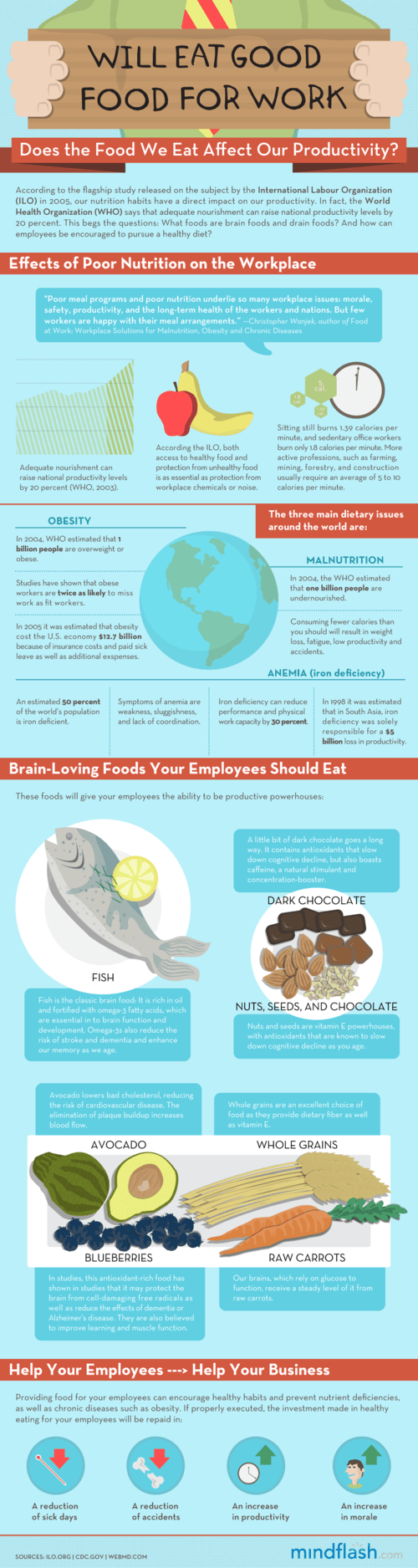
Does The Food We Eat Affect Our Productivity?

Start a Blog at WordPress.com.

Up ↑