
…but while it was responsive it did not have custom posts, hence, back to the old look. Click the image for things to think about when choosing a theme…
Thinks I find along the way
…but while it was responsive it did not have custom posts, hence, back to the old look. Click the image for things to think about when choosing a theme…

Friend, mentor and client Nilofer Merchant expounds on the topic of ‘onlyness’:
The first step to unlocking talent in the #SocialEra is celebrating something I’ve termed onlyness.
Onlyness is that thing that only that one individual can bring to a situation. It includes the journey and passions of each human. Onlyness is fundamentally about honoring each person: first as we view ourselves and second as we are valued. Each of us is standing in a spot that no one else occupies. That unique point of view is born of our accumulated experience, perspective, and vision. Some of those experiences are not as “perfect” as we might want, but even those experiences are a source for what you create. For example, the person whose younger sibling has a disease might grow up to work in medicine to find the cure. The person who is obsessed with beautiful details might end up caring about industrial design and reinvent how we all use technology. The person who has grown up under oppression might end up advocating for freedom of speech and thus advance the condition of his country. This individual onlyness is the fuel of vast creativity, innovations, and adaptability.
Full story at: Onlyness (The Topic and the Talk at TEDxHouston) – Nilofer Merchant.
Watch the video:
The main thing is to keep the main thing the main thing, right? Here’s a minimalist workflow for content and thought leadership marketing that will help you get found when people are looking for you and what you do in the coming year…

The beautiful thing about this simple workflow is that you have to do the reading anyway in order to maintain your expert status — why not turn it into thought leadership marketing? Also every tool is free and completely cross platform and it could all be executed from a $199 Chromebook. I explain here:
How could I explain this more clearly or make this post better? Comment below or use the contact form above…

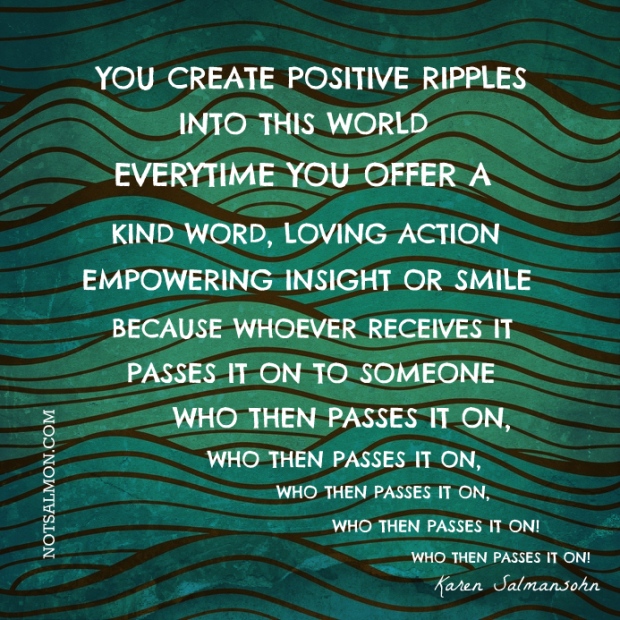
I curate a lot of Karen Salmansohn‘s ‘posters‘ on my blog — well over 100 at this point. Her she writes about posters as ‘pattern interrupts‘:
About two years ago, I gave birth to a baby boy. Shortly after, I found myself experiencing trouble giving birth to writing a book. I began believing in that much talked-about “mommy brain.”
Thankfully, I’ve always loved design. Being the positive problem solver that I am, I started experimenting with designing inspiring posters. It seems the “designer” part of my brain was not fogged by newbie mommyhood. (Perhaps this is a topic for yet another essay – where I explore the interesting workings of the right versus left brain! I know in the book My Stroke of Insight, the author said she found it easier to write in a journal rather than by computer when she was on her way to recovery. But I digress!)
I began calling my daily posters I was writing and designing my “Daily Inspirational Flashcards” – because their goal was to quickly remind people of positive psychological beliefs and productive habits which lead to the happiest life. Soon, my “Inspirational Flashcards” began to go viral – with thousands – then hundreds of thousands – then even millions of shares for a single poster. I began receiving hundreds of emails from people – thanking me – explaining that my daily “Inspirational Flashcards” were truly helping them battle depressed emotional states – even when it came to dealing with majorly challenging issues like a bipolar disorder or a loved one’s death.” Read the rest of the article here: Can Posters Work As Pattern Interrupts In Changing Moods? | Psychology Today.
I love Karen’s work [duh! Why else would I curate it so much?]. My friend and mentor RJ always says ‘never confuse the artist with the art’ but in this case, the artist is the art and it’s all beautiful. To answer the original question there have been many times when Karen’s posters have interrupted my mood in a good way hence the reason I share them so much…
…as much as I am an internet mechanic who helps thinkers become thought leaders! Here’s what I mean…
Yes, I do WordPress websites buy my emphasis is not on high maintenance sites that look pretty and deliver no traffic. I’d rather you think of me as an internet mechanic that can keep your content marketing engine running smoothly. Comment, call or ‘connect’ so we can talk about how this applies to you and your organization…

 One of my new, favorite bloggers Heidi Cohen has these thoughts on blog design for you to ponder…
Writers at heart, many bloggers rush through selecting their blog design elements without much thought when they first start. But the reality is that design is core to your blog’s brand and readership. Therefore, out-of-the box blog set-ups most likely won’t work for you.
Blog design doesn’t require artistic training. It requires strategic (read: high level) thought, determining your blog’s goals and target audience (aka: persona) before you jump in and start blogging.
Review the blogs you read frequently to become familiar with your options. Consider which blogs you like and which elements of those blogs attract your attention. Make a list of those elements you want and those that you don’t want.
Here are twenty-one blog design elements that you don’t have to be a graphic designer to select…
Go to the source if you are interested in her 21 elements. Me? Through a long and rigorous evaluation process, I have decided to become a Woo Themes developer. I won’t bore you with the details of my search, but it literally lasted years. Woo offers over 100 themes that look good ‘out of the box’ but are also very easy for me to customize to a client’s specifications…
Heidi’s right! Much more important than the design is the actual strategy. Adam Osborne said “Adequacy is sufficient. All else is superfluous” and I agree. When it comes to design, I believe a tweaked Woo theme may be all you need – as I tell my clients, ‘Google doesn’t search for pretty’. I focus instead on delivering to my clients a system or toolkit with a repeatable process that is easy to use based on the premise that if it’s easy and fun to do, they might actually do it. On the back end, I have been working hard this year to link my ‘e1evation workflow’ more deeply to the value demands of my target audience by linking keywords to the problems my target audience is trying to solve. If you use a repeatable process like mine for your blogging and use a Woo theme for your site, you will draw your target audience in and the design won’t scare them away!
Heidi’s thoughts on determining your blog’s goals and target audience are must read before getting started — comment or ‘connect’ so we can talk about how this applies to you and your organization…
I love it when I find a quote to support my preconceived notions because if I say it, it’s just opinion, but if an ‘expert’ says it, well, it must be true. In this case a designer talks about web design…
“This one will probably get me into trouble.
I’ve worked as a graphic designer for over two decades and I’m not supposed to say this stuff. After all, it’s my job to make miracles. To wave my magic design wand and make a business look stronger, smarter, and more powerful than it really is.
Before I start dodging rotten tomatoes, though, I’m going to go ahead and say it out loud.
It’s a smart business move to have a well-designed website.
But good design — even great design — won’t solve all your business problems. Not even close.” Source: The Myth of Beautiful Website Design | Copyblogger
Although I do design websites, I think of myself less as a web designer than I do a social media technologist. In my methodology, a blog enabled website is a homebase or hub for a social media publishing network. My goal in design is simply to have the site load fast, connect to social media outposts and not be so ugly that a user won’t roll around on the floor clawing her eyes out. That’s it. As Pamela says in the quoted article “Don’t expect miracles from your graphic design. It’s definitely a valuable part of creating your business’s image, but it’s not a substitute for a sound marketing strategy.”

I got this from Seth Godin who got it from the Google dictionary…
“A brand is the set of expectations, memories, stories and relationships that, taken together, account for a consumer’s decision to choose one product or service over another. If the consumer (whether it’s a business, a buyer, a voter or a donor) doesn’t pay a premium, make a selection or spread the word, then no brand value exists for that consumer.
A brand’s value is merely the sum total of how much extra people will pay, or how often they choose, the expectations, memories, stories and relationships of one brand over the alternatives.
A brand used to be something else. It used to be a logo or a design or a wrapper. Today, that’s a shadow of the brand, something that might mark the brand’s existence. But just as it takes more than a hat to be a cowboy, it takes more than a designer prattling on about texture to make a brand. If you’ve never heard of it, if you wouldn’t choose it, if you don’t recommend it, then there is no brand, at least not for you.
If you hear a designer say this, “A TCHO Chocolate bar, with its algorithmic guilloche patterns, looks like a modern form of currency. “Modern” was always part of the brand brief — no faux traditionalism, but resolutely forward-looking for a new generation of chocolate enthusiasts…” then I wonder if there’s a vocabulary disconnect.
Design is essential but design is not brand.
(Believe it or not, I didn’t make that quote up).
PS a Google tip: you can find the definition of any word by typing “define:” followed by the word into your search box.” Source: Seth’s Blog: define: Brand
This goes hand in hand with the earlier post I did about Facebook pages…
![Reblog this post [with Zemanta]](https://i0.wp.com/img.zemanta.com/reblog_e.png)
 Bright, shiny objects!
You must be logged in to post a comment.