John Adams on celebrating the 2nd of July

-500px
-500px (Photo credit: Wikipedia)

“The Second Day of July 1776 will be the most memorable Epocha, in the History of America. It ought to be solemnized with Pomp and Parade, with Shews, Games, Sports, Guns, Bells, Bonfires, and Illuminations from one End of this Continent to the other from this Time forward forever more.” – John Adams to Abigail Adams, July 3, 1776. 1776 filled the calendar with dates deserving of remembrance and even celebration. John Adams, delegate from Massachusetts to the Second Continental Congress, wrote home to his wife Abigail that future generations would celebrate July 2, the date the Congress voted to approve Richard Henry Lee’s resolution declaring independence from Britain for 13 of the British colonies in America. Two days later, that same Congress approved the wording of the document Thomas Jefferson had drafted to announce Lee’s resolution to the world. Today, we celebrate the date of the document Jefferson wrote, and Richard Henry Lee is often a reduced to a footnote, if not erased from history altogether. Who can predict the future? (You know, of course, that Adams and Jefferson both died 50 years to the day after the Declaration of Independence, on July 4, 1826. In the 50 intervening years, Adams and Jefferson were comrades in arms and diplomacy in Europe, officers of the new government in America, opposing candidates for the presidency, President and Vice President, ex-President and President, bitter enemies, then long-distance friends writing almost daily about how to make a great new nation. Read David McCullough’s version of the story, if you can find it.)”

American Minute for December 26th; the Battle of Trenton

Emanuel Leutze's depiction of Washington's att...

The first six months of the Revolution saw the Continental Army chased out of New York, across New Jersey, and into Pennsylvania.

Ranks dwindled from 20,000 to 2,000 exhausted soldiers- most leaving at year’s end when their six-month enlistment was up.

Expecting a British invasion, the Continental Congress fled Philadelphia and sent the word:

“Until Congress shall otherwise order, General Washington shall be possessed of full power to order and direct all things.”

In a military operation, with the password “Victory or Death,” Washington’s troops crossed the ice-filled Delaware River at midnight Christmas Day.

Trudging in a blinding blizzard, with one soldier freezing to death, they attacked the feared Hessian troops at Trenton, New Jersey, on daybreak DECEMBER 26, 1776, capturing nearly a thousand in just over an hour.

A few Americans were shot and wounded, including James Monroe, the future 5th President.

Washington wrote August 20, 1778:

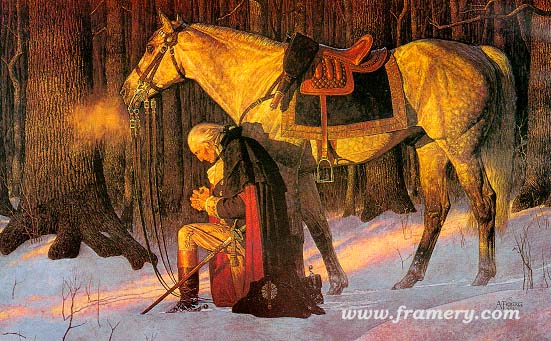
“The Hand of Providence has been so conspicuous in all this-the course of the war-that he must be worse than an infidel that lacks faith, and more wicked that has not gratitude to acknowledge his obligations; but it will be time enough for me to turn Preacher when my present appointment ceases.”

via American Minute for December 26th.

Congress votes for independence; This Day in History — 7/2/1776

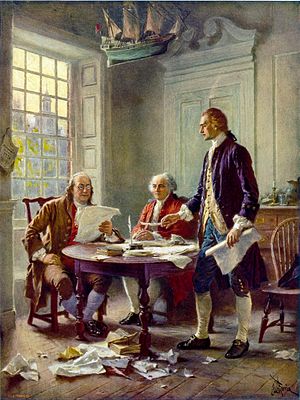
Benjamin Franklin, John Adams and Thomas Jeffe...
Benjamin Franklin, John Adams and Thomas Jefferson writing the Declaration of independence (1776) were all of British descent. (Photo credit: Wikipedia)

On this day in 1776, the Second Continental Congress, assembled in Philadelphia, formally adopts Richard Henry Lee’s resolution for independence from Great Britain. The vote is unanimous, with only New York abstaining.

The resolution had originally been presented to Congress on June 7, but it soon became clear that New York, New Jersey, Pennsylvania, Delaware, Maryland and South Carolina were as yet unwilling to declare independence, though they would likely be ready to vote in favor of a break with England in due course. Thus, Congress agreed to delay the vote on Lees Resolution until July 1. In the intervening period, Congress appointed a committee to draft a formal declaration of independence. Its members were John Adams of Massachusetts, Benjamin Franklin of Pennsylvania, Roger Sherman of Connecticut, Robert R. Livingston of New York and Thomas Jefferson of Virginia. Thomas Jefferson, well-known to be the best writer of the group, was selected to be the primary author of the document, which was presented to Congress for review on June 28, 1776.

On July 1, 1776, debate on the Lee Resolution resumed as planned, with a majority of the delegates favoring the resolution. Congress thought it of the utmost importance that independence be unanimously proclaimed. To ensure this, they delayed the final vote until July 2, when 12 colonial delegations voted in favor of it, with the New York delegates abstaining, unsure of how their constituents would wish them to vote. John Adams wrote that July 2 would be celebrated as the most memorable epoch in the history of America. Instead, the day has been largely forgotten in favor of July 4, when Jeffersons edited Declaration of Independence was adopted.” via Congress votes for independence — History.com This Day in History — 7/2/1776.

George Washington assigned to lead the Continental Army; This Day in History

On this day in 1775, George Washington, who would one day become the first American president, accepts an assignment to lead the Continental Army.

Washington had been managing his family’s plantation and serving in the Virginia House of Burgesses when the second Continental Congress unanimously voted to have him lead the revolutionary army. He had earlier distinguished himself, in the eyes of his contemporaries, as a commander for the British army in the French and Indian War of 1754.

Born a British citizen and a former Redcoat, Washington had, by the 1770s, joined the growing ranks of colonists who were dismayed by what they considered to be Britain’s exploitative policies in North America. In 1774, Washington joined the Continental Congress as a delegate from Virginia. The next year, the Congress offered Washington the role of commander in chief of the Continental Army.

After accepting the position, Washington sat down and wrote a letter to his wife, Martha, in which he revealed his concerns about his new role. He admitted to his “dear Patcy” that he had not sought the post but felt “it was utterly out of my power to refuse this appointment without exposing my Character to such censures as would have reflected dishonour upon myself, and given pain to my friends.” He expressed uneasiness at leaving her alone, told her he had updated his will and hoped that he would be home by the fall. He closed the letter with a postscript, saying he had found some of “the prettiest muslin” but did not indicate whether it was intended for her or for himself.

On July 3, 1775, Washington officially took command of the poorly trained and under-supplied Continental Army. After six years of struggle and despite frequent setbacks, Washington managed to lead the army to key victories and Great Britain eventually surrendered in 1781. Due largely to his military fame and humble personality, Americans overwhelmingly elected Washington their first president in 1789.

via George Washington assigned to lead the Continental Army — History.com This Day in History — 6/15/1775.

Continental Congress chooses national flag; This Day in History

On this day in 1777, during the American Revolution, the Continental Congress adopts a resolution stating that “the flag of the United States be thirteen alternate stripes red and white” and that “the Union be thirteen stars, white in a blue field, representing a new Constellation.”

The national flag, which became known as the “stars and stripes,” was based on the “Grand Union” flag, a banner carried by the Continental Army in 1776 that also consisted of 13 red and white stripes. According to legend, Philadelphia seamstress Betsy Ross designed the new canton for the flag, which consisted of a circle of 13 stars and a blue background, at the request of General George Washington. Historians have been unable to conclusively prove or disprove this legend.

With the entrance of new states into the United States after independence, new stripes and stars were added to represent new additions to the Union. In 1818, however, Congress enacted a law stipulating that the 13 original stripes be restored and that only stars be added to represent new states.

On June 14, 1877, the first Flag Day observance was held on the 100th anniversary of the adoption of the American flag. As instructed by Congress, the U.S. flag was flown from all public buildings across the country. In the years after the first Flag Day, several states continued to observe the anniversary, and in 1949 Congress officially designated June 14 as Flag Day, a national day of observance.” via Continental Congress chooses national flag — History.com This Day in History — 6/14/1777.

Those were different days…

The title page to the 1611 first edition of th...
Image via Wikipedia

September 11, 1777, the Chaplain of Congress, Patrick Allison, brought to the attention of the Continental Congress that Revolutionary War had interrupted trade with the King’s authorized printers in England, thereby causing a shortage of the King James Authorized Version of the Bible, commonly used in education. A Continental Congress committee passed the motion: “The use of the Bible is so universal and its importance so great that your committee refers the above to the consideration of Congress…The Committee recommends that Congress will order the Committee of Commerce to import 20,000 Bibles from Holland, Scotland, or elsewhere, into the different parts of the States of the Union. Whereupon it was resolved accordingly to direct said Committee of Commerce to import 20,000 copies of the Bible.” That same day, the British won the Battle of Brandywine, forcing Washington’s troops to retreat to Valley Forge. In a panic, the Continental Congress evacuated Philadelphia before action could be taken on the resolution. Five years later, the Continental Congress again responded to the shortage of Bibles by authorizing the printing of America’s first English language Bible, which had been described in a petition as: “a neat edition of the Holy Scriptures for the use of schools.” Congress, on September 10, 1782, selected the publisher of The Pennsylvania Magazine, Robert Aitken, who died JULY 15, 1802, for the printing: “Resolved, That the United States in Congress assembled highly approve the pious and laudable undertaking of Mr. Aitken, as subservient to the interest of religion, as well as an influence in the progress of arts in this country, and being satisfied from the above report of his care and accuracy in the execution of the work, they recommend this edition of the Bible to the inhabitants of the United States, and hereby authorize him to publish this recommendation. – Charles Thomson, Secretary.” Copies of this Bible are with the American Bible Society’s Museum of Biblical Art in New York, and Houston Baptist University’s Dunham Bible Museum.

Start a Blog at WordPress.com.

Up ↑