Do you like me?

Being a WordPress consultant in the WordPress.com community is a terrible thing. I’m always coming across things that I’d like to change or add to my blog as I read your content on your sites. Changing the look and feel of my blog is something that I could do even more often than I do, but recently, I changed to the Splendio theme and I’m quite happy with the results. It’s a little bit edgy for me, but I think the generally upbeat ‘feel’ is consistent with my message of wholeheartedness and self-compassion…

What about you? What’s your take?

Why We Need to Have Compassion for Our Inner Critic

Kristin Neff writes:

We know how much it hurts. “I’m an idiot!” “I’m disgusting.” “No one will ever love me.” “What a lame-ass.”

So why do we do it? As soon as we ask ourselves this question, we often just pile on more self-criticism. “I’m such a bitch, even to myself.” “That’s why I’m such a loser, I’m always putting myself down.”

Don’t beat yourself up for beating yourself up in the vain hope that somehow it will help you stop beating yourself up. Instead, take a step back, and give your inner critic some slack. In its ineffective, counterproductive way, your inner critic is actually trying to keep you safe.

As humans we have two main evolved safety systems. The oldest and most quickly triggered is the threat defense system, which involves the amygdala. When we sense danger, our response is typically fight, flight, freeze, or submit: We turn and fight the threat, run like hell away from the threat, play dead in hopes the threat will pass, or show our bellies and hope the threat will be placated. These strategies are very successful for animals living in the wild, helping them to survive and pass on their genes. For humans, however, these responses often just make things worse. That’s because the threat we’re usually facing is a threat to our self-concept. We confuse our thoughts and representations of ourselves for our actual selves, meaning that when our self-image is under siege, we react as if our very existence is threatened. When this happens, our threat defense system uses the same strategies to stay safe:

Fight — we beat ourselves up emotionally, using cruel language to cut ourselves down.

Flight — we become anxious and restless, fleeing from ourselves by numbing out or using distractions like food or alcohol.

Freeze — we get stuck in rumination, thinking about our perceived inadequacies over and over again.

Submit — we admit that yes, we’re terrible, and accept all the harsh judgments we throw at ourselves.

More often than not we engage in some combination of all these strategies. Our stress levels go up as our amygdala activates our sympathetic nervous system (which arouses us so we can deal with threats) and floods our system with adrenaline and cortisol. And it’s a double whammy because when we criticize ourselves, we are both the attacker and the attacked. This type of chronic stress can eventually lead to anxiety and depression, undermining our physical and emotional wellbeing.

Still, it’s important to remember that when our inner critic attacks, at root it is trying to ward off danger. Marshal Rosenberg, author of the book Non-Violent Communication, says self-criticism is the “tragic expression of an unmet need.” It’s tragic because self-criticism makes us feel horrible and doesn’t effectively motivate productive change. (See my blog “The Motivational Power of Self-Compassion.”) But if we look closely — our inner critic cares. There is some safety need it is trying to meet. Our inner critic wants us to be happy, but doesn’t know a better way to go about it. Let’s say you criticize yourself for not going to the gym, calling yourself a “lazy slob.” At some level, your inner critic is reacting out of concern that if you don’t go to the gym you won’t be healthy, or that you’ll be rejected by others. We can be kind and compassionate to this part of ourselves, because at some level it has our best interests at heart. And believe it or not, by giving compassion to our inner critic, we are moving out of the threat defense system and into our other safety system.

As mammals, we also evolved the attachment/affiliation system as a survival strategy. Mammals have the innate capacity to be soothed by warmth and affection, meaning that our young are likely to stay near caregivers, be protected, and survive. The care-giving system deactivates the sympathetic nervous system (reducing cortisol) and activates the parasympathetic nervous system, which calms us down. This route to emotional safety is much more effective — reducing our stress and anxiety rather than exacerbating it. And it gives us the emotional balance needed to make wise decisions, including making behavioral changes if needed. (I write about self-compassion and the mammalian care-giving system in my blog “The Chemicals of Care.”)

So the next time you find yourself in the throws of harsh self-criticism, instead of beating yourself up for beating yourself up, thank your inner critic for its efforts, then try the strategy of giving yourself some compassion instead. It’s more effective, and a lot less painful!

Full story at: Kristin Neff: Why We Need to Have Compassion for Our Inner Critic.

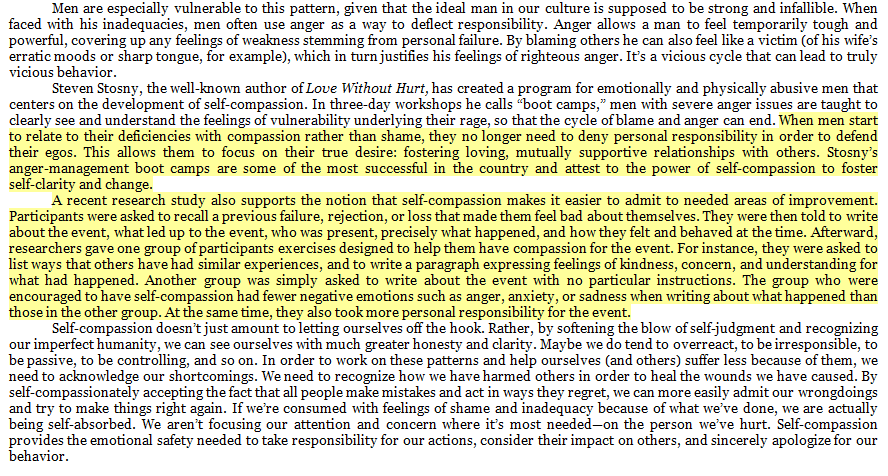
Another excerpt…

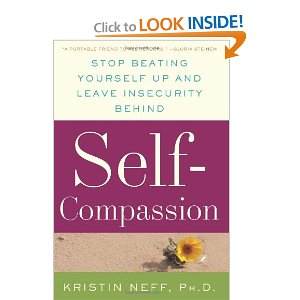
…from Kristen Neff’s book ‘Self-compassion’. Click image to enlarge…

ScreenClip
You can find Steven Stosny’s books here and his website here. If you’re not familiar with Kristen Neff, you can catch her bio and a few posts at HuffPo

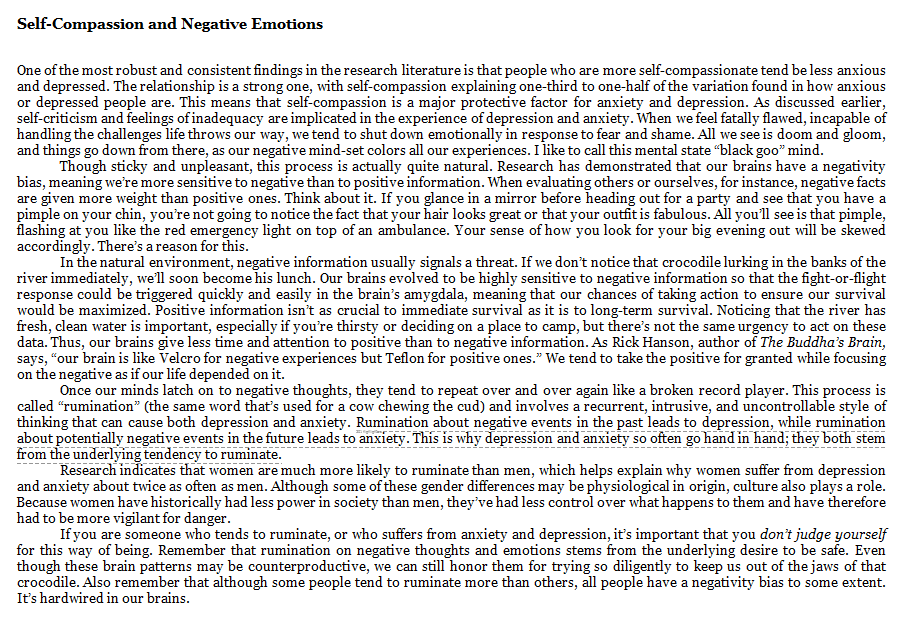
Self compassion and negative emotions…

Lately, I have been finding wisdom and refuge in Kristen Neff’s book Self-compassion [which I highly recommend!]. Here is a recent passage that resonated with me…

Click image to enlarge...
Click image to enlarge…

Never Settle For Less

See on Scoop.itWholeheartedness

Know your worth. NEVER settle for less than you deserve.

Todd Lohenry‘s insight:

The word ‘deserve’ makes me feel uneasy because in my past, what I deserve has led to feelings of entitlement and expectation that lead to disappointment. Still, a healthy self-compassionate perspective is a necessity; only you can find the balance in your life…

See on www.livelifehappy.com

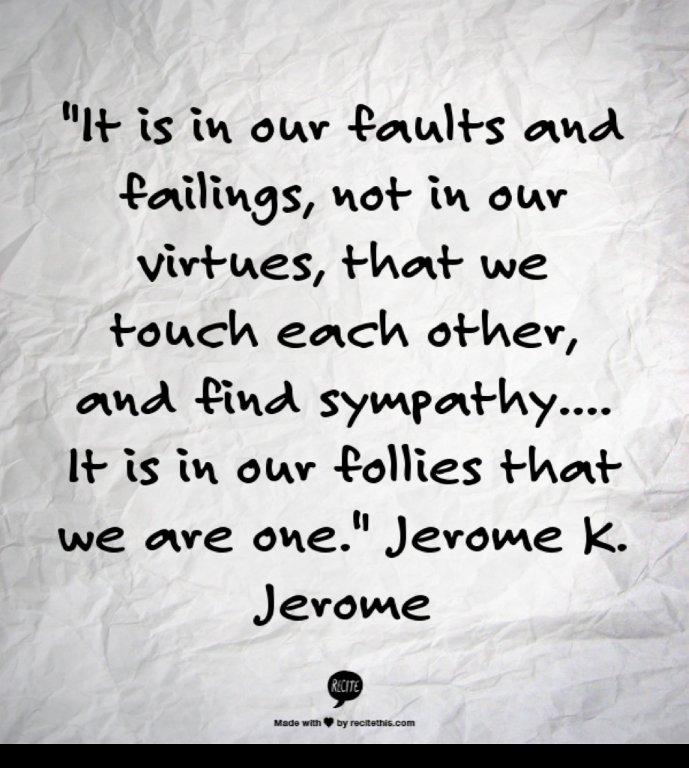
It is in our faults and failings…

Another great quote from Kristin Neff’s book “Self-compassion”…

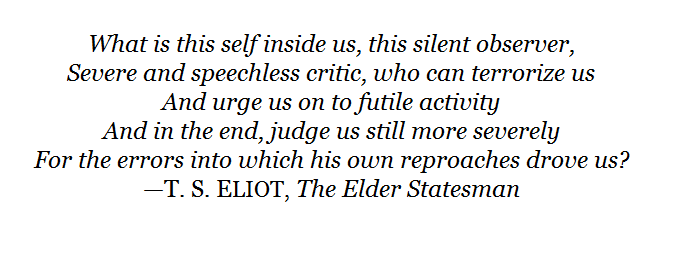
What is this self inside us…

A great quote from Kristen Neff’s book on self-compassion which I highly recommend…

41A4d+sT3wL._BO2,204,203,200_PIsitb-sticker-arrow-click,TopRight,35,-76_AA300_SH20_OU01_
Click the image to learn more…

Creating an Unreal Other

Tara Brach writes:

It is easy to be untouched by stories we read in the newspaper, on the Internet or watch on the news about people suffering from unemployment, loss of loved ones, war or natural disasters. More and more, in our world, we have a sense of “unreal others.” Unless we are really awake, we don’t see the person we’re reading about as a real subjective being. We don’t have a sense of “the one who is looking out through those eyes or feeling with that heart.” The other is not real to us, and our hearts don’t respond with authentic compassion. Continue reading “Creating an Unreal Other”

The best of wholeheartedness for the week ending 3/9/2013

  1. “The secret of getting ahead is getting started. The secret of getting started is breaking your complex overwhelming tasks into small manageable tasks, and then starting on the first one.” -Mark Twain, legendary author.
  2. “When all your desires are distilled; You will cast just two votes: To love more, And be happy.”   – Hafiz
  3. “Opposition is a natural part of life. Just as we develop our physical muscles through overcoming opposition – such as lifting weights – we develop our character muscles by overcoming challenges and adversity.” -Stephen R. Covey, best-selling author and speaker.
  4. “Any time I am in resentment, I am not taking care of myself. I am blaming someone else for something I need to do.” “The higher the expectations, the lower the serenity. I try to keep my boundaries high, my expectations low, and my heart open.” -Anon
  5. “When you take charge of your life, there is no longer a need to ask permission of other people or society at large. When you ask permission, you give someone veto power over your life.” – Geoffrey F. Abert
  6. Todd’s tweets…
  7. Just added a great image in “Storypad” undefined
  8. ““When all your desires are distilled; You will cast just two votes: To love more, And be happy.”   – Hafiz” undefined
  9. ““All the ups and downs are grace in different wrappings, sent to refine consciousness. Say thanks to them all.”  …” undefined
  10. ““Opposition is a natural part of life. Just as we develop our physical muscles through overcoming opposition –…” undefined
  11. ““The secret of getting ahead is getting started. The secret of getting started is breaking your complex…” undefined
  12. @toddlohenry Thx for all the great tweets this a.m. Clipping them all with Evernote to read later!
  13. @SocialBro Hey guys! I have a @bufferapp customer here, @toddlohenry, and we have some questions. Is there an email addy we can contact? :)
  14. @jenpastiloff Something tells me I would have heard from you if I curated your content incorrectly. :-D
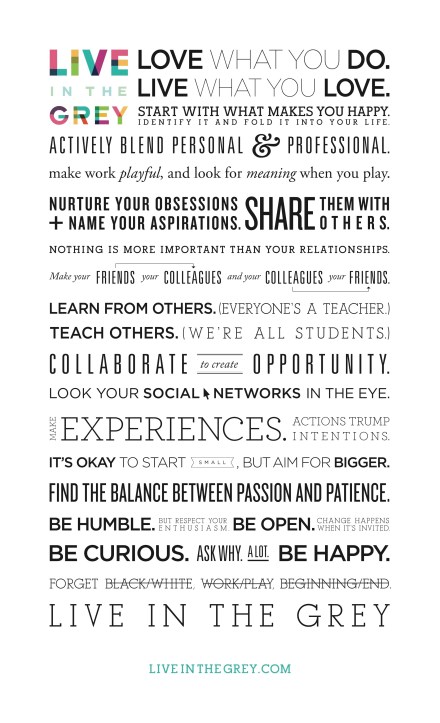
  15. @livegrey Love your site and what you’re doing and I’d like to do everything I can to promote your thinking…
  16. @toddlohenry Hi there Todd. Thanks for sharing our philosophy on your blog!
  17. @farhanadhalla Thanks for writing such good stuff. Hope all’s well…
  18. @barbmarkway Thanks for calling my attention to the event in the first place; Kristen Neff was AWESOME!!! I won’t take notes now… :-D
  19. Remember in Step Nine we were told to make direct amends wherever possible, but this generous principle should extend further. We…
  20. @toddlohenry I think it’s 100% diff. Reblog the heck out of me or quote me but give credit where credit is due. Respect, right? Thoughts?
  21. @toddlohenry reblogging credits the orig person. Knowingly Taking someone’s ideas and calling them your own lacks ethics
  22. “Smile, It Will Make You Look Better” undefined
  23. Just added a great image in “Storypad” undefined
  24. “The Key To Healing It Is Feeling It…” undefined
  25. @JenPastiloff How does copycatting differ from ‘reblogging’ or curating content according to fair use guidelines in your mind? Or does it?
  26. RT @steven_oriordan: Be mindful of your self-talk, it is a conversation with the Universe! #Universe #Selftalk #Quote
  27. Everyone is doing their best from their current state of consciousness…
  28. Your Best Secrets For A Good Night’s Sleep [feedly]…

Wholeheartedness for 3/7/2013

  1. Todd’s tweets…
  2. 9 Foods That Healed My Body Belong In Every Kitchen ow.ly/hOcwp
  3. The Science of Love: Why It Makes Us High | FinerMinds ow.ly/hOcub
  4. How to be Super Productive in Less Than 2 Minutes | FinerMinds ow.ly/hObVt
  5. Remember in Step Nine we were told to make direct amends wherever possible, but this generous principle should extend further. We…
  6. @toddlohenry I think it’s 100% diff. Reblog the heck out of me or quote me but give credit where credit is due. Respect, right? Thoughts?
  7. @toddlohenry reblogging credits the orig person. Knowingly Taking someone’s ideas and calling them your own lacks ethics
  8. “Smile, It Will Make You Look Better” undefined
  9. Just added a great image in “Storypad” undefined
  10. “The Key To Healing It Is Feeling It…” undefined
  11. You Don’t Suck. You Are Kind. « Positively Positive ow.ly/hLXIc
  12. How to Increase Your Value in the Market Place (part 2) bit.ly/YOZuAv
  13. The War on Your Stomach: Why You Eat Twinkies & Coke. ~ Sean Williams bit.ly/YOZuAo

Thoughts on expectation and loss…

  1. This is a long ‘meditation’ on loss that I have found helpful…

The Key To Healing It Is Feeling It…

Kute-Blackson-261x300-8x6.jpgKute Blackson writes:

All of your feelings are a gift.

Yet we often judge feelings as good or bad. We often try to eliminate the bad ones and feel only the good ones. However, in doing so, you end up disconnecting from the full range of your heart, self-expression, and power.

To the degree that you suppress what you might think of as the negative feelings is to the degree that you also disconnect from your capacity to fully experience the positive feelings.

Continue reading “The Key To Healing It Is Feeling It…”

Wholeheartedness for 3/6/2013

  1. 3 Power-Packed Reasons Juicing Will Make Your Body Glow | FinerMinds ow.ly/hLXGQ
  2. “Praise is like sunlight to the human spirit. We cannot flower and grow without it.” ~Jess lair ow.ly/hKG1Y
  3. RT @toddlohenry “Your mind will answer most questions if you learn to relax and wait for the answer.” ~William S. Burroughs t….
  4. “Your mind will answer most questions if you learn to relax and wait for the answer.” ~William S. Burroughs ow.ly/hKFWL
  5. Recipes With Fruit: How To Work More Apples, Bananas, Oranges Into Your Diet ow.ly/hKCKp
  6. Conflict-Management Advice From DeVon Franklin (VIDEO) ow.ly/hKCCZ
  7. Do You Want To Be Right Or Happy? How To Resolve Conflict ow.ly/hIk9E
  8. 10 Things I Wish I’d Known Before I Started Blogging ow.ly/irc8Z
  9. I just left a comment in “Five Reasons it’s Wrong to Steal Other People’s Content” fyre.it/6oWzMb.5

Compassion…

Self-compassion…

Neff, Kristin_400Kristin Neff writes:

So what’s the answer? To stop judging and evaluating ourselves altogether. To stop trying to label ourselves as “good” or “bad” and simply accept ourselves with an open heart. To treat ourselves with the same kindness, caring, and compassion we would show to a good friend, or even a stranger for that matter. Sadly, however, there’s almost no one whom we treat as badly as ourselves.

Neff, Kristin. Self-Compassion: Stop Beating Yourself Up and Leave Insecurity Behind (Kindle Locations 105-108). William Morrow. Kindle Edition.

Continue reading “Self-compassion…”

Technology and mindfulness…

  1. :-D
  2. The Pope is hardly the first person to lose interest in their real job so soon after joining Twitter.
  3. Some thoughts on the Wisdom 2.0 conference last weekend. So much appreciation for Soren and his team for putting… fb.me/JZ265OrW
  4. WISDOM 2.0 will guide our interactions toward greater meaning, productivity, and wellbeing via @SFGate bit.ly/XCrtWF
  5. Wisdom 2.0’s Compassionate, Chaos-Reducing Brand Of Leadership sns.mx/JOouy7
  6. ⊱⊋↝Leadership↜⊊⊰ The Art of Conscious Leadership – from Wisdom 2.0 2013 via @karin_sebelin sco.lt/8E12JN
  7. ⊱⊋↝Leadership↜⊊⊰ The Art of Conscious Leadership – from Wisdom 2.0 2013 via @karin_sebelin sco.lt/8E12JN
  8. For business leaders out there, Wisdom 2.0 provides out-of-the-box practical thinking – you can get more videos by downloading the HBR…
  9. Arianna Huffington At Wisdom 2.0 (VIDEO) huff.to/13Yces2 via @HealthyLiving Deeper wisdom comes from the school of hard knocks.
  10. Arianna Huffington At Wisdom 2.0 (VIDEO) huff.to/13Yces2 via @HealthyLiving What wisdom do you really get from inexperienced lives?
  11. Arianna Huffington At Wisdom 2.0 (VIDEO) huff.to/13Yces2 via @HealthyLiving Wisdom from college students, docs, lawyers and business
  12. Watch Wisdom 2.0 2013 on @livestream: new.livestream.com/accounts… There’s a conference on wisdom! How come nobody told me. I’m totally there!
  13. @Padmasree Padma watching your Wisdom 2.0 presentation on HBR! Totally inspiring. I am showing this to my team to spread the wisdom.
  14. Some thoughts on the Wisdom 2.0 conference last weekend. So much appreciation for Soren and his team for putting… fb.me/JZ265OrW
  15. The Shift: Exploring Your Life Purpose with Wisdom 2.0 Founder Soren Gordhamer. bit.ly/Y19Woy #Wisdom2conf
  16. Like—》RT @AlliPolin: >Mindful curiosity can take you on new paths of understanding & discovery ow.ly/i5FfM via @ThinDifference
  17. Food for thought: Wisdom 2.0. @harvardbiz: How to Be Mindful in an ‘Unmanageable’ World s.hbr.org/YYcl47
  18. Great post by Jack Kornfield. His interview with Bill Ford was one of my favorite ones. Enjoy another perspective of Wisdom 2.0, from the driver’s seat!
  19. “Without a connection to our inner world, to our own thoughts and body, the creative mind becomes inaccessible amid the mass of other content we digest.” Soren Gordhamer – Wisdom 2.0

    linkedin.com/today/post/art…

  20. Yoga e maestri zen contro lo stress digitale. L’intossicazione tecnologica crea disagio? Ecco Wisdom 2.0 —> lettura.corriere.it/yoga-e-…
  21. YOGA E MAESTRI ZEN CONTRO LO STRESS DIGITALE
    L’intossicazione tecnologica crea disagio? Ecco Wisdom 2.0
  22. YOGA E MAESTRI ZEN CONTRO LO STRESS DIGITALE
    L’intossicazione tecnologica crea disagio? Ecco Wisdom 2.0
  23. Check out the music of Abraham, at http://www.lensesmusic.com. We were both at the Wisdom 2.0 summit this past weekend. I just love that the Bay Area is at the center of such cool stuff like mindfulness technology.
  24. The conference I helped to host this weekend, Wisdom 2.0 is written up in this great summary by Arianna Huffington. She recognizes the energy and unique spirit of this event and the amazing people who pour their time into creating this space to process the collective spirit from technology to mindfulness in daily life.

    We sat down with Congressman Tim Ryan this weekend to chart out collaborations for a new foundation focused on creating environments throughout our daily lives that support taking a deep breath, listening, processing deeply with each other and sharing our best selves in the collective conversation.

    I am so happy to share a glimpse here and host these conversations with you in future gatherings. The happiest place on earth.

  25. Arianna Huffington agrees with me – the Wisdom 2.0 Conference was really, really special.
  26. When I’m listening to the signals my body gives, I do very strange things. Like take Caltrain down to Mtn. View for the Hacker Dojo, stay for 15 minutes and go right back to San Francisco. I can make up a reason (too tired, day too full, energetic mismatch) but I don’t need to know. My inner compass is screaming “go back, sleep early, wake up at 5am and have a productive day.”
  27. Many of you have asked me what Wisdom 2.0 was like. In this post, Tony Schwartz shares some of his insights from the 2013 conference …
  28. Wisdom 2.0 2013 Session Proposal – Holacracy: Building a More Conscious Organization
  29. From Suffering to Seeking to Achieving: What Consciousness Can DO! – Wisdom 2.0 – 2013 Conference

Self-compassion; A Healthier Way of Relating to Yourself

I ‘discovered’ Dr. Kristin Neff’s work on self-compassion reading Brene Brown’s book ‘Daring Greatly’. What is it?

Here’s her TEDx talk on the topic:

Full story [including self-test] at: Self-compassion – A Healthier Way of Relating to Yourself.

Letting go in love…

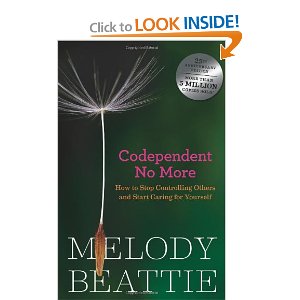
codependent no moreMelody Beattie writes:

When people with a compulsive disorder do whatever it is they are compelled to do, they are not saying they don’t love you – they are saying they don’t love themselves.
Codependent No More

Gentle people, gentle souls, go in love.

Yes, at times we need to be firm, assertive: those times when we change, when we acquire a new behavior, when we need to convince others and ourselves we have rights.

Those times are not permanent. We may need to get angry to make a decision or set a boundary, but we can’t afford to stay resentful. It is difficult to have compassion for one who is victimizing us, but once we’ve removed ourselves as victims, we can find compassion.

Our path, our way, is a gentle one, walked in love – love for self, love for others. Set boundaries. Detach. Take care of ourselves. And as quickly as possible, do those things in love.

Today, and whenever possible. God let me be gentle with others and myself. Help me find the balance between assertive action taken in my own best interests, and love for others. Help me understand that at times those two ideas are one. Help me find the right path for me.

via Blog | Just For Today Meditations.

Wholeheartedness = courage, compassion and connection…

220px-Brene_portrait_cropWEBTime to mix things up again. Thanks to my friend Tim Kastelle for sharing Brené Brown’s TED Talk on vulnerability. She writes here on cultivating worthiness…

Practicing courage, compassion, and connection in our daily lives is how we cultivate worthiness. The key word is practice. Mary Daly, a theologian, writes, “Courage is like—it’s a habitus, a habit, a virtue: You get it by courageous acts. It’s like you learn to swim by swimming. You learn courage by couraging.” The same is true for compassion and connection. We invite compassion into our lives when we act compassionately toward ourselves and others, and we feel connected in our lives when we reach out and connect. Before I define these concepts and talk about how they work, I want to show you how they work together in real life—as practices. This is a personal story about the courage to reach out, the compassion that comes from saying, “I’ve been there,” and the connections that fuel our worthiness.

Brown, Brene (2010-09-20). The Gifts of Imperfection: Let Go of Who You Think You’re Suppose to Be and Embrace Who You Are (p. 7). BookMobile. Kindle Edition.

Here’s the TED Talk in case you haven’t seen it yet…

The benefits of “I’m sorry…”

Melody Beattie writes:

Did you ever do something stupid that hurt someone’s feelings? Did you ever treat someone wrong and there was no justification for how you behaved? I have. It’s an awful place to be, when we realize what we’ve done.

The more we value that person, the more we want them to know how genuinely sorry we are. We’d give any­thing to see their facial muscles soften and hear them say, “It’s okay.”

I first learned about the value of forgiveness when 1 was in treatment for chemical dependency. I didn’t realize how much I’d hurt other people until I’d been sober for a while. When I became aware of my guilt, it was paralyzing and thick. I just wanted it to go away, and I didn’t think it ever would. The antidote for guilt is forgiveness. Asking for forgiveness from others or God puts us in a vulnerable place. There is nothing we can do except wait until we get word—and believe—that it’s okay.

I recently read a magazine article about the physiolog­ical benefits of saying, “I’m sorry” Acknowledging to someone that we’ve hurt them, saying we’re sorry, and genuinely meaning it improves health.

Recovery programs have known for a long time that becoming aware of the harm we’ve done and making direct amends are essential for the well-being of the person making amends. But making amends doesn’t just benefit us. It helps the other person too.

As hard as I try not to, I still make mistakes and do things that hurt others. Sometimes I know what I’m doing is wrong, and I do it anyway Other times it’s an accident.

Forgiveness isn’t just a value we need if and when we’re recovering. It’s a value we’ll need all our lives.

Value: Forgiveness has many components: self-inspection, self-responsibility compassion, living by a set of ethics, letting go of our defenses, letting go of resentments and judgments, humbling ourselves, wanting to be close to God, acknowledging to other people that they’re impor­tant to us, knowing that others care enough about us. All these aspects of forgiveness are good. Whether we’re extending or receiving forgiveness, it’s the value this week.

via January 8 – from “52 Weeks of Conscious Contact”.

Stop Beating Yourself Up… Start Loving Yourself Radically!

kute-blackson-261x3001Kute Blackson writes:

It can be easy to judge yourself at times.

Many of us do it quite well.

We beat ourselves up. Criticize. Treat ourselves harshly. We often strive to make ourselves different from what we are.

From the moment we are born, we get conditioned. We are told who we should and shouldn’t be. We are told repeatedly that who we are isn’t enough. It gets reinforced by the advertising in the media that wants to sell you something.

When you accept yourself for being who you are and who you are not, a powerful freedom is yours.

Beating yourself up to try and fit some idea of who you need to be in order to be loved and accepted by others only creates more stress and suffering.

Beating yourself up to be something often keeps you feeling like nothing and can keep you stuck where you are.

Judging yourself in an effort to change simply reinforces the very patterns you are seeking to change.

No matter what has happened to you, know this:

You are perfect as you are.

So what if you didn’t need to change, improve, or be anything other than what you are already?

What if you were to radically, completely accept who you are and not in this moment?

Not accepting only causes you more suffering.

Acceptance is the key to your freedom. It’s in acceptance of who you are and where you are in your process of being a human being that you create the space to truly be with yourself as you are. It’s this space of non-judgment that is profoundly healing. Even to simply accept your non-acceptance is freedom.

Acting like some idealized version of yourself that you think you should be doesn’t make you authentically who you are or truly free.

The real freedom is in dropping all the “shoulds” of who you think you should or shouldn’t be, and allow yourself to simply be. Then the real you can blossom.

As you begin to accept yourself totally even those parts of yourself that you judge or think are “bad” will heal in the space of love, compassion, and acceptance.

Judging yourself is easy. But it takes real courage to love yourself radically.

To love yourself radically is to not only love just the parts of you that you like, but also the parts that you don’t like.

What parts of yourself have you been judging?

What if you committed to loving that?

What if you committed to loving even the part of you that “can’t” love?

It’s in loving radically that you set yourself free.

It’s time.

Love. Now.

Source: Stop Beating Yourself Up…Start Loving Yourself Radically!

Start a Blog at WordPress.com.

Up ↑