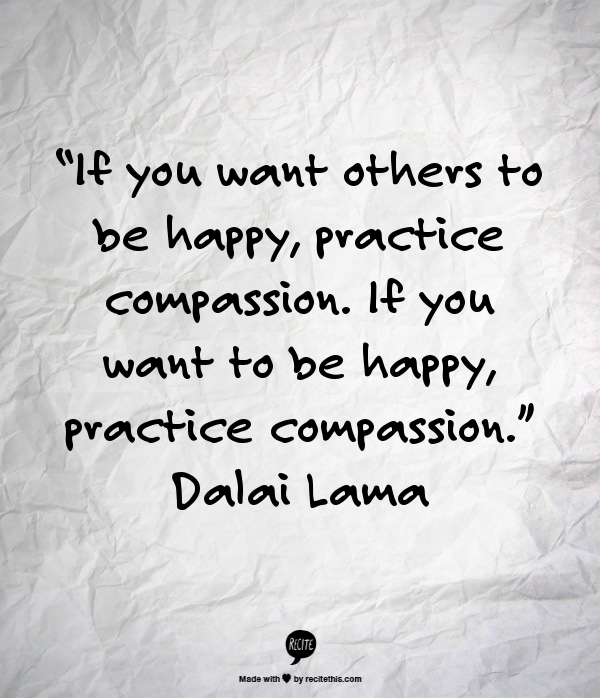
Self-compassion vs. Self-esteem

There is a difference; the first is healthy the second is not…

inspiredaybyday's avatarInspired Blog

A few weeks ago, a friend recommended a book about Self-compassion, so I started to look into this subject and realized that most people, including myself, do not practice Self-compassion very well. However, we live in a culture where Self-esteem is an obsession, so I wanted to look into the differences between these two.

self-compassion

I have always tried to be a better person, a better student, a better daughter, a better wife, a better mother, a better professional, etc. the list goes on and on. I always try to be better, and although there is nothing wrong with trying to be better, I feel like it is a constant source of self-inflicted pressure in my life.

I believe that many people go through the same pattern of trying to always be better in order to feel accepted and loved, yet, somewhere along the way they forget to love themselves

View original post 664 more words
Do you or someone you know suffer from Bitchy Resting Face?

Too funny…

Bitchy Resting Face is a disorder that affects millions of women every day. Together we can face the problem…

via Do you or someone you know suffer from Bitchy Resting Face? | elephant journal.

Are you actually a bitch? An asshole? Then try tonglen — a practice for love, vulnerability, strength in tough times, compassion and empathy—and see us in the morning.

Me? I suffer from ARF – asshole resting face. If I’m not consciously making an effort to smile, people assume I’m ready to pull out a gun and go postal. If there is some truth behind the humor in this video for you, Elephant Journal recommends this post

Essence of Mindful Prayer

recite-32085-1286722747-fz1ur9

Tara Brach writes;

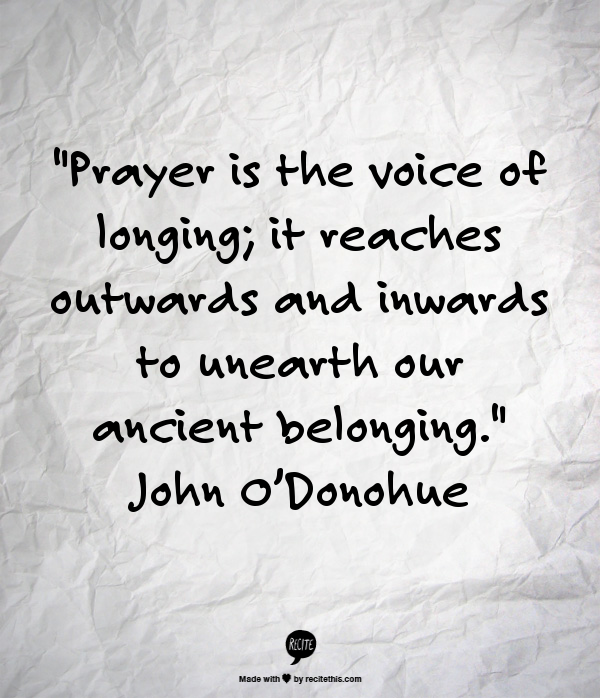
When we are suffering and turn to prayer, no matter what the apparent reasons for our pain, the basic cause is always the same: we feel separate and alone.  Our reaching out is a way of relieving ourselves of this pain of isolation.  Yet the bodhisattva’s aspiration radically deepens the meaning of prayer by guiding us to also turn inward.  We discover the full purity and power of prayer by listening deeply to the suffering that gives rise to it. Like a great tree, such prayer sinks its roots into the dark depths in order to reach up fully to the light. This is what I call mindful prayer—opening wakefully to our suffering and allowing ourselves to reach out in our longing for connection.  Irish poet and priest John O’Donohue writes: “Prayer is the voice of longing; it reaches outwards and inwards to unearth our ancient belonging.” The more fully we touch our pain and longing, the more fully we are released into boundless, compassionate presence.

via Tara Brach – Essence of Mindful Prayer.

Why We Sometimes Enjoy Pity and How to Stop

See on Scoop.itLiving Business

Why pity-seeking becomes a habit, it can interfere with our happiness and our relationships.

Todd Lohenry‘s insight:

“A man cannot be comfortable without his own approval.” ~Mark Twain. Read that again. Did you see comfortable or uncomfortable? The first time I read it I thought it was another take on the classic Eleanor Roosevelt quote "No one can make you feel inferior without your consent." but Twain’s quote speaks to the need for self-compassion…

See on tinybuddha.com

Make Mistakes

See on Scoop.itLiving Business

Make mistakes, learn from them, laugh about them, and move along.

Todd Lohenry‘s insight:

The key to me is how do I talk to myself when I’ve made a ‘mistake’. Not treating myself with self-compassion is the biggest mistake or what the Buddha called the ‘second arrow’. If the first arrow is the mistake, not treating myself with compassion is like shooting myself with a second arrow…

See on www.lifehack.org

Closing the Compassion Gap: Andy Bradley at TEDxBrighton

See on Scoop.itLiving Business

Growing up in a family run care home, Andy Bradley discusses how his experiences with the elderly have helped him to better understand how we can provide com…

See on www.youtube.com

Wholeness and Compassion

begethers's avatarKnowing You Matter

As I say at the beginning of this video (closing the compassion gap) ‘what unites us in our vulnerability’.

I am noticing in my work and my life alongside my family and friends that compassion is more fully released and expressed through adversity and grief being acknowledged and validated. Our shared experience of pain and loss unlocks the energy and intention to meet suffering with kindness; this is our loving nature. Compassion is not partial, it should not be ‘reserved for patients’ – this is pity and is smothering. Compassion is all round us, literally right under our noses as kindness is never more than a breath away.

In health and social care there is a paradox – a subtle violence is done to those who struggle daily to show compassion (often in spite of the task and process driven system and culture) by not asking them about the impact…

View original post 411 more words

Pema Chodron On Faith, Anger & Divorce

I like listening to Pema Chodron:

Here at MBG, we love Pema Chodron, and were thrilled to discover this candid conversation between the great Buddhist monk and Bill Moyers on PBS. 

In this interview, Pema Chodron talks about the pain and anger she felt after her divorce and explains how her strong emotions drove her to her spiritual practice. 

“If we could learn to not be afraid of groundlessness, not be afraid of insecurity and uncertainty,” she says, “it would be calling on an inner strength that would allow us to be open and free and loving and compassionate in any situation.”

With gems like this, the entire video is worth a watch. 

via Pema Chodron On Faith, Anger & Divorce (Video).

http://www.youtube.com/watch?feature=player_embedded&v=jTfx-fm_ZzU

Brain can be trained in compassion, study shows

See on Scoop.itLiving Business

A new study by researchers at the Center for Investigating Healthy Minds at the Waisman Center of the University of Wisconsin-Madison shows that adults can be trained to be more compassionate. The report, published in Psychological Science, a journal of the Association for Psychological Science, investigates whether training adults in compassion can result in greater altruistic behavior and related changes in neural systems underlying compassion.

“Our fundamental question was, ‘Can compassion be trained and learned in adults? Can we become more caring if we practice that mindset?'” says Helen Weng, lead author of the study and a graduate student in clinical psychology. “Our evidence points to yes.”

See on www.sciencedaily.com

Can People Choose Their Emotions Like Spock?

Zachary Quinto as Spock in the 2009 Star Trek film

Troy Campbell writes:

In Star Trek Into Darkness, Spock claims he can choose whether or not to feel an emotion. He makes a good case that in certain situations feelings would not functionally help him and that resisting feelings would spare him from suffering. The always emotionally charged Captain Kirk asks Spock how he does it, claiming that he himself cannot. Continue reading “Can People Choose Their Emotions Like Spock?”

Compassion…

You Say, ‘Jesus Is the Only Way’!”

I might lose a friend or two over this post, but over the weekend, I read an article by Dr. Steve McSwain on the Huffington Post and it rocked my world! I curate it here:

To those who know me, it is no surprise that I was born with a WHY chromosome.

Because I was so fortunate as to travel the world during my teen years…those highly impressionable years…I’ve seen things, heard things, experienced things that became fertile soil to my many questions.

I was raised in a Southern Baptist pastor’s home. Everyone I knew was Christian. Most were Baptist. Even if you did not go to church, you regarded yourself as Christian and, very often, as Baptist, too. So, the nearest thing to me of a person of another “religion” was a Catholic.

Yet, on more than one occasion, I’ve stood with thousands of other actual Catholics in St. Peter’s Square in Rome…as they eagerly awaited a blessing from the Pope… and, as I watched with curiosity… wonder… questions.

Continue reading “You Say, ‘Jesus Is the Only Way’!””

It’s easy to show skin…

See on Scoop.itLiving Business

It’s easy to show skin. It takes bravery to show humility, vulnerability, compassion, heart, kindness, and self-respect. -Mandy Hale

See on www.livelifehappy.com

Cultivating Compassion…

See on Scoop.itLiving Business

We each have the potential to live with a compassionate, open heart. In this talk we explore the conditioning that closes us off to authentic caring, and the…

See on www.youtube.com

Compassion is a Verb

See on Scoop.itLiving Business

Love this, and these few short quotes on kindness…

See on taralemieux.blogspot.com

The Dalai Lama on the Ultimate Source of Happiness

Tara Lemieux shared this:

“So inner peace is the ultimate source of happiness, joyfulness.”

His Holiness, the Dalai Lama (in an excerpt from the film “Dalai Lama Renaissance”) provides a simple view of inner peace, happiness, God and money.

And, it’s not what you think it is.

Why do I practice compassion?

It’s not for the “him,” or the “them,” or the “they”—it’s for me, and to bring inner peace to all of my days.

via Mindful Musings: The Dalai Lama on the Ultimate Source of Happiness..

Self-compassion resources…

Click the image to go to a new page of resources I just curated...
Click the image to go to a new page of resources I just curated…

The freedom of yes…

How do we accept ourselves or others when our actions are causing harm? Does acceptance mean passivity? Does it undermine our efforts towards change? This talk responds to these questions with a simple, illuminating and challenging principle about genuine transformation: Acceptance is the prerequisite of true healing and awakening. Only when we’ve paused to recognize and allow this moment’s experience to be fully as it is, can we respond from our intelligence and compassion to prevent future suffering…

Forget Self-Esteem: You Need Self-Compassion to Succeed

Heidi Grant Halvorson writes:

If you look under the Self-Help heading on Amazon, you’ll find roughly 5,000 books listed under the sub-head Self-Esteem. The vast majority of these books aim to not only tell you why your self-esteem might be low, but to show you how to get your hands on some more of it. It’s a thriving business because self-esteem is, at least in Western cultures, considered the bedrock of individual success.

You can’t possibly get ahead in life, the logic goes, unless you believe you are perfectly awesome. Continue reading “Forget Self-Esteem: You Need Self-Compassion to Succeed”

More self-compassion…

51RDx3TrpPL._BO2,204,203,200_PIsitb-sticker-arrow-click,TopRight,35,-76_SX225_SY300_CR,0,0,225,300_SH20_OU01_I’m reading a new book on self-compassion that looks very promising. It’s called The Mindful Path to Self-Compassion: Freeing Yourself from Destructive Thoughts and Emotions. Here is an excerpt from the introduction:

Life is tough. Despite our best intentions, things go wrong, sometimes very wrong. Ninety percent of us get married, full of hope and optimism, yet 40% of marriages end in divorce. We struggle to meet the demands of daily life, only to find ourselves needing care for stress-related problems like high blood pressure, anxiety, depression, alcoholism, or a weakened immune system. How do we typically react when things fall apart? More often than not, we feel ashamed and become self-critical: “What’s wrong with me?” “Why can’t I cope?” “Why me?” Continue reading “More self-compassion…”

Dove Experiment Aims to Change the Way You See Yourself

Mashable writes:

Dove posted on Monday a three-minute ad on YouTube that teaches a vital lesson about how we view ourselves compared to how others see us. Trust us, it’s worth your time.

A former forensic artist for the San Jose police department met a series of women and asked each to describe the way they look. He had no way of seeing them behind a curtain. He prompted them to detail everything: hair length, facial structure, their most prominent features. He then sketched each participant from their self-description.

Each woman was asked before the study to get to know one of the other participants. The forensic artist then prompted each woman to describe the other’s face.

via Dove Experiment Aims to Change the Way You See Yourself.

Continue reading “Dove Experiment Aims to Change the Way You See Yourself”

Start a Blog at WordPress.com.

Up ↑