
The Sure Heart’s Release…
Our longing is to realize and embody loving presence, yet we each have deeply conditioned habits that bind our hearts. This talk reflects on these habits, and explores how we can free ourselves by bringing a mindful, compassionate attention to places where we are most trapped in feeling separate, fearful and unworthy…
Part 1…
Part 2…
Practice compassion…

Practice compassion…
We could be better
Apparently most people agree — it is ‘about me’! Except, when we all agree it’s ‘about me’, there is no compassion and society breaks down…


“Although people say they want to be thanked more often at work, fewer than 50% of Americans polled for the John Templeton Foundation, a philanthropic organization, reported that they would be very likely to thank salespeople, their mail carriers, or cleaning crews, and just 15% express daily gratitude to friends or colleagues. 74% never or rarely express gratitude to their bosses—but 70% said they’d feel better about themselves if their bosses were more grateful.”
~ Andrew O’Connell – We Could Be Better At Giving Thanks, Harvard Business Review
Credits: Stats from HBR. Image: snoopn4pnuts.com
Compassion…

Compassion…
I’m Not Selfish. I Love Myself.

This is part of a great post by Hayley Hobson on Positively Positive:
There is a radical difference between selfish and self-love.
Selfish is acting in complete disregard for others. Self-love means nurturing yourself so you are able to give back with vitality and compassion.
We’re not supposed to be self-sacrificing, are we?
It’s already difficult enough in our modern world for a woman with purpose (like me) to balance relationship, friendship, and children with our own aspirations. Don’t you think?
Get the rest here: I’m Not Selfish. I Love Myself. « Positively Positive.
Self compassion
Dr. Kristen Neff on the topic of self-compassion…
Mindful compassion
Interesting video on mindful compassion…

As much as i understand that compassion is a important virtue not just for being a better you, but also to make sense of things we cant accept and have to deal, unfortunately without a choice. And in those moments, if we can bring about some compassion, within, we struggle a little less.
I like to learn more about compassion, not just as a virtue, but as a science that works (such as mindfulness)
Here is a talk that combines both and Paul Gilbert makes it humorous

Self-Compassion and Setbacks
Another great post from Barb Markway…

 I originally wrote this for Psychology Today, but I think the information may also be useful to my awesome readers here. Haven’t we all had the experience of trying to change something–maybe exercise more, quit smoking, or eat healthy? We do great for awhile and then boom, we “mess up.” How do we keep a setback from turning into a major relapse, and along with it, feeling awful about ourselves? Here are some gentle suggestions (on Psychology Today, they’d be called “tips.” Oh, and they’d also be numbered.)
Expect setbacks. Change takes time, and often frequent tries. For example, according to the U.S. Centers for Disease Control and Prevention, most smokers require 5 to 7 attempts before they finally quit. Did these people fail the 5 to 7 times prior to the final cessation of smoking? Or were these attempts part of their eventual success? Consider thinking of…
View original post 861 more words
From Story to Presence…
 A ‘quote*’ from Tara Brach’s meditation “From Story to Presence”…
“The reality is each one of us has caused hurt to other people and each one of us has been hurt by other people. But if we keep running the story of “You hurt me; you’re bad” or “I hurt you; I’m bad” all that happen is a looping that creates separation. What if instead we say the story is that I hurt you and we let that story be there, we don’t put it aside too quickly…
We let it be there and we feel what it feels like in our body. The very presence with that vulnerability awakens compassion. Now the trick — because this is where there can be more suffering is to take the story “I caused you suffering” and to get stuck on the “I’m bad, I’m bad, I’m bad”. We’re wedded to the story and we don’t have access to deeper presence…
So the pathway I am describing to you, and it takes a real sensitivity, is that when stories arise in our mind — to not to quickly go ‘it’s just a story, back to the breath’ because that is just another form of aversion and denial — is to let it be there a bit, but not to believe the story.”
She goes on to say “the story behind some of the more drama stories is really the story of Self. As we open to this presence, we wake up out of that core story that keeps us separate”.
You can hear the whole talk here:
*I tried to transcribe it as best I could; this is NOT an official transcription…
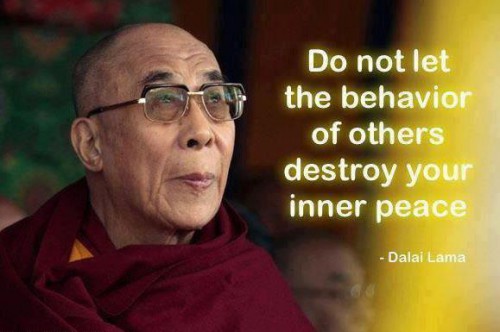
The Authentic Search for God…

Dr. Steve McSwain writes:
In an authentic search for God, the cosmos of inclusiveness just keeps widening and expanding, not unlike the ever-expanding universe in which we live.
That’s a bit of a paraphrase of something Fr. Richard Rohr says in his book Immortal Diamond. It has been my experience, too. It seems the more aware I become of the Immortal Presence, the wider my heart stretches to include all persons…all faiths…all traditions.
Without judgment. With love. Continue reading “The Authentic Search for God…”
Fall in Love With Yourself
Nicole Urdang writes:
What happens when you fall in love?
Your world suddenly shifts completely to the other person. You pay them undivided attention, listen to what they want, and try to give it to them.
Your heart opens.
You want the best for them.
You become wildly generous in all ways.
You show patience, tolerance, and understanding.
You give them the benefit of the doubt.
You focus on their best qualities and ignore the rest.
You are affectionate, considerate, complimentary, and loving.
You crave their company.
You trust them.
You even like their quirky behaviors.
You support and encourage them.
You feel protective and have their back.
You forgive easily.
Now, imagine giving all those wonderful things to yourself.
Really imagine it.
Slowly.
Meditatively.
Each and every one.
How does that feel?
If it’s fabulous, turn your reverie into action. Do everything you possibly can to show yourself tenderness, consideration, patience, and compassion.
Now, watch how your relationship with yourself changes.
Lest some of you think this is narcissistic, it is not. Falling in love with yourself doesn’t mean you think you’re better than anyone else, just equally deserving of kindness, compassion, and time. You realize how wonderfully healing it can be to appreciate and care for yourself. Paradoxically, the more lovingly you treat yourself, the more tenderness, compassion, and patience you will have for others.
via Fall in Love With Yourself | Holistic Divorce Counseling.
How Do You Find Self-Worth When You Don’t Like Yourself?
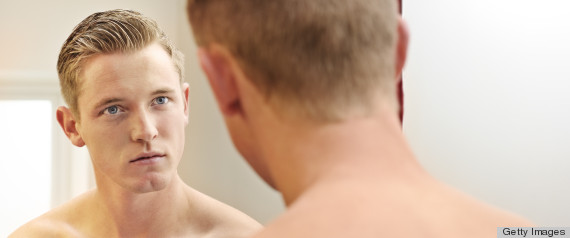
My friend Michael Rohrer writes:
Being desired is such a basic craving. We all want to be desired: by our family, by our friends, by a lover, by our coworkers. What happens when we don’t desire ourselves?
I’m beginning to realize that I don’t like myself very much. All these years of feeling like I couldn’t raise the eyebrow or pique the interest of an attractive man might actually stem from the fact that I’m exuding the pheromones of one who feels unworthy of being loved and therefore thinks he’s undesirable to all. Could it be that simple? I’m sure I’m not the only gay man — or person — who feels or has felt this way. Do you have to love yourself before you can love someone else or be loved by someone else? Is that a myth?
I keep wondering if I’ll ever love myself enough to be loved by another person. I hate being vulnerable, but vulnerability is key to opening one’s heart to another person. For years I’ve told myself, “When the right person shows up, I’ll know, and my heart will automatically open.” Is that utter bullshit?
Continue reading: How Do You Find Self-Worth When You Don’t Like Yourself? | Michael Rohrer.
A few years ago, I would not have touched the HuffingtonPost with a 10 foot mouse [now I have 100 fans there!] and I certainly would not have curated an article by a gay man. In the time between, however, many thinks [intentional] have changed. “We all want to be desired: by our family, by our friends, by a lover, by our coworkers.” This desire makes us all human and should unite, rather than divide…
Over 10 years ago, The Telegraph reported:
Whether you hail from Surbiton, Ulan Bator or Nairobi, your genetic make-up is strikingly similar to that of every other person on Earth, an analysis concludes today.
Although scientists have long recognised that, despite physical differences, all human populations are genetically similar, the new work concludes that populations from different parts of the world share even more genetic similarities than previously assumed.
All humans are 99.9 per cent identical and, of that tiny 0.1 per cent difference, 94 per cent of the variation is among individuals from the same populations and only six per cent between individuals from different populations.
Nonetheless, the team found that tiny differences in DNA can provide enough information to identify the geographic ancestry of individual men and women.
The results of the study, published today in the journal Science, have implications for understanding ancient human migrations and for resolving an ongoing debate about the use of family histories in medical research, said Prof Marcus Feldman of Stanford University who led the team.
via DNA survey finds all humans are 99.9pc the same – Telegraph.
Are we not, then, all interconnected persons? All sparks of the divine? All stardust?
Tara Brach writes:
Because so many of us grew up without a cohesive and nourishing sense of family, neighborhood, community or “tribe,” it is not surprising that we feel like outsiders, on our own and disconnected. We learn early in life that any affiliation—with family and friends, at school or in the workplace—requires proving that we are worthy. We are under pressure to compete with each other, to get ahead, to stand out as intelligent, attractive, capable, powerful, wealthy. Someone is always keeping score.
After a lifetime of working with the poor and the sick, Mother Teresa’s surprising insight was: “The biggest disease today is not leprosy or tuberculosis but rather the feeling of not belonging.” In our own society, this disease has reached epidemic proportions. We long to belong and feel as if we don’t deserve to.
D.H. Lawrence described our Western culture as being like a great uprooted tree with its roots in the air. “We are perishing for lack of fulfillment of our greater needs,” he wrote, “we are cut off from the great sources of our inward nourishment and renewal.”
Lo, these many years I turned to ‘tribes’ — Christian Fundamentalists, The Republican Party, The Green Bay Packers — to make me feel right inside when in truth everything inside me was screaming at me from the mirror that everything inside me was wrong, and to compensate for the lack of a cohesive, nourishing sense of belonging. By learning about and practicing self-compassion, however, I am making progress in making peace with myself, my past, my present and my future…
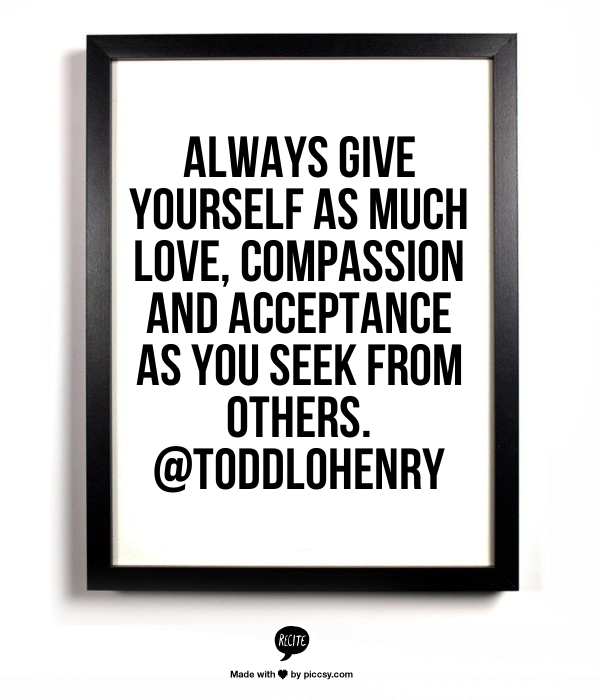
Thank you for your post, Michael, and for giving me pause to think about this topic. I agree that thinking our hearts will ‘automatically open’ is utter bullshit but, that if we practice self-compassion our hearts may slowly and gently open to the possibility of healthy interdependence and my hope is that when we are able to give ourselves at least the same amount of love, compassion and acceptance we seek from others, the craving to be desired may pass away. Namasté!
Related articles
- Tara Brach: The Trance of Fear (toddlohenry.com)
- Living Whole-Heartedly (toddlohenry.com)
- Taking refuge in the Buddha (toddlohenry.com)
- Define Your Own Happiness (toddlohenry.com)
- Awakening Now (toddlohenry.com)
Switcheroo
Thank you, Hope! Practice self compassion in all you do and with all you meet…
Reflections of my life…

This song which was popular when I was 11 reflects the quiet despair I have felt for much of my life…
As I approach my 55th birthday tomorrow, I truly believe my best days are ahead of me. My plan for me…
Reject shame in all its forms.
Practice self-compassion and lovingkindess and wholeheartedness will follow.
Practice mindfulness and live in the now.
Remember what other people do is their karma. How I respond is mine.
Follow my dharma…
That’s all…
“May all beings everywhere be happy and free. May the thoughts and actions of our lives contribute to that happiness and to that freedom for all.”
Random images [click to enlarge]…


I’m no longer political but I still cherish this picture…


tumblr m52de7alsw1r7dgeuo1 1280
The Opposite of Doubt
 Kaveri Patel writes:
Doubt has been a constant companion, a shadow friend I could not escape. No matter how hard I tried to see if anyone else stood behind her, she’d contort herself in strange ways to block my view. Continue reading “The Opposite of Doubt”
Hearts Set Free…

Psychologist and writer Barb Markway shares this this ‘Independence Day’:
The Self-Compassion Bill of Rights
Today, this fourth day of July, year two thousand and twelve, I, Barbara Ellen Gerth Markway, do solemnly declare these inalienable truths and freedoms for myself, and for my Self-Compassion Project friends. Continue reading “Hearts Set Free…”
Awakening Now
At this moment [which is all I have and all I am] this seems to me to be the most beautiful poem I have ever read:
Why wait for your awakening?
The moment your eyes are open, seize the day.
Would you hold back when the Beloved beckons?
Would you deliver your litany of sins like a child’s collection of sea shells, prized and labeled?
“No, I can’t step across the threshold,” you say, eyes downcast.
“I’m not worthy” I’m afraid, and my motives aren’t pure.
I’m not perfect, and surely I haven’t practiced nearly enough.
My meditation isn’t deep, and my prayers are sometimes insincere.
I still chew my fingernails, and the refrigerator isn’t clean.
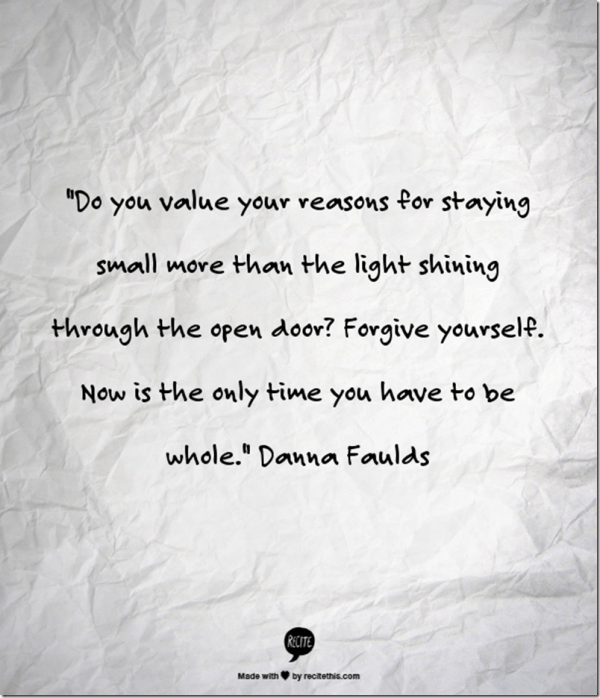
“Do you value your reasons for staying small more than the light shining through the open door?
Forgive yourself.
Now is the only time you have to be whole.
Now is the sole moment that exists to live in the light of your true Self. Perfection is not a prerequisite for anything but pain.
Please, oh please, don’t continue to believe in your disbelief.
This is the day of your awakening.
If this poem resonates with you as well, here are two Tara Brach meditations on self-compassion that I’d like to share with you. “All I plead with you is this” she says “make love of yourself perfect”…
Listen here:
Segment 1: 2011-03-23-Part-1-Healing-Power-of-Self-Compassion
Segment 2: 2011-03-30-Part-2-Healing-Power-of-Self-Compassion
 Bright, shiny objects!
You must be logged in to post a comment.