Loving Ourselves Unconditionally

More Melody Beattie:

“Love yourself into health and a good life of your own.

Love yourself into relationships that work for you and the other person. Love yourself into peace, happiness, joy, success, and contentment.

Love yourself into all that you always wanted. We can stop treating ourselves the way others treated us, if they behaved in a less than healthy, desirable way. If we have learned to see ourselves critically, conditionally, and in a diminishing and punishing way, it’s time to stop. Other people treated us that way, but it’s even worse to treat ourselves that way now.

Loving ourselves may seem foreign, even foolish at times. People may accuse us of being selfish. We don’t have to believe them.

People who love themselves are truly able to love others and let others love them. People who love themselves and hold themselves in high esteem are those who give the most, contribute the most, and love the most.

How do we love ourselves? By forcing it at first. By faking it, if necessary. By acting as if. By working as hard at loving and liking ourselves as we have at not liking ourselves.

Explore what it means to love yourself.

Do things for yourself that reflect compassionate, nurturing, self love.

Embrace and love all of yourself – past, present, and future. Forgive yourself quickly and as often as necessary. Encourage yourself. Tell yourself good things about yourself.

If we think and believe negative ideas, get them out in the open quickly and honestly, so we can replace those beliefs with better ones.

Pat yourself on the back when necessary. Discipline yourself when necessary. Ask for help, for time; ask for what you need.

Sometimes, give yourself treats. Do not treat yourself like a pack mule, always pushing and driving harder. Learn to be good to yourself. Choose behaviors with preferable consequences – treating yourself well is one.

Learn to stop your pain, even when that means making difficult decisions. Do not unnecessarily deprive yourself. Sometimes, give yourself what you want, just because you want it.

Stop explaining and justifying yourself. When you make mistakes, let them go. We learn, we grow, and we learn some more. And through it all, we love ourselves.

We work at it, and then work at it some more. One day we’ll wake up, look in the mirror, and find that loving ourselves has become habitual. We’re now living with a person who gives and receives love, because that person loves him or herself. Self-love will take hold and become a guiding force in our life.

Today, I will work at loving myself. I will work as hard at loving myself as I have at not liking myself. Help me let go of self-hate and behaviors that reflect not liking myself. Help me replace those with behaviors that reflect self-love. Today, God, help me hold myself in high self-esteem. Help me know I’m lovable and capable of giving and receiving love.

From The Language of Letting Go by Melody Beattie ©1990, Hazelden Foundation. All rights reserved.” via the language of letting go | Tumblr.

Warning! Video: NSFW…

Impatience

“The hardest thing about practicing patience is that practicing impatience feels so justified.” via May 24 | Language of Letting Go.

Life is not to be endured

More wisdom from Melody Beattie:

“Life is not to be endured; life is to be enjoyed and embraced.

The belief that we must square our shoulders and get through a meager, deprived existence for far-off “rewards in Heaven” is a codependent belief.

Yes, most of us still have times when life will be stressful and challenge our endurance skills.  But, in recovery, we’re learning to live, to enjoy our lives, and handle situations as they come.

Our survival skills have served us well.  They have gotten us through difficult times-as children and adults.  Our ability to freeze feelings, deny problems, deprive ourselves, and cope with stress has helped us get where we are today.  But we’re safe now.  We’re learning to do more than survive.  We can let go of unhealthy survival behaviors.  We’re learning new, better ways to protect and care for ourselves.  We’re free to feel our feelings, identify and solve problems, and give ourselves the best.  We’re free to open up and come alive.

Today, I will let go of my unhealthy endurance and survival skills.  I will choose a new mode of living, one that allows me to be alive and enjoy the adventure.”

Source: this is a quote “Life is not to be endured; life is to be… | turtle_dove on Xanga

Times of Reprogramming

“Do not ask for success unless you’re ready to conquer the behaviors that would sabotage success.” Melody Beattie via Language of Letting Go – May 22 – Times of Reprogramming – SoberRecovery : Alcoholism Drug Addiction Help and Information.

Getting Needs Met

“I want to change careers . . .  I need a friend . . . I’m ready to be in a relationship . . .

Regularly, we become aware of new needs. We may need to change our behavior with our children. We may need a new couch, love and nurturing, a dollar, or help.

Do not be afraid to recognize a want or need. The birth of a want or need, the temporary frustration from acknowledging a need before it’s met, is the start of the cycle of receiving what we want. We follow this by letting go, then receiving that which we want and need. Identifying our needs is preparation for good things to come.

Acknowledging our needs means we are being prepared and drawn to that which will meet them. We can have faith to stand in that place in between.

Today, I will let go of my belief that my needs never get met. I will acknowledge my wants and needs, and then turn them over to my Higher Power. My Higher Power cares, sometimes about the silliest little things, if I do. My wants and needs are not an accident. God created me and all my desires.” via Daily Meditation ~ Getting Needs Met – Miracles In Progress Codependents Anonymous Group.

Sadness

Melody Beattie shares this:

“Ultimately, to grieve our losses means to surrender to our feelings.

So many of us have lost so much, have said so many good byes – have been through so many changes. We may want to hold back the tides of change, not because the change isn’t good, but because we have had so much change, so much loss.

Sometimes, when we are in the midst of pain and grief, we become shortsighted, like members of a tribe described in the movie Out of Africa.

“If you put them in prison,” one character said, describing this tribe, “they die.”

“Why?” asked another character.

“Because they can’t grasp the idea that they’ll be let out one day. They think it’s permanent, so they die.”

Many of us have so much grief to get through. Sometimes we begin to believe grief, or pain, is a permanent condition.

The pain will stop. Once felt and released, our feelings will bring us to a better place than where we started. Feeling our feelings, instead of denying or minimizing them, is how we heal from our past and move forward into a better future. Feeling our feelings is how we let go.

It may hurt for a moment, but peace and acceptance are on the other side. So is a new beginning.

God, help me fully embrace and finish my endings, so I may be ready for my new beginnings.” via Language of Letting Go – May 20 – Sadness – SoberRecovery : Alcoholism Drug Addiction Help and Information.

Why does life have to be so hard?

“Why does doing this have to be so hard?” I asked a friend one day.

“It doesn’t,” he said.

Challenge: Unquestionably, life can be tough and chal­lenging at times. It hurts. It can be scary and confusing. Many of us have had to garner great amounts of strength and courage to face difficult situations. There are times when endurance and rising to the occasion are important survival skills. It equally important to know when an easy-does-it approach is enough.” via May 18.

Don’t Stop Living Your Life

“So often, when a problem occurs, inside or around us, we revert to thinking that if we put our life on hold we can positively contribute to the solution. If a relationship isn’t working, if we face a difficult decision, if we’re feeling depressed, we may put our life on hold and torment ourselves with obsessive thoughts.

Abandoning our life or routines contributes to the problem and delays us from finding the solution.

Frequently, the solution comes when we let go enough to live our life, return to our routine, and stop obsessing about the problem.

Sometimes, even if we don’t feel like we have let go or can let go, we can act as if we have, and that will help bring about the letting go we desire.

You don’t have to give up your power to problems. You can take your focus off your problem and direct it to your life, trusting that doing so will bring you closer to a solution.

Today, I will go on living my life and tending to my routine. I will decide, as often as I need to, to stop obsessing about whatever is bothering me. If I don’t feel like letting go of a particular thing, I will act as if I have let go of it until my feelings match my behavior.” via Language of Letting Go – May 18 – Don’t Stop Living Your Life – SoberRecovery : Alcoholism Drug Addiction Help and Information.

Don’t overdo it

“So, you surrendered. You let go. Now you’re ready to face a particular challenge. So you hunker down and garner all your forces. And you hit the wall again.

“What’s wrong?” you may ask. “I’m doing all the spir­itual things I’m supposed to do. And things still aren’t working. I can’t get anywhere.”

Did you ever try to get a key to unlock a door, and you tried and tried, and the key just wouldn’t open it? The harder you tried, the more frustrated you became. So you stopped trying for a while, relaxed, and tried again. Voila. The key fit perfectly and the slightest turn unlocked the door.

Many of us live our lives that way While some people may not try at all, we may be trying too hard. There’s a gentler way of being in the world, of trying things, doing things, going about our business.

Whether I’m tackling a specific project, enjoying a new relationship, or grinding through some miserable sit­uation, my first inclination is to force myself and try too hard. If one cup of tea tastes good, I’ll drink five. If I want to express love or concern for someone, I’ll overdo it.

“If it’s worth doing, it’s worth doing well,” doesn’t mean if it’s worth doing, try harder and harder. Doing it well means relaxing and letting the actions unfold—gently, naturally without force. We don’t have to make things happen. We can learn to take our part in letting them happen. It is really okay to ease up a little. We don’t have to think that hard, try that hard, feel that hard, do quite so much. Pull back a little. Relax.

When force and trying harder doesn’t do it, try some­thing else.

Value: “Easy does it” is the value this week.” via May 16.

Climb the highest mountain

“We can climb the highest mountains and navigate the darkest valleys. We can do anything. Just not all at once.” Melody Beattie via May 15 | Language of Letting Go.

Eating life one bite at a time

“Thank God for the ability to break life down into days.

Gratitude Focus: We can start and end each day by being grateful for everything that happened in it and the help we encountered along the way.” via May 14.

Codepedence is not just an issue for partners of addicts

I don’t normally curate this much content in one ‘swell foop’ as I like to say but Melody Beattie’s perspective on owning your own stuff and Mark Brower’s comments on same were so good I couldn’t find anything to exclude. Mark starts out and then quotes my ‘Language of Letting Go’ reading for today…
Many of us struggle with codependency. When addiction is present in a relationship, the old model was that the addict was “dependent” and his or her spouse was “codependent.” But today we know that usually both the addict and spouse struggle with codependency in its various forms.

Codependency happens when we lose touch with our sense of self, and become over-dependent on how other people are doing, and/or how they perceive us. Since we are not “okay” with ourselves, we have to work overtime to ensure that other people around us are doing okay, and/or that they feel good about us.

So we wind up tolerating things we shouldn’t tolerate, feeling responsible for things we shouldn’t feel responsible for, and compromising what we want simply in order to please someone else. This inevitably leads to distress and frustration, which causes the addict to move deeper into their addiction, and for the addict’s spouse to cope in other ways.

The issue of codependence is complicated for Christians, because it gets mixed up with our desire to love and serve other people. The Bible tells us to “consider others better than ourselves.” But the same Bible also tells us to love our neighbor as ourselves, which presupposes some sort of healthy self-regard. The Bible also portrays Jesus himself taking time away from the crowds – not being “nice” and doing what they want him to do – in order to rest and reconnect with God the Father.

The trick to living a recovery life in relationships with others is to know how to separate healthy love with unhealthy codependence.

Melody Beattie has been a great help for me over the years with her many books on this topic. One of her best books on this topic is a daily meditation book called “The Language of Letting Go.”

In another article on this blog, I wrote about codependence, and quoted at length from her book. But it’s so good and helpful that I want to quote some more! What follows are some excerpts about the issue of “Property Lines”:

A helpful tool in our recovery, especially in the behavior we call detachment, is learning to identify who owns what. Then we let each person own and possess his or her rightful property.

If another person has an addiction, a problem, a feeling, or a self-defeating behavior, that is their property, not ours. If someone is a martyr, immersed in negativity, controlling, or manipulative, that is their issue, not ours.

If someone has acted and experienced a particular consequence, both the behavior and the consequence belong to that person.

People’s lies, deceptions, tricks, manipulations, abusive behaviors, inappropriate behaviors, cheating behaviors, and tacky behaviors belong to them, too. Not us.

People’s hopes and dreams are their property. Their guilt belongs to them too. Their happiness or misery is also theirs. So are their beliefs and messages.

If some people don’t like themselves, that is their choice. Their choices are their property, not ours. What people choose to say and do is their business.

What is our property? Our property includes our behaviors, problems, feelings, happiness, misery, choices, and messages; our ability to love, care, and nurture; our thoughts, our denial, our hopes and dreams for ourselves. Whether we allow ourselves to be controlled, manipulated, deceived, or mistreated is our business.

In recovery, we learn an appropriate sense of ownership. If something isn’t ours, we don’t take it. If we take it, we learn to give it back. Let other people have their property, and learn to own and take good care of what’s ours.

Today, I will work at developing a clear sense of what belongs to me, and what doesn’t. If it’s not mine, I won’t keep it. I will deal with myself, my issues, and my responsibilities.

If you want to learn more about codependence, consider signing up for the Recovery Journey, an e-course for people in recovery from sexual struggles. If you are the partner of someone who struggles, note that we have a special module with materials just for the partners. You can learn more about this program at the website: http://recoveryjourney.com

Source: Codepedence is not just an issue for partners of addicts | sexualsanity.com

Codependence is a constant battle for me and it has made made my wife’s vacation in Italy even more difficult than the simple logistics of trying to run a business and hold down the fort with 4 boys while she’s gone but by the grace of God, with the help of Celebrate Recovery, my good friends Sandy and Steve and Melody Beattie’s good thoughts. we are winning on this trip! If these issues resonate with you, drop me a note below. I’ll be happy to share with you what I have…

One day at a time…

“It’s easy to look at all the tasks and unsolved problems and feel so pressured that we get paralyzed and don’t get any­thing done. It takes discipline to gather in our scattered forces and focus on one thing, one day, one step, and some­times one hour—even when taking only that one step can seem so trivial in the face of all that looms.

Would you rather try to do everything at once and get nothing done, or take one small step and do that well? Remember, one plus one equals two.

Inventory Focus: Are you creating unnecessary fear and drama by taking on more than you can handle? Are you willing to trade in the I’m-out-of-control-and-overwhelmed feeling for a sense of manageability? Do you have any history with deliberately living life one day or one step at a time? How did that work? Plans, goals, and dreams are good, but the only way to get there is one day at a time.via May 12.

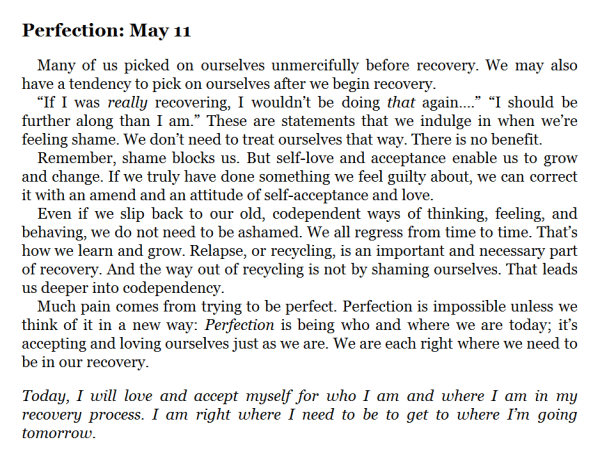
Perfection?

Another great perspective from Melody Beattie…

Melody Beattie

Easy does it…

“I watched a friend set up beach chairs and an umbrella. He was grunting, groaning, trying with all his might to accomplish a simple task. After he finished, he looked around and clapped the sand off his hands.

“I’m pretty dumb,” he said. “It didn’t have to be that hard or that much work.”

Yes, life really can be easier. Relaxing and letting it unfold can seem too simple and easy at times. What if we really knew that it was okay to gently go about our lives, living and working and handling things at a relaxed pace? What if we knew it was okay to gently take care of ourselves, and that a force would be present to guide us and help us accomplish each task, each problem, in fact, all the parts of our lives?

Life experience truly has taught me that when I relax, I am so much more capable of experiencing great happi­ness as well as simple joys. Things get done, problems get solved, and my needs get met.

Gratitude Focus: We can be grateful for all the situations that teach and remind us that “easy does it” works.” via May 11.

…on One Day at a Time

“Arc you always this happy?” I asked my favorite clerk at the grocery store.

“I am today,” he said.

Doing anything forever – even being happy – can seem like too much. The good news is that we don’t have to do anything forever. Just today.

Challenge: The hardest part about taking life one day at a time is remembering that the present moment is all we have.” via May 10.

…on One Day at a Time

“One day at a time” isn’t a value I acquired because I wanted to. I had to. Now I apply it because I want to.

Application: Sailing through life? Falling in love? Plenty of money? Or maybe things aren’t going that well. Lonely? Dealing with relationship issues? Not sure how the relationship will work out?Your boss is driving you nuts, but you don’t want to quit? Concerned about your child? Whatever circumstances we find ourselves in, taking each day as it comes is a good idea.” via May 9.

…on Taking One Day at a Time

More Melody Beattie…

“My best friend was going through some tough situations in her life. I was in the midst of a hard stretch too. We didn’t particularly like the things we had to do in our lives. We talked about our feelings and decided that what we were going through was necessary and important, even though we didn’t like it.We expressed gratitude for our lives.

“It’s still a dreadful time,” I said.

“Brutal,” she said. “I guess we’re back to the old one­ day-at-a-time approach. We’re so lucky. What do people do that haven’t learned that gem?”

There are times when we can look at the stretch ahead and like what we see. Taking life one day at a time is still a good idea, even when things are going well.

Taking life one day at a time can be particularly use­ful when the road ahead looks dreadful. We may not even know where to start with some challenges. That’s when taking life one day at a time is essential.

“I’ve been using alcohol and other drugs every day since I’ve been twelve years old,” I said to my counselor years ago in treatment. “Now you’re telling me I need to stay sober the rest of my life. Plus get a job. And a life. How am I going to do that?”

“One day at a time,” she said. She was right. Sometimes I had to take life one minute at a time or one hour at a time. And all these years later, it still works.

Value: Taking life one day at a time is the gem we’ll focus on this week.” via May 8.

Fear & Codependency

“Fear is at the core of codependency. It can motivate us to control situations or neglect ourselves. Many of us have been afraid for so long that we don’t label our feelings fear. We’re used to feeling upset and anxious. It feels normal. Peace and serenity may be uncomfortable. At one time, fear may have been appropriate and useful. We may have relied on fear to protect ourselves, much the way soldiers in a war rely on fear to help them survive. But now, in recovery, we’re living life differently. It’s time to thank our old fears for helping us survive, then wave good-bye to them. Welcome peace, trust, acceptance, and safety. We don’t need that much fear anymore. We can listen to our healthy fears, and let go of the rest. We can create a feeling of safety for ourselves, now. We are safe, now. We’ve made a commitment to take care of ourselves. We can trust and love ourselves.

God, help me let go of my need to be afraid. Replace it with a need to be at peace. Help me listen to my healthy fears and relinquish the rest.Beattie, Melody (2009-12-15). The Language of Letting Go (Hazelden Meditation Series) (p. 127). Hazelden. Kindle Edition.

Discover what works for you

Melody Beattie writes:

There is no quick fix, no panacea that will work for every person. Success rarely happens overnight or in five days. Even the Twelve Steps are only suggestions. Although proven to work, the details and decisions about how we apply those Steps in our lives are left to each one of us.

And few things happen overnight, except the beginning of a new day.

Listen to your mentors. Examine what’s been tried and true, and has worked and helped countless others along their paths. The Twelve Steps are one of those approaches. But don’t be taken in by false claims of overnight success and instant enlightenment along your path.

True change takes time and effort, especially when were changing and tackling big issues. We can often get exactly the help we need at times from a therapist, book, or seminar— the best things in life really are free and available to each one of us. The Twelve Steps, again, qualify in this area.

Discover what works for you.

Trust that you’ll be guided along your path and receive exactly the help and guidance you need. Then give it time. There really isn’t an easier, softer way.

God, give me perseverance to tackle my problems.

Source: April 8: Discover What Works for You | Language of Letting Go

Melody Beattie’s work on codependency works for me and has been a tremendous help over the past year as a supplement to the work I am doing in Celebrate Recovery. What is working for you this Easter as you think about resurrection and rebirth?

Start a Blog at WordPress.com.

Up ↑