I watched the video and pulled out a more detailed summary (not a full verbatim transcript, but close enough that you’ll see the phrasing and when things happen). Use it as a reference or to pick which “acts of love” you want to try first…
New Video! – Cat and dog
Testing autopost via ifttt.com. This is a video of my cat Boo showing my son’s dog who is the boss…
Don’t believe what you hear about black cats
The most beautiful animal I ever owned [actually, she owned me!] was a black cat named Boo; far from bringing bad luck, they bring love and affection for those that love them. Now that I know the shelter has a hard time finding homes for them, after Halloween I’m going to adopt some more!
Full story at: Don’t believe what you hear about black cats.
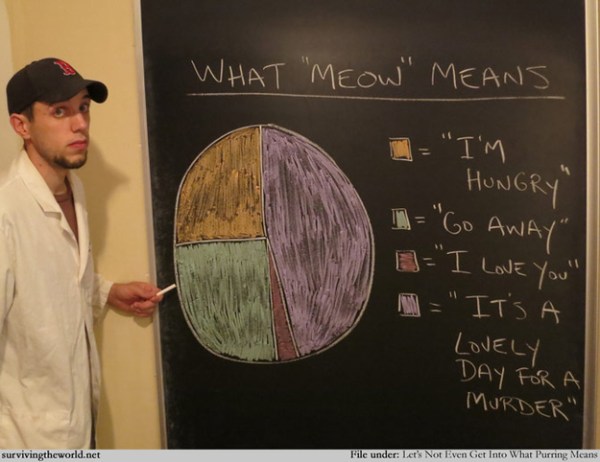
A Handy Guide To What “Meow” Means
Spoiler: Your cat is kind of a jerk.

If you’re not getting daily life advice from Surviving The World, you should be. via A Handy Guide To What “Meow” Means.
Detachment

Melody Beattie writes:
Detachment doesn’t come naturally for many of us. But once we realize
the value of this recovery principle, we understand how vital detachment
is. The following story illustrates how a woman came to understand
detachment.“The first time I practiced detachment was when I let go of my alcoholic
husband. He had been drinking for seven years, since I had married him.
For that long, I had been denying his alcoholism and trying to make him
stop drinking.“I did outrageous things to make him stop drinking, to make him see the
light, to make him realize how much he was hurting me. I really thought
I was doing things right by trying to control him.“One night, I saw things clearly. I realized that my attempts to control
him would never solve the problem. I also saw that my life was
unmanageable. I couldn’t make him do anything he didn’t want to do. His
alcoholism was controlling me, even though I wasn’t drinking.“I set him free, to do as he chose. The truth is, he did as he pleased
anyway. Things changed the night I detached. He could feel it, and so
could I. When I set him free, I set myself free to live my own life.
“I’ve had to practice the principle of detachment many times since then.
I’ve had to detach from unhealthy people and healthy people. It’s never
failed. Detachment works.”Detachment is a gift. It will be given to us when we’re ready for it.
When we set the other person free, we are set free….
Learning healthy detachment has been one of the most difficult things I’ve ever done. I knew how to be attached in an unhealthy way; it’s called codependency. I knew how to be detached in an unhealthy way; it’s called “Eff you — I’m leaving!”. Healthy detachment for me looks a lot like interdependence without giving over control or response-ability to my partner but I can’t say that I’ve mastered it yet or that I will in this lifetime. It may come naturally to some people but it does not come naturally to me — I have to work hard at it every day. I don’t claim perfection — only progress — but I know that learning healthy detachment is one of the best investments I can make in myself…
Related articles
- Codepedence is not just an issue for partners of addicts (toddlohenry.com)
- Choices (toddlohenry.com)
- Sadness (toddlohenry.com)
- Recognizing Choices (toddlohenry.com)
- Directness (toddlohenry.com)
- …on Control (toddlohenry.com)
Letting Go of the Need to Control
Another great post from Melody Beattie – this time on the topic of detachment…
The rewards from detachment are great: serenity; a deep sense of peace; the ability to give and receive love in self-enhancing, energizing ways; and the freedom to find real solutions to our problems.
Letting go of our need to control can set us and others free. It can set our Higher Power free to send the best to us.
If we weren’t trying to control someone or something, what would we be doing differently?
What would we do that we’re not letting ourselves do now? Where would we go? What would we say?
What decisions would we make?
What would we ask for? What boundaries would be set? When would we say no or yes?
If we weren’t trying to control whether a person liked us or his or her reaction to us, what would we do differently? If we weren’t trying to control the course of a relationship, what would we do differently? if we weren’t trying to control another person’s behavior, how would we think, feel, speak, and behave differently than we do now?
What haven’t we been letting ourselves do while hoping that self-denial would influence a particular situation or person? Are there some things we’ve been doing that we’d stop?
How would we treat ourselves differently?
Would we let ourselves enjoy life more and feel better right now? Would we stop feeling so bad? Would we treat ourselves better?
If we weren’t trying to control, what would we do differently? Make a list, then do it.
Today, I will ask myself what I would be doing differently if I weren’t trying to control. When I hear the answer, I will do it. God, help me let go of my need to control. Help me set myself and others free.
Source: March 18: Letting Go of the Need to Control | Language of Letting Go
Detachment is the most difficult of all recovery topics for me. I’m trying to understand the difference between trying to control and having health or reasonable expectations. Maybe there is no such thing as an expectation can have of my wife or children; not if I want to be happy or at peace anyway…
The times I have a glimpse of what detachment looks like are those times when I’m playing with my black cat Boo. I don’t expect Boo to bark like a dog or come when called. She meows and sometimes when it suits her mood she comes when called but I don’t expect her to be something that is not in her nature.
Someday I’ll write a book called ‘Everything I need to know about detachment I learned from my cat’ but I still have much to learn from her…
One of my ‘students’ in the NWTC social media certification course is Ernie Stevens III. Take a moment to watch this video he put together on an upcoming film he’s producing. What an amazing talent — looks like the student is a master… :-D