Through people like Ron Tite, Carrie Klassen and Gemma Stone I’ve met and worked with so many lovely Canadians. Happy Canada Day to you all!

Thinks I find along the way
Through people like Ron Tite, Carrie Klassen and Gemma Stone I’ve met and worked with so many lovely Canadians. Happy Canada Day to you all!

 Terri Cole writes:
Last week’s theme of focusing your energy on what you can do rather than on what makes your feel powerless continues this week as we explore the concept of Living in Non-Reality.
Start by asking yourself if you are in acceptance of certain factual aspects of your life, even if they are not exactly what you want them to be at the moment.
Let’s look at a common example in our lives today – traffic. When you are sitting in traffic, do you complain that if your boss hadn’t called you into a 4:45 pm meeting and you left right at 5pm as planned, you would not be sitting in traffic right now? This line of thinking is living in Non-Reality, and it can permeate all areas of your life if you are not aware of it.
Years ago when I was living in L.A. and spending many hours of my life sitting in traffic, I became aware of my non-reality based inner dialogue. My frustration at “wasting” time inspired elaborate stories of how it was someone else’s fault that I was caught up, and if the facts were just not the facts, I would be freely speeding down the PCH without a care. After a few futile weeks of this behavior, I decided to stop wasting my energy and re-framed my mind about traffic time.
Instead of spinning my wheels (no pun intended), I decided traffic time was my time to restore, to put space between my home and office life. In the morning, it gave me a chance to prepare for the day ahead, and in the evening, it gave me a chance to let go of the daily frustrations and not bring them into my peaceful home. I listened to books on tape, podcasts from interesting speakers and brushed up on my Spanish. This was a much better use of my time than ruminating about whose fault it was that the light turned red before I could cross the intersection.
Although we do have the power to actively change many aspects of our lives, there will always be situations that are out of our control. Your empowerment is in how you manage these events. Can you accept the things you cannot change and surrender to how it is rather than rail against it? Can you find the silver lining, like quality alone time, even when you’re sitting in traffic?
Source: If Only…!
Watch Terri here…

 Melody Beattie shares this:
We feel safe around direct, honest people. They speak their minds, and we know where we stand with them.
Indirect people, people who are afraid to say who they are, what they want, and what they’re feeling, cannot be trusted. They will somehow act out their truth even though they do not speak it. And it may catch everyone by surprise.
Directness saves time and energy. It removes us as victims. It dispenses with martyrdom and games. It helps us own our power. It creates respectful relationships.
It feels safe to be around direct, honest people. Be one.
Today, I will own my power to be direct. I do not have to be passive, nor do I need to be aggressive. I will become comfortable with my own truth, so those around me can become comfortable with me.” via June 23: Directness.
Melody Beattie writes:
Willpower is not the key to the way of life we are seeking. Surrender is.
“I have spent much of my life trying to make people be, do, or feel something they aren’t, don’t want to do, and choose not to feel. I have made them, and myself, crazy in that process,” said one recovering woman.
I spent my childhood trying to make an alcoholic father who didn’t love himself be a normal person who loved me. I then married an alcoholic and spent a decade trying to make him stop drinking.
I have spent years trying to make emotionally unavailable people be emotionally present for me. I have spent even more years trying to make family members, who are content feeling miserable, happy.
What I’m saying is this: I’ve spent much of my life desperately and vainly trying to do the impossible and feeling like a failure when I couldn’t. It’s been like planting corn and trying to make the seeds grow peas. Won’t work!
By surrendering to powerlessness, I gain the presence of mind to stop wasting my time and energy trying to change and control that which I cannot change and control. It gives me permission to stop trying to do the impossible and focus on what is possible: being who I am, loving myself, feeling what I feel, and doing what I want to do with my life.
In recovery, we learn to stop fighting lions, simply because we cannot win. We also learn that the more we are focused on controlling and changing others, the more unmanageable our life becomes. The more we focus on living our own life, the more we have a life to live, and the more manageable our life will become.
Today, I will accept powerlessness where I have no power to change things, and I’ll allow my life to become manageable.” via Daily Meditation ~ Powerlessness & Unmanageability – Miracles In Progress Codependents Anonymous Group.
Today, I am thinking about how to apply this to my in-laws…
My mother in law will never love me like a son and my sibling in laws will never treat me like a brother. Three years ago during the ‘summer of forgiveness’, I made amends and was forgiven and yet I remain in their ‘penalty box‘. I refuse to let myself in an close the lid on top of me. I refuse to play a role in their drama. If I’m not going to get what I need it’s not worth the work…
 Nicholas Bate via BackOfAnEnvelope: Profitability.
The command-and-control approach to management has in recent years become less and less viable. Globalization, new technologies, and changes in how companies create value and interact with customers have sharply reduced the efficacy of a purely directive, top-down model of leadership. What will take the place of that model? Part of the answer lies in how leaders manage communication within their organizations—that is, how they handle the flow of information to, from, and among their employees. Traditional corporate communication must give way to a process that is more dynamic and more sophisticated. Most important, that process must be conversational.
We arrived at that conclusion while conducting a recent research project that focused on the state of organizational communication in the 21st century. Over more than two years we interviewed professional communicators as well as top leaders at a variety of organizations—large and small, blue chip and start-up, for-profit and nonprofit, U.S. and international. To date we have spoken with nearly 150 people at more than 100 companies. Both implicitly and explicitly, participants in our research mentioned their efforts to “have a conversation” with their people or their ambition to “advance the conversation” within their companies. Building upon the insights and examples gleaned from this research, we have developed a model of leadership that we call “organizational conversation.”
Smart leaders today, we have found, engage with employees in a way that resembles an ordinary person-to-person conversation more than it does a series of commands from on high. Furthermore, they initiate practices and foster cultural norms that instill a conversational sensibility throughout their organizations. Chief among the benefits of this approach is that it allows a large or growing company to function like a small one. By talking with employees, rather than simply issuing orders, leaders can retain or recapture some of the qualities—operational flexibility, high levels of employee engagement, tight strategic alignment—that enable start-ups to outperform better-established rivals.” Get more here: Leadership Is a Conversation – Harvard Business Review.

Michael Hyatt writes:
Over the course of my career, I have fired off my share of angry letters and e-mail. However, I cannot think of a single time when these communiques had a positive effect. Usually, they only served to escalate the conflict and alienate the recipient.” Get more here: Before You Send That Angry E-mail | Michael Hyatt.
Think twice, click send once…


Nicholas Bate offers these tips:
1: Send Less E-Mail. Get less e-mail.
2: Tidy Up. Gain clarity.
3: Fewer People. Faster, focused and easier.
4: Use A Wall Planner Not Your Phone To Plan. The future, not just today.
5: You KNOW the problem: (1) Wake Up (2) Look Up (3) Get Real
6: Stand Up. Gain determination.
7: You Don’t Need To Be Nice. Polite, loyal and on time definitely. But this ain’t kindergarten.
8: Put the work in at the start. For an easy life later on.
9: Take A Break. It activates higher brain where the best work is always done.
10: Start at the end. Start with the result you want and work backwards.
11: Work Hard To Maintain The Relationship. Productive business needs trusting relationships.
12: Make Small, Big. And Big, Small. Get perspective/get a plan.
13: Know Your Rhythm. Follow your rhythm rather than just the Siren’s call of pure urgency.
14: Re-claim your unique advantage. Stop & Think.
15: Hands & Heart. Engage both.
16: Be Here Now. Once you have decided, give it 110%
17: Love Mondays. It sets the tone for the week.
The detail here.
Bonus 1: Professionalism 101
Bonus 2: How To Be Brilliant
Bonus 3: How To Be Brilliant at Business
via ParadoxicalProductivity: The Director’s Cut, the first 17.
Sadly, no mention of exercise and healthy eating. Perhaps those things are so obvious that Nicholas didn’t think it was necessary to put on this list. So, call me ‘master of the obvious’, but you’ll not likely be able to even touch this list if you aren’t eating healthily and exercising every day. Reference this post from yesterday…
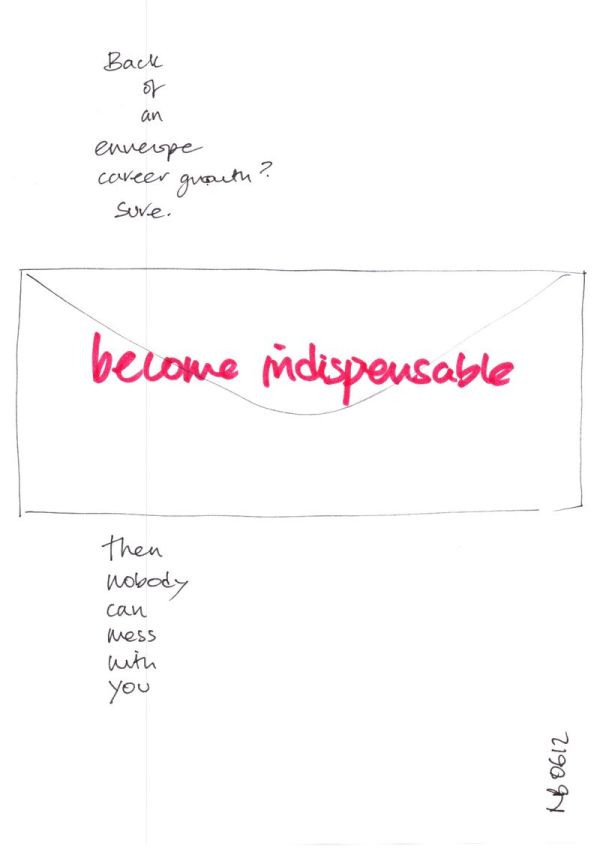
Nicholas Bate via BackOfAnEnvelope: Career Growth. How? Read Linchpin by Seth Godin!!!

“What you do today is important, because you are exchanging a day of your life for it.” Unknown.
When you take cash out of your wallet to give to someone, you surely expect something of equal or greater value in return. Do you treat your time the same way?
At one of my first jobs, I found myself spending a massive amount of time on tasks that didn’t really add value to me or my purpose.
“Ah well, at least I got something done today,” I would often mutter to rationalize wasting time on just busy work. Or even better: “Well, that took a lot of my time, but at least I’ll have tomorrow to take care of what I really need to do.”
I found that I didn’t truly own my time. I would arrive home from work exhausted, unwilling to do anything, and dreading that I only had an hour to sleep before waking up to do the whole thing over again.
Why did all of this happen? Because I let my boss, my friends, and poor decisions take ownership of my time.” Get more here: Why Owns Your Time? | Tiny Buddha: Wisdom Quotes, Letting Go, Letting Happiness In.


“You wake up in the morning, and lo! your purse is magically filled with twenty-four hours of the magic tissue of the universe of your life. No one can take it from you. No one receives either more or less than you receive. Waste your infinitely precious commodity as much as you will, and the supply will never be withheld from you. Moreover, you cannot draw on the future. Impossible to get into debt. You can only waste the passing moment. You cannot waste tomorrow; it is kept for you.” Thomas Arnold Bennett via On time…………….

notsalmon via “I can’t” is usually code for “I won’t” or “I don’t wanna.” You can do ANYTHING you really want. -Marie Forleo.

“Great relationships develop not from the absence of conflict, but from determining an agreeable pattern for how to resolve conflict. Defining the rules of engagement for how you “fight” with someone you care about is ultimately much more important than trying to never have a disagreement.” Healthy Living on HuffingtonPost.com via Rory Vaden: 10 Rules Of Relationship Conflict Resolution.
Here’s a test of the new Hangout over air functionality…


Banner ads first appeared on the web in 1994 and since then they have been used extensively over the Internet. They are made to be eye catching and impressive so that they create an urge in the visitors to click into their business. But, their mass production and misuse has caused viewers to be skeptical and unresponsive to them. After 8 years, do people still fall for this attractive ad?
Via Prestige Marketing. The scoop on marketing. via Who looks at banner ads? [infographic].
I find a lot of helpful infographics. Here’s another one…

Go to the source if you need a bigger version: Flowchart: How to Develop a Social Media Strategy
“There’s a “refresh” button you can click on the computer when you’re on-line. It makes the computer operate more efficiently.
Sometimes we get a little sluggish, too. We’ve been pushing too hard. Mulling the same thoughts over and over. Doing the same things over and over. Sometimes we need a change of scenery. Sometimes we need to refresh our thoughts with prayer, meditation, a few words from a friend, or spending some time with a good book.
Maybe it’s our bodies that need refreshing. We need a cold beverage, a brisk walk, a nap, or a hot shower.
Maybe we need a bigger refreshment: a weekend at a spa, a vacation. Even if our budget is low, we can pitch a tent in a park and take in the refreshing beauty of the world around us.
Look around. The world abounds with refreshments. The next time you get bogged down, stop pushing so hard. Do what you need to do to become efficient and operate with ease.
Refresh yourself.
God, help me understand the power of taking the time to refresh myself. Then help me stop thinking about it and actually do it.” via April 26: Refresh Yourself.




 Bright, shiny objects!
You must be logged in to post a comment.