How I apply David Allen’s ‘Getting Things Done’ to social media and ‘thought leadership’ marketing…

When I’m teaching social media, I don’t spend a lot of time talking about whether or not social media works for lead generation or thought leadership — that’s been pretty well established at this point. I usually start out my classes by saying that the single most important issue in social media today — especially for my students were who are mostly business owners or traditional marketing professionals — is ‘how do I add social media to my already overflowing plate and still get home for supper?’. Most of the people in my classes are struggling to keep up with e-mail let alone manage a blog, four social networks and an e-newsletter…

As a consultant, every minute that I spend on my own Internet marketing is a minute that I can’t bill to a client, therefore, I’ve had to force myself to become pretty efficient about how I do things like process e-mail, consumer information and published to the Internet. My constant inspiration in this process has been David Allen’s classic work ‘Getting Things Done‘. I recommend it to anyone who will listen. The heart and soul of David Allen’s book is this diagram:
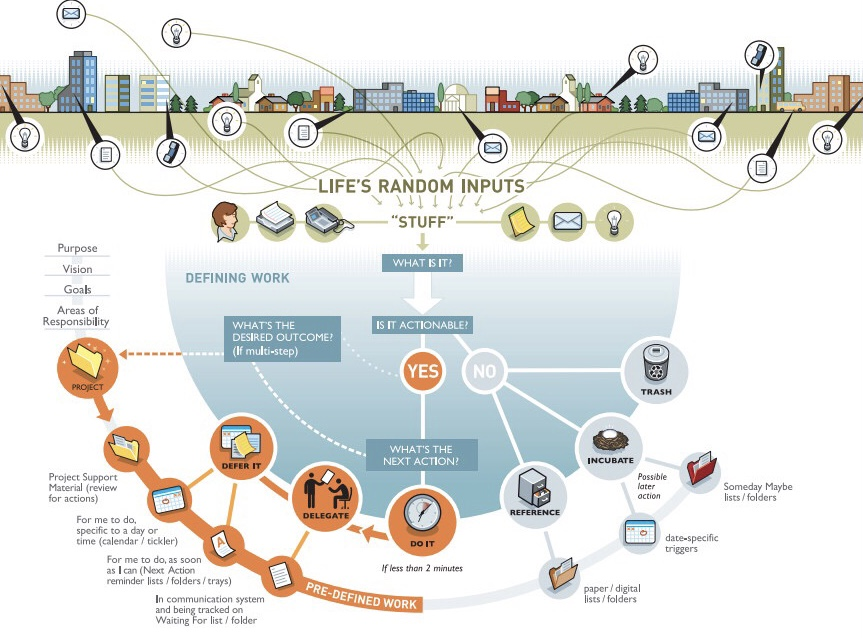
How I apply Getting Things Done [GTD] to social media and ‘thought leadership’ marketing…

Thanks to David’s methodology I use as many containers as I need and not one more. I usually handle information only once — especially if I can process it in 2 min. or less. Here’s an attempt to depict what my thought leadership process looks like:

If you’re looking for a way to become more efficient about how you develop and document your expertise, comment below or use the contact form to get in such. I’d love to talk with you about applying David Allen’s Getting Things Done [GTD] principles to your world…

Go back

Your message has been sent

Warning
Warning
Warning
Warning.

Some people like to make things overly complicated. Me? Sometimes I like to grossly oversimplify things and take them back to the basics. Example? ‘Thought leadership’ marketing. To my mind, if you want to be a thought leader there are only two things you need to do well:

  • Deepen your expertise through a continuous learning program
  • Document your expertise through blogging and social networks

Everything else is just details…

When it comes to effective business development, or marketing and sales again, I think there are only two activities you need to master:

  • Generating leads
  • Managing leads

Again, everything else is just details…

Whether you are a freelancer or running a large enterprise I believe there are 7 databases you must manage effectively to succeed. They are:

That’s all there is to it! If you can effectively manage these 7 databases you can go from reacting to your market to dominating your market.

Questions? Feedback? I’d be happy to expand/expound on any of these topics…

Enhanced by Zemanta
http://www.xtranormal.com/site_media/swf/flvplayer.swf

Dana VanDen Heuvel shared this with me as something we need to show at our social media bootcamp today. Had to share it here! btw, there’s still time to sign up. You can get more info here

Image representing Marketo as depicted in Crun...
Image via CrunchBase

Forrester reported over three years ago that the lead management market was heating up…

“Since the start of this year, I’ve been receiving a boatload of briefing requests from companies wanting to show me their lead generation and management solutions. Most recently, Marketo just announced their lead management solution. While honored, I also find reviewing these solutions confusing because there is a lot of variation in the product presentations and overlap between categories. And it’s not clear to me if lead management automation deserves to be a separate category or to be subsumed as part of the broader marketing platform. (I know Suresh Vittal includes lead management as a component of his enterprise marketing platform. But does the B2B need the same platform components as B2C?) Here’s how I see it and I’d like to hear your views as well.”

Click here to read more…

Image representing Google Reader as depicted i...
Image via CrunchBase

Are you still getting email newsletters? I’m doing everything I can to eliminate them and keep my inbox for ‘just in time’ information only. Wait! Where do I get the information which was contained in those newsletters? Through newsfeeds. Here’s a post that might help you get started…

“Do you have a huge number of blog and news feeds in your feedreader that you can’t possibly keep up with on a daily basis? Or, on the other end of the spectrum, have you resisted deciphering those three little letters, RSS, and continue to check your bookmarked links regularly to see if your favorite web pages have updated?

Now there is a new — and incredibly simple — solution. Guy Kawasaki, whom I used to read in Macworld Magazine when he was the original brand evangelist, recently started a new network of websites called Alltop.com. Based on the popurls model, the sites — each focusing on a specific topic — show the latest five posts from a wide range of news sources and blogs covering that topic, all on one page. Topics include celebrities, health, “green,” social media, small business and many others.

I suggested to Guy that he create a “nonprofit” topic and worked with him to identify news and blog feeds that should be included. And that’s how nonprofit.alltop.com was born.”

Whether you take the Alltop approach or use the free Google Reader to subscribe to feeds — just do it! Getting newsletters out of your inbox and into your browser is a great way to resist following the rabbit trail of an interesting newsletter in the middle of your work. Save your inbox for action and your newsreading for a newsreader! Contact me if you’re interested in learning how to make the switch…

Social Media Landscape
Image by fredcavazza via Flickr
Consider this…

Every job requires a variety of skills to be successful, and social media marketer or communicator or specialist at a B2B company is no different. But when you start to list out the skills and realize the level of competency required for this postion, it becomes daunting to find individuals with all of them. If you were looking to make a social media hire, which may be a quaint thought in a few years, you must determine what skills hold the highest priority for your organization. This may be difficult to determine if your B2B company is looking for the person to start the company’s social media programs.

And if you are looking for a social media postion, while you cannot excel at all of these, you must excel at several of them and possess a high level of proficiency at most of them. So let’s take a look at the major skills, which I have presented in the form of positions or job titles.

Follow the ‘via’ link to go to the source where you can find all the skills you need…

Image representing Facebook as depicted in Cru...
Image via CrunchBase

If you’re a business owner and you’ve heard the recent news about Facebook’s attention-grabbing new feature for location-sharing and checkins, you’re probably itching to find out what Facebook Places can do for your business and how it can help you reach out to would-be customers and loyal regulars in your community.

While Facebook isn’t ready to announce any special brand-platform relationships or tie-ins just yet, one Facebook ad exec told us that the company does have plans to integrate Places with its larger marketing offerings for SMBs. The best thing a business owner can do to prepare for those offerings is get familiar with the ins and outs of Facebook and location marketing now.

Here are a few pointers for how SMBs can use Facebook Places and other marketing tools starting today.

You can follow the ‘via’ link above to go to the source and read the rest of the article if you’d like to dig a little deeper…

Holy shit!!! I just updated my iPhone to 3.1 a...
Image by jimrenaud via Flickr

While the Vikings were sticking it to the Packers on Monday Night Football, Verizon was sticking it to Apple and AT&T in the only way they really could; on the issue of reliability and connectivity…

Recently, I had the chance to use both my BlackBerry Curve and an iPhone 3Gs on a trip from Green Bay to Nebraska and back. My assessment? The iPhone excelled in every area except one: phone calls and connectivity leading me to ponder ‘what does it profit a man if he gains all the apps in the world but suffers the loss of his phone call’ [sorry, Lord!]. The BlackBerry on Sprint outperformed the iPhone on AT&T in phone calling, streaming inbound audio from Pandora, and uploading to the internet. Unfortunately, the quality of photos and videos on the Curve is less satisfactory than the iPhone making IT a less than useful tool for the social media applications I was using. So what’s the answer? There is no answer! The iPhone fails in the one thing a phone is supposed to do; make and hold calls and Verizon stuck it to them good in this new campaign…

Don’t get me wrong — the iPhone is truly amazing — but by partnering with AT&T Apple has left the door open for someone else to dominate in the smartphone space like maybe Google/Verizon. The moral of the story? Think before you buy an iPhone and ask the users where you live what their experience has been. The best advice is still to go with the best network in your area and then get the best phone they have. If you want that slick iPhone capability without the phone, get an iPod Touch — you’ll be happier!

Reblog this post [with Zemanta]
Desert

In December of last year, I embarked upon an experiment to see if I could leverage a website with a blog combined with social media tools to increase traffic to a site. In that month, my sandbox site had a grand total of 670 pageviews. In the month that ended yesterday, I had a total of 15,985 — an approximate 25 fold increase in traffic! This morning I got 670 pageviews by 10:00. Here are some other statistics… Continue reading “Is your website a ‘billboard in the desert’?”

Asus EEE PC black
Image via Wikipedia

I have great hopes for this product, but the experience of this reviewer is not so hot…

“Everex’s CloudBook aims to one-up the Asus Eee PC with a larger hard drive and a flashy new operating system. 

Along with our review of the CloudBook, we’re taking a closer look by using this new UMPC to perform everyday activities from blogging to editing images to listening to music. Follow along with our CloudBook adventures.”

The hardware is from Everex and the OS is a version of Ubuntu optimized by the folks at Google for use with Google Apps for Domains and other applications.

Based on what I’m reading here, I’m more than underwhelmed. Let’s hope these folks get their act together. Click here to read the full article online…

Social media is a tool that, on the surface, appears to only have use in certain areas- such as simple interpersonal relationships or business-to-consumer marketing.  However, experienced users recognize the benefits of social media in establishing and maintaining business-to-business marketing.  Those in marketing may claim, “Well, people who are into social media aren’t the audience we are going after.” or, “My distributors are too old- they don’t even use email!”  Certainly these arguments are true in some cases, but you will not gain anything if you don’t step out of your comfort zone and try.  Remember that your future network of distributors will most likely be experienced social media users.  If your business peers aren’t deep into social media, their interns and new hires will be.

Many people are still not sure what “social media” is.  Is it Facebook, Linkedin, or Youtube?  Actually it is not any one of these things on its own.  It is a means of communicating, sharing, and listening.  It’s all about sharing your ideas with your distributors so that both of you can be more successful.  Tips, tricks, and success stories help build relationships.  Social media, in all its forms, is all about posting questions to your networks, listening to ideas, and getting timely feedback to create better business partners.  It’s about sharing presentations and demonstrations to help build credibility in your industry.

Social media in the business-to business realm is all about connecting, learning, and growing- it is building and fostering relationships so that businesses can grow together. And remember, its all about the relationships!

tommytrc @ HC Miller [the author of this post] belongs on your follow list! Not only is he the nicest guy in social media but he’s an ‘a-list’ content aggregator and creator as well…

“Today, I was firing off a couple of emails when I noticed that the message count in the top corner said, “483 Messages”! I decided enough was enough and began doing some more research into managing my inbox. I checked up on lifehacker.com, 43folders.com, and a few others to see what was going on. One of the best words of wisdom I found, however, rested in Scott Hanselman’s blog.

Remember that your inbox is not storage, it’s a list of what hasn’t been categorized yet.

This is exactly what my inbox had become. Sure it was kind of handy to have every email that I have received in the past year within a couple of pages, but I thought there must be a better way to manage it. I will list a few of the resources that I picked up, but let me sum most of them up.” Click here to read more…

Reblog this post [with Zemanta]

I don’t comment on politics often here, but here’s a politician who gets YouTube! Ex-reality tv star cum DA Sean Duffy is a former client of mine who looks like he’ll have a new zip code in January — although he’s no technologist himself, at least he understands the value of social media in getting his ‘awesome’ out. Comment, call or use the contact form to discuss how this applies to your business…

I came across a mention of this today and thought it appropriate to share.  This is dated advice. Dated from 1885 to be more specific!

Thomas Smith, a London Businessman, wrote a guide called Successful Advertising in 1885. The sayings he used are still being used today and form the foundation for the Theory of Frequency in advertising and marketing.

  1. The first time people look at any given ad, they don’t even see it.
  2. The second time, they don’t notice it.
  3. The third time, they are aware that it is there.
  4. The fourth time, they have a fleeting sense that they’ve seen it somewhere before.
  5. The fifth time, they actually read the ad.
  6. The sixth time they thumb their nose at it.
  7. The seventh time, they start to get a little irritated with it.
  8. The eighth time, they start to think, “Here’s that confounded ad again.”
  9. The ninth time, they start to wonder if they’re missing out on something.
  10. The tenth time, they ask their friends and neighbors if they’ve tried it.
  11. The eleventh time, they wonder how the company is paying for all these ads.
  12. The twelfth time, they start to think that it must be a good product.
  13. The thirteenth time, they start to feel the product has value.
  14. The fourteenth time, they start to remember wanting a product exactly like this for a long time.
  15. The fifteenth time, they start to yearn for it because they can’t afford to buy it.
  16. The sixteenth time, they accept the fact that they will buy it sometime in the future.
  17. The seventeenth time, they make a note to buy the product.
  18. The eighteenth time, they curse their poverty for not allowing them to buy this terrific product.
  19. The nineteenth time, they count their money very carefully.
  20. The twentieth time prospects see the ad, they buy what is offering.

What do you think? How much of this do you think is still applicable?

I was just corresponding with Dana VanDen Heuvel and thanks to Gist and the Gist gadget for Google Apps, I noticed that Dana had just posted some really good content, so I swiped it [with proper attribution of course] and I’m sharing it with you here now. It looks like King Solomon was right — there is nothing new under the sun…

Clipart of bills and coins
Image via Wikipedia

“There’s never been a better time to take advantage of the expansive opportunities for online business development and growth that the internet affords. According to a Juniper Research study, the number of U.S. internet shoppers will grow at an average rate of 12 percent per year through 2010, resulting in more than $144 billion in online sales.” Click here to read more…

httpv://www.youtube.com/watch?v=Wgi0t2ap-us&feature=player_embedded

Luxrealty

…but when your client is ‘Luxemburg Linda’ who loves the color, you make an exception! Linda just launched luxemburgrealty.com this week and after attending one of executive briefings on business blogging, she decided to add a simple Posterous blog to her site to drive search engine optimization and social media. Click the image above to visit the Luxemburg Realty blog

…on the Top 10 Tactics and Tools for Social Media. Here’s my mindmap. What’s missing? You can grab the map and move it around or make it full screen if that helps by using the menu bar at the bottom of the map…

Groupon logo.
Image via Wikipedia

In order to stimulate interest, businesses are told they have to discount goods and services by at least 50 percent. Even deeper discounts of up to 80 percent are encouraged. On top of that, the group buying site keeps as much as 50 percent (more perhaps?) of the amount the merchant brings in.

You do the math. If you offer a deal of $20 for $40 worth of goods or services, then the group site keeps as much as 50 percent of the amount sold, does that make sense?

Oh, but it’s advertising. Right, I get that. And if you’re advertising budget is big enough, or the margins on your products are high enough, it makes sense. You don’t lose your shirt with every sale. But, not every small business is the Gap. Quite to the contrary, most of us work on minimal ad budgets and thin margins.

One small business, Poises Cafe, lost so much money the owners had to dip into their personal savings to cover what they claim was an $8,000 loss! The owner called it a “terrible decision,” one that was made at the objection of her husband. Consider not only the strain this placed on their business, but their personal lives as well.

Paul Chaney has done a good job addressing the Groupon dilemma here. Personally, as a consumer I love Groupon, but as a small business owner I have a lot of other options that are free or much cheaper. You can follow the ‘via’ link above to read the rest of Paul’s article — comment below or ‘connect’ above to discuss how this applies to you and your organization…

Start a Blog at WordPress.com.

Up ↑