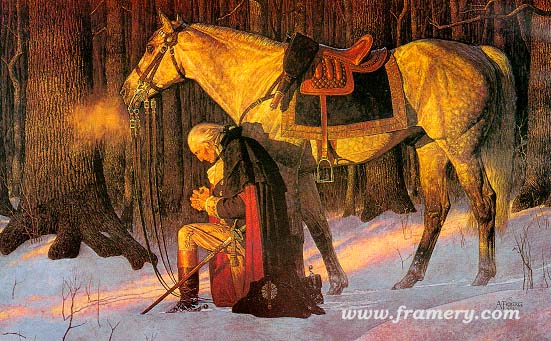
A story about George Washington…

1795 - 1823
1795 – 1823 (Photo credit: Wikipedia)

Have you ever heard this one?

About a dozen years before the Revolutionary War, tensions increased in America between the British and the French with their Indian allies, resulting in battles.
The most notable period of the French and Indian Wars lasted from 1754 to 1763. It is considered the first global war, as allies of the French and English fought all around the world.
On July 9, 1755, about 1,400 British troops marched over the Appalachian Mountains to seize French Fort Duquesne, near present day Pittsburgh. As they marched through a deep wooded ravine along the Monongahela River eight miles from the fort, they were ambushed by French regulars, Canadians, and Potawatomi and Ottawa Indians.
Not accustomed to fighting unless in an open field, over 900 British soldiers were annihilated.
It was known as the Battle of the Wilderness or Battle of Monongahela.
23-year-old Virginia Colonel George Washington rode back and forth during the battle delivering orders for General Edward Braddock, the Commander-in-Chief of British forces in America.
Eventually, Braddock was killed and every officer on horseback was shot, except Washington.
Washington carried Braddock from the field.
Braddock’s field desk was captured, revealing all of the British military plans, enabling the French to surprise and defeat British forces in succeeding battles at Fort Oswego, Fort William Henry, Fort Duquesne, and Carillon. The Iroquois tribes of Senecas and Cayugas decided to switch their allegiance to the French.
Before he died, Braddock gave Washington his battle uniform sash, which Washington reportedly carried with him while serving as Commander-in-Chief and as President.
Washington presided at the burial service for General Braddock, as the chaplain was wounded. Braddock’s body was buried in the middle of the road so as to prevent his body from being found and desecrated.
Shortly thereafter, writing from Fort Cumberland, George Washington described the Battle of Monongahela to his younger brother, John Augustine Washington, JULY 18, 1755:
“As I have heard, since my arrival at this place, a circumstantial account of my death and dying speech, I take this early opportunity of contradicting the first, and of assuring you, that I have not as yet composed the latter.
But by the All-Powerful Dispensations of Providence, I have been protected beyond all human probability or expectation; for I had four bullets through my coat, and two horses shot under me, yet escaped unhurt, although death was leveling my companions on every side of me!”
An Indian warrior later declared:
“Washington was never born to be killed by a bullet! I had seventeen fair fires at him with my rifle and after all could not bring him to the ground!”

Source: William J Federer’s American Minute for January 1st

American Minute for January 8th; The Battle of New Orleans

English: Andrew Jackson - 7 th President of th...

I think this is one of the most fascinating stories in American history and the whole think could have been avoided by one text message [which of course couldn’t happen at the time]:

Though the War of 1812 was effectively over two weeks earlier with the signing of the Treaty of Ghent, December 24, 1814, news had not yet reached New Orleans.

On January 8, 1815, in the last battle of the War of 1812, nearly 10,000 British soldiers advanced under cover of darkness and heavy fog, intending to surprise General Andrew Jackson’s Tennessee and Kentucky sharpshooters, aided by French pirate Jean Lafitte and his men.

As the British neared, the fog suddenly lifted and in just a half hour 2,042 British were killed or wounded, while there were only 71 American casualties.

General Andrew Jackson wrote on January 26, 1815, to Robert Hays regarding the victorious Battle of New Orleans:

“It appears that the unerring hand of Providence shielded my men from the shower of balls, bombs, and rockets, when every ball and bomb from our guns carried with them a mission of death.”

General Jackson told his aide-de-camp Major Davezac of his confidence before the Battle:

“I was sure of success, for I knew that God would not give me previsions of disaster, but signs of victory. He said this ditch can never be passed. It cannot be done.”

Andrew Jackson wrote to Secretary of War James Monroe, February 17, 1815:

“Heaven, to be sure, has interposed most wonderfully in our behalf, and I am filled with gratitude, when I look back to what we have escaped.”

The Treaty of Ghent was ratified by the U.S. Senate, February 16, 1815.

All British troops were immediately brought back to Europe as Napoleon had escaped from the Island of Elba, February 26, 1816.

For one hundred days, events in Europe cascaded toward the massive Battle of Waterloo.

President James Madison proclaimed for the United States a National Day of Thanksgiving Devout Acknowledgment to Almighty God on March 4, 1815.

via American Minute for January 8th.

American Minute for January 3rd

Emanuel Leutze's depiction of Washington's att...

Frederick the Great of Prussia called these ten days “the most brilliant in the world’s history.”

After winning the Battle of Trenton, Christmas night, George Washington’s small force met General Cornwallis‘ 8,000 man British army.

The night before the battle, Washington left his campfires burning and silently marched his army around the back of the British camp at Princeton, New Jersey.

At daybreak, JANUARY 3, 1777, Washington attacked, capturing three regiments of British troops. Enthusiasm swept America. Yale President Ezra Stiles stated in an Election Address before the Governor and General Assembly of Connecticut:

“In our lowest and most dangerous state, in 1776 and 1777, we sustained ourselves against the British Army of 60.000 troops, commanded by…the ablest generals Britain could procure throughout Europe, with a naval force of 22,000 seamen in above 80 men-of-war.

Who but a Washington, inspired by Heaven, could have conceived the surprise move upon the enemy at Princeton-or that Christmas eve when Washington and his army crossed the Delaware?”

Ezra Stiles continued:

“The United States are under peculiar obligations to become a holy people unto the Lord our God.”

via American Minute for January 3rd.


George Washington assigned to lead the Continental Army; This Day in History

On this day in 1775, George Washington, who would one day become the first American president, accepts an assignment to lead the Continental Army.

Washington had been managing his family’s plantation and serving in the Virginia House of Burgesses when the second Continental Congress unanimously voted to have him lead the revolutionary army. He had earlier distinguished himself, in the eyes of his contemporaries, as a commander for the British army in the French and Indian War of 1754.

Born a British citizen and a former Redcoat, Washington had, by the 1770s, joined the growing ranks of colonists who were dismayed by what they considered to be Britain’s exploitative policies in North America. In 1774, Washington joined the Continental Congress as a delegate from Virginia. The next year, the Congress offered Washington the role of commander in chief of the Continental Army.

After accepting the position, Washington sat down and wrote a letter to his wife, Martha, in which he revealed his concerns about his new role. He admitted to his “dear Patcy” that he had not sought the post but felt “it was utterly out of my power to refuse this appointment without exposing my Character to such censures as would have reflected dishonour upon myself, and given pain to my friends.” He expressed uneasiness at leaving her alone, told her he had updated his will and hoped that he would be home by the fall. He closed the letter with a postscript, saying he had found some of “the prettiest muslin” but did not indicate whether it was intended for her or for himself.

On July 3, 1775, Washington officially took command of the poorly trained and under-supplied Continental Army. After six years of struggle and despite frequent setbacks, Washington managed to lead the army to key victories and Great Britain eventually surrendered in 1781. Due largely to his military fame and humble personality, Americans overwhelmingly elected Washington their first president in 1789.

via George Washington assigned to lead the Continental Army — History.com This Day in History — 6/15/1775.

Start a Blog at WordPress.com.

Up ↑