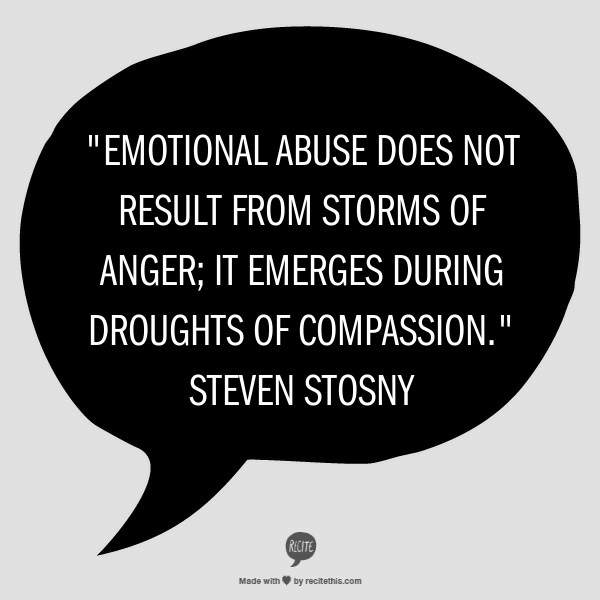
Emotionally abusive behavior is anything that intentionally hurts the feelings of another person. Since almost everyone in intimate relationships does that at some time or other, emotionally abusive behavior must be distinguished from an emotionally abusive relationship, which is more than the sum of emotionally abusive behaviors. Continue reading “Emotional Abuse”
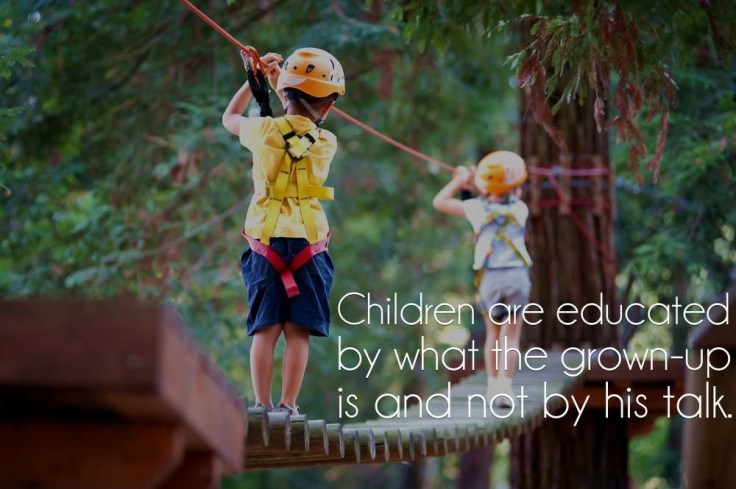
Do You Make These Parenting Mistakes?
Stepcase Lifehack
Full story at: Do You Make These Parenting Mistakes?.
A Credo for Your Relationships with Others
You and I are in a relationship which I value and want to keep. We are also two separate persons with our own individual values and needs. So that we will better know and understand what each of us values and needs, let us always be open and honest in our communication. When you are experiencing a problem in your life, I will try to listen with genuine acceptance and understanding in order to help you find your own solutions rather than imposing mine. And I want you to be a listener for me when I need to find solutions to my problems. At those times when your behavior interferes with what I must do to get my own needs met, I will tell you openly and honestly how your behavior affects me, trusting that you respect my needs and feelings enough to try to change the behavior that is unacceptable to me. Also, whenever some behavior of mine is unacceptable to you, I hope you will tell me openly and honestly so I can try to change my behavior. And when we experience conflicts in our relationship, let us agree to resolve each conflict without either of us resorting to the use of power to win at the expense of the other’s losing. I respect your needs, but I also must respect my own. So let us always strive to search for a solution that will be acceptable to both of us. Your needs will be met, and so will mine–neither will lose, both will win. In this way, you can continue to develop as a person through satisfying your needs, and so can I. Thus, ours can be a healthy relationship in which both of us can strive to become what we are capable of being. And we can continue to relate to each other with mutual respect, love and peace.” via A Credo for Your Relationships with Others – Gordon Training International.
This is a work-worthy goal but I am sooooooooo far away from this…
Accepting powerlessness
Back to back Melody Beattie! Here she writes:
Since I’ve been a child, I’ve been in an antagonistic relationship with an important emotional part of myself: my feelings. I have consistently tried to ignore, repress, or force my feelings away. I have tried to create unnatural feelings or force away feelings that were present.
I’ve denied I was angry, when in fact I was furious. I have told myself there must be something wrong with me for feeling angry, when anger was a reasonable and logical response to the situation.
I have told myself things didn’t hurt, when they hurt very much. I have told myself stories such as “That person didn’t mean to hurt me.” . . . “He or she doesn’t know any better.” . . . “I need to be more understanding.” The problem was that I had already been too understanding of the other person and not understanding and compassionate enough with myself.
It has not just been the large feelings I have been at war with; I have been battling the whole emotional aspect of myself. I have tried to use spiritual energy, mental energy, and even physical exertion to not feel what I need to feel to be healthy and alive.
I didn’t succeed at my attempts to control emotions. Emotional control has been a survival behavior for me. I can thank that behavior for helping me get through many years and situations where I didn’t have any better options. But I have learned a healthier behavior – accepting my feelings.
We are meant to feel. Part of our dysfunction is trying to deny or change that. Part of our recovery means learning to go with the flow of what we’re feeling and what our feelings are trying to tell us.
We are responsible for our behaviors, but we do not have to control our feelings. We can let them happen. We can learn to embrace, enjoy, and experience – feel – the emotional part of ourselves.
Today, I will stop trying to force and control my emotions. Instead, I will give power and freedom to the emotional part of myself.” via Just For Today Meditations » Blog.
Letting Go
Melody Beattie writes:
Stop trying so hard to control things. It is not our job to control people, outcomes, circumstances, and life. Maybe in the past we couldn’t trust and let things happen. But we can now. The way life is unfolding is good. Let it unfold.
Stop trying so hard to do better, be better, and be more. Who we are and the way we do things is good enough for today.
Who we were and the way we did things yesterday was good enough for that day.
Ease up on ourselves. Let go. Stop trying so hard.
Today, I will let go. I will stop trying to control everything. I will stop trying to make myself be and do better, and I will let myself be.” via Just For Today Meditations » Blog.
Related articles
- When Things Don’t Work (toddlohenry.com)
- Surviving Slumps (toddlohenry.com)
- Withholding (toddlohenry.com)
- Take a time-out (toddlohenry.com)
- Letting the Cycles Flow (toddlohenry.com)
- Living Our Lives (toddlohenry.com)
- Sadness (toddlohenry.com)
- Loving Ourselves Unconditionally (toddlohenry.com)
- Figuring out God’s will (toddlohenry.com)
- Letting Go of Self Doubt (toddlohenry.com)
Insisting on the Best
Melody Beattie writes:
We deserve the best life and love has to offer, but we are each faced with the challenge of learning to identify what that means in our life. We must each come to grips with our own understanding of what we believe we deserve, what we want, and whether we are receiving it.
There is only one place to start, and that is right where we are, in our current circumstances. The place we begin is with us.
What hurts? What makes us angry? What are we whining and complaining about? Are we discounting how much a particular behavior is hurting us? Are we making excuses for the other person, telling ourselves we’re “too demanding”?
Are we reluctant, for a variety of reasons, especially fear, to tackle the issues in our relationships that may be hurting us? Do we know what’s hurting us and do we know that we have a right to stop our pain, if we want to do that?
We can begin the journey from deprived to deserving. We can start it today. We can also be patient and gentle with ourselves as we travel in important increments from believing we deserve second best, to knowing in our hearts that we deserve the best, and taking responsibility for that.
Today, I will pay attention to how I allow people to treat me, and how I feel about that. I will also watch how I treat others. I will not overreact by taking their issues too personally and too seriously; I will not under react by denying that certain behaviors are inappropriate and not acceptable to me.” Source: Language of Letting Go – July 16 – SoberRecovery : Alcoholism Drug Addiction Help and Information
One way to Stop Being Disappointed
Have you ever heard the expression ‘Doing _____ is like wrestling with a pig; you get dirty and the pig likes it’. Steve Pavlina writes:
If someone is late about 70% of the time, and you expect them to be on time, that’s a rather foolish prediction, isn’t it? They may be on time, but they probably won’t be.
What many people will do is get angry with the friend who’s frequently late. Does this usually change that person’s behavior? Perhaps sometimes, but it usually has little or no effect. The person will most likely continue being late at roughly the same frequency.
Wanting a person to change doesn’t change their behavior. It’s more likely to cement the behavior in place since people tend to resist others’ demands of them.
Instead of resisting your predictions, a more sensible approach is to accept them. Accept that your friend will probably continue to be late most of the time.
Note that this doesn’t mean predicting that your friend will always be late, so you can be pleasantly surprised when they’re on time. That would be inaccurate as well. It means accepting that you don’t really know when they’ll show up and that most likely they’ll be later than they say they will. Predict based on reality, not on overly positive or negative expectations. In many cases your prediction will be a spectrum of possible outcomes with some being more probable than others.
Now your friend may change their behavior over time, but when such changes are going to occur, you’ll typically see advance evidence of them. Is your friend committed to becoming more punctual? If so, is there any physical evidence other than empty promises? For instance, when you visit your friend’s home, do you see books like How to Be Punctual lying around? Does your friend share details of their efforts to change? In other words, do you have some solid evidence that this habit will in fact be corrected?
Let me put this another way. If someone said they’d bet you $100 that your friend would be late most of the time for all get-togethers for the next six months, would you take that bet (meaning that you’re betting that your friend will usually be on time)? If you wouldn’t take the bet, it’s fair to say you expect the old behavior to continue.
If there’s no evidence of change, then your best prediction of future behavior is past behavior. In this case, the past does equal the future.
If your current prediction is that the old behavior is likely to continue, then go ahead and project this expectation forward in time for at least a decade. In the absence of clear evidence to the contrary, it’s reasonable to expect that this pattern will continue year after year for at least the next 10 years.
Now do your best to accept this prediction without resistance. Don’t try to alter it for emotional reasons.
The best predictor of future behavior is past behavior, so if you’re clear about the past behavior, you can reasonably expect that it will continue as-is for the most part, absent any serious commitment to alter course. Change is always possible, but entertain the possibility that it may not happen.
Now with this newfound acceptance in mind, how does that affect your relationship with your friend? Does it mandate that you kick this person out of your life? Not necessarily. What it means is that you can now account for the likelihood that this person will be late most of the time. This means your decisions will be more intelligent since they’ll be based on more accurate predictions, not on false hopes.” via How to Stop Being Disappointed.
My old friend RJ always says that when it comes to people what you got is what you’ll get; we can hope that people change but to expect otherwise is an invitation to disappointment. Stop wrestling with pigs!!!
Surviving Slumps
A slump can go on for days. We feel sluggish, unfocused, and sometimes overwhelmed with feelings we can’t sort out. We may not understand what is going on with us. Even our attempts to practice recovery behaviors may not appear to work. We still don’t feel emotionally, mentally, and spiritually as good as we would like.
In a slump, we may find ourselves reverting instinctively to old patterns of thinking, feeling, and behaving, even when we know better. We may find ourselves obsessing, even when we know that what we’re doing is obsessing and that it doesn’t work.
We may find ourselves looking frantically for other people to make us feel better, the whole time knowing our happiness and well being does not lay with others.
We may begin taking things personally that are not our issues, and reacting in ways we’ve learned all to well do not work.
We’re in a slump. It won’t last forever. These periods are normal, even necessary. These are the days to get through. These are the days to focus on recovery behaviors, whether or not the rewards occur immediately. These are sometimes the days to let ourselves be and love ourselves as much as we can.
We don’t have to be ashamed, no matter how long we’ve been recovering. We don’t have to unreasonably expect “more” from ourselves. We don’t ever have to expect ourselves to live life perfectly.
Get through the slump. It will end. Sometimes, a slump can go on for days and then, in the course of an hour, we see ourselves pull out of it and feel better. Sometimes it can last a little longer.
Practice one recovery behavior in one small area, and begin to climb uphill. Soon, the slump will disappear. We can never judge where we will be tomorrow by where we are today.
Today, I will focus on practicing one recovery behavior on one of my issues, trusting that this practice will move me forward. I will remember that acceptance, gratitude, and detachment are a good place to begin.” via Just For Today Meditations » Daily Recovery Readings – June 26, 2012.
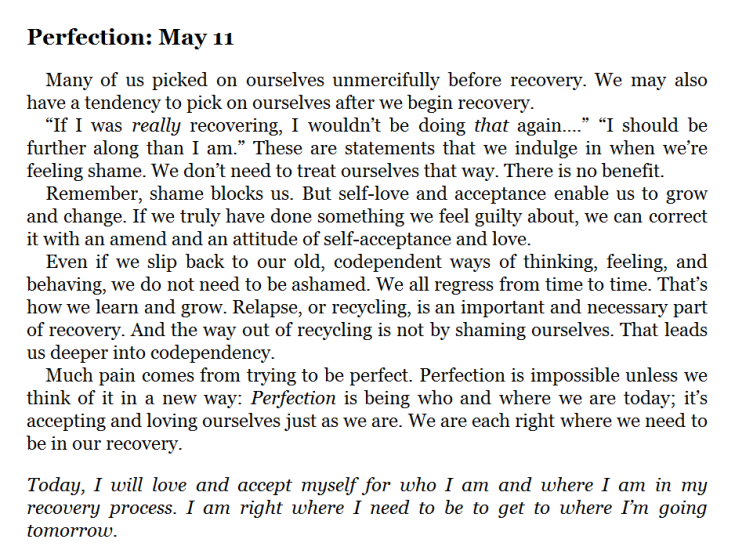
Perfection
Melody Beattie writes:
Try harder. Do better. Be perfect. These messages are tricks that people have played on us. No matter how hard we try, we think we have to do better. Perfection always eludes us and keeps us unhappy with the good we’ve done.
Messages of perfectionism are tricks because we can never achieve their goal. We cannot feel good about ourselves or what we have done while these messages are driving us. We will never be good enough until we change the
messages and tell ourselves we are good enough now.
We can start approving of and accepting ourselves. Who we are is good
enough. Our best yesterday was good enough; our best today is plenty good
too.
We can be who we are, and do it the way we do it – today. That is the
essence of avoiding perfection.
Help me let go of the messages that drive me into the crazies. I will
give myself permission to be who I am and let that be good enough.” Source: Daily SNIPS Discussion: 062706 0507-1111 – DailyStrength
Related articles
- Sadness (toddlohenry.com)
- Recognizing Choices (toddlohenry.com)
- Affirm Yourself… (toddlohenry.com)
- Codepedence is not just an issue for partners of addicts (toddlohenry.com)
- Letting the Cycles Flow (toddlohenry.com)
- Rise to the Occasion (toddlohenry.com)
- …on Control (toddlohenry.com)
- You have the power (toddlohenry.com)
- Feeling Good (toddlohenry.com)
- …on Taking One Day at a Time (toddlohenry.com)
Boundaries

Melody Beattie writes:
“Having boundaries doesn’t complicate life; boundaries simplify life.” Beyond Codependency.
There is a positive aspect to boundary setting. We learn to listen to ourselves and identify what hurt us and what we don’t like. But we also learn to identify what feels good.
When we are willing to take some risks and begin actively doing so, we will enhance the quality of our life.
What do we like? What feels good? What brings us pleasure? Whose company do we enjoy? What helps us to feel good in the morning? What’s a real treat in our life? What are the small, daily activities that make us feel nurtured and cared for?
What appeals to our emotional, spiritual, mental, and physical self? What actually feels good to us?
We have deprived ourselves too long. There is no need to do that anymore, no need. If it feels good, and the consequences are self-loving and not self-defeating, do it!
Today, I will do for myself those little things that make life more pleasurable. I will not deny myself healthy treats.” via Thought for the Day.
Related articles
- Setting New Boundaries: Daily Devotions for Those in Recovery (The Serenity Meditation Series) ebook (roprbqao.typepad.com)
- Fear & Codependency (toddlohenry.com)
- Recognizing Choices (toddlohenry.com)
- …on Control (toddlohenry.com)
Surrender
Melody Beattie writes:
Master the lessons of your present circumstances.
We do not move forward by resisting what is undesirable in our life today. We move forward, we grow, we change by acceptance.
Avoidance is not the key; surrender opens the door.
Listen to this truth: We are each in our present circumstances for a reason. There is a lesson, a valuable lesson that must be learned before we can move forward.
Something important is being worked out in us, and in those around us. We may not be able to identify it today; but we can know that it is important. We can know it is good.
Overcome not by force, overcome by surrender. The battle is fought, and won, inside ourselves. We must go through it until we learn, until we accept, until we become grateful, until we are set free.
Today, I will be open to the lessons of my present circumstances. I do not have to label, know, or understand what I’m learning; I will see clearly in time. For today, trust and gratitude are sufficient.
Maybe I should change the name of this blog to The Daily Beattie?! :-D
Related articles
- Sadness (toddlohenry.com)
- …on Control (toddlohenry.com)
- Are You Making Someone Else Your Higher Power? (toddlohenry.com)
- Codepedence is not just an issue for partners of addicts (toddlohenry.com)
- Letting the Cycles Flow (toddlohenry.com)
- …on feeling good (toddlohenry.com)
- Loving Ourselves Unconditionally (toddlohenry.com)
- Go easy (toddlohenry.com)
Surrender
Melody Beattie writes:
Master the lessons of your present circumstances.
We do not move forward by resisting what is undesirable in our life today. We move forward, we grow, we change by acceptance.
Avoidance is not the key; surrender opens the door.
Listen to this truth: We are each in our present circumstances for a reason. There is a lesson, a valuable lesson that must be learned before we can move forward.
Something important is being worked out in us, and in those around us. We may not be able to identify it today; but we can know that it is important. We can know it is good.
Overcome not by force, overcome by surrender. The battle is fought, and won, inside ourselves. We must go through it until we learn, until we accept, until we become grateful, until we are set free.
Today, I will be open to the lessons of my present circumstances. I do not have to label, know, or understand what I’m learning; I will see clearly in time. For today, trust and gratitude are sufficient.
Loving Ourselves Unconditionally
But most of all? You deserve it from YOURSELF! Melody Beattie writes:
Love yourself into health and a good life of your own.
Love yourself into relationships that work for you and the other person. Love yourself into peace, happiness, joy, success, and contentment.
Love yourself into all that you always wanted. We can stop treating ourselves the way others treated us, if they behaved in a less than healthy, desirable way. If we have learned to see ourselves critically, conditionally, and in a diminishing and punishing way, it’s time to stop. Other people treated us that way, but it’s even worse to treat ourselves that way now.
Loving ourselves may seem foreign, even foolish at times. People may accuse us of being selfish. We don’t have to believe them.
People who love themselves are truly able to love others and let others love them. People who love themselves and hold themselves in high esteem are those who give the most, contribute the most, love the most.
How do we love ourselves? By forcing it at first. By faking it if necessary. By “acting as if.” By working as hard at loving and liking ourselves as we have at not liking ourselves.
Explore what it means to love yourself.
Do things for yourself that reflect compassionate, nurturing, self-love.
Embrace and love all of yourself — past, present, and future. Forgive yourself quickly and as often as necessary. Encourage yourself. Tell yourself good things about yourself.
If we think and believe negative ideas, get them out in the open quickly and honestly, so we can replace those beliefs with better ones.
Pat yourself on the back when necessary. Discipline yourself when necessary. Ask for help, for time; ask for what you need.
Sometimes, give yourself treats. Do not treat yourself like a pack mule, always pushing and driving harder. Learn to be good to yourself. Choose behaviors with preferable consequences — treating yourself well is one.
Learn to stop your pain, even when that means making difficult decisions. Do not unnecessarily deprive yourself. Sometimes, give yourself what you want, just because you want it.
Stop explaining and justifying yourself. When you make mistakes, let them go. We learn, we grow, and we learn some more. And through it all, we love ourselves.
We work at it, then work at it some more. One day we’ll wake up, look in the mirror, and find that loving ourselves has become habitual. We’re now living with a person who gives and receives love, because that person loves him- or herself. Self-love will take hold and become a guiding force in our life.
Today, I will work at loving myself. I will work as hard at loving myself as I have at not liking myself. Help me let go of self-hate and behaviors that reflect not liking myself. Help me replace those with behaviors that reflect self-love. Today, God, help me hold myself in high self-esteem. Help me know I’m lovable and capable of giving and receiving love.” via June 16: Loving Ourselves Unconditionally.
Responsibility
Melody Beattie writes:
Self care means taking responsibility for ourselves. Taking responsibility for ourselves includes assuming our true responsibilities to others. Sometimes, when we begin recovery, we’re worn down from feeling responsible for so many other people. Learning that we need only take responsibility for ourselves may be such a great relief that, for a time, we disown our responsibilities to others.
The goal in recovery is to find the balance: we take responsibility for ourselves, and we identify our true responsibilities to others.
This may take some sorting through, especially if we have functioned for years on distorted notions about our responsibilities to others. We may be responsible to one person as a friend or as an employee; to another person, we’re responsible as an employer or as a spouse. With each person, we have certain responsibilities. When we tend to those true responsibilities, we’ll find balance in our life.
We are also learning that while others aren’t responsible for us, they are accountable to us in certain ways.
We can learn to discern our true responsibilities for ourselves, and to others. We can allow others to be responsible for themselves and expect them to be appropriately responsible to us.
We’ll need to be gentle with ourselves while we learn.
Today, I will strive for clear thinking about my actual responsibilities to others. I will assume these responsibilities as part of taking care of myself.
Related articles
- Sadness (toddlohenry.com)
- Codepedence is not just an issue for partners of addicts (toddlohenry.com)
- …on Control (toddlohenry.com)
- Are You Making Someone Else Your Higher Power? (toddlohenry.com)
- …on feeling good (toddlohenry.com)
- Fear & Codependency (toddlohenry.com)
Detachment means “freedom from emotion”

Letting someone else’s behavior determine how we feel at every turn is irresponsible. Our emotions should be determined by us, not by someone else. But no doubt we have spent years confusing the boundaries that separate us from other people. Whether at work or at home, we have too often let someone else’s “insanity” affect how we behave and how we feel.
At first, it may seem insensitive not to react to others’ problems or negative behavior. We may fear they’ll think we simply don’t care about them. Learning that it is far more caring to let other people handle their own lives takes time and patience. But with practice, it will begin to feel comfortable. In fact, in time it will feel freeing and wonderful.
I will work on detachment today, knowing that in time the rewards will come.
Affirm Yourself…
Melody Beattie writes:
Who or what do you want to become? A good parent? A sober, recovering person? A good girlfriend, boyfriend, or spouse? Do you want to become happy, peaceful, tolerant? Don’t wait until you’re successful to tell yourself you’re that. Start now by saying you are what you want to become instead of reinforcing the words I’m not. Yes, you have much to learn. Yes, there’s a ways to go on that path. And you may not be proficient at it, or an expert, yet. But you don’t have to be to say those two little words I am.
Help create the new part of your personality by using and affirming those powerful words I am. Then watch as a new part of yourself emerges.
God, help me use my creative powers to create a better, more fulfilling life. Help me use the words I am to create who you and I want me to be…
Related articles
- Sadness (toddlohenry.com)
- …on Control (toddlohenry.com)
- Loving Ourselves Unconditionally (toddlohenry.com)
- …on feeling good (toddlohenry.com)
- Codepedence is not just an issue for partners of addicts (toddlohenry.com)
On being connected…
LOL. ‘Make me one with everything’…
What did the Buddhist monk say to the hot-dog vendor? Can you make me one with everything?
I was buckling my seat belt in the little Cessna one day, getting ready for flight training, when my instructor Rob turned to me.
“I just take a second when I strap myself in and tell myself I’m becoming one with the plane as I do,” Rob said. “It really helped me in the beginning when I was nervous and felt so separate from the airplane.”
What a great idea, I thought. That day turned into one of my most comfortable flying sessions. It reminded me of a lesson I had learned a while back.
For most of my life, I felt disconnected from things: from myself, from other people, from life. That feeling of separateness haunted me. It explains why I tried so desperately to attach myself codependently to people, places, and things.
Over the years, I began to see that my separateness was an illusion. The same energy, the same life force, that runs through all the universe runs through you and me, too.
We’re connected, whether we know it or not.
Nobody has to make you one with everything. You already are.
Let go of your illusion of separateness.
Connect yourself.
God, help me know my oneness with the world. Help me know how connected I really am so I don’t have to connect in ways that don’t work.
Something else I like about Melody Beattie — she’s a pilot, or at least a student pilot…
Related articles
- Letting Go of Self Doubt (toddlohenry.com)
- Codepedence is not just an issue for partners of addicts (toddlohenry.com)
- Choices (toddlohenry.com)
- Fear & Codependency (toddlohenry.com)
- …on Control (toddlohenry.com)
Codepedence is not just an issue for partners of addicts
I don’t normally curate this much content in one ‘swell foop’ as I like to say but Melody Beattie’s perspective on owning your own stuff and Mark Brower’s comments on same were so good I couldn’t find anything to exclude. Mark starts out and then quotes my ‘Language of Letting Go’ reading for today…
Many of us struggle with codependency. When addiction is present in a relationship, the old model was that the addict was “dependent” and his or her spouse was “codependent.” But today we know that usually both the addict and spouse struggle with codependency in its various forms.
Codependency happens when we lose touch with our sense of self, and become over-dependent on how other people are doing, and/or how they perceive us. Since we are not “okay” with ourselves, we have to work overtime to ensure that other people around us are doing okay, and/or that they feel good about us.
So we wind up tolerating things we shouldn’t tolerate, feeling responsible for things we shouldn’t feel responsible for, and compromising what we want simply in order to please someone else. This inevitably leads to distress and frustration, which causes the addict to move deeper into their addiction, and for the addict’s spouse to cope in other ways.
The issue of codependence is complicated for Christians, because it gets mixed up with our desire to love and serve other people. The Bible tells us to “consider others better than ourselves.” But the same Bible also tells us to love our neighbor as ourselves, which presupposes some sort of healthy self-regard. The Bible also portrays Jesus himself taking time away from the crowds – not being “nice” and doing what they want him to do – in order to rest and reconnect with God the Father.
The trick to living a recovery life in relationships with others is to know how to separate healthy love with unhealthy codependence.
Melody Beattie has been a great help for me over the years with her many books on this topic. One of her best books on this topic is a daily meditation book called “The Language of Letting Go.”
In another article on this blog, I wrote about codependence, and quoted at length from her book. But it’s so good and helpful that I want to quote some more! What follows are some excerpts about the issue of “Property Lines”:
A helpful tool in our recovery, especially in the behavior we call detachment, is learning to identify who owns what. Then we let each person own and possess his or her rightful property.
If another person has an addiction, a problem, a feeling, or a self-defeating behavior, that is their property, not ours. If someone is a martyr, immersed in negativity, controlling, or manipulative, that is their issue, not ours.
If someone has acted and experienced a particular consequence, both the behavior and the consequence belong to that person.
People’s lies, deceptions, tricks, manipulations, abusive behaviors, inappropriate behaviors, cheating behaviors, and tacky behaviors belong to them, too. Not us.
People’s hopes and dreams are their property. Their guilt belongs to them too. Their happiness or misery is also theirs. So are their beliefs and messages.
If some people don’t like themselves, that is their choice. Their choices are their property, not ours. What people choose to say and do is their business.
What is our property? Our property includes our behaviors, problems, feelings, happiness, misery, choices, and messages; our ability to love, care, and nurture; our thoughts, our denial, our hopes and dreams for ourselves. Whether we allow ourselves to be controlled, manipulated, deceived, or mistreated is our business.
In recovery, we learn an appropriate sense of ownership. If something isn’t ours, we don’t take it. If we take it, we learn to give it back. Let other people have their property, and learn to own and take good care of what’s ours.
Today, I will work at developing a clear sense of what belongs to me, and what doesn’t. If it’s not mine, I won’t keep it. I will deal with myself, my issues, and my responsibilities.
If you want to learn more about codependence, consider signing up for the Recovery Journey, an e-course for people in recovery from sexual struggles. If you are the partner of someone who struggles, note that we have a special module with materials just for the partners. You can learn more about this program at the website: http://recoveryjourney.com
Source: Codepedence is not just an issue for partners of addicts | sexualsanity.com
Codependence is a constant battle for me and it has made made my wife’s vacation in Italy even more difficult than the simple logistics of trying to run a business and hold down the fort with 4 boys while she’s gone but by the grace of God, with the help of Celebrate Recovery, my good friends Sandy and Steve and Melody Beattie’s good thoughts. we are winning on this trip! If these issues resonate with you, drop me a note below. I’ll be happy to share with you what I have…
Related articles
- Fear & Codependency (toddlohenry.com)
- …on Control (toddlohenry.com)
- …on feeling good (toddlohenry.com)
- The Reality of Recovery, Part 2 (carolynswords.wordpress.com)
- When to stop enabling and start disabling (spreadinformation.wordpress.com)
…on Taking One Day at a Time
“My best friend was going through some tough situations in her life. I was in the midst of a hard stretch too. We didn’t particularly like the things we had to do in our lives. We talked about our feelings and decided that what we were going through was necessary and important, even though we didn’t like it.We expressed gratitude for our lives.
“It’s still a dreadful time,” I said.
“Brutal,” she said. “I guess we’re back to the old one day-at-a-time approach. We’re so lucky. What do people do that haven’t learned that gem?”
There are times when we can look at the stretch ahead and like what we see. Taking life one day at a time is still a good idea, even when things are going well.
Taking life one day at a time can be particularly useful when the road ahead looks dreadful. We may not even know where to start with some challenges. That’s when taking life one day at a time is essential.
“I’ve been using alcohol and other drugs every day since I’ve been twelve years old,” I said to my counselor years ago in treatment. “Now you’re telling me I need to stay sober the rest of my life. Plus get a job. And a life. How am I going to do that?”
“One day at a time,” she said. She was right. Sometimes I had to take life one minute at a time or one hour at a time. And all these years later, it still works.
Value: Taking life one day at a time is the gem we’ll focus on this week.” via May 8.
…on feeling good
“Make yourself feel good. It’s our job to first make ourselves feel better and then make ourselves feel good. Recovery is not only about stopping painful feelings; it is about creating a good life for ourselves. We don’t have to deny ourselves activities that help us feel good. Going to meetings, basking in the sun, exercising, taking a walk, or spending time with a friend are activities that may help us feel good. We each have our list. If we don’t, we’re now free to explore, experiment, and develop that list. When we find a behavior or activity that produces a good feeling, put it on the list. Then, do it frequently. Let’s stop denying ourselves good feelings and start doing things that make us feel good. Today, I will do one activity or behavior that I know will create a good feeling for me. If I’m uncertain about what I like, I will experiment with one behavior today.” via Beattie, Melody (2009-12-15). The Language of Letting Go (Hazelden Meditation Series) (p. 126). Hazelden. Kindle Edition.
Today I’ll be working hard on making myself feel good even though my wife is far away and I miss her terribly. What ‘feel good challenge will you over come today?
Related articles
- Owning our Power (toddlohenry.com)
- Go easy (toddlohenry.com)
- Feeling Good (toddlohenry.com)
- On Making Yourself Do Uncomfortable Things! (toddlohenry.com)
- Rise to the Occasion (toddlohenry.com)


You must be logged in to post a comment.