What is a blog?

What is a blog? It can be everything and it can be nothing. As the Bard said “Nothing is good or bad but thinking makes it so”. During my blogging career, I estimate that I have created between 15 and 20,000 blog posts on every topic from A-to-Z — most of them, unfortunately, ineffective…

And this is only my business blog...
And this is only my business blog…

In this next phase of my business I’m attempting to become more mindful and intentional about what I’m doing online and why in this post is an attempt to unpack blogging from that perspective; more mindfulness and awareness of why we actually do social media and what we can expect from the effort.

What blogging isn’t…

A get rich quick scheme. If you are thinking that this was one of those articles I think you’ll be happier somewhere else on the Internet. But if you’re looking for deeper insight into what blogging is from perspective of mindfulness and intention and what it can do for you then please read on… Continue reading “What is a blog?”

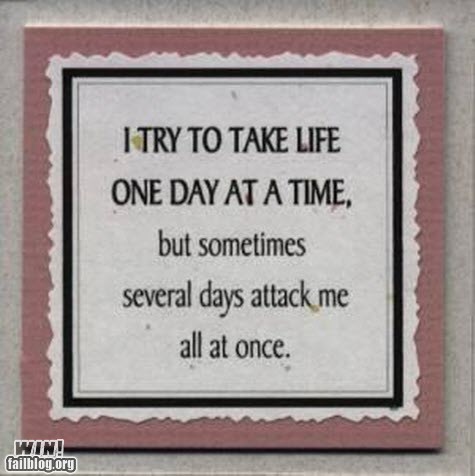
One Day at a Time

“One day at a time–this is enough. Do not look back and grieve over the past for it is gone; and do not be troubled about the future, for it has not yet come. Live in the present, and make it so beautiful it will be worth remembering.” via One Day at a Time – Single Parents – Families.com.

I had a bit of an epiphany yesterday while weeding in the garden. My wife and I were talking about taking things one day at a time. I told her that while she was in Italy, sometimes it was all I could do to live second to second, minute to minute, hour to hour let alone a day at a time. The purpose of living one day at a time is to reduce life to bite sized chunks — like the old riddle how do you eat an elephant? One bite at a time…

Jesus said ‘sufficient unto the day is the evil thereof‘ [I don’t know why I like the King James version of that quote so much, but I do]. The epiphany for me was that this not only applies to looking forward, but also looking back. Sometimes I can’t bear up under the future OR the past but I don’t have to. I can live one moment at a time when things get overwhelming!

The Apostle Paul said in Philippians chapter 3:”12 Not that I have already obtained all this, or have already arrived at my goal, but I press on to take hold of that for which Christ Jesus took hold of me. 13 Brothers and sisters, I do not consider myself yet to have taken hold of it. But one thing I do: Forgetting what is behind and straining toward what is ahead, 14 I press on toward the goal to win the prize for which God has called me heavenward in Christ Jesus.”

I forget what is behind and I strain toward what is ahead one day at a time…

“Information, if viewed from the point of view of food, is never a production issue. … It’s a consumption issue, and we have to start thinking about how we create diets and exercise,” said JP Rangaswami in his TEDx presentation.

For a man who currently has 38,000 books in his collection and lives in Calcutta, India where they are known for their rich, savory and sweet Southern Indian cuisine, his is a theory that could very well make sense!

Since most of us consume food according to a certain diet, minimize our surrender to sinful indulgences, measure our nutrition intake to make sure we have enough of everything; it’s possible that we’ve been doing the exact same thing all along with our consumption of data – or perhaps we should. As Plato the philosopher once said, “Knowledge is the food of the soul”.

“When I saw Supersize Me, I started thinking, now what would happen if an individual had 31 days of nonstop Fox News?” joked JP Rangaswami.

What do you think? If you saw information the way you see food, what would you do to digest the knowledge differently – nibble, bite, scoff or binge?” via How To Eat Information | FinerMinds.

Long before I saw this TEDx talk on eating information, my thinking on the topic was galvanized by Clay Johnson’s book The Information Diet which I highly recommend if you are intrigued by JP Rangaswami’s thoughts and are looking for more on the topic…

Me? I ‘eat’ information via Gmail, Google Reader and Gist and then share the best of it here and at business.toddlohenry.com, Twitter, Twylah, etc. Johnson’s book and Rangaswami’s statement about “Information overload or ‘filter failure’?” address the heart of the matter — just because I can track almost anything or anyone in Google Reader or Gist doesn’t mean I should in the same way that I shouldn’t eat everything I find at the Piggly Wiggly and I certainly shouldn’t eat it all at the same time! As the Apostle Paul said “All things are possible but not all things are beneficial” — tools without forethought result in poor tactics. Johnson and Rangaswami’s thoughts can help us ‘eat’ information on purpose instead of by accident…

If you want to ‘eat’ better, I suggest you need better thoughts, tools and tactics. One way to do that might be to read my free ebook on ‘personal news aggregation’. Register at http://elevation.company/pna/

5 Traits of a Good Marriage

Hindu marriage ceremony from a Rajput wedding.
Image via Wikipedia

Drs. Les and Leslie Parrott, say in their book, When Bad Things Happen to Good Marriages, that there are 5 traits of a healthy, life-long marriage: ownership, hope, empathy, forgiveness, and commitment. Here is a summary of each of those characteristics.

1. Ownership: Taking Responsibility

Often, couples believe their problems are the result of the other person’s actions.  It’s easy to avoid responsibility for our problems by blaming someone else.  But in the long-haul, admitting mistakes and owning up to our part of the problem is the single most powerful predictor of turning something bad into something good. Couples need to realize that it’s not who’s wrong, but what’s wrong that counts.

2. Hope:  Believing that Good Ultimately Triumphs

The foundation of hope is belief.  We must believe that the kind of marriage we want is possible.  Hope keeps love alive.  Stop hoping and marriage dies.

3. Empathy:  Walking in your Spouse’s Shoes

A spouse must be aware of what their spouse is feeling and what’s behind that feeling.  Empathy involves both the head and the heart. Many of us do one or the other pretty well; we either feel our partner’s pain with our heart, or we try to solve their problem with our head.  To do both can be a challenge.  But that is what empathy is all about.

4. Forgiveness:  Healing the Wounds

In a good marriage, both husbands and wives are quick to ask for forgiveness and to grant forgiveness. The simple words, “I was wrong. Will you please forgive me?” are magical in marriage. Forgiveness was designed to heal the deepest wounds of a human heart.

5. Commitment: Loving for Life

No matter how long a couple has been married, commitment may be the most effective tool good marriages use in battling bad things. Without commitment and the trust it engenders, marriages would have little hope of lasting.

In the face of difficulty, the key is to stay committed to your spouse and work together. Sit down with your spouse tonight and discuss how you are doing in each of these categories.

As the Apostle Paul said “Not that I have already obtained all this, or have already arrived at my goal, but I press on to take hold of that for which Christ Jesus took hold of me.” I’m struggling with many of these issues right now, trying to do the right thing with my wife despite manipulation from her family. Don’t they realize we have enough drama in our lives without more from their Karpman Drama Triangle?! Apparently not — the problem is that other people are unmanageable and the only thing I can manage is me…

Start a Blog at WordPress.com.

Up ↑
