While a website is just the start of a transformational thought leadership campaign, this is a pretty good start for Suzanne. Follow her blog to see what she does next!
…and everything is right in my ‘Personal News Aggregation’ universe. For about a week, I was having problems syncing my accounts on feedly and Google Reader and it was really frustrating — especially since it has always worked so well in the past. As you can see, however, my desktop version…
When I’m teaching social media, I don’t spend a lot of time talking about whether or not social media works for lead generation or thought leadership — that’s been pretty well established at this point. I usually start out my classes by saying that the single most important issue in social media today — especially for my students were who are mostly business owners or traditional marketing professionals — is ‘how do I add social media to my already overflowing plate and still get home for supper?’. Most of the people in my classes are struggling to keep up with e-mail let alone manage a blog, four social networks and an e-newsletter…
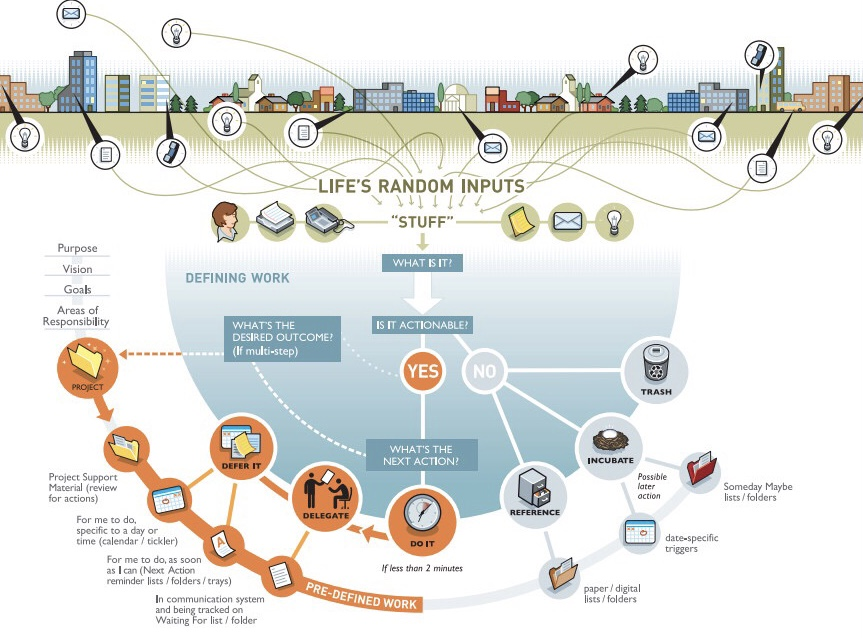
As a consultant, every minute that I spend on my own Internet marketing is a minute that I can’t bill to a client, therefore, I’ve had to force myself to become pretty efficient about how I do things like process e-mail, consumer information and published to the Internet. My constant inspiration in this process has been David Allen’s classic work ‘Getting Things Done‘. I recommend it to anyone who will listen. The heart and soul of David Allen’s book is this diagram:
How I apply Getting Things Done [GTD] to social media and ‘thought leadership’ marketing…
Thanks to David’s methodology I use as many containers as I need and not one more. I usually handle information only once — especially if I can process it in 2 min. or less. Here’s an attempt to depict what my thought leadership process looks like:
If you’re looking for a way to become more efficient about how you develop and document your expertise, comment below or use the contact form to get in such. I’d love to talk with you about applying David Allen’s Getting Things Done [GTD] principles to your world…
Do you ever wonder what makes certain people captivating, and others…
Not so much?
Often, it has nothing to do with someone’s age, looks or even talent, but rather an innate ability to get and keep other people’s attention.
Kind of like an “it factor.”
Now what if I said that you have this certain “it factor” too but you probably don’t know it and worse, you’re not using it to your full advantage.
Hopefully, you’d be intrigued enough to keep reading…
Because my guest today, Sally Hogshead, is the world’s leading expert on the science of fascination and she’s going to show you six steps to be more fascinating.
Now before you balk, please understand that this isn’t about changing who you are.
This is about understanding and embracing the distinct advantages you were born with and being more of that.
Later today at 13:00 Chicago time, I’ll be interviewing author Nilofer Merchant on the topic of ‘onlyness’. What is it? In her book 11 Rules for Creating Value in the Social Era, she writes:
Celebrate onlyness. The foundational element starts with celebrating each human and, more specifically, something I’ve termed onlyness. Onlyness is that thing that only one particular person can bring to a situation. It includes the skills, passions, and purpose of each human. Onlyness is fundamentally about honoring each person, first as we view ourselves and second as we are valued. Each of us is standing in a spot that no one else occupies. That unique point of view is born of our accumulated experience, perspective, and vision. Some of those experiences are not as “perfect” as we might want, but even those experiences are a source of ideas and creativity. Without this tenet of celebrating onlyness, we allow ourselves to be simply cogs in a machine—dispensable and undervalued.
Merchant, Nilofer (2012-09-12). 11 Rules for Creating Value in the Social Era (Kindle Locations 107-108). Perseus Books Group. Kindle Edition.
It is my belief that an understanding of onlyness is fundamental for transformational thought leadership and I plan to talk with Nilofer about what onlyness is, how it came to her, why she thinks it’s important in the social era, how is it different than branding [or is it?] and how does one tap into it. Our talk will be available as an event in Google+ as it happens and in an archive after the fact…
Here’s Nilofer’s TEDTalk on the topic of Onlyness;
As much as you may want it, you don’t have 100% control over your life. In fact, control is an illusion. But what you do have is CHOICE and that’s awesome.
Our inner and outer choices influence our reality more than anything else. That’s why the choices you make are incredibly important! So what’s a “good” choice?
Let’s go for more than good, let’s go for the BEST kind of choice you can possibly make…
The World Health Organization estimates that about 121 million people worldwide have some form of depression; whether it lasts a couple of minutes, or through many years of your life, chances are we’ve all experienced some form of depression, and it’s never any fun.
As a self-help author and travel writer, I’ve seen similarities in people all around the world. No matter where we come from, no matter what socio-economic standard or cultural background, we all have one thing in common. We all want to be happy.
While doing research for my next book, I discovered a formula to help people strengthen their inner faith, to enable them to have confidence in every aspect of their life, and ultimately to tap into authentic happiness.
The thing is that though everyone wants to be happy, our negative beliefs and patterns often stand in the way. To get to happiness, we must first stop believing in and acting on the negative. Here are some ideas to help you be happy now!




 Bright, shiny objects!
You must be logged in to post a comment.