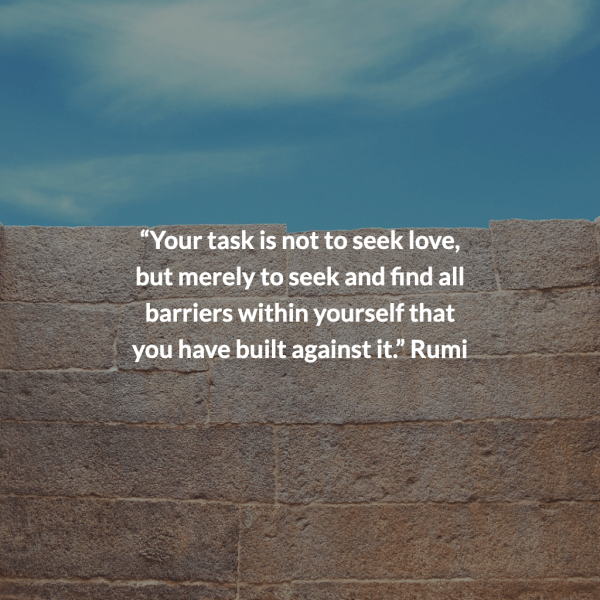
Love Thyself – How to Give Thanks to Your Former Reflection in The Mirror

FinerMinds

Full story at: Love Thyself – How to Give Thanks to Your Former Reflection in The Mirror.

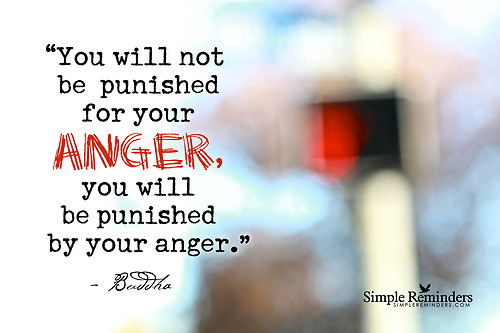
You will not be punished for your anger…

Simple Reminders

via “You will not be punished for your anger, you will be punished….

My Creative Life: Brené Brown

Full story at: My Creative Life: Brené Brown | SusannahConway.com.

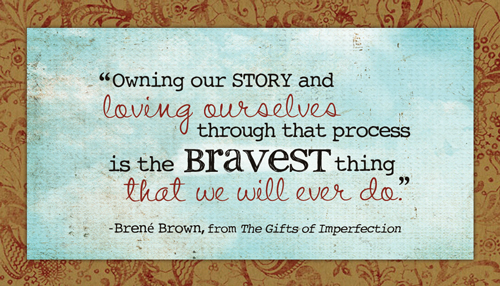
Wholeheartedness = courage, compassion and connection…

220px-Brene_portrait_cropWEBTime to mix things up again. Thanks to my friend Tim Kastelle for sharing Brené Brown’s TED Talk on vulnerability. She writes here on cultivating worthiness…

Practicing courage, compassion, and connection in our daily lives is how we cultivate worthiness. The key word is practice. Mary Daly, a theologian, writes, “Courage is like—it’s a habitus, a habit, a virtue: You get it by courageous acts. It’s like you learn to swim by swimming. You learn courage by couraging.” The same is true for compassion and connection. We invite compassion into our lives when we act compassionately toward ourselves and others, and we feel connected in our lives when we reach out and connect. Before I define these concepts and talk about how they work, I want to show you how they work together in real life—as practices. This is a personal story about the courage to reach out, the compassion that comes from saying, “I’ve been there,” and the connections that fuel our worthiness.

Brown, Brene (2010-09-20). The Gifts of Imperfection: Let Go of Who You Think You’re Suppose to Be and Embrace Who You Are (p. 7). BookMobile. Kindle Edition.

Here’s the TED Talk in case you haven’t seen it yet…

How to Make Tea

How to Make Tea - Prevention.com

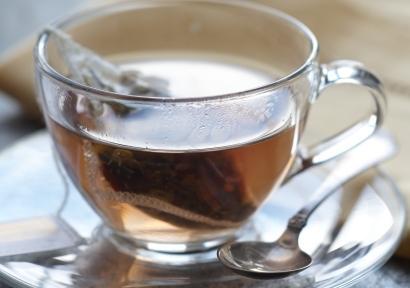
Lately, I have been turned on to the joy of loose leaf tea. My ‘tealologist’ Jenelle of Caffe Tlazo in Algoma, WI says that the tea we buy in the grocery store is the ‘hot dog‘ of teas made of from the floor sweepings of the good stuff. You can learn more about making good tea here: How to Make Tea – Prevention.com. Ask Jenelle if you want to know more about buying good tea once you know how to make it…

Oh, Discipline! We Need To Hang Out More Often!

donnagatesDonna Gates writes:

Chop wood and carry water. According to meditation masters and seasoned yogis, the path to greater awareness is unadorned and practical.

In order to awaken to our essential self, all we need is determined effort.

And after we “wake up,” the story is the same: Chop wood and carry water.

Too often, we glamorize spirituality. We are accustomed to finding peace in a place that we need to go to. In reality, our greatest source of strength and peace is within.

And the only way to get there is with consistent effort and discipline.

Discipline can take us to deeper and more fulfilling places in life. It can make our dreams a reality and it can bring our goals within arm’s reach.

Full story at: Oh, Discipline! We Need To Hang Out More Often!.

The Reason Love Dies (And How To Get It Back!)

Shelly Bullard writes:

Our nature is to want to escape anything that feels like it’s limiting to us. Obligations, expectations, “shoulds.”

But what about things that we want to do–do we like that?

Yes, of course.

Well, the same rules apply to love.

When you feel like you have to love—that you have to do things to make your partner happy, that you have to be a certain way to get the love you want—then the feeling of authentic love starts to disintegrate and die. Sounds harsh, but it’s true.

Love needs space to grow.

Like fire, love needs a little breathing room. Stifle it and it burns right out.

The reason love dies under heavy limitations is because limits are counter to our very nature, which is growth. We can’t help but expand. We can’t help but evolve. We can’t help but to change.

Full story at: The Reason Love Dies (And How To Get It Back!).

Why Feeling Like a Victim Makes You Unhappy

shelley-bullardShelly Bullard writes:

We all get caught in the victim-trap from time to time. Feeling like we’ve been wronged; like we were right and they were, well, I’m sure we can complete the sentence with lots of words. It’s true, being a victim is not an uncommon stance to take in this world.

But you should know that feeling like a victim only makes you feel worse. Many of us don’t realize this. In fact, often we hang-out in victim-land because we unconsciously believe that it will get us what we want (which is care, concern, and love). On some level we think being a victim will make us feel better! We are sorely mistaken.

If you recognize that sometimes you identify as a victim and you want to stop the pattern, then keep reading. In this article I’m going to discuss why feeling like a victim ultimately leads to more unhappiness, and how to turn the pattern around. Continue reading “Why Feeling Like a Victim Makes You Unhappy”

What Are Your #1’s?

Brian Johnson shares this thought:

Want to optimize your life? Try this simple exercise to identify the top things you could *start* doing and *stop* doing that will lead to the most positive impact in your life!

via What Are Your #1’s? « Positively Positive.

F%#k It! The 2 Magic Words Necessary To Live A Bold Life!

Kute Blackson writes:

It’s your life.

Are you living boldly?

Or are you playing it safe?

Safe is risky. Safe is an illusion. Safe is death.

Whose life are you living? Yours or someone else’s?

It’s your life. Not your parent’s, brother’s, cousin’s, friend’s or neighbor’s.

We are constantly bombarded by the media and sold the lie: “Who you are is not enough!”

We are taught to fit in. To play it safe. To seek approval. To be realistic. This process begins from the moment we are born. We are told who we need to be in order to get love and survive. We learn to play “The Game.” But ironically, the better you play the game, the more you lose …. YOU.

Continue reading “F%#k It! The 2 Magic Words Necessary To Live A Bold Life!”

You Have to Know What Kind of Love You Deserve to Attract It

Full story at: You Have to Know What Kind of Love You Deserve to Attract It | Tiny Buddha.

30sec Tip: How to Reset Your Focus – Lifehack.

Are You Playing The Victim? Here’s How To Regain Your Power!

Full story at: Are You Playing The Victim? Here’s How To Regain Your Power!.

Who Are You Trying to Prove Yourself To?

“If you don’t like something change it; if you can’t change it, change the way you think about it.” ~Mary Engelbreit

Full story at: Who Are You Trying to Prove Yourself To? | Tiny Buddha.

Standing Up for Ourselves

Melody-Beattie-8x6.jpgMelody Beattie writes:

“We learn some behaviors have self-defeating consequences, while others have beneficial consequences. We learn we have choices” Beyond Codependency

It is so easy to come to the defense of others. How clear it is when others are being used, controlled, manipulated, or abused. It is so easy to fight their battles, become righteously indignant, rally to their aid, and spur them on to victory.

“You have rights,” we tell them. “And those rights are being violated. Stand up for yourself, without guilt.”

Why is it so hard, then, for us to rally to our own behalf? Why can’t we see when we are being used, victimized, lied to, manipulated, or otherwise violated? Why is it so difficult for us to stand up for ourselves?

There are times in life when we can walk a gentle, loving path. There are times, however, when we need to stand up for ourselves – when walking the gentle, loving path puts us deeper into the hands of those who could mistreat us.

Some days, the lesson we’re to be learning and practicing is one of setting boundaries. Some days, the lesson we’re learning is that of fighting for our own rights and ourselves.

Sometimes, the lesson won’t stop until we do.

Today, I will rally to my own cause. I will remember that it is okay to stand up for myself when that action is appropriate. Help me, God, to let go of my need to be victimized. Help me appropriately, and with confidence, stand up for myself.

via Blog | Just For Today Meditations | Maintaining A Life.

How to Make 2013 The Best Year of Your Life

Stepcase Lifehack

Full story at: How to Make 2013 The Best Year of Your Life.

7 Tips to Develop a Daily Practice for Growth, Healing, and Happiness

Tiny Buddha: Wisdom Quotes, Letting Go, Letting Happiness In

Full story at: 7 Tips to Develop a Daily Practice for Growth, Healing, and Happiness.

What to do when someone pushes your buttons

Why We Do What We Do: Intrinsic vs. Extrinsic Motivation

We’ve all heard that money can’t buy us happiness. Or as the Beatles rightly pointed out, it can’t buy you love either.

However, despite this knowledge, we are surrounded by on average 3,000 advertisements a day telling us that success and happiness comes from earning a lot of money, achieving fame and being physically beautiful. It’s little wonder we strive towards achieving these things in hope that they will equal happiness.

In this 4-minute video, Brian Johnson, author of Philosopher’s Notes, explains how we can break this cycle of extrinsic motivation by become more intrinsically motivated; simply by focusing on attaining meaningful relationships, growing as a human being and contributing. Not surprisingly, not only does this make you a better person, research has shown that it also makes you more psychologically happy and stable, too.

via Why We Do What We Do: Intrinsic vs. Extrinsic Motivation | FinerMinds.

5 Life Lessons I’ve Learned From My Cat Bob

LOL! I thought I was the only one being ‘instructed’ by my cat, but Dayne Stevens has a great post here on a totally different set of lessons than what I’m ‘taking’:

Many of us live with and love animals. But we can learn a great deal from them regarding life, how we face challenges, and how we need to live with less resistance. I personally am more of a cat person versus a dog person, but I think both cats and dogs have things to teach us…if we pay close attention.

Over the last 8 years, I’ve been the proud owner of a big, and I mean BIG, cat named Bob. Bob has been with me through good and bad times, always loyal, always loving.

The other day I was watching him sleep and it got me to thinking about the life lessons he has taught me. They’ve made a huge difference in my life; I hope they do the same for you.

Full story at: 5 Life Lessons I’ve Learned From My Cat Bob.

You can read my related cat post here

The benefits of “I’m sorry…”

Melody Beattie writes:

Did you ever do something stupid that hurt someone’s feelings? Did you ever treat someone wrong and there was no justification for how you behaved? I have. It’s an awful place to be, when we realize what we’ve done.

The more we value that person, the more we want them to know how genuinely sorry we are. We’d give any­thing to see their facial muscles soften and hear them say, “It’s okay.”

I first learned about the value of forgiveness when 1 was in treatment for chemical dependency. I didn’t realize how much I’d hurt other people until I’d been sober for a while. When I became aware of my guilt, it was paralyzing and thick. I just wanted it to go away, and I didn’t think it ever would. The antidote for guilt is forgiveness. Asking for forgiveness from others or God puts us in a vulnerable place. There is nothing we can do except wait until we get word—and believe—that it’s okay.

I recently read a magazine article about the physiolog­ical benefits of saying, “I’m sorry” Acknowledging to someone that we’ve hurt them, saying we’re sorry, and genuinely meaning it improves health.

Recovery programs have known for a long time that becoming aware of the harm we’ve done and making direct amends are essential for the well-being of the person making amends. But making amends doesn’t just benefit us. It helps the other person too.

As hard as I try not to, I still make mistakes and do things that hurt others. Sometimes I know what I’m doing is wrong, and I do it anyway Other times it’s an accident.

Forgiveness isn’t just a value we need if and when we’re recovering. It’s a value we’ll need all our lives.

Value: Forgiveness has many components: self-inspection, self-responsibility compassion, living by a set of ethics, letting go of our defenses, letting go of resentments and judgments, humbling ourselves, wanting to be close to God, acknowledging to other people that they’re impor­tant to us, knowing that others care enough about us. All these aspects of forgiveness are good. Whether we’re extending or receiving forgiveness, it’s the value this week.

via January 8 – from “52 Weeks of Conscious Contact”.

Start a Blog at WordPress.com.

Up ↑