Do you or someone you know suffer from Bitchy Resting Face?

Too funny…

Bitchy Resting Face is a disorder that affects millions of women every day. Together we can face the problem…

via Do you or someone you know suffer from Bitchy Resting Face? | elephant journal.

Are you actually a bitch? An asshole? Then try tonglen — a practice for love, vulnerability, strength in tough times, compassion and empathy—and see us in the morning.

Me? I suffer from ARF – asshole resting face. If I’m not consciously making an effort to smile, people assume I’m ready to pull out a gun and go postal. If there is some truth behind the humor in this video for you, Elephant Journal recommends this post

Big Brother Is Watching: What Did You Expect?

012914fae961c171135b9781a1be4605Arthur Dobrin writes:

We need to think harder about why privacy is important, what we mean by privacy, assess the various trade-offs and create public policies that reflect our values regarding the relationship between individuals and society.

The fear that the US will become a surveillance society is misplaced. It already is one.

The reality is that almost everything about you is already known, if not by the government, then by business. Every time you get on an airplane, you are scanned. Every time you search for a product online, the information falls into the hands of retailers who want you to buy their products.

We are instantly connected to the world—we talk, socialize, get the news, play, pay bills, state our opinions, research, shop. So it should be no surprise that the world knows everything about us in return. The flow of information goes in both directions…

via Big Brother Is Watching: What Did You Expect? | Psychology Today.


Father’s Day Tribute: Ever Wondered Why?

Ever wondered why your dad drove an old car (which you were incredibly embarrassed of) throughout your entire childhood, while you went to a good school?

Or why the monsters from under your bed never came out as long as he was there?

Or as an adult, why he still tries to protect you just as he did as a child?

In honor of Father’s Day, we wanted to share this touching 2-minute video as it reminded us of all the small things dads do to show their love and support, which often as children, we never noticed.

via Father’s Day Tribute: Ever Wondered Why?.

Essence of Mindful Prayer

recite-32085-1286722747-fz1ur9

Tara Brach writes;

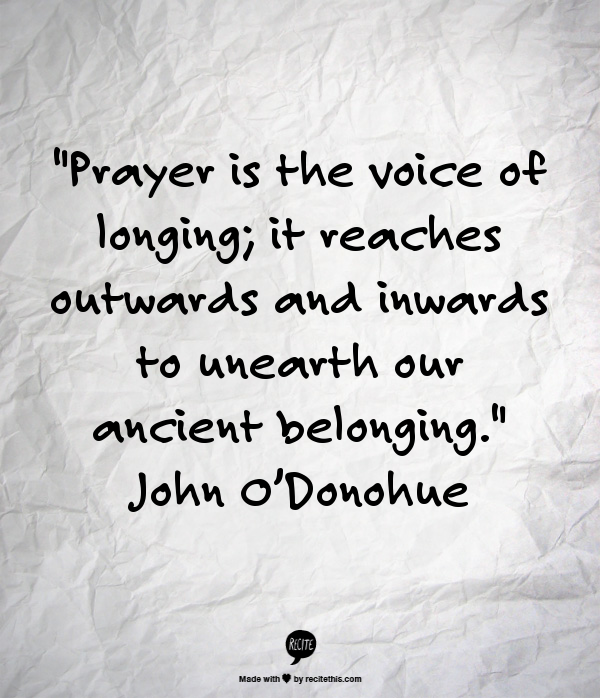
When we are suffering and turn to prayer, no matter what the apparent reasons for our pain, the basic cause is always the same: we feel separate and alone.  Our reaching out is a way of relieving ourselves of this pain of isolation.  Yet the bodhisattva’s aspiration radically deepens the meaning of prayer by guiding us to also turn inward.  We discover the full purity and power of prayer by listening deeply to the suffering that gives rise to it. Like a great tree, such prayer sinks its roots into the dark depths in order to reach up fully to the light. This is what I call mindful prayer—opening wakefully to our suffering and allowing ourselves to reach out in our longing for connection.  Irish poet and priest John O’Donohue writes: “Prayer is the voice of longing; it reaches outwards and inwards to unearth our ancient belonging.” The more fully we touch our pain and longing, the more fully we are released into boundless, compassionate presence.

via Tara Brach – Essence of Mindful Prayer.

The Benefit of Building Sand Castles

“We are like children building a sand castle. We embellish it with beautiful shells, bits of driftwood, and pieces of colored glass. The castle is ours, off limits to others. We’re willing to attack if others threaten to hurt it. Yet despite all our attachment, we know that the tide will inevitably come in and sweep the sand castle away. The trick is to enjoy it fully but without clinging, and when the time comes, let it dissolve back into the sea.” ― Pema Chödrön 

via Mindful Musings: The Benefit of Building Sand Castles. (Quote of the Day).

What do sad people have in common?

What

Do sad people have in

Common?

It seems

They have all built a shrine

To the past

And often go there

And do a strange wail and

Worship.

What is the beginning of

Happiness?

It is to stop being

So religious

Like That.

~ Hafiz

via What do sad people have in common? by Hafiz | Electronic Poets.

Living Whole-Heartedly

Tara Brach writes:

The happiest people I know have something in common: they are whole-hearted in how they engage in their lives…whole-hearted in relating with others, in work, in meditation, and in play. They have a capacity to give themselves thoroughly to the present moment.

Yet for many, it’s challenging to engage with this quality of presence. Take this personal ad  for example. It says:

Free to a good home, beautiful 6-month old male kitten, orange and caramel tabby, playful, friendly, very affectionate, ideal for family with kids.  OR handsome 32-year old husband, personable, funny, good job, but doesn’t like cats.  He or the cat goes.  Call Jennifer and decide which one you’d like.

How often do we find that in our relationships, rather than loving presence, we have an agenda for someone to change, to be different? How often do we find that our insecurities prevent us from being spontaneous, or whole-heartedly engaged with friends? You might think of one important relationship and ask yourself: “What is between me and feeling fully present when I’m with this person?” Notice the fears creeping in about falling short, the urge to get your needs met, the sense of “not enough time,” the wanting for your experience together to unfold a certain way!

This same conditioning plays out in all aspects of living, and it is well grounded in our evolutionary wiring. We need to manage things, to feel in control. We try to avoid disappointments, to prevent things from going wrong. 

via Tara Brach: Living Whole-Heartedly.

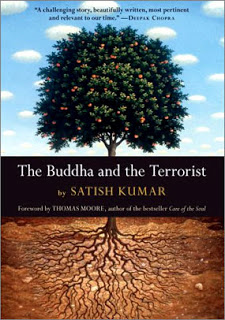
The Buddha and The Terrorist

TheBuddahandtheTerrorist_CoverLarge

Tara Brach quoted this in a meditation I was listening to today:

It is often said, accurately, that violence begets violence. There is a virus buried deep in all violence that is contagious, that inspires an equally brutal and mindless response. A terrorist blows up a bus, and an army comes out to settle the score. This exchange of violence and this contagion of terror have been handed down for eons from family to family and from nation to nation. It is a chain of terror made up of people gone amok with anger and those just as disturbed with their feelings of virture and righteous vengeance.

But there is good news. The Gospel of Jesus, the Dharma of Buddha, the Tao of Lao Tzu, and the tariqa, or way of love, in Sufism all teach that you can let go of your grip on this chain. You can be free of it. When obscene violence interrupts your life, you don’t have to respond with virtuous, justified, and reasonable force. You can choose not to be part of the destructive cycle, and that choice not to participate is a first step toward peace.

But to step outside the circle of terror you have to do something quite unreasonable. You have to forfeit vengeance and abandon all reasonable expectations that the majority of your community, friends, and family may take for granted. You will probably have to go it alone and trust your spiritual instincts. You may appear passive and weak. Only you know the inner courage needed to overcome habits of vengeance and punishment that are assumed to be right and virtuous.

via The Buddha and Madison | New Wood.

Dealing With Anger

See on Scoop.itLiving Business

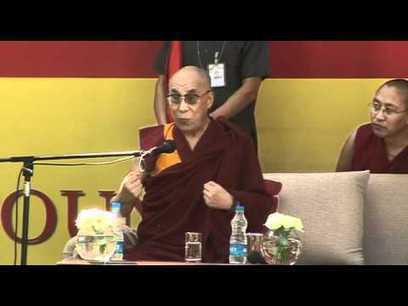
His Holiness the Dalai Lama talks about dealing with anger in this clip from his visit to Doon School in Dehradun, India, on October 28, 2011. The entire eve…

See on www.youtube.com

Do Not Be Ashamed

img_2943_2-tara-001

Tara Brach shared this poem with me:

You will be walking some night

in the comfortable dark of your yard

and suddenly a great light will shine

round about you, and behind you

will be a wall you never saw before.

It will be clear to you suddenly

that you were about to escape,

and that you are guilty: you misread

the complex instructions, you are not

a member, you lost your card

or never had one. And you will know

that they have been there all along,

their eyes on your letters and books,

their hands in your pockets,

their ears wired to your bed.

Though you have done nothing shameful,

they will want you to be ashamed.

They will want you to kneel and weep

and say you should have been like them.

And once you say you are ashamed,

reading the page they hold out to you,

then such light as you have made

in your history will leave you.

They will no longer need to pursue you.

You will pursue them, begging forgiveness.

They will not forgive you.

There is no power against them.

It is only candor that is aloof from them,

only an inward clarity, unashamed,

that they cannot reach. Be ready.

When their light has picked you out

and their questions are asked, say to them:

“I am not ashamed.” A sure horizon

will come around you. The heron will begin

his evening flight from the hilltop.

via “Do Not Be Ashamed” by Wendell Berry.

She did not share it with me directly, but rather through her series of meditation podcasts. This poem was wrapped in a meditation called Be All That You Are. You can listen to it here

Secrets of the Millionaire Mind: The Philosophers Notes Challenge – Day 4

A few words from Brian on the book…

“How’s your financial blueprint? Don’t worry, I didn’t have mine either until I read T. Harv Eker’s great (and surprisingly funny!) book. If you’re committed to creating financial freedom (who isn’t?) then my strong recommendation is that you add this to your must-read list.”

In today’s challenge, we’ll take a quick look at some of Brian’s favorite big ideas (this book is so full of them he had to stop himself at 21!) – everything from defining financial freedom, learning to play to win, and seeing how the size of your character determines your response to various sized problems.

What you’ll see is that T. Harv believes strongly in the fact that: “Your inner world reflects your outer world,” and dedicates a great deal of the book to teaching us how to change our thinking – to reprogram ourselves to think and act like rich people do.

So… let’s get to work on that financial blueprint, shall we?

To take part in today’s challenge, simply watch Brian’s video above and share your responses to it below (and to get a copy of the book, just click here).

via Secrets of the Millionaire Mind: The Philosophers Notes Challenge – Day 4.

Canadian Police Officer Discusses Freedom, Yoga & the Bhagavad Gita…

See on Scoop.itLiving Business

Officer Brigitte Brousseau is a certified yoga teacher. In this 1 minute video, she discusses how she has become clear with the responsibility and power to take away another’s freedom.

See on www.elephantjournal.com

How to Exude One of Life’s Most Important Skills (By the Bucket-Load!)

Self-confidence.

Don’t you just wish that you could hit a magic button and it would come to your rescue when you need it the most – or for some of us, each and every day?

In this empowering 13-minute TED Talk, athletic director and head coach of the Varsity Soccer team at Ryerson University, Dr. Joseph, explains why he believes self-confidence is the most important skill in both athletics, and in life.

We really enjoyed this motivating talk as it reminded us that even if we’re not blessed with a natural healthy glow of self-confidence – it’s a skill that can be mastered, no matter how lacking in it we may be.

via How to Exude One of Life’s Most Important Skills (By the Bucket-Load!).

Spiritual Liberation: The Philosophers Notes Challenge – Day 3

Welcome to day 3 of the challenge!

Today’s challenge is on Spiritual Liberation by Michael Bernard Beckwith.

For those not familiar with Michael, he is the founder of the Agape Spiritual Center, where his talks have been described as “electrifying,” and he also was one of the featured teachers in The Secret.

“My central message is not about religiosity or churchianity. It is about aspiring toward spiritual liberation, which I define as becoming free from the narrow confines of fear, doubt, worry, and lack, and living instead from a conscious awareness of one’s Authentic Self, one’s true nature of wholeness.

Spiritual liberation results from discovering and expressing the intrinsic qualities of enlightened consciousness that have been ours since the moment we came into existence. Simply put, all that is required to live up to our highest potential is already inside us awaiting our conscious activation. Living up to our potential is about becoming more ourselves, more of who and what we are as awakened beings, a central theme you will encounter throughout this book.” – Michael Bernard Beckwith from Spiritual Liberation.

via Spiritual Liberation: The Philosophers Notes Challenge – Day 3.

Pema Chodron On Faith, Anger & Divorce

I like listening to Pema Chodron:

Here at MBG, we love Pema Chodron, and were thrilled to discover this candid conversation between the great Buddhist monk and Bill Moyers on PBS. 

In this interview, Pema Chodron talks about the pain and anger she felt after her divorce and explains how her strong emotions drove her to her spiritual practice. 

“If we could learn to not be afraid of groundlessness, not be afraid of insecurity and uncertainty,” she says, “it would be calling on an inner strength that would allow us to be open and free and loving and compassionate in any situation.”

With gems like this, the entire video is worth a watch. 

via Pema Chodron On Faith, Anger & Divorce (Video).

The Secret to Creating Holistic Success: Do You Have It?

In this highly engaging 31-minute presentation, the incredibly charismatic, best-selling author and featured teacher in The Secret, Lisa Nichols, shares her secrets… quite literally.

Listen to this inspiring video to hear the entertaining story behind her appearance in The Secret, and to learn of her soulful tips on living an authentic life and creating holistic success.

Lisa would have to be one of our most favorite people. Her energy, honesty and hard-working attitude is an inspiration to all of us.

via The Secret to Creating Holistic Success: Do You Have It?.

How to Stop Worrying and Start Living: The Philosophers Notes Challenge – Day 2

Okay guys, are you ready for day 2 of the challenge?

This time we’re going to be studying How to Stop Worrying and Start Living by Dale Carnegie.

Carnegie is also the author of the famed, How to Win Friends and Influence People, so we can’t wait to start today’s challenge.

Our favorite quote from the book is:

“Seventy per cent of all patients who come to physicians could cure themselves if they got rid of their fears and worries.”

We love that line. It reminds us of a quote from another great book by Jose Silva, The Silva Method, where Mr. Silva says that he believes 90% of illness is caused by stress and our own negative beliefs. 

So, are you ready to take part in today’s challenge?

Simply watch the above video, and tell us what’s the biggest takeaway you got from this lesson, and how you can start implementing the wisdom from this book into your life.

via How to Stop Worrying and Start Living: The Philosophers Notes Challenge – Day 2.

Kindness: The Easy, Powerful Act You Can Do to Change the Planet

Did you know that by doing an act of kindness for someone, you produce the same serotonin levels you would have had you been on the receiving end?

And what’s more, observing an act of kindness also increases your serotonin levels?

With this in mind, if we all made it our mission to do at least one act of kindness everyday, imagine how this contagious energy would lift the vibration of the planet?

To learn more about the power of kindness, and the strength that comes from choosing our emotions, check out this 9-minute video by the legendary Dr. Wayne Dyer.

via Kindness: The Easy, Powerful Act You Can Do to Change the Planet.

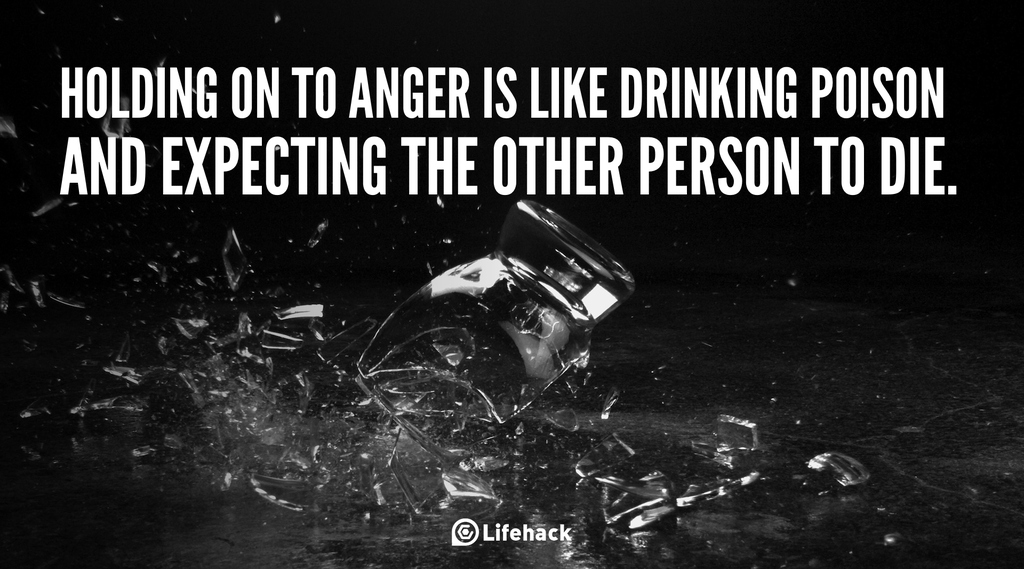
Holding on to Anger…

From Evernote:

Holding on to Anger…

Clipped from: http://www.lifehack.org/articles/communication/30sec-tip-holding-anger.html

Rare and Precious Joy

Tara Brach writes:

When I talk to people about how much they experience joy, most say, “Not so much.” Joy is not a frequent visitor, and when it does appear, it’s fleeting.

Joy arises when we are open to both the beauty and suffering inherent in living. Like a great sky that includes all different types of weather, joy is an expansive quality of presence. It says “Yes to life, no matter what!”  Yet it’s infrequency lets us know our more habitual posture: resisting what’s happening, saying “No” to the life that is here and now.  We tend to override our innate capacity for joy with our incessant inner dialogue, our chronic attempts to avoid unpleasantness and to hold on to pleasure. Rather than joy in the present moment, we are trying to get somewhere else, to experience something that is better, different.

The great French writer, André Gide, said:

“Know that joy is rarer, more difficult and more beautiful than sadness. Once you make this all-important discovery, you must embrace joy as a moral obligation.”

via Tara Brach: Rare and Precious Joy.

It’s Not Personal, Really: How to Rise Above the Negativity of Others

How do you react when a friend’s bluntness hurts your feelings, or when a disgruntled boss speaks to you in a rude manner?

For many of us, we often can’t help but take others negative reactions to us personally – leaving us feeling a mixture of confusion, resentment, or that we’re being misunderstood.

However, in truth, this is where we’re often the ones misreading the situation.

In this interview with Oprah, don Miguel Ruiz, acclaimed author of The Four Agreements, discusses the second “Agreement” from his book – how to not take things personally.

In the video, he reminds us that we’re not always the “secondary character” of everyone’s world (something we often forget!), and that we can’t control or change people (and nor should we try).

via It’s Not Personal, Really: How to Rise Above the Negativity of Others.

Start a Blog at WordPress.com.

Up ↑