“If you care about understanding something, then you need to study it, either learning from others’ experience or collecting the data yourself that would allow you to test the causal claim of your common sense theory. In the absence of data, we are all free to speculate, but it is worth reminding yourself that your speculation is exactly that; a flimsy common-sense story that is vulnerable to being blown over by a gust of actual evidence. The common-sense stories we tell to make sense of the world may be compelling, but they are not evidence.
This understanding is essential to taking our own common sense with the grain of salt that it deserves. What seems like common sense to us is, to a great extent, driven by intuition. And, as authors like Daniel Kahneman, Max Bazerman, Dan Ariely, Richard Thaler, and Cass Sunstein have written about so articulately, intuitive judgment is beset by biases. It is possible to train your intuition to improve its fidelity, but that requires substantial training, practice, and feedback. It is rare that life provides us with sufficient training, practice, and feedback. Without them, it is dangerous to place too much confidence in your common-sense intuitions.”
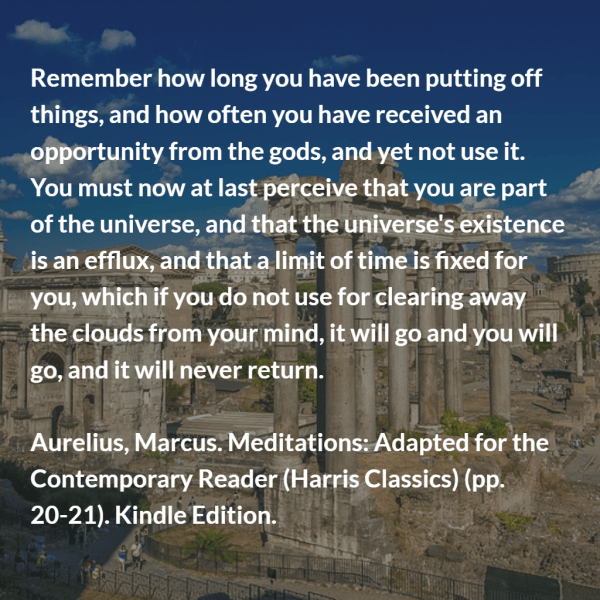
Remember how long you have been putting off things, and how often you have received an opportunity from the gods, and yet not use it. You must now at last perceive that you are part of the universe, and that the universe’s existence is an efflux, and that a limit of time is fixed for you, which if you do not use for clearing away the clouds from your mind, it will go and you will go, and it will never return. Every moment you should think steadily as a Roman and as a man to do what he must in hand with perfect and simple dignity, and a feeling of affection, and freedom, and justice; and to give yourself relief from all other thoughts. And you will give yourself relief, if you live your every act in life as if it were the last, laying aside all carelessness and passionate aversion from the commands of reason , and all hypocrisy, and self-love , and discontent with the portion which has been given to you. You see how few the things are, of which if a man has hold of, he is able to live a life which flows in quiet, and is like the existence of the gods; for the gods on their part will require nothing more from him who observes these things. Do wrong to yourself, do wrong to yourself, your soul; but you will no longer have the opportunity of honoring yourself. Every man’s life is sufficient. But yours is nearly finished, and although your soul should revere itself it also places its happiness in the souls of others.
Aurelius, Marcus. Meditations: Adapted for the Contemporary Reader (Harris Classics) (pp. 20-21). Kindle Edition.
I’m guessing that Emitt Rhodes is the greatest 70’s musician you never heard of. I have been a ‘fan’ of his since middle school. I thought I was sooo very sophisticated for liking this kind of album when I was that young. Truth is, he reminded me much of my hero of that time, Paul McCartney. Turns out I’m not the only one — many referred to him as a ‘One Man Beatles’ who played all the instruments himself ala McCartney in his first solo album…
Here’s what the Wikipedia has to say about Emitt’s early career:
“The Merry-Go-Round had a recording contract with A&M Records when they disbanded in 1969. Rhodes recorded songs at A&M to fulfill that contract, but A&M decided to not release them at the time. Rhodes then decided to go out on his own and bought equipment to make a recording studio in his parents’ garage. Rhodes recorded his first album (Emitt Rhodes) in that home studio. He got a recording contract with ABC/Dunhill Records, which released his album as well as the next two albums he recorded (Mirror and Farewell to Paradise). Rhodes got a $5,000 advance for Emitt Rhodes, which he spent on recording equipment.[citation needed]
His first album was a critical success – Billboard called Rhodes “one of the finest artists on the music scene today” and later called his first album one of the “best albums of the decade”. The album reached number 29 on the Billboard charts. The single “Fresh as a Daisy” reached number 54 on the pop chart. Rhodes opened at the Troubadour nightclub on February 9, 1971, concurrent with a large earthquake that struck the Los Angeles area. An ad that ran in Billboard said “That wasn’t an earthquake, that was Emitt Rhodes opening at the Troubadour!” Meanwhile, shortly after Emitt Rhodes was released by Dunhill, A&M decided to release their old recordings of The American Dream, which confused record buyers. Mirror was released in 1971 and did reach the top 200 on Billboard‘s album chart. In 1973 Dunhill released Rhodes’ final album, Farewell to Paradise.[1]
Rhodes wrote all of the songs on his albums. On Emitt Rhodes, Mirror, and Farewell to Paradise, he played all of the instruments and sang all of the vocals while recording himself in his home recording studio. He used a four-track recorder for the instruments for Emitt Rhodes and transferred those to an eight-track recorder to add the vocals. He used an eight-track recorder for Mirror, and Farewell to Paradise. The mixdown engineer on Farewell to Paradise was Curt Boettcher, the producer and musician who is best remembered for his work on the “soft pop” albums by Sagittarius and The Millennium.[citation needed]
Rhodes’ contract with Dunhill called for an album every six months (six albums over three years) – a schedule that was impossible for Rhodes to meet, due to writing all of the songs and recording each instrument and vocal individually by himself.[1] Dunhill sued Rhodes for $250,000 and withheld royalties because of his failure to deliver albums on the timescale required by the contract. Emitt Rhodes took nearly a year to record, the album Mirror took nine months, and Farewell to Paradise took over a year.”
Bankrupt, Rhodes faded into obscurity for over 35 years. I looked for this documentary made by an Italian fan for over two years and found it yesterday morning. Curious? Dig in…
You can read more about Emitt’s life here and here and in the links below:
“From 1986 to 2011, Oprah Winfrey hosted The Oprah Winfrey Show. It was the highest rated talk show of all-time and familiar to nearly anyone who owned a television set in North America at that time.
Throughout the 1980s and 1990s, the “Queen of All Media” built a brand that stretched far beyond the television screen. She went on to become a billionaire, a well-regarded philanthropist, and a recipient of the Presidential Medal of Freedom. And as she was busy working toward these otherworldly accomplishments, Oprah relied on a simple habit: journaling.
Journaling is simply the act of thinking about your life and writing it down. That’s it. Nothing more is needed. But despite its simplicity, the daily journal has played a key role in the careers of many prolific people.
As you might expect, journaling is a favorite habit of many writers. From Mark Twain to Virginia Woolf, Francis Bacon to Joan Didion, John Cheever to Vladimir Nabokov. A journal was rarely far from any of these artists. Susan Sontag once claimed that her journal was where she “created herself.”
Journaling has been utilized by scores of brilliant thinkers and inventors. Charles Darwin. Marie Curie. Leonardo da Vinci. Thomas Edison. Albert Einstein. Similarly, leaders and politicians throughout history have kept journals in one form or another. People like Thomas Jefferson, Winston Churchill, and Marcus Aurelius. In the sporting world, athletes like Katie Ledecky, winner of multiple gold medals, and Eliud Kipchoge, the world record holder in the marathon, rely on journals to reflect on their daily workouts and improve their training.
Why have so many of history’s greatest thinkers spent time journaling? What are the benefits?”
If you can’t stop watching TV long enough to get your life together you seriously don’t want to change. That’s basic s***. It’s the bare minimum, to be honest. So what will it be? Netflix or a better paying career? Donuts or about a body you can be proud of? Video games or a loving relationship?
Every time you think you can’t stop that’s just another excuse. You can. You can and you will. Stop buying yourself off. Stop letting your own internal condition dominate the quality of your life — take back the wheel. If you continue to be led by your emotions of regret you’ll eventually live that vision on your deathbed thinking what if…










 Bright, shiny objects!
You must be logged in to post a comment.