George Armstrong Custer. (Photo credit: Wikipedia)
Crazy Horse and Sitting Bull, leaders of the Sioux tribe on the Great Plains, strongly resisted the mid-19th-century efforts of the U.S. government to confine their people to reservations. In 1875, after gold was discovered in South Dakota’s Black Hills, the U.S. Army ignored previous treaty agreements and invaded the region. This betrayal led many Sioux and Cheyenne tribesmen to leave their reservations and join Sitting Bull and Crazy Horse in Montana. By the late spring of 1876, more than 10,000 Native Americans had gathered in a camp along the Little Bighorn River–which they called the Greasy Grass–in defiance of a U.S. War Department order to return to their reservations or risk being attacked.
In mid-June, three columns of U.S. soldiers lined up against the camp and prepared to march. A force of 1,200 Native Americans turned back the first column on June 17. Five days later, General Alfred Terry ordered Custer’s 7th Cavalry to scout ahead for enemy troops. On the morning of June 25, Custer drew near the camp and decided to press on ahead rather than wait for reinforcements.
At mid-day, Custer’s 600 men entered the Little Bighorn Valley. Among the Native Americans, word quickly spread of the impending attack. The older Sitting Bull rallied the warriors and saw to the safety of the women and children, while Crazy Horse set off with a large force to meet the attackers head on. Despite Custer’s desperate attempts to regroup his men, they were quickly overwhelmed. Custer and some 200 men in his battalion were attacked by as many as 3,000 Native Americans; within an hour, Custer and every last one of his soldier were dead.
The Battle of Little Bighorn–also called Custer’s Last Stand–marked the most decisive Native American victory and the worst U.S. Army defeat in the long Plains Indian War. The gruesome fate of Custer and his men outraged many white Americans and confirmed their image of the Indians as wild and bloodthirsty. Meanwhile, the U.S. government increased its efforts to subdue the tribes. Within five years, almost all of the Sioux and Cheyenne would be confined to reservations.” via Battle of Little Bighorn — History.com This Day in History — 6/25/1876.
We need healthy boundaries about receiving money, and we need healthy boundaries about giving money.
Some of us give money for inappropriate reasons.
We may be ashamed because we have money and don’t believe we deserve it. We may belong to an organization that uses shame as a form of control to coerce us out of our money that the organization wants.
We can get hooked into giving money to our children, family members, or friends because we have earned or unearned guilt. We allow ourselves to be financially blackmailed, sometimes by the people we love.
This is not money freely given, or given in health.
Some of us give money out of a sense of caretaking. We may have exaggerated feelings of responsibility for others, including financial responsibility.
We may be giving simply because we have not learned to own our power to say no when the answer is no.
Some of us give because we hope or believe people will love us if we take care of them financially.
We do not have to give money to anyone. Giving money is our choice. We do not have to allow ourselves to be victimized, manipulated, or coerced out of our money. We are financially responsible for ourselves. Part of being healthy is allowing those around us be financially responsible for themselves.
We do not have to be ashamed about having the money that we earn; we deserve to have the money we have been given — whatever the amount, without feeling obligated to give it all away, or guilty because others want what we have.
Charity is a blessing. Giving is part of healthy living. We can learn to develop healthy boundaries around giving.
Today, I will strive to begin developing healthy boundaries about giving money. I understand that giving is my choice.
Charles Babbage’s Difference Engine 2 at the Science Museum in London
“On two occasions, I have been asked [by members of Parliament], ‘Pray, Mr. Babbage, if you put into the machine wrong figures, will the right answers come out?’ I am not able to rightly apprehend the kind of confusion of ideas that could provoke such a question.” Charles Babbage. via Anderson Layman’s Blog: Apprehending confusion……..
Sometimes, to protect ourselves, we close ourselves off from a person we’re in a relationship with. Our body may be present, but we’re not. We’re not available to participate in the relationship.
We shut down.
Sometimes, it is appropriate and healthy to shut down in a relationship. We may legitimately need some time out. Sometimes it is self-defeating to close ourselves off in a relationship.
To stop being vulnerable, honest, and present for another person can put an end to the relationship. The other person can do nothing in the relationship when we are gone. Closing ourselves makes us unavailable to that relationship.
It is common to go through temporary periods of closing down in a relationship. But it is unhealthy to make this an ongoing practice. It may be one of our relationship-sabotaging devices.
Before we close down, we need to ask ourselves what we are hoping to accomplish by shutting down. Do we need some time to deal? To heal? To grow? To sort through things? Do we need time out from this relationship? Or are we reverting to our old ways – hiding, running, and terminating relationships because we are afraid we cannot take care of ourselves in any other way?
Do we need to shut down because the other person truly isn’t safe, is manipulating, lying, or acting out addictively or abusively? Are we shutting down because the other person has shut down and we no longer want to be available?
Shutting down, shutting off, closing ourselves and removing our emotional presence from a relationship is a powerful tool. We need to use it carefully and responsibly. To achieve intimacy and closeness in a relationship, we need to be present emotionally. We need to be available.
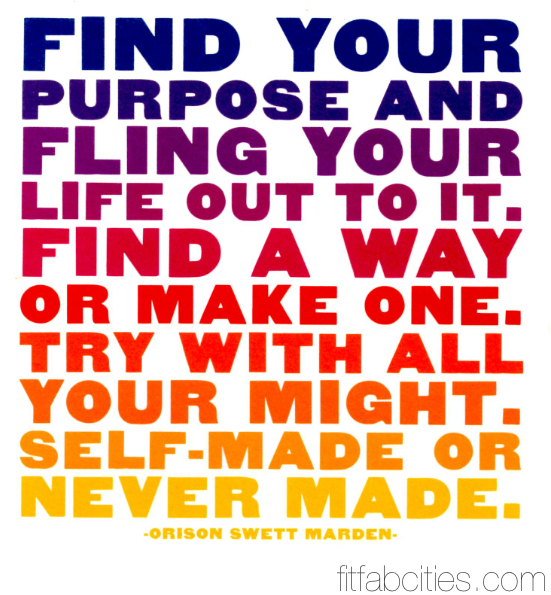
“The golden opportunity you are seeking is in yourself. It is not in your environment, it is not in luck or chance, or the help of others; it is in yourself alone.” Orison Swett Marden. via The Golden Opportunity | PositiveBoomer.
Your work is not good enough. Experience is lacking perhaps. Effort is lacking maybe. The criticism is valid, worth noting and acting upon.
Level 2
There is a difference of opinion. Your output, your deliverable is a quality one but there is a difference of opinion. This might be something worth considering to add even more value to your output or it could be a bit of politics. The criticism is worth considering and exploring to decide whether your product does need to be improved or the relationship with an individual needs to be bettered.
Level 3
You’ve reminded someone what they might do if they got their own act together. What you have produced does not need to be changed in any way but the critic will attempt to lessen their own vulnerability by criticising your work. Avoid politicing and produce great work.
Level 4
The attack has changed from product to personal. You really are getting some people thinking. You really are doing some worthwhile things. Stay balanced, consider all points but don’t go off path as you begin to discover your greatest works.
Level 5
The continued comments from all quarters will-as long as you stay balanced-produce friction which will help you produce your greatest works.
Level 6
Oh oh. You are ‘it’. You are the new thing. They finally get it. But: your ego kicks in. There is no room for criticism. You refuse to listen. Your products wanes.
Level 7
With luck, you have learnt your lesson. Humility over ego. Listen over judge. Grow over stay-the-same. Criticism continues but it’s just grit to wonderful output.” via The Seven Levels of Criticism.
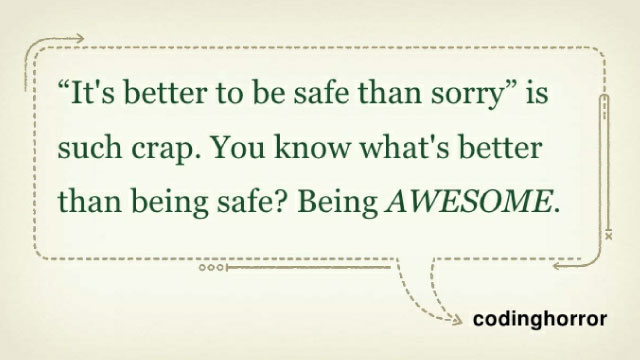
Nobody wants to suck, but the truth is, before you can be great at anything, you’re going to suck. Coding Horror blogger and co-founder of Stack Overflow Jeff Atwood has three simple rules for going from the sucking to awesome.
He writes on Coding Horror that “the only thing that prevents us from being awesome is our own fear of sucking.” What he’s found works for him and others to push past that:
1. Embrace the Suck
2. Do It in Public
3. Pick Stuff That Matters
These are his slides expanding on the above: (As presentation slides, they’re brief but most of the points are pretty clear. For ones that are cryptic, you can download the full presentation with his notes on Slideshare). Get more here: Stop Sucking and Be Awesome Instead: A Three Step Process.
“Winners, I am convinced, imagine their dreams first. They want it with all their heart and expect it to come true. There is, I believe, no other way to live.” Joe Montana. via Anderson Layman’s Blog: Expect……………...
“We must each lead a way of life with self-awareness and compassion, to do as much as we can. Then, whatever happens we will have no regrets.” ~Dalai Lama. Get more here: 4 Powerful Lessons from a Life Well Lived | Tiny Buddha.
Adrienne M. posted on the flipside of detachment over at her blog today:
If you attach yourself to one person, you ultimately end up having an unhealthy relationship. Shirley MacLaine.
Needing people in our lives is healthy, human, and natural. Needing a single person to love at a very deep level is also soothing to the soul’s well-being. Love and attachment are not synonymous, however. They are close to being opposites. If we “attach” ourselves to others, our movements as separate individuals are hampered. Attachment means dependency; it means letting our movements be controlled by the one we are “hooked” to.
Dependency on mood-altering chemicals, on food, on people, means unmanageability in our individual lives. Many of us in this recovery program, though abstinent, still struggle with our dependency on a certain person or a certain friend.
The tools we are learning apply in all cases of dependency. It is healthy independence we are striving for—taking responsibility for our own lives—making choices appropriate for our personal selves. Loving others means letting them make their own choices unhampered by our “attachment.”
Any fact facing us, however difficult, even seemingly hopeless, is not so important as our attitude toward that fact. How you think about a fact may defeat you before you ever do anything about it. You may permit a fact to overwhelm you mentally before you start to deal with it actually. On the other hand, a confident and optimistic thought pattern can modify or overcome the fact altogether. -Norman Vincent Peale, The Power of Positive Thinking
A bitter why me attitude will have you going in the wrong direction. It is much healthier to focus your energy on what you can do.
You may have been unfortunate. You may have even been victimized. You may need to grieve your losses, allowing yourself some time to feel sad, angry, and out of sorts. But there comes a time, when it is in your best interest to accept what is and move toward solutions.
The solution does not mean that you will erase the past. You can’t. But the solution does lie in accepting what is, putting away the bitter why me mindset, and opting for a Given my situation, what can I do now attitude.
Focusing on how things use to be or what you use to be able to do can sometimes create a downward spiral both emotionally and physically. Replacing this paradigm with a solution focused goal oriented mindset can have the opposite effect, creating healthy momentum.
The solution lies within the attitude. It is what it is. What can I do moving forward?
Kudos to client Jackie Dumaine for this article that appeared in the Calgary Herald…
Before entering the world of yoga, Jackie Dumaine worked in advertising sales for radio and did that for five years.
She was extremely successful at it and made a very “healthy” six-figure income.
“However, it was quickly not becoming in alignment with my values anymore. The industry is a little bit competitive and a little bit cutthroat,” she says. “And something was pulling me towards a life that was more spiritual and more heart-centred.
“And when I started a yoga practice, that desire, that longing, just heightened and that’s what spawned my thoughts of leaving radio and going to India to study yoga and meditation.”
When she was in India, what fascinated her the most was the philosophy behind the postures. She went there to learn how to teach the physical aspect of yoga, how to teach an actual yoga class.” via Ancient Wisdom for a Modern World.
May this article get you everything you so richly deserve, Jack!
When the seasons change, I get inspired to take a close look at my eating habits and simplify my diet by eating the things that really make my body feel best. Here are 10 healthy eating habits I am focusing on right now to detox my diet.
Never miss a Kodak moment with the social network-powered Instaglasses. Instagram has revolutionized the way people capture and share their moments with the world through visually enhancing filters and instant uploading.
There are some Instagram-worthy scenes that come and go before you’ve even had the chance to grab your phone. With the Instaglasses, capturing and filtering your snapshots is simple and hassle-free. Wearers can activate the camera with a simple push of a button, located on the side of the frame. Concepts like Instaglasses and Google Glasses integrate technology into everyday products, keeping you constantly connected to the digital world.
























 Bright, shiny objects!
You must be logged in to post a comment.