Fear Kills

Fear kills more dreams than failure ever will.

Today is National Forgive your Mom and Dad Day…

Thanks to my friend Phil for pointing this out…

graphic1

Making Peace with Selfishness and Setting Healthy Personal Boundaries

Evita Ochel has a thoughtful article on a difficult topic for me to understand. I share it in hopes that it may help both of us:

One topic that seems to pose some of the greatest challenges for the human species is that of personal boundaries. We want to interact with others, we want to be loving and caring, but we also want to honor our personal space and needs. In this essay, we will address how to expand our consciousness on the topic of selfishness and explore its many dimensions, as well as become more effective in our personal boundary setting.

Why this Ad? How do I sponsor this page?

Some people’s boundaries are too tight. Some are too loose. Some are non-existent. When should we say “yes” to others and when should we say “no”? How do we know what decisions to make when it comes to other people’s happiness? These questions and considerations do not have easy answers. Whether you officially consider yourself an empath or not, nearly all of us will deal with the challenge of creating healthy personal boundaries at one time in our life, if not many.

Continue reading “Making Peace with Selfishness and Setting Healthy Personal Boundaries”

I won’t give up…

Reminder #9

Mastery of Forethought

Say what you want, but playing it forward in a healthy way is a good tool…

Live & Learn's avatarLive & Learn

dwight-funny-1

Dwight-funny-2

the office,Dwight Schrute


And one more:

“I never smile. Showing one’s teeth is a submission signal in primates. When someone smiles at me, all I see is a chimpanzee begging for its life.”

– Dwight (The Office)


Source: Thank you Karen @ Karen’s Korner

View original post

Be Yourself!

thumbnail.oscar-wilde-be-yourself.jpg

Let the Wrong People Walk Away

thumbnail.joel-osteen-wrong-people-walk-away.jpg

Where The Heart Is

bz panel 03-15-14

Learn To Trust The Journey

Learn to trust the journey, even when you do not understand it.

via my feedly.com reader

You were born…

You were born to make an impact.

New photo added to “Camera Roll”

from Blogger http://blogger.toddlohenry.com/2014/03/new-photo-added-to-roll_15.html
via IFTTT

Count Your Blessings

via Count Your Blessings.

The Punishment Model

recite-31682--1041151454-1lkj2st
Robert C. Jameson writes:

There’s a process I see when I work with individuals and couples. I call it the “Punishment Model.” As I listen to many couples sharing their issues, I often see one partner berating their significant other. They are just verbally beating them up. Wow! This is painful and it’s not the most effective way to creating a loving relationship. These people are supposed to be “loving each other.” And, here they are hurting each other. What’s going on? Basically, the berating partner is attempting to teach their significant other a lesson. Let me explain. Let’s say a child attempts to put their finger in a candle flame. The parent sees this and, with much terror and fervor, the parent slaps the child’s hand. The parent says, “Don’t you ever put your finger in a flame again!” To make his/her point, the parent again slaps the child’s hand. The child being curious and wonders what all the commotion is about, so they attempt to touch this magical flame again. The parent sees this second attempt and totally loses it. Yelling, “I told you not to put your finger in that flame!” The parent slaps the child’s hand again and again and again. Then the parent says, “I’m going to punish you so severely that you will never put your finger in a flame again. And, if you even think of putting your finger in a flame, you’ll remember this moment!” The parent then slaps the child’s hand again and again. This is the “Punishment Model.” Simply, someone does something “wrong” and a punishment is delivered. A lesson is supposedly being taught. And, the punishment continues until everyone knows the lesson has been learned, and until everyone knows that the behavior has been eradicated forever. When I see this process occurring in a relationship, I frequently ask, “What lesson are you trying to teach your partner?” Their response is, “I don’t know! I didn’t know I was teaching a lesson.” My next question is, “How will you know your partner has learned the lesson? This is important to know, because you will continue punishing your partner until you know they have learned the lesson.” Their response again is, “I don’t know.” This same process happens within ourselves. We beat our selves up for doing what we think is “wrong” and we keep beating ourselves over and over again, hoping we will never repeat the behavior. The “Punishment Model” is not the most effective way to promote change and yet it does work. That’s why we keep doing it. I’m not suggesting that we use the “Punishment Model” as a method for change, however, if you find yourself in the process, either as the recipient of the punishment or the deliver of the punishment, you could ask those two important questions. “What is the lesson I want you to learn or I am to be learning?” and “When will I know I you have or I have learned the lesson?” Stating the answers out loud often ends the punishment. Learning has occurred and we can return to a loving place. Source: The Punishment Model | Robert C. Jameson

from Blogger http://blogger.toddlohenry.com/2014/03/the-punishment-model.html
via IFTTT

Trust in Ourselves…

Melody Beattie writes:

Trust can be one of the most confusing concepts in recovery.

Who do we trust? For what?

The most important trust issue we face is learning to trust ourselves. The most detrimental thing that’s happened to us is that we came to believe we couldn’t trust ourselves.

There will be some who tell us we cannot trust ourselves, we are off base and out of whack. There are those who would benefit by our mistrusting ourselves.

Fear and doubt are our enemies. Panic is our enemy.

Confusion is our opposition.

Self-trust is a healing gift we can give ourselves. How do we acquire it? We learn it. What do we do about our mistakes, about those times we thought we could trust ourselves but were wrong? We accept them, and trust ourselves anyway.

We know what is best for us. We know what is right for us.

If we are wrong, if we need to change our mind, we will be guided into that – but only by trusting where we are today.

We can look to others for support and reinforcement, but trust in ourselves is essential.

Do not trust fear. Do not trust panic. We can trust ourselves, stand in our own truth, stand in our own light. We have it now. Already. We have all the light we need for today. And tomorrow’s light shall be given to us then.

Trust ourselves, and we will know whom to trust. Trust ourselves, and we will know what to do. When we feel we absolutely cannot trust ourselves, trust that God will guide us into truth.

God, help me let go of fear, doubt, and confusion – the enemies of self-trust. Help me go forward in peace and confidence. Help me grow in trust for myself and live, one day at a time, one experience at a time.

Source: Trust in Ourselves – Mar. 14 | Language of Letting Go

Beyond The Matrix…

from Blogger http://blogger.toddlohenry.com/2014/03/beyond-matrix_14.html
via IFTTT

Bradshaw: Heal Your Inner Child…

from Blogger http://blogger.toddlohenry.com/2014/03/bradshaw-heal-your-inner-child.html
via IFTTT

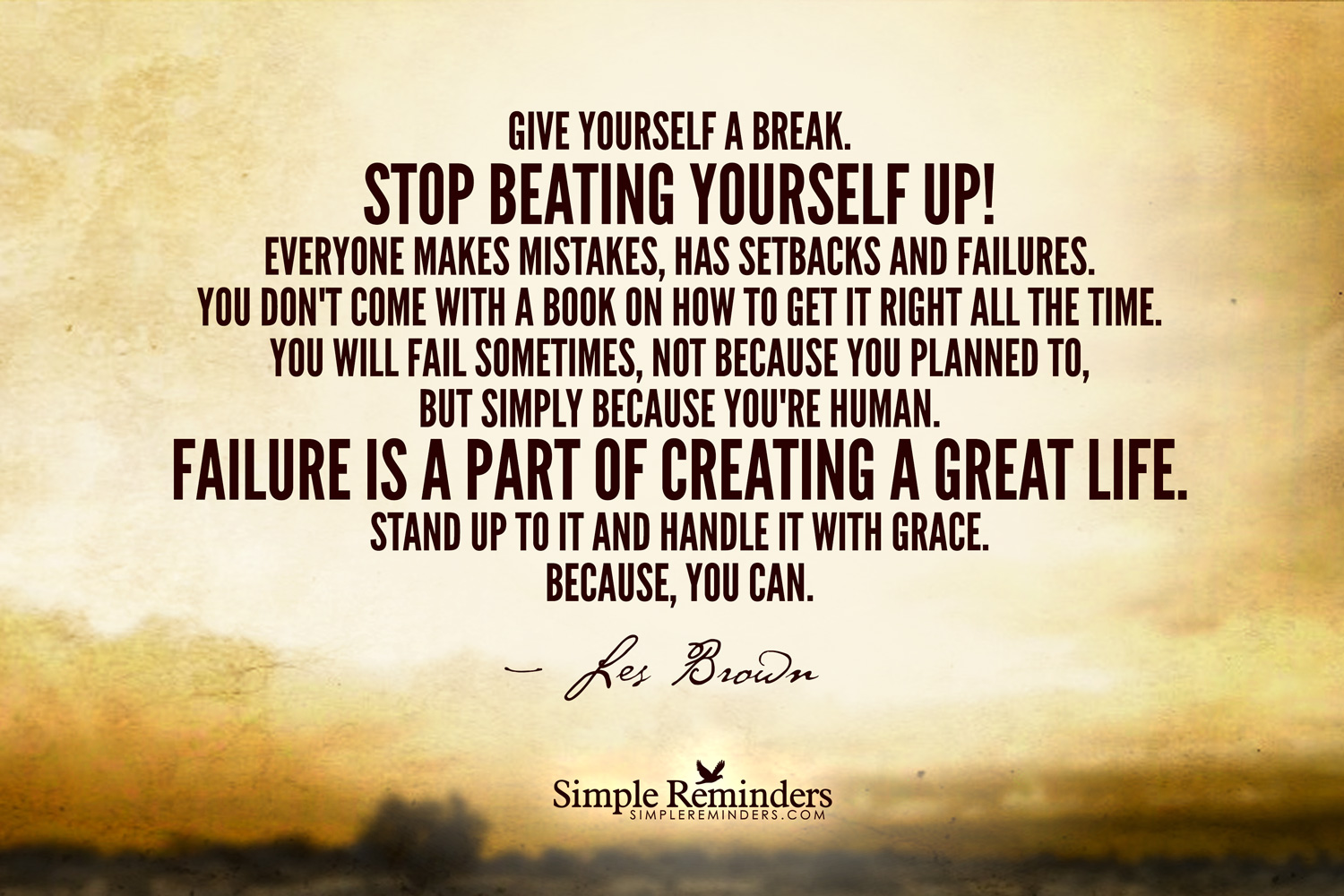
Stop Beating Yourself Up

via Stop Beating Yourself Up.

Start a Blog at WordPress.com.

Up ↑