Let America be America again

Langston Hughes

Let America be America again.
Let it be the dream it used to be.
Let it be the pioneer on the plain
Seeking a home where he himself is free.

(America never was America to me.)

Let America be the dream the dreamers dreamed—
Let it be that great strong land of love
Where never kings connive nor tyrants scheme
That any man be crushed by one above.

(It never was America to me.)

O, let my land be a land where Liberty
Is crowned with no false patriotic wreath,
But opportunity is real, and life is free,
Equality is in the air we breathe.

(There’s never been equality for me,
Nor freedom in this “homeland of the free.”)

Say, who are you that mumbles in the dark?
And who are you that draws your veil across the stars?

I am the poor white, fooled and pushed apart,
I am the Negro bearing slavery’s scars.
I am the red man driven from the land,
I am the immigrant clutching the hope I seek—
And finding only the same old stupid plan
Of dog eat dog, of mighty crush the weak.

I am the young man, full of strength and hope,
Tangled in that ancient endless chain
Of profit, power, gain, of grab the land!
Of grab the gold! Of grab the ways of satisfying need!
Of work the men! Of take the pay!
Of owning everything for one’s own greed!

I am the farmer, bondsman to the soil.
I am the worker sold to the machine.
I am the Negro, servant to you all.
I am the people, humble, hungry, mean—
Hungry yet today despite the dream.
Beaten yet today—O, Pioneers!
I am the man who never got ahead,
The poorest worker bartered through the years.

Yet I’m the one who dreamt our basic dream
In the Old World while still a serf of kings,
Who dreamt a dream so strong, so brave, so true,
That even yet its mighty daring sings
In every brick and stone, in every furrow turned
That’s made America the land it has become.
O, I’m the man who sailed those early seas
In search of what I meant to be my home—
For I’m the one who left dark Ireland’s shore,
And Poland’s plain, and England’s grassy lea,
And torn from Black Africa’s strand I came
To build a “homeland of the free.”

The free?

Who said the free? Not me?
Surely not me? The millions on relief today?
The millions shot down when we strike?
The millions who have nothing for our pay?
For all the dreams we’ve dreamed
And all the songs we’ve sung
And all the hopes we’ve held
And all the flags we’ve hung,
The millions who have nothing for our pay—
Except the dream that’s almost dead today.

O, let America be America again—
The land that never has been yet—
And yet must be—the land where every man is free.
The land that’s mine—the poor man’s, Indian’s, Negro’s, ME—
Who made America,
Whose sweat and blood, whose faith and pain,
Whose hand at the foundry, whose plow in the rain,
Must bring back our mighty dream again.

Sure, call me any ugly name you choose—
The steel of freedom does not stain.
From those who live like leeches on the people’s lives,
We must take back our land again,
America!

O, yes,
I say it plain,
America never was America to me,
And yet I swear this oath—
America will be!

Out of the rack and ruin of our gangster death,
The rape and rot of graft, and stealth, and lies,
We, the people, must redeem
The land, the mines, the plants, the rivers.
The mountains and the endless plain—
All, all the stretch of these great green states—
And make America again!

From The Collected Poems of Langston Hughes, published by Alfred A. Knopf, Inc. Copyright © 1994 the Estate of Langston Hughes. Used with permission.

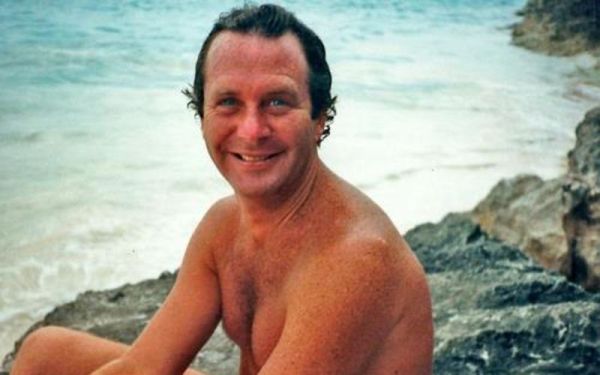
Celebrate What Makes Your Dad Unique With A 23andMe Health + Ancestry Kit 

LOL. Really? When my dad did this he discovered his father was NOT his father and that his mother had had an affair. On the plus side, he discovered he’s more Irish than he thought…

Source: Celebrate What Makes Your Dad Unique With A 23andMe Health + Ancestry Kit – Get $50 Off Now Through June 17!

Do you know the work of David Whyte?

All Irishmen (they claim) are poets. Some are more amazing than others…

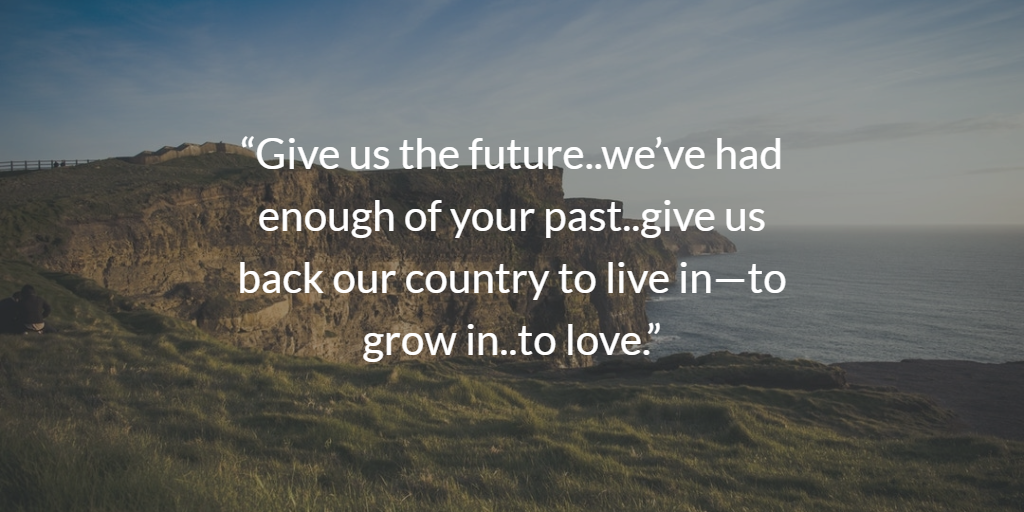
Paul McCartney; Give Ireland Back To The Irish

“Get Back,” McCartney’s second-to-last single as a Beatle, began life as an anti-anti-immigrant song, but at the start of his solo years, McCartney’s music embraced the rock equivalent of “sticking to sports.” On Ram’s “Too Many People,” he sang, “Too many people preaching practices,” a critique of Lennon’s activism; on “Wild Life,” the eponymous track from Wings’ debut album, he wailed, “You’re breathing a lot of political nonsense in the air.” But McCartney soon opted for the polar opposite of keeping quiet (or staying subtle) in penning the most overtly political protest of his career. On January 29, 1972, McCartney met with Lennon in New York, where the pair of feuding friends agreed to stop sniping publicly about the Beatles’ breakup. The next day, January 30, was Bloody Sunday, when British soldiers in Northern Ireland shot 28 unarmed civilians (half of whom died) during a peaceful protest march. McCartney, temporarily radicalized by his hobnobbing with Lennon in Greenwich Village, immediately wrote a response and recorded it with Wings on February 1. “Give Ireland Back to the Irish” was released as the band’s first single before the end of the month. “I’m not really a controversial person,” McCartney said in a syndicated interview in December ’72, explaining that he had “merely wanted to get over how I felt about the Irish thing” — namely, that “I like the Irish … and the violence was getting a little too close to our own front door.” In a 1974 Rolling Stone interview, McCartney said that before Bloody Sunday, he’d thought, “‘God, John’s crackers, doing all these political songs,’” adding, “I always used to think it’s still cool to not say anything about it, because it’s not going to sell anyway and no one’s gonna be interested.” Much later, he recalled, “I wasn’t really into protest songs — John had done that — but this time I felt that I had to write something, to use my art to protest.” Source: ‘Egypt Station’ and the Legacy of Paul McCartney’s Message Songs – The Ringer

Is this the greatest Irish obituary ever?

The hilarious obituary of Massachusetts man, Chris Connors (67), who passed away in 2016, claims he died of stubbornness and whiskey: Is this the greatest Irish obituary ever?


U2 top-paid musicians in US last year: survey

U2 may not be the freshest faces in music but the Irish rockers were the industry’s top earners in the United States last year, Billboard said in an annual survey Monday: U2 top-paid musicians in US last year: survey

Drought and Drone Reveal ‘Once-in-a-Lifetime’ Signs of Ancient Henge in Ireland

Goodbye, Delores…

Dolores O’Riordan, the lead singer of the Irish rock band the Cranberries, died on Monday in London. She was 46.

Her death was announced by her publicist, who did not specify the cause.

“Irish and international singer Dolores O’Riordan has died suddenly in London today,” Lindsey Holmes, the publicist, said in an emailed statement, adding that Ms. O’Riordan had been in London for a recording session…

This may be one of the most haunting love songs ever…

Bonus!!!

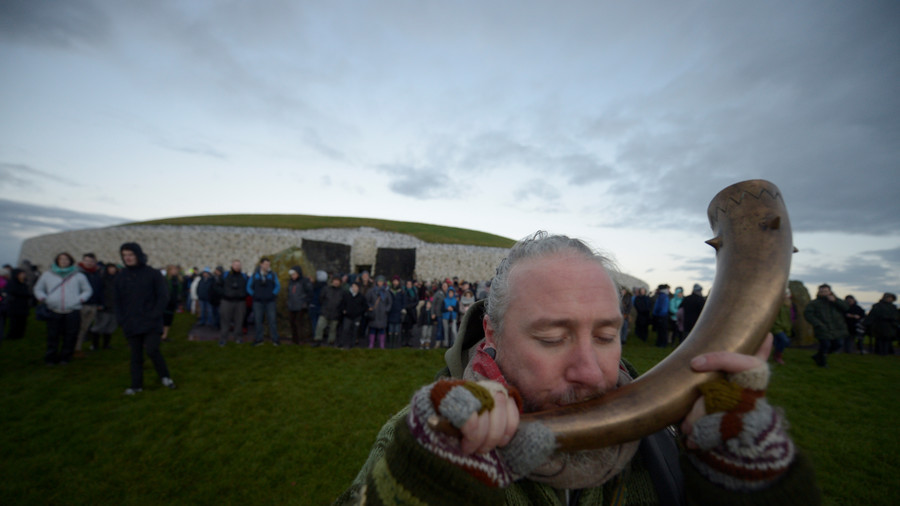
In the early hours of the morning on December 21 something magical happens in an Irish field, the rising sun aligns perfectly with an ancient passage tomb, travels down the long corridor and illuminates the inner chamber. Go to the source to read the backstory: 5,000yo Irish tomb’s winter solstice magic to be livestreamed (VIDEO) — RT World News

Watch here:

Top Dublin pubs for ‘craic’ and a Guinness

A list of the top ten pubs, in our humble opinion, to be found in Ireland’s capital city, Dublin. Go to the Source: Top Dublin pubs for ‘craic’ and a Guinness (PHOTOS)

Guinness 200th anniversary in the United States

The love affair between America and Guinness. “Keeping a friendship alive for 200 years require genuine mutual affection”. Source: Guinness 200th anniversary in the United States

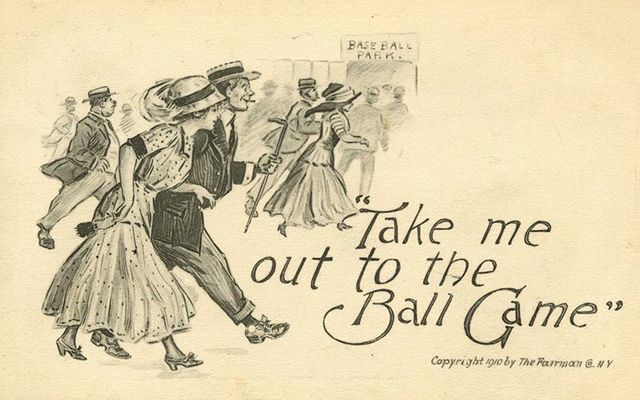
The forgotten Irish verses of Take Me Out to the Ball Game

Today, we sing the chorus of Take Me Out to the Ball Game during every 7th inning. The full story of the song, about a young baseball fan named Katie Casey, has long been forgotten. Source: The forgotten Irish verses of Take Me Out to the Ball Game | IrishCentral.com

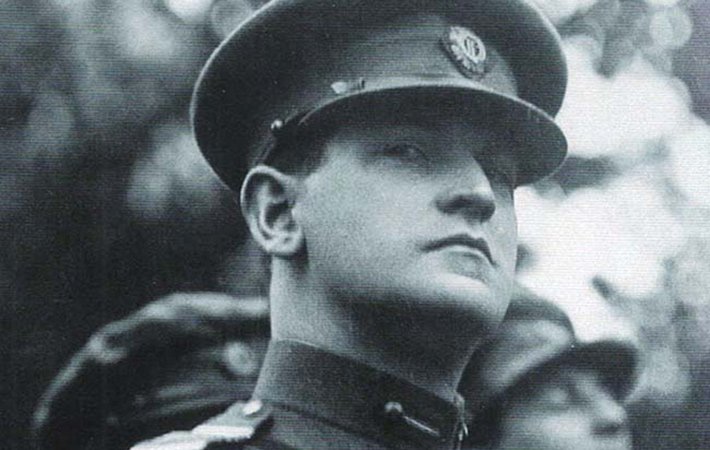
Legendary Irish hero Michael Collins was assassinated 93 years ago today

The Irish fighting legend Michael Collins also had a marvelous way with words. Here are his 10 most memorable quotes. Source: Legendary Irish hero Michael Collins was assassinated 93 years ago today | IrishCentral.com 

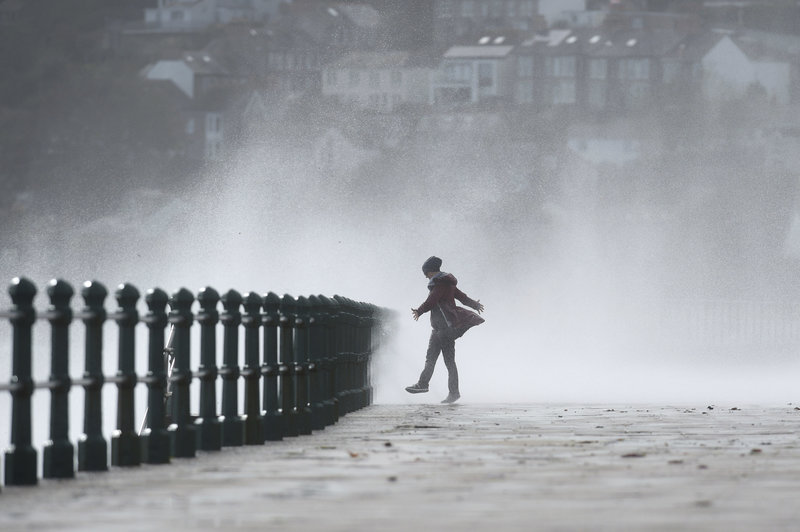
Historic Storm Ophelia Kills At Least 3 People In Ireland, Turns U.K. Skies Red : The Two-Way

The remnants of post-tropical cyclone Ophelia hit parts of Ireland with wind gusts of more than 90 miles per hour. The storm knocked out power to some 360,000 customers. Source: Historic Storm Ophelia Kills At Least 3 People In Ireland, Turns U.K. Skies Red : The Two-Way : NPR

Today in Irish History – 17 April:

I like this blog…

Stephen Colbert learns to pronounce Irish names

Irish names are crazy, let’s all just agree. In this video, Stephen Colbert learns how to pronounce some of the more difficult names.

Source: Stephen Colbert learns to pronounce Irish names – Holy Kaw!

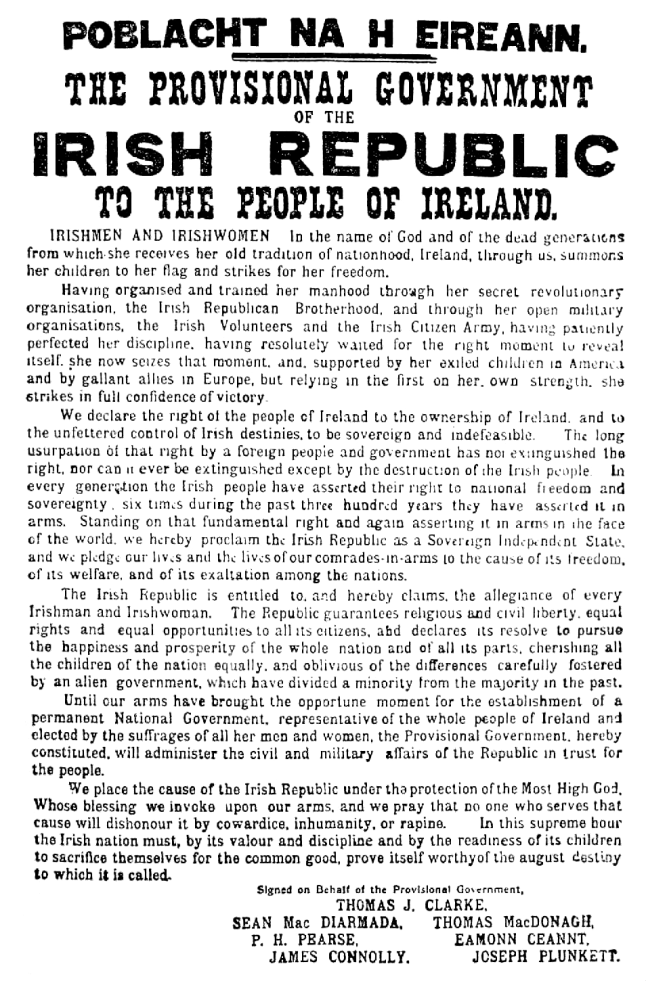
What is the Easter Rising?

Easter_Proclamation_of_1916

The Easter Rising (Irish: Éirí Amach na Cásca),[2] also known as the Easter Rebellion, was an armed insurrection in Ireland during Easter Week, 1916. The Rising was launched by Irish republicans to end British rule in Ireland and establish an independent Irish Republic while the United Kingdom was heavily engaged in World War I. It was the most significant uprising in Ireland since the rebellion of 1798.[3]
Organised by seven members of the Military Council of the Irish Republican Brotherhood,[4] the Rising began on Easter Monday, 24 April 1916, and lasted for six days. Members of the Irish Volunteers — led by schoolmaster and Irish language activist Patrick Pearse, joined by the smaller Irish Citizen Army of James Connolly and 200 members of Cumann na mBan — seized key locations in Dublin and proclaimed an Irish Republic. There were isolated actions in other parts of Ireland, with an attack on the Royal Irish Constabulary barracks at Ashbourne, County Meath and abortive attacks on other barracks in County Galway and at Enniscorthy, County Wexford.
With vastly superior numbers and artillery, the British Army quickly suppressed the Rising, and Pearse agreed to an unconditional surrender on Saturday 29 April. After the surrender, all of Ireland remained under martial law. About 3,500 people were taken prisoner by the British, many of whom played no part in the Rising, and 1,800 of them were sent to internment camps or prisons in Britain. Most of the leaders of the Rising were executed following courts-martial. The Rising succeeded in bringing physical force republicanism back to the forefront of Irish politics, and support for republicanism continued to rise in Ireland. In December 1918, republicans (by then represented by the Sinn Féin party) won a landslide victory in the general election to the British Parliament, on a policy of abstentionism and Irish independence. On 21 January 1919 they convened the First Dáil and declared the independence of the Irish Republic, which led to the Irish War of Independence.
Almost 500 people were killed in the Easter Rising. About 54% were civilians, 30% were British military and police, and 16% were Irish rebels. More than 2,600 were wounded. Most of the civilians were killed as a result of the British using artillery and heavy machine guns, or mistaking civilians for rebels. The shelling and the fires it caused left parts of inner city Dublin in ruins. Go to the source: https://en.wikipedia.org/wiki/Easter_Rising

pablo (16)

Start a Blog at WordPress.com.

Up ↑