There are a lot of great external blog editors in the world, but you may not be aware of the one that I consider the best; Microsoft Word for Windows. Microsoft Word for Windows you say? How is Microsoft Word considered an external blog editor? What most people don’t realize is that anything that you can write in Microsoft Word can be sent to your blog in less than three clicks. That means you can use all the features of Microsoft Word to create stunningly beautiful blog posts that are spelling and grammar checked. It also means that if you already know how to use Microsoft Word you already know how to blog!
Some of my favorite Microsoft Word blogging features…
Anything can do in Word can be easily uploaded to my blog. Let me show you how here:
PS Sorry my Mac using friends; Microsoft does not include this feature in Microsoft Word for Mac…
Jeff Lieberman, an MIT-trained artist, scientist and engineer, discusses the possibility of completely eliminating certain sources of suffering from humanity. Sounds impossible, right?
In this thought-provoking video, Jeff explores some fascinating topics which stir up some profound questions and realizations. From exploring our consciousness, to demonstrating our ability to create alternate realities, to reminding us that we are all one. He pinpoints a key element that if we accept and trust, would make suffering no longer be part of our existence.
A ‘quote*’ from Tara Brach’s meditation “From Story to Presence”…
“The reality is each one of us has caused hurt to other people and each one of us has been hurt by other people. But if we keep running the story of “You hurt me; you’re bad” or “I hurt you; I’m bad” all that happen is a looping that creates separation. What if instead we say the story is that I hurt you and we let that story be there, we don’t put it aside too quickly…
We let it be there and we feel what it feels like in our body. The very presence with that vulnerability awakens compassion. Now the trick — because this is where there can be more suffering is to take the story “I caused you suffering” and to get stuck on the “I’m bad, I’m bad, I’m bad”. We’re wedded to the story and we don’t have access to deeper presence…
So the pathway I am describing to you, and it takes a real sensitivity, is that when stories arise in our mind — to not to quickly go ‘it’s just a story, back to the breath’ because that is just another form of aversion and denial — is to let it be there a bit, but not to believe the story.”
She goes on to say “the story behind some of the more drama stories is really the story of Self. As we open to this presence, we wake up out of that core story that keeps us separate”.
You can hear the whole talk here:
*I tried to transcribe it as best I could; this is NOT an official transcription…
Being desired is such a basic craving. We all want to be desired: by our family, by our friends, by a lover, by our coworkers. What happens when we don’t desire ourselves?
I’m beginning to realize that I don’t like myself very much. All these years of feeling like I couldn’t raise the eyebrow or pique the interest of an attractive man might actually stem from the fact that I’m exuding the pheromones of one who feels unworthy of being loved and therefore thinks he’s undesirable to all. Could it be that simple? I’m sure I’m not the only gay man — or person — who feels or has felt this way. Do you have to love yourself before you can love someone else or be loved by someone else? Is that a myth?
I keep wondering if I’ll ever love myself enough to be loved by another person. I hate being vulnerable, but vulnerability is key to opening one’s heart to another person. For years I’ve told myself, “When the right person shows up, I’ll know, and my heart will automatically open.” Is that utter bullshit?
A few years ago, I would not have touched the HuffingtonPost with a 10 foot mouse [now I have 100 fans there!] and I certainly would not have curated an article by a gay man. In the time between, however, many thinks [intentional] have changed. “We all want to be desired: by our family, by our friends, by a lover, by our coworkers.” This desire makes us all human and should unite, rather than divide…
Over 10 years ago, The Telegraph reported:
Whether you hail from Surbiton, Ulan Bator or Nairobi, your genetic make-up is strikingly similar to that of every other person on Earth, an analysis concludes today.
Although scientists have long recognised that, despite physical differences, all human populations are genetically similar, the new work concludes that populations from different parts of the world share even more genetic similarities than previously assumed.
All humans are 99.9 per cent identical and, of that tiny 0.1 per cent difference, 94 per cent of the variation is among individuals from the same populations and only six per cent between individuals from different populations.
Nonetheless, the team found that tiny differences in DNA can provide enough information to identify the geographic ancestry of individual men and women.
The results of the study, published today in the journal Science, have implications for understanding ancient human migrations and for resolving an ongoing debate about the use of family histories in medical research, said Prof Marcus Feldman of Stanford University who led the team.
Because so many of us grew up without a cohesive and nourishing sense of family, neighborhood, community or “tribe,” it is not surprising that we feel like outsiders, on our own and disconnected. We learn early in life that any affiliation—with family and friends, at school or in the workplace—requires proving that we are worthy. We are under pressure to compete with each other, to get ahead, to stand out as intelligent, attractive, capable, powerful, wealthy. Someone is always keeping score.
After a lifetime of working with the poor and the sick, Mother Teresa’s surprising insight was: “The biggest disease today is not leprosy or tuberculosis but rather the feeling of not belonging.” In our own society, this disease has reached epidemic proportions. We long to belong and feel as if we don’t deserve to.
D.H. Lawrence described our Western culture as being like a great uprooted tree with its roots in the air. “We are perishing for lack of fulfillment of our greater needs,” he wrote, “we are cut off from the great sources of our inward nourishment and renewal.”
Lo, these many years I turned to ‘tribes’ — Christian Fundamentalists, The Republican Party, The Green Bay Packers — to make me feel right inside when in truth everything inside me was screaming at me from the mirror that everything inside me was wrong, and to compensate for the lack of a cohesive, nourishing sense of belonging. By learning about and practicing self-compassion, however, I am making progress in making peace with myself, my past, my present and my future…
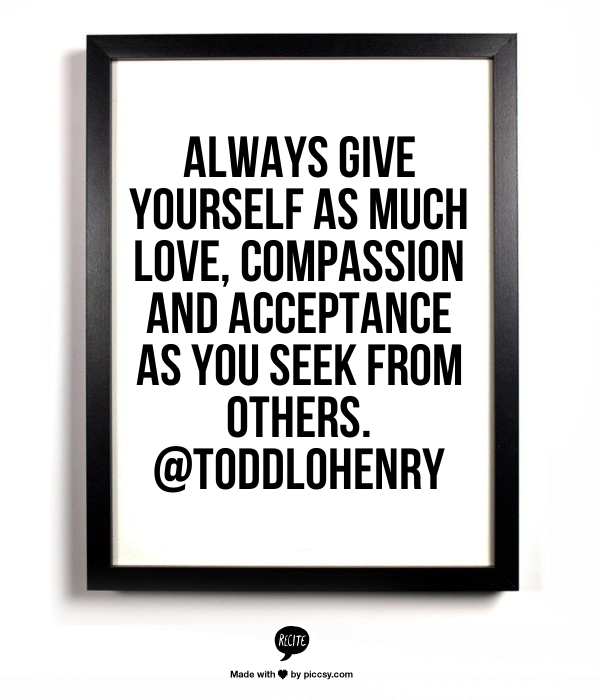
Thank you for your post, Michael, and for giving me pause to think about this topic. I agree that thinking our hearts will ‘automatically open’ is utter bullshit but, that if we practice self-compassion our hearts may slowly and gently open to the possibility of healthy interdependence and my hope is that when we are able to give ourselves at least the same amount of love, compassion and acceptance we seek from others, the craving to be desired may pass away. Namasté!
Reject shame in all its forms.
Practice self-compassion and lovingkindess and wholeheartedness will follow.
Practice mindfulness and live in the now.
Remember what other people do is their karma. How I respond is mine.
Follow my dharma…
That’s all…
“May all beings everywhere be happy and free. May the thoughts and actions of our lives contribute to that happiness and to that freedom for all.”
Random images [click to enlarge]…
tumblr m52de7alsw1r7dgeuo1 1280
I’m no longer political but I still cherish this picture…
If this poem resonates with you as well, here are two Tara Brach meditations on self-compassion that I’d like to share with you. “All I plead with you is this” she says “make love of yourself perfect”…
A few weeks ago, I came across the movie ‘Peaceful Warrior‘ via streaming Netflix through one of those ‘list posts’ something like the top 20 inspirational movie speeches of all time. All the standards were there; Braveheart, Rocky, etc. but in the list I also found this clip:
I became interested in Dan Millman‘s story and writing and this morning I found this on FinerMinds:
“Life comes at us in waves of change. We cannot predict or control those waves, but we can become better surfers.” – Dan Millman
How can we as humans develop a talent for living?
In life, we all have moments of perfection. For example, the day you embarked on the sojourn of a lifetime. The moment you realized you found true love. The birth of your child. Or the moment you finally realized your self-worth is more important than anyone else’s opinion of you.
But with these delicious moments comes many more moments in life that are sent to test us. Whether they come in the form of everyday routine, or more significant life events that irrecoverably change us – we must learn how to strengthen our minds, body and soul so we don’t continuously get caught in the undercurrent of these challenging times.
In this wonderful TED Talk, best-selling author Dan Millman (he’s the guy who wrote Way of the Peaceful Warrior) explains how.
Another wonderful meditation by Tara Brach that I’d like to share with you:
Living with chronic blame or resentment is a trance that confines us to a limited fragment of what we are. This talk looks at the ways this trance is fueled and the process by which we release the armoring around our hearts.
Self-aggression, whether it’s low key blame or deep condemnation, prevents us from intimacy with others and discovering the truth and wholeness of our Being. This talk explores how we can release self-blame, and free ourselves to access our natural warmth and creativity in responding to our world.
How do we accept ourselves or others when our actions are causing harm? Does acceptance mean passivity? Does it undermine our efforts towards change? This talk responds to these questions with a simple, illuminating and challenging principle about genuine transformation: Acceptance is the prerequisite of true healing and awakening. Only when we’ve paused to recognize and allow this moment’s experience to be fully as it is, can we respond from our intelligence and compassion to prevent future suffering…
Jung wrote that our suffering arises from the unseen, unfelt parts of our psyche. This talk explores ways we can establish a healing presence by recognizing and communicating with the parts of our being that we habitually ignore or judge…
The word “Namaste” has become quite mainstream thanks to the explosive popularity of the yoga industry in recent years. I’m sure you’ve said it before, and you probably have an idea of the general meaning of it. It’s a way for your soul to recognize and acknowledge the soul of another.
It would be amazing if more people took the time to really understand why we should ALL be saying Namaste to one another, and were able to shift their perspective a little bit to see other people for what they really are.
Think of yourself as a vessel filled with light. Light that changes colors depending on what angle you are looking at it, and those colors represent the many experiences you’ve had in your life. Your soul has become all of the sunsets you’ve watched, the ocean air you’ve breathed, the friends you’ve made, the love you’ve shared, the times that made you laugh and cry. You are all of your experiences.
Each and every person out there is the same way. The person in the car next to you, the cashier at the grocery store, your mailman, your friend, your spouse, even that annoying co-worker… they all carry with them that same ever-changing light, a spectrum of colors that uniquely defines them and their life experiences. They too have experienced love and pain, they have their history, their own things they hold dear, and have seen their own beautiful sights. No two are the same, yet we all have it inside us.
It’s so easy to see only the surface of a person and dismiss them for only what they are presenting to you in a given situation. But we’re all connected in that we carry around our entire life — each experience you have, each interaction, all of it is with you all the time.
The next time you find yourself passing a person on the street, in a meeting, or talking with your friends, try to be aware of the enormity of what they’re actually carrying around with them. Practicing this makes the ability to forgive and accept much easier.
To me, Namaste means that I see you. I understand we’re both souls trying to make our way in this world, all part of some larger plan. I know that while the color of our lights may shine differently, we all share the same internal fire, and my soul bows to and acknowledges that in your soul.
In my work I have defined self-compassion as having three main interacting components: self-kindness, a sense of common humanity and mindfulness. Self-kindness refers to the tendency to be caring and understanding with oneself rather than being harshly critical or judgmental. Instead of taking a cold “stiff-upper-lip” approach in times of suffering, self-kindness offers soothing and comfort to the self. Common humanity involves recognizing that all humans are imperfect, fail and make mistakes. It connects one’s own flawed condition to the shared human condition so that one can take greater perspective towards one’s personal shortcomings and difficulties. Mindfulness involves being aware of one’s painful feelings in a clear and balanced manner so that one neither ignores nor obsesses about disliked aspects of oneself or one’s life.
For the past decade or so I’ve been conducting research on self-compassion and have found that people who are compassionate to themselves are much less likely to be depressed, anxious and stressed and are much more likely to be happy, resilient and optimistic about their future. In short, they have better mental health.
The power of self-compassion is not just an idea; it’s very real and actually manifests in our bodies. When we soothe our own pain, we are tapping into the mammalian care-giving system. And one important way the care-giving system works is by triggering the release of oxytocin. Research indicates that increased levels of oxytocin strongly increase feelings of trust, calm, safety, generosity and connectedness and facilitates the ability to feel warmth and compassion for ourselves. Oxytocin is released in a variety of social situations, including when a mother breastfeeds her child, when parents interact with their young children or when someone gives or receives a soft, tender caress. Because thoughts and emotions have the same effect on our bodies whether they’re directed to ourselves or to others, this research suggests that self-compassion may be a powerful trigger for the release of oxytocin.
Self-criticism appears to have a very different effect on our body. The amygdala is the oldest part of the brain and is designed to quickly detect threats in the environment. When we experience a threatening situation, the fight-or-flight response is triggered: the amygdala sends signals that increase blood pressure, adrenaline and the hormone cortisol, mobilizing the strength and energy needed to confront or avoid a threat. Although this system was designed by evolution to deal with physical attacks, it is activated just as readily by emotional attacks — by ourselves or others. Recent research indicates that generating feelings of self-compassion actually decreases our cortisol levels. In one study conducted by Helen Rockliff and her colleagues, researchers asked participants to imagine receiving compassion and feeling it in their bodies. Every minute they were told things like, “Allow yourself to feel that you are the recipient of great compassion; allow yourself to feel the loving-kindness that is there for you.” It was found that the participants given these instructions had lower cortisol levels after the imagery than those in the control group. Participants also demonstrated increased heart rate variability afterwards. The safer people feel, the more open and flexible they can be in response to their environment, and this is reflected in how much their heart rate varies in response to stimuli. So you could say that by giving themselves compassion, participants’ hearts actually opened and became less defensive.
When we soothe our painful feelings with the healing balm of self-compassion, not only are we changing our mental and emotional experience, we’re also changing our body chemistry. An effective aspect of self-compassion practice, therefore, is to tap into our body’s self-healing system through physical sensations.
This means that an easy way to calm and comfort yourself when you’re feeling bad is through soothing touch. It seems a bit silly at first, but your body doesn’t know that. It just responds to the physical gesture of warmth and care, just as a baby responds to being held in its mother’s arms. Remember, physical touch releases oxytocin, reduces cortisol and calms cardiovascular stress. So why not try it? If you notice that you’re feeling tense, upset or self-critical, try giving yourself a warm hug, or tenderly stroking your arm or face, or gently rocking your body. What’s important is that you make a clear gesture that conveys feelings of love, care and tenderness. If other people are around, you can often fold your arms in a non-obvious way, gently squeezing yourself in a comforting manner. Notice how your body feels after receiving the hug or caress. Does it feel warmer, softer, calmer? It’s amazing how easy it is to tap into mammalian care-giving system and change your biochemical experience.
We know how much it hurts. “I’m an idiot!” “I’m disgusting.” “No one will ever love me.” “What a lame-ass.”
So why do we do it? As soon as we ask ourselves this question, we often just pile on more self-criticism. “I’m such a bitch, even to myself.” “That’s why I’m such a loser, I’m always putting myself down.”
Don’t beat yourself up for beating yourself up in the vain hope that somehow it will help you stop beating yourself up. Instead, take a step back, and give your inner critic some slack. In its ineffective, counterproductive way, your inner critic is actually trying to keep you safe.
As humans we have two main evolved safety systems. The oldest and most quickly triggered is the threat defense system, which involves the amygdala. When we sense danger, our response is typically fight, flight, freeze, or submit: We turn and fight the threat, run like hell away from the threat, play dead in hopes the threat will pass, or show our bellies and hope the threat will be placated. These strategies are very successful for animals living in the wild, helping them to survive and pass on their genes. For humans, however, these responses often just make things worse. That’s because the threat we’re usually facing is a threat to our self-concept. We confuse our thoughts and representations of ourselves for our actual selves, meaning that when our self-image is under siege, we react as if our very existence is threatened. When this happens, our threat defense system uses the same strategies to stay safe:
Fight — we beat ourselves up emotionally, using cruel language to cut ourselves down.
Flight — we become anxious and restless, fleeing from ourselves by numbing out or using distractions like food or alcohol.
Freeze — we get stuck in rumination, thinking about our perceived inadequacies over and over again.
Submit — we admit that yes, we’re terrible, and accept all the harsh judgments we throw at ourselves.
More often than not we engage in some combination of all these strategies. Our stress levels go up as our amygdala activates our sympathetic nervous system (which arouses us so we can deal with threats) and floods our system with adrenaline and cortisol. And it’s a double whammy because when we criticize ourselves, we are both the attacker and the attacked. This type of chronic stress can eventually lead to anxiety and depression, undermining our physical and emotional wellbeing.
Still, it’s important to remember that when our inner critic attacks, at root it is trying to ward off danger. Marshal Rosenberg, author of the book Non-Violent Communication, says self-criticism is the “tragic expression of an unmet need.” It’s tragic because self-criticism makes us feel horrible and doesn’t effectively motivate productive change. (See my blog “The Motivational Power of Self-Compassion.”) But if we look closely — our inner critic cares. There is some safety need it is trying to meet. Our inner critic wants us to be happy, but doesn’t know a better way to go about it. Let’s say you criticize yourself for not going to the gym, calling yourself a “lazy slob.” At some level, your inner critic is reacting out of concern that if you don’t go to the gym you won’t be healthy, or that you’ll be rejected by others. We can be kind and compassionate to this part of ourselves, because at some level it has our best interests at heart. And believe it or not, by giving compassion to our inner critic, we are moving out of the threat defense system and into our other safety system.
As mammals, we also evolved the attachment/affiliation system as a survival strategy. Mammals have the innate capacity to be soothed by warmth and affection, meaning that our young are likely to stay near caregivers, be protected, and survive. The care-giving system deactivates the sympathetic nervous system (reducing cortisol) and activates the parasympathetic nervous system, which calms us down. This route to emotional safety is much more effective — reducing our stress and anxiety rather than exacerbating it. And it gives us the emotional balance needed to make wise decisions, including making behavioral changes if needed. (I write about self-compassion and the mammalian care-giving system in my blog “The Chemicals of Care.”)
So the next time you find yourself in the throws of harsh self-criticism, instead of beating yourself up for beating yourself up, thank your inner critic for its efforts, then try the strategy of giving yourself some compassion instead. It’s more effective, and a lot less painful!
…to boost your Search Engine Optimization [SEO] and increase the odds that you’ll get found! You could implement these fast and free steps TODAY and change how you use Twitter forever…
…to boost your Search Engine Optimization [SEO] and increase the odds that you’ll get found! You could implement these fast and free steps TODAY and change how you use Twitter forever…
…to boost your Search Engine Optimization [SEO] and increase the odds that you’ll get found! You could implement these fast and free steps TODAY and change how you use Twitter forever…
Einstein said “things must be made as simple as possible but no simpler”. This thinking inspires every aspect of my workflow and the tools I select for myself and my clients. With that in mind, here are the 20% of the tools that yield more than 80% of my results…
Einstein said “things must be made as simple as possible but no simpler”. With that in mind, here are the 20% of the tools that yield more than 80% of my results…
The main thing is to keep the main thing the main thing, right? Here’s a minimalist workflow for content and thought leadership marketing that will help you get found when people are looking for you and what you do in the coming year…
The beautiful thing about this simple workflow is that you have to do the reading anyway in order to maintain your expert status — why not turn it into thought leadership marketing? Also every tool is free and completely cross platform and it could all be executed from a $199 Chromebook. I explain here:
How could I explain this more clearly or make this post better? Comment below or use the contact form above…
Ever heard of the Pareto Principle? Mostly likely you have but may not know it by that name. “The Pareto principle (also known as the 80–20 rule, the law of the vital few, and the principle of factor sparsity) states that, for many events, roughly 80% of the effects come from 20% of the causes.” In the ‘e1evation workflow‘, 80% of my results come from having mastered just three tools. Why is this important? My clients include thought leaders like authorNilofer Merchant, author and professorPhilip Auerswald, author and professor Timothy Kastelle, consultant Gretchen Jahn and professor and TEDFellowNina Tandon; people like that don’t have the time or patience to learn an infinite number of tools — they need to know the three that will yield the most effective results…
I teach them [and all my clients] that if I could only use three tools for effective content marketing there is no confusion in my mind as to what they would be:
Why? No other combination of tools covers the basics of content marketing better. Google Reader helps me find great content that deepens my expertise. WordPress and Twylah help me document my expertise by turning everything I create or curate into content marketing with Search Engine Optimization [SEO] value for my domain. Let me explain…
Here are all the tools I use in the ‘e1evation workflow’:
And here are the 20% that yield the 80% of my results:
Questions? Feedback? Comment or contact me to talk more about how this applies to you and your situation…
The guys over at the Minimalists have this thought to share:
This Friday is the busiest shopping day of the year: Black Friday. Retailers prepare months in advance for this dark day—preparation that’s meant to stimulate your insatiable desire to consume: Doorbuster sales. New products. Gigantic newspaper ads. TV, radio, print, billboards. Sale, sale, sale! Early bird specials. One day only! Get the best deal. Act now! While supplies last.
The Minimalists would, however, like to shed some light on this darkest of Fridays. It’s important to understand that consumption is an unquenchable thirst. Retailers and advertisers and manufacturers know this too well. And thus, they’ve invented an entire day designed to take advantage of your insatiable desire to consume.
The pernicious aspects of Black Friday are not few. The pandemonium of this day is a synecdoche for our consumer culture as a whole. On this day, people consume gluttonously without regard for the harm they’re inflicting on themselves. On this day, greed becomes ravenous. On this day, people live without real meaning, buying gifts to fill a void that can’t possibly be filled with material possessions.
Sadly, people participate in the rapacious nature of Black Friday in the name of a holiday, as if buying gifts was an ideal way to celebrate Christmas. But thankfully, you have options.
Instead of embracing Black Friday, you can Block Friday. You can refuse to buy material items for people to display your love. Rather, you can showcase your love, caring, and affection through daily actions—every day, not just holidays.
If you want to give gifts, why not gift an experience—a nice meal, tickets to a concert, or a sunset on the beach? After all, the best, most loving gift you can give someone is your time and undivided attention.
Will you join us? Will you opt out of Black Friday? If not, why not?
I will opt out! I hate what Christmas has become and the stress that it causes by all the false expectations it creates. Give me Thanksgiving with family, food and gratitude and I’ll see you next year…


















 Bright, shiny objects!
You must be logged in to post a comment.