This is Your Anxious Brain on Meditation

In mindfulness meditation, when you notice a thought, you’ll likely be tempted to dwell on it and take it somewhere. Instead, you can just touch it lightly with your attention and go right to your breath. It doesn’t matter if you were off in space for a long time. In the moment you touch the thought, you can bounce right back.
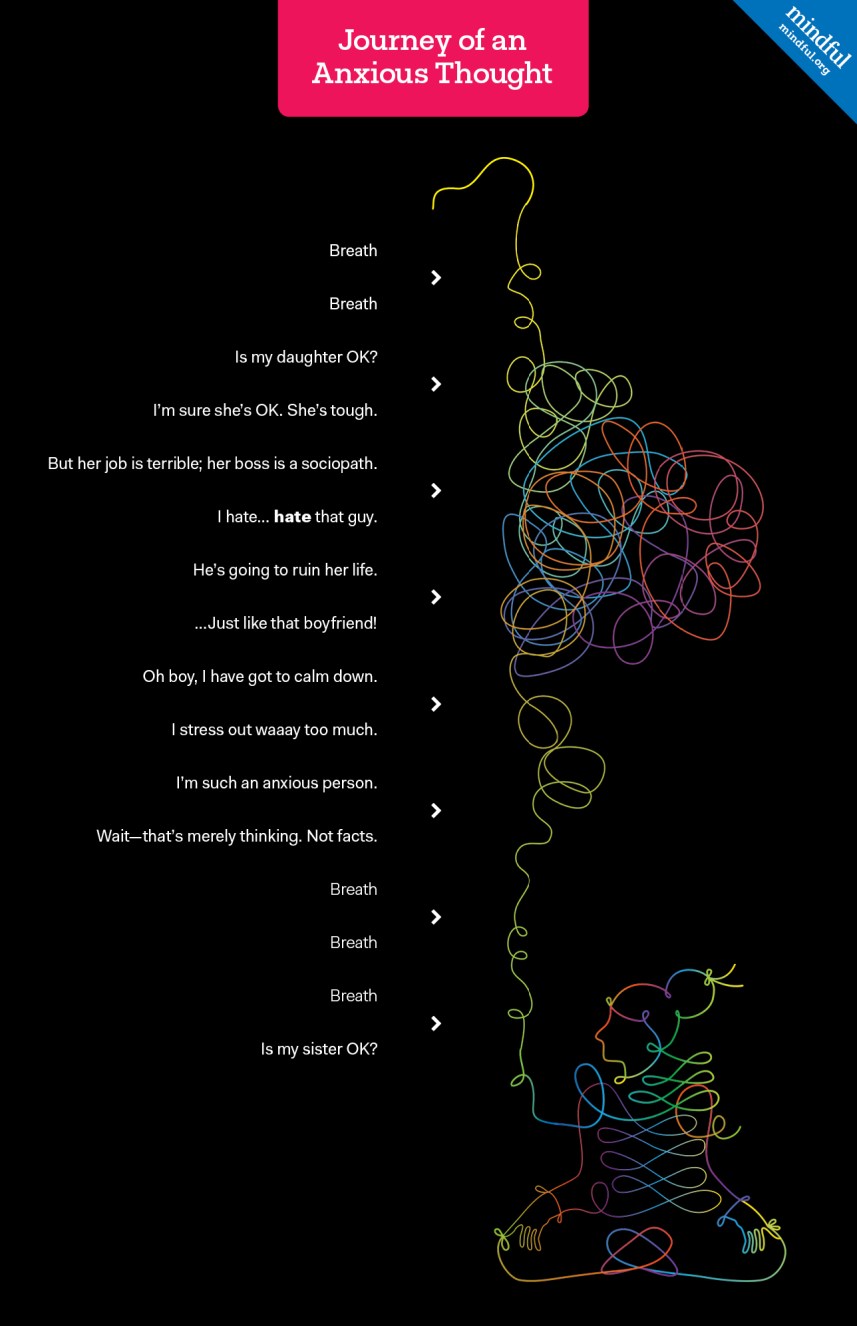
Source: This is Your Anxious Brain on Meditation – Mindful

This talk from Tara Brach may help with this issue!

#recommendedread – What Storytelling Does to Our Brains

In 1748, the British politician and aristocrat John Montagu, the 4th Earl of Sandwich, used a lot of his free time for playing cards. One of the problems he had was that he greatly enjoyed eating a snack, whilst still keeping one hand free for the cards.
So he came up with the idea to eat beef between slices of toast, which would allow him to finally eat and play cards at the same time. Eating his newly invented “sandwich,” the name for two slices of bread with meat in between, became one of the most popular meal inventions in the western world.
Now you are very likely to never forget the story of who invented the sandwich. Or at least, much less likely to do so than if it had been presented in bullet points or another purely information based form.
For over 27,000 years, since the first cave paintings were discovered, telling stories has been one of our most fundamental communication methods.
Here is the science around storytelling and how we can use it to make better decisions every day:
https://blog.bufferapp.com/science-of-storytelling-why-telling-a-story-is-the-most-powerful-way-to-activate-our-brains

How the Brain Processes Different Types of Content

Our brains process some content formats differently than others. Learn how your audience responds to your content to tailor your strategy.

Source: How the Brain Processes Different Types of Content by Todd Lohenry

A Courageous Brain: Not Manipulated by Needless Fear

pablo-4

Our ancestors evolved a frightened brain for survival in harsh conditions. Today, unnecessary and unwarranted fear can make it harder to speak from the heart, dream big dreams and stand up to the manipulations of advertisers and demagogues. A Courageous Brain: Not Manipulated by Needless Fear is a Commonwealth Club National Podcast where Dr. Rick Hanson, Ph.D., explores the practical neuroscience of courage in ourselves, our homes, offices and politics.  Go to the Commonwealth Club for more information.

Source: A Courageous Brain: Not Manipulated by Needless Fear – Dr. Rick Hanson

Listen here…

How Sleep Apnea Causes Biochemical Havoc in Your Brain

How Sleep Apnea Causes Biochemical Havoc in Your…

How to change your brain

How to create a happy brain

A Very Happy Brain

How Gratitude and Kindness Go Together for Brain-Changing Happiness

Nice post on the Kindness Blog…

Kindness Blog's avatarKindness Blog

How Gratitude and Kindness Go Together for Brain-Changing Happiness

by Kellie Edwards (Meditation teacher and psychologist)

How Gratitude and Kindness Go Together for Brain-Changing Happiness

You are probably not interested in my personal opinions about gratitude. If you read something about gratitude you want to know that it’s not just relevant to me but to you as well. Well, at least I hope that’s what you want.

Because that way you might try something that will make a big difference to your day. And even transform your life. OK, I know that sounds like a big claim. But recent neuroscience and psychological research back me up here — and so do my personal experiments.

I have been testing the science in my own life for some time now, and I know that my brain is changing for the better. So too are my feelings of happiness (or if you prefer, my “well-being”). And my ability to regain my balance…

View original post 586 more words

Supervising Your Brain

Boston Terrier brindle coat "Dawson"...

AJ Jacobs has a post that caught my eye if only because I once had an unruly Boston terrier…

I don’t trust my brain. It’s got some good qualities, sure, but it needs constant supervision. It’s like an unruly Boston terrier — left to its own devices, it will scamper off and rummage through the garbage can, spreading rotten guacamole all over the house. In my brain’s case, this means the hours spent wallowing in unrealistic worries, time-wasting regret and revenge fantasies.

My brain needs constant tugs on its leash to redirect it. And I think I’m not alone. Most brains are like that.

So who should supervise my brain? Since I’d rather not have an NSA-implanted chip monitoring my thoughts, I have to monitor my thoughts myself. I have appointed myself my brain’s babysitter.

Get the rest of the article here: Supervising Your Brain | AJ Jacobs.

This Is How Your Brain Reacts When You’re Hurt And In Pain

via This Is How Your Brain Reacts When You’re Hurt And In Pain.

Post it note for your brain?

Your brain on sugar

The brain as a ‘reducing valve’…

I try to listen to one mediation from @tarabrach every day; in this mediation below, she talks about the concept of the brain as a ‘reducing valve’:

That is an interesting concept to me and I was able to read more about it here if you are interested in knowing more about to what she was referring:

Reflecting on my experience, I find myself agreeing with the eminent Cambridge philosopher, Dr. C. D. Broad, \”that we should do well to consider much more seriously than we have hitherto been inclined to do the type of theory which Bergson put forward in connection with memory and sense perception. The suggestion is that the function of the brain and nervous system and sense organs is in the main eliminative and not productive. Each person is at each moment capable of remembering all that has ever happened to him and of perceiving everything that is happening everywhere in the universe. The function of the brain and nervous system is to protect us from being overwhelmed and confused by this mass of largely useless and irrelevant knowledge, by shutting out most of what we should otherwise perceive or remember at any moment, and leaving only that very small and special selection which is likely to be practically useful.\” Continue reading “The brain as a ‘reducing valve’…”

How to Rewire Your Brain (and Renew Your Life)

See on Scoop.itLiving Business

There is a state of wisdom and love within you now. You can access it through meditation.

See on tinybuddha.com

Your Brain On Tech Overload

See on Scoop.itLiving Business

Your device isn’t evil unto itself, of course. But the more you can become aware of your own habits and the effect your screen time is having on you, the more in control of your attention you can be.

See on www.huffingtonpost.com

Silencing Your Lizard Brain: Stop Feeling Pressured and Inadequate

See on Scoop.itLiving Business

“Serenity comes when you trade expectations for acceptance.” ~Unknown

See on tinybuddha.com

Brain can be trained in compassion, study shows

See on Scoop.itLiving Business

A new study by researchers at the Center for Investigating Healthy Minds at the Waisman Center of the University of Wisconsin-Madison shows that adults can be trained to be more compassionate. The report, published in Psychological Science, a journal of the Association for Psychological Science, investigates whether training adults in compassion can result in greater altruistic behavior and related changes in neural systems underlying compassion.

“Our fundamental question was, ‘Can compassion be trained and learned in adults? Can we become more caring if we practice that mindset?'” says Helen Weng, lead author of the study and a graduate student in clinical psychology. “Our evidence points to yes.”

See on www.sciencedaily.com

Think You’re Health Conscious? How’s Your Brain Looking?

It’s the most complicated organ in the human body, burns 20-30% of the total number of calories in your body, and is said to contain more tiny internal connections than there are stars.

The wonder-organ we’re referring to is the human brain.

And despite its complex nature, it’s actually very easy to look after.

Although, with many of us being unaware of how our intelligence, happiness and longevity continually changes depending on how we care for our brain, learning how to improve its health can undoubtedly change our lives.

via Think You’re Health Conscious? How’s Your Brain Looking?.

Start a Blog at WordPress.com.

Up ↑