Calvin and Hobbes on Denial

Calvin and Hobbes Comic Strip, October 02, 2012 on GoComics.com.

3 Ways to Trust Your Body and Trust Yourself

“Your body is precious. It is our vehicle for awakening. Treat it with care.” ~Buddha

Full story at:  3 Ways to Trust Your Body and Trust Yourself | Tiny Buddha.


The Wisdom of Learning What’s Right and True for You

“Knowing others is intelligence; knowing yourself is true wisdom.” ~Lao-tzu

Full story at: The Wisdom of Learning What’s Right and True for You | Tiny Buddha.


Don’t Ever Let Anyone

Live Life Quotes, Love Life Quotes, Live Life Happy

via Don’t Ever Let Anyone.


Coping with Families

Melody Beattie writes about dealing with families while in recovery:

There are many paths to self-care with families. Some people choose to sever connections with family members for a period of time. Some people choose to stay connected with family members and learn different behaviors. Some disconnect for a time, and then return slowly on a different basis.

There is no one or perfect way to deal with members of our family in recovery. It is up to each of us to choose a path that suits us and our needs at each point in time.

The idea that is new to us in recovery is that we can choose. We can set the boundaries we need to set with family members. We can choose a path that works for us, without guilt and obligation or undue influence from any source, including recovery professionals.

Our goal is to detach in love with family members. Our goal is to be able to take care of ourselves, love ourselves, and live healthy lives despite what family members do or don’t do. We decide what boundaries or decisions are necessary to do this.

It’s okay to say no to our families when that is what we want. It’s okay to say yes to our families if that feels right. It’s okay to call time out and it’s okay to go back as a different person.

God, help me choose the path that is right for me with family. Help me understand there is no right or wrong in this process. Help me strive for forgiveness and learn to detach with love, whenever possible. I understand that this never implies that I have to forfeit self-care and health for the good of the system.” via Just For Today Meditations » Daily Recovery Readings – October 2, 2012.

Everybody’s Life

“Everybody”s Life” | gapingvoid.

A loving reminder about love…

notsalmon

via A loving reminder about love….

Your words have great power. Use them to support and inspire.

notsalmon

via Your words have great power. Use them to support and inspire..


Death Midget Carrion Comedy

Get more here: Death Midget Carrion Comedy | Bizarro Blog!.

If The Feelings Aren’t There

If The Feelings Aren’t There.

Your Thoughts Create Your World: Patrol Your Mind

“Since you alone are responsible for your thoughts, only you can change them.” ~Paramahansa Yogananda

via Your Thoughts Create Your World: Patrol Your Mind | Tiny Buddha.

You Cannot Heal

You Cannot Heal.

You’re Worth More Than This!

Visual Inspiration: You’re Worth More Than This!.

White Crowned Sparrow

White Crowned Sparrow | Pops Digital.

Friends are family we find

Friends are family we find. We don’t share the same blood, but we share the same kinda hearts. – Karen Salmansohn.

Today is your lucky day!

Today is your lucky day. – Karen Salmansohn.

1 Minute That Will Change Your Day

Monday Inspiration: 1 Minute That Will Change Your Day | FinerMinds.

The 10 Keys to Ruling Your World

Being the most powerful and effective person you can be in your day-to-day life is the result of being in the most balanced state of mind possible at all times. Therefore, your state of mind is truly the essence of your life. Learning to manage your state of mind from a more peaceful, grounded and clear perspective is the pathway to balance and harmony. Below are ten keys thoughts and ideas to help put you in this confident and liberating place of awareness.” Full story at: The 10 Keys to Ruling Your World.

Uh oh?

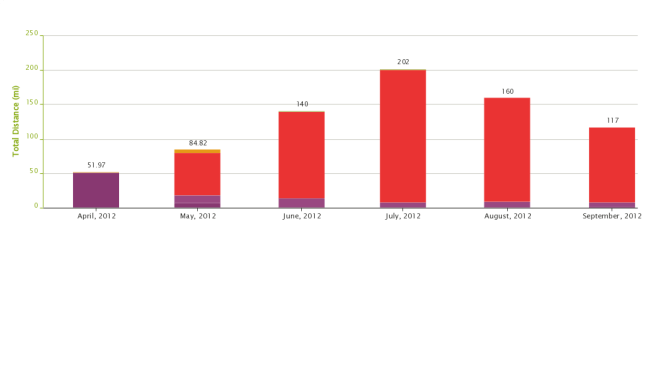
Speaking of progress — as I was in my previous post — it’s not continuous! In face, September — as I adjusted to a new schedule with school back in session, etc., was my either my 4th best or my 3rd worst [depending on your perspective] since I started exercising again…

Am I worried about ‘losing it’? Not in the least. I’m learning to practice moderation and consistency and adjusting to changing weather. More important is that overall I am making progress. According to Endomondo, I’ve exercised 83% of the days since I started in March — that’s a low B in just about anybody’s book…

The most important thing is that exercise is now an important part of my life again and I’m making progress. Dialectical progress, but progress nonetheless…

Dialectical progress…

Looking back at this past week and trying to understand the lessons the Universe has for me is ‘progress’ and in particular I’m thinking about the dialectical nature of progress. Dialectical? I’ll have more on that later. First, here are the two posts that got me thinking. The first, an excellent lesson from Christine Hassler on why change or progress is not linear called ‘Ever Feel Like You’re backtracking?. I read another good one one from Jason Wachob earlier this week called Forget Perfection: Strive Toward Progress. There are other good ones I’ve curated as well — just search for ‘progress’ or ‘perfection’ in the search bar…

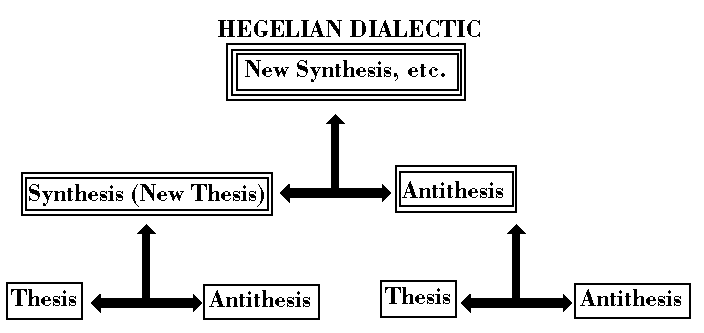
These posts made me think about my incomplete doctoral thesis on the relationship between Hermann Hesse’s writings and Hegel’s Dialectic. What is Hegel’s Dialectic? Here’s the wikipedia definition:

“Hegelian dialectic, usually presented in a threefold manner, was stated by Heinrich Moritz Chalybäus as comprising three dialectical stages of development: a thesis, giving rise to its reaction, an antithesis, which contradicts or negates the thesis, and the tension between the two being resolved by means of a synthesis. Although this model is often named after Hegel, he himself never used that specific formulation. Hegel ascribed that terminology to Kant.[28] Carrying on Kant’s work, Fichte greatly elaborated on the synthesis model, and popularized it.

On the other hand, Hegel did use a three-valued logical model that is very similar to the antithesis model, but Hegel’s most usual terms were: Abstract-Negative-Concrete. Hegel used this writing model as a backbone to accompany his points in many of his works.

The formula, thesis-antithesis-synthesis, does not explain why the thesis requires an Antithesis. However, the formula, abstract-negative-concrete, suggests a flaw, or perhaps an incomplete-ness, in any initial thesis—it is too abstract and lacks the negative of trial, error and experience. For Hegel, the concrete, the synthesis, the absolute, must always pass through the phase of the negative, in the journey to completion, that is, mediation. This is the actual essence of what is popularly called Hegelian Dialectics.

To describe the activity of overcoming the negative, Hegel also often used the term Aufhebung, variously translated into English as “sublation” or “overcoming,” to conceive of the working of the dialectic. Roughly, the term indicates preserving the useful portion of an idea, thing, society, etc., while moving beyond its limitations. (Jacques Derrida’s preferred French translation of the term was relever).[29]

In the Logic, for instance, Hegel describes a dialectic of existence: first, existence must be posited as pure Being (Sein); but pure Being, upon examination, is found to be indistinguishable from Nothing (Nichts). When it is realized that what is coming into being is, at the same time, also returning to nothing (in life, for example, one’s living is also a dying), both Being and Nothing are united as Becoming.[30]

As in the Socratic dialectic, Hegel claimed to proceed by making implicit contradictions explicit: each stage of the process is the product of contradictions inherent or implicit in the preceding stage. For Hegel, the whole of history is one tremendous dialectic, major stages of which chart a progression from self-alienation as slavery to self-unification and realization as the rational, constitutional state of free and equal citizens. The Hegelian dialectic cannot be mechanically applied for any chosen thesis. Critics argue that the selection of any antithesis, other than the logical negation of the thesis, is subjective. Then, if the logical negation is used as the antithesis, there is no rigorous way to derive a synthesis. In practice, when an antithesis is selected to suit the user’s subjective purpose, the resulting “contradictions” are rhetorical, not logical, and the resulting synthesis is not rigorously defensible against a multitude of other possible syntheses. The problem with the Fichtean “Thesis-Antithesis-Synthesis” model is that it implies that contradictions or negations come from outside of things. Hegel’s point is that they are inherent in and internal to things. This conception of dialectics derives ultimately from Heraclitus.” Full story at: Dialectic – Wikipedia, the free encyclopedia.”

Pretty heady stuff, eh? Basically, it’s just another way of describing that ‘two steps forward one step back’ process we call progress. Wherever you’re at as you read this, stop, look yourself in the mirror and say “I’m enough and I’ve come as far as I can”. Remember, your best days are still ahead…

That time I interviewed David Allen, father of Getting Things Done (GTD)

On Friday, I launched a series on Getting Things Done [GTD] on the internet. I wanted to include this 2010 interview with David Allen but as humbling as it is to admit, I couldn’t track it down on my own site! :-D

Fortunately, I did locate it and I share it with you here as part of the series. The action starts at about 1:50 into the recording…


Start a Blog at WordPress.com.

Up ↑