
notsalmon
via Love yourself for who you are now. Believe in yourself for who you have the power to become..
Thinks I find along the way
“Each problem has hidden in it an opportunity so powerful that it literally dwarfs the problem. The greatest success stories were created by people who recognized a problem and turned it into an opportunity.” Joseph Sugarman via Problems Present Opportunities.
Full story at: Give Yourself Permission to Be Imperfect « Positively Positive.


This is as close as I get to creating a work of ‘art’. For me it communicates that in the midst of the blackness of my soul is a faint glimmer of hope; I am worth more than this current situation I have accepted as reality. It keeps me from ending my life. For now…

I have a couple of lovely client friends in Calgary. Then this morning I saw this video on David Kanigan‘s blog:
Now I get the old Gordon Lightfoot song…
For a number of reasons right now, I’d like to be Alberta bound…
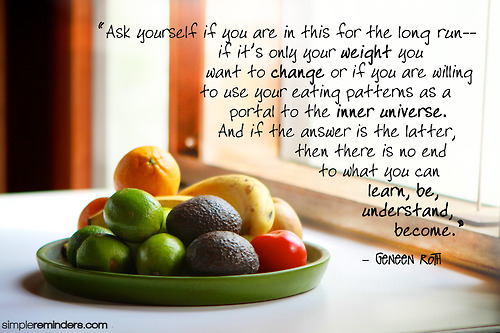
I have been changing my relationship with food and beverages. I used to do Atkins. 3 times in my life I’ve knowing the ‘joy’ of losing 50 pounds and the subsequent shame of gaining it all back. There is no silver bullet for me. The only way to win at losing is to change your relationship with food and to begin to exercise. Sorry to be boring but it is the only way…

Michael Hyatt offers a good system for recalling what you read here. Me? I prefer Kindle books. How else can you carry a searchable, annotable library of hundreds of books around in your pocket? Full story at: How to Retrieve What You’ve Read—Almost Instantly | Michael Hyatt.

Live Life Quotes, Love Life Quotes, Live Life Happy

 It always bothers me when I hear someone say I’m just a ______. To me it’s a sign of discontent and resignation. Melody Beattie writes:
“I‘m just a hairstylist.” the woman said to me almost apologetically. “I want to do something big, something important in the world.”
“Do you have any idea how important it is to people to get a good haircut?” I asked.
Maybe we don’t have to do anything different to he of service. We just need to bring an attitude of service to what we already do.
Action: Do one thing each day that serves someone else. with no thought of receiving anything in return. It doesn’t have to be a big thing. Call someone; give them encouragement. Or just listen, instead of talking, during a conversation. Wait on someone—bring them a cup of coffee or a glass of water. Take a minute during prayer time and say a prayer for someone else. If you’re in recovery, volunteer to do a practical task, like cleaning up after the meeting. If we can’t change the world, at least we can do our part to keep it going.” via October 20.
Whether you do or don’t is kind of irrelevant in this case — if you’re a fan of excellence and are continually looking to improve your product or service or self, I believe you will be inspired by this movie in the same way I was…
I think the thing that impressed me most was the continuous application of the Japanese concept of Kaizen which, according to the Wikipedia means:
The Japanese word “kaizen” means simply “improvement,” with no inherent meaning of either “continuous” or “Japanese philosophy” in Japanese dictionaries or in everyday use. The word refers to any improvement, one-time or continuous, large or small, in the same sense as the mundane English word “improvement”.[5] However, given the common practice in Japan of labeling industrial or business improvement techniques with the word “kaizen” (for lack of a specific Japanese word meaning “continuous improvement” or “philosophy of improvement”), especially in the case of oft-emulated practices spearheaded by Toyota, the word Kaizen in English is typically applied to measures for implementing continuous improvement, or even taken to mean a “Japanese philosophy” thereof. The discussion below focuses on such interpretations of the word, as frequently used in the context of modern management discussions.
Kaizen is a daily process, the purpose of which goes beyond simple productivity improvement. It is also a process that, when done correctly, humanizes the workplace, eliminates overly hard work (“muri”), and teaches people how to perform experiments on their work using the scientific method and how to learn to spot and eliminate waste in business processes. In all, the process suggests a humanized approach to workers and to increasing productivity: “The idea is to nurture the company’s human resources as much as it is to praise and encourage participation in kaizen activities.”[6] Successful implementation requires “the participation of workers in the improvement.”[7] People at all levels of an organization participate in kaizen, from the CEO down to janitorial staff, as well as external stakeholders when applicable. The format for kaizen can be individual, suggestion system, small group, or large group. At Toyota, it is usually a local improvement within a workstation or local area and involves a small group in improving their own work environment and productivity. This group is often guided through the kaizen process by a line supervisor; sometimes this is the line supervisor’s key role. Kaizen on a broad, cross-departmental scale in companies, generates total quality management, and frees human efforts through improving productivity using machines and computing power.[citation needed]
While kaizen (at Toyota) usually delivers small improvements, the culture of continual aligned small improvements and standardization yields large results in the form of compound productivity improvement. This philosophy differs from the “command and control” improvement programs of the mid-twentieth century. Kaizen methodology includes making changes and monitoring results, then adjusting. Large-scale pre-planning and extensive project scheduling are replaced by smaller experiments, which can be rapidly adapted as new improvements are suggested.” via Kaizen – Wikipedia, the free encyclopedia.
This film is available via streaming Netflix — although the topic is a little odd, if you’ve read this far I predict that you, too, will be as inspired as I was by Jiro…


Kim Anami writes:
You want love.
I want love too.
Underneath everything we do is the desire to be loved.
And to love.
Ideally, it permeates all of your words and actions, this sprinkling of love.
Whether you are asking your lover to pick her clothes up off the floor (although in a passion-strewn frenzy, such things can be forgiven. Ah, the power of great sex.);
Or your child has ignored your request to go to bed;
Or the barrista makes your ceremonial, non-milk matcha with milk again (ahem);
How many ways can you stay in love?
Love is an overarching feeling. It can film the room and the universe with its enormity.
It is also a conscious choice, moment-to-moment, to be loving.
In the end, your withholding love from others when they “f**k up” and “don’t do things the right way” diminishes you.
The more you radiate love, you constantly lift your vibration. You attract more love. It becomes so that an unloving word now sounds cacophonous coming out of your mouth.
Sometimes, a couple (or parent and child) have gone so long being defended against each other, that the idea of being loving is unimaginable. They’ve forgotten. It’s been that long.
You can change it in an instant.
If you decide to.
Every moment holds within it a new blueprint for the future. You can choose.
Then you have to remain committed to the choice. And committed to love.” Full post at: I Know What You Want | | Kim Anami.













 Bright, shiny objects!
You must be logged in to post a comment.