
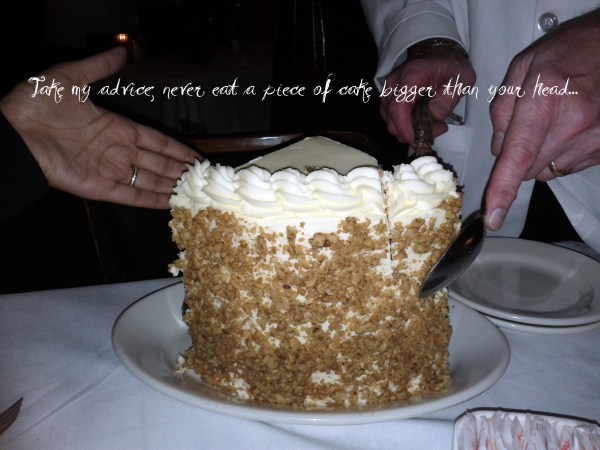
This? Whatever you’re settling for in yourself or others…
Thinks I find along the way
This? Whatever you’re settling for in yourself or others…

Jasmin Bedria writes:
When most people envision the ideal relationship, they think of engulfing, inseparable love. Being “attached at the hip” is typically an early sign that you and your new love share the ever-consuming, romantic high of a Nicholas Sparks novel.
You want to keep learning about each other, acting as sponges to the other’s every word and affection.
So, how in the world can detachment actually strengthen an intensely loving and growing relationship?
Detachment is one of the most important aspects in achieving true, profound fulfillment. Believe it or not, practicing detachment while remaining vulnerable will benefit you in remarkable ways.
Get the full story here: 5 Reasons Detachment Can Save Your Relationship
And, for me it’s one of the most difficult concepts imaginable. Sigh…
Off in the field.

Posted from WordPress for Android

 Melody Beattie writes:
Stop trying so hard to control things. It is not our job to control people, outcomes, circumstances, life. Maybe in the past we couldn’t trust and let things happen. But we can now. The way life is unfolding is good. Let it unfold.
Stop trying so hard to do better, be better, be more. Who we are and the way we do things is good enough for today.
Who we were and the way we did things yesterday was good enough for that day.
Ease up on ourselves. Let go. Stop trying so hard.
Today, I will let go. I will stop trying to control everything. I will stop trying to make myself be and do better, and I will let myself be.

23 Health and Fitness Resources You May Have Missed http://bit.ly/QBInoP
— Todd Lohenry (@toddlohenry)
3 hours ago
Warning: Avoid These 7 Mistakes When Building a Home Based Business http://bit.ly/UBR4go
— Todd Lohenry (@toddlohenry)
3 hours ago
Are Religious People Happier? | Psychology Today http://twy.la/UR8Ude
— Todd Lohenry (@toddlohenry)
3 hours ago
A new playlist: The joy of eating http://bit.ly/QAflpK
— Todd Lohenry (@toddlohenry)
19 hours ago
Avoiding Family Angst on Thanksgiving http://bit.ly/QAflpG
— Todd Lohenry (@toddlohenry)
19 hours ago
5 Thanksgiving dinner disasters and how to avoid them http://bit.ly/QAflpC
— Todd Lohenry (@toddlohenry)
19 hours ago
Holidays, Families, and Fairness | Psychology Today http://twy.la/QAeFk4
— Todd Lohenry (@toddlohenry)
19 hours ago
Good read! http://storify.com/toddlohenry/storypad/elements/50afe3fe4ed978857641a9c9
— Todd Lohenry (@toddlohenry)
19 hours ago
4 Low-Calorie Pumpkin Treats http://bit.ly/U2vl0q
— Todd Lohenry (@toddlohenry)
19 hours ago
17 Important Things To Do With Thanksgiving Leftovers http://bit.ly/U2vl0k
— Todd Lohenry (@toddlohenry)
19 hours ago
DIY Gifts Are the Ultimate Remedy for Black Friday http://bit.ly/U2vm4l
— Todd Lohenry (@toddlohenry)
19 hours ago
AdjustYourPrivacy Locks Down Your Entire Internet Life from One Page http://bit.ly/WHlbqG
— Todd Lohenry (@toddlohenry)
19 hours ago
6 ways to tweet yourself out of a job http://bit.ly/UyHIlj
— Todd Lohenry (@toddlohenry)
19 hours ago
Crashing the Yoga Barrier for Men http://twy.la/Sj51zc
— Todd Lohenry (@toddlohenry)
19 hours ago
spinach salad with warm bacon vinaigrette http://bit.ly/YavELP
— Todd Lohenry (@toddlohenry)
19 hours ago
Poor Rudolph…
— Todd Lohenry (@toddlohenry)
a day ago
Passing Along Work Ethic to Children: http://bit.ly/Y9XRSR
— Todd Lohenry (@toddlohenry)
a day ago

Recently thought leader Michael Hyatt had two guest posters on his blog; both had some interesting perspectives that serve as great instruction [or gentle reminders for seasoned bloggers] on structure in a blog post. The first is from Philip Rothschild who says:
I do, in fact, use a blog post template. I don’t follow it slavishly, but I always start with it. It includes all the elements that I have learned make for an effective post. It also helps me write faster, because it provides me with a track to run on.
My blog post template consists of five components:
- Lead Paragraph. This is key. If you take too long on the wind-up, you will lose readers. You have to get into the premise of the post and make it relevant to your readers. After the title, this is the second most important component of your post.
- Relevant Image. I use images for the same reasons magazines do: I want to pull my readers into the post itself. Pictures do that. I get 90 percent of mine from iStockPhoto. (Click here for a 20% discount.) Occasionally, I use a screenshot or an embedded video or slideshow.
- Personal Experience. I always try to share my personal experience. Why? Because readers connect with stories. The more honest and transparent I can be, the better. In fact, my most popular posts generally come out of some failure on my part.
- Main Body. Everything to this point has been an introduction. I always try to make my main content scannable.I use bullets, numbered lists—and often both. This makes the content more accessible to readers and more sharable via Twitter and Facebook.
- Discussion Question. For the past few years, I have ended every post with a question. I don’t intend my posts to be a monologue. Instead, I want to start a conversation. As a result, I measure my effectiveness at this by how many comments I get.
I also follow a few overall rules when writing my posts:
- Make the posts short.This is my biggest personal challenge. I have a tendency to be too thorough. Consequently, I aim for 500 words. This usually means I have to write the post and then go back and tighten it up.
- Use short paragraphs.I try to stick to 3–4 sentences. If it’s more than this, the content looks too dense. Readers will give up and move on. (Notice how newspapers usually follow this rule.)
- Keep short sentences.As a general rule, I try avoid compound sentences. A period gives the reader a natural stop—and a sense of progress as they pass one milestone after another. To quote a common copywriting axion, short sentences make the copy read fast.
- Use simple words. I love language, so I am often tempted to use big words. However, I have learned to avoid this. My goal is to communicate, notto impress my readers with my vocabulary.
- Provide internal links. I can’t say everything in one post, so I link to other posts where I have developed a thought in more detail. This has the added vantage of increasing my pageviews and session times. I think it is also genuinely helpful to my readers.
While your template might be different, it is worth outlining and tweaking as you hone your writing skills. This will allow you to write faster and more effectively.
Blogger Ali Luke offers these insights on basic types of blog posts…
These are the three simple post structures you can use:
- The How-to Post.A how-to post aims to teach the reader something, by taking them through a step-by-step process. It’s usually structured with numbered, sequential steps. And, where appropriate, these steps might include a screenshot or photo to show the reader what to expect at each stage.If you’re writing a how-to post, the easiest way to begin is with a careful plan. Work out the necessary steps. You may find you need to break complicated procedures into several parts, or merge simple ones together. Get them into the best possible order.Once you’ve done that, your post will be straightforward to write—and straightforward for readers to follow.Variations:
- “How I ____ and How You Can Too”: Readers love to hear how you succeeded with something. This formula lets you explain your own steps and offer action points for them.
- “Why ___ Matters and How To Do It”: If you suspect your readers need to know the why before the how, spend the first third or half of your post explaining the why, then move on to practical steps.
- The List Post.A list post offers readers a selection of ideas, tips, suggestions, or resources. These are normally numbered. If you’ve been around the blogging world for long, you’ll have come across this type of post—probably many times.The key difference between a list post and a how-to post is that readers don’t need to follow the list from start to end: they can dip in and use those points that seem most applicable to their own situation.As with a how-to post, pre-planning is essential. Aim to come up with a couple more items than you need, and cut the weakest. Think about the order of your items, too: easiest to hardest works well, or you could alternate “do” and “don’t” tips.Variations:
- “The A–Z of ___”: You may well have seen this format used in magazines. An A–Z list post usually aims to produce a comprehensive overview of a particular topic, in bite-size chunks.
- “Roundup: ___”: This form of post gathers together resources (generally blog posts) on a particular topic, meaning each list item includes a link. You could also use this to list, say, the top 20 tweeters in your niche.
- The Review Post.Review posts offer an informed opinion about a particular product or service. These are a great way to serve your readers, who might be debating whether or not to purchase a particular item. They also help establish your own knowledge and expertise in your field.It’s up to you what exactly you include in your reviews, but one simple structure you can use is this:
- Overview—what’s included, how much it costs, and so on
- The good—mention the two or three aspects that were most enjoyable or useful to you
- The bad—write about what didn’t work so well – this adds credibility, especially if you’re an affiliate for the product / service
- Verdict—should your readers buy the product / service?
Variations:
- “Product X vs Product Y”: Often, readers will be struggling to choose between two similar products or companies. A comparative review helps them make up their mind.
- “Top Ten Books On ___”: Similar to a roundup list post, but with added opinion, a “top ten” of books or other products in your niche offers readers bite-size reviews—and a resource to return to.
Of course, these aren’t the only structures you can use. But they do give you a great basis to build on. And they help ensure that your reader gets real value from your writing.
If you’ve had success with one of the above post structures, or if you’ve got a favorite structure of your own, let us know in the comments.
Source: 3 Great Blog Post Structures You Can Use Today | Michael Hyatt
To Ali’s list I would add a 4th type of blog post which I call a ‘curative’ or curation post. That’s the type of post you see here! I could have just tweeted this two links or emailed them to a few friends, but I took a little extra time to glue the relevant parts of the two posts together and when I’m done, I’ll share this post with a couple of hundred people I work with but it will also be posted here on the blog for anyone who might find nature Google search or be searching for something specific on my site. While some people may frown on the concept of curation, curators provide a valuable service to the original writer, to their readers and to themselves when their curation truly adds value. As an added bonus, here’s a link to a recent post that shows my curation workflow…
I invite you to interact with me through the comment form or the connect menu option above — I’d be happy to talk with you about how I use all of these tactics for effective blogging…



I find it interesting that Dr. Gregg Henriques’ title implies many of us are a bit neurotic from time to time; reading his article may help some ‘get a grip’:
Although the term “neurotic” has more recently fallen out of favor, it was used by psychiatrists for most of the 20th Century to describe a broad category of conditions that were associated with poor functioning, anxiety and depression, but were clearly differentiated from “psychotic” in that in contrast to individuals in the latter category, neurotics maintained contact with reality and were rarely engaged in highly deviant, socially unacceptable behavior. (A factoid worth noting is that the term “borderline”, of borderline personality disorder fame, originated from the conceptual space between neurotic and psychotic. Originally, borderline individuals were those who generally maintained contact with reality, but under duress exhibited extreme volatility and primitive defenses and were not good candidates for psychoanalysis).
Get more here: (When) Are You Neurotic? | Psychology Today
I agree with Dr. Henriques when he says later in the article “The importance of understanding the meaning of “neurotic” in terms of character adaptations is that we are all neurotic some of the time, even if we might be low on trait Neuroticism.” Reading the rest of his thoughts gave me some valuable insights…

I realize that this is kind of a morbid thought, but I couldn’t help but think that 10 to 15 years later the same children were strewn across a battlefield in Russia or France or North Africa in many of the same positions. That, for me, summarizes in a succinct way the horror of war…

Leo Babauta has an interesting answer to this season of rampant consumerism. Don’t buy anything except essentials until next year:
Today is one of the worst days of the year: overconsumption day (or Black Friday as some call it). Or you could call it one of the best days of the year: Buy Nothing Day.
I prefer the latter — it means we waste less, consumer fewer resources, stop looking to shopping to solve our problems and make us happy, and instead find simpler ways of finding contentment.
And so today I extend a challenge to all of you, and the world: Buy Nothing Until 2013.
Yes, I’m taking Buy Nothing Day and extending it through the end of the year.
Why the hell would you want to do this challenge?
Do it as a protest against consumerism and corporate influences on our lives. Do it as a tool for contentment, for simplicity. Do it to reclaim the holidays as a time of connection and love, not of buying and debt. Do it just to see if you can.
And yes, you can still do it if you’ve already done some Black Friday shopping. We’ll forgive our past sins and start afresh. :)
Get the rest of the plan here: » Challenge: Buy Nothing Until 2013 :zenhabits
Me, I think I could easily do this — it’s the other people in my family I’m not so sure about! What about you? And how do you plan to proceed this holiday season?
I don’t know why I find big ships out on Lake Michigan fascinating — I just know that I do. Here is one heading to winter port…

Posted from WordPress for Android

Right back at you, David! I’m grateful for WordPress and what it enables me to do but more importantly, the people with whom it connects me…

…for your inspiring posts, your comments, your friendship and your followership. B.G. captured my thoughts this morning, I’m grateful for you.
Susan, Mimi, LaDona, Lori, Lorne, Alex, Anake, Anneli, Ashi, Beth, Becky, Bonnie, Brenna, Caitlin, Carol, Carolyn, Christian, Clanmother, Cristi, Currie, David, Dale, Darlene, Dogdaz, Frank, Frank, Feygirl, Francine, George, Gretchen, Grisa, Indira, Ioanna, Ivon, Jaz, Jeff, Jenni, John, John, John, Joyce, Kalabalu, Katrina, Keith, Kevin, Kim, Kristin, Kurt, Laurie, Leonard, Lu, Luke, Manoli, Maralee, Marina, Marion, Mark, MBB, Meikah, Melody, Misafusa, MindfulDiary, MixandMatchmeme, Michael, Michael, Michael, Mirta, OneHot(Mess),
View original post 87 more words
Take 21 days to create a new healthy habit and the habits you create will take care of you! With what healthy habits would you like to start the new year? A year from now, you’ll wish you had started today…
Oh, and by the way if you’re a geeky type you might want to look into tools like Habitforge to get you started!
image via Visual Inspiration: Create Healthy Habits!.

Enjoying a temporary stay of execution. Next year will be a different story…


Posted from WordPress for Android












 Bright, shiny objects!
comments