That crazy thing we call love is perhaps one of the most studied and least understood areas in psychology. One reason is that many studies of romantic relationships are carried out not in real life, but in the lab. Making matters worse, many of these studies involve dating relationships between samples of convenience, consisting of undergraduate students. Though these students are certainly capable of close relationships, many of them haven’t matured enough to know themselves, much less what they want out of a romantic partner.
What better way to find out about love than to survey the experts? Not the psychology experts—the expert members of couples who have been married 10 years or longer. The surprising findings of this study, reported in the prestigious journal Social Psychological and Personality Science, showed not only that many people were still in love even after 10 years of marriage, but also which factors predicted the strength of their passion. As reported by Stony Brook University psychologist K. Daniel O’Leary (2012) and his research team, the findings provided a stark contrast to the typically glum view we have of long-term marriages. Rather than being doomed to a bland, mediocre existence, these couples endorsed their positive feelings toward their spouses with hearty (dare I say) enthusiasm. A whopping 40 percent of those married 10 years or more stated that they were “Very intensely in love”—the highest rating on the scale. Another 15 percent gave their marriages the second-highest rating on the love intensity scale. Perhaps even more surprisingly, those who stuck together for 30 years and more also gave their marriages high ratings with 40 percent of women and 35 percent of men saying that they were very intensely in love. Clearly, many couples are able to maintain high levels of passion as the decades go by well into their middle and later years.
Full story at: 1. Twelve Ties That Bind Long-Term Relationships | Psychology Today.
Your Time Has Come
If you are reading this column, count your blessings – you have survived a potentially catastrophic 2012. But the media tells us ‘Not so fast!’ Now we have to prepare to be sucked over the Fiscal Cliff. 2013 doesn’t have to be the new end of our old world. In fact, it can be the beginning of our new, sustainable, progressive world. But before we make plans for the future, let’s take some time to assess how far we’ve come recently. As the year winds down, we have the perfect opportunity to set ourselves up for a good new year – and maybe even the best for the rest of our lives.” Full story at: Your Time Has Come | Psychology Today.
The Most Dangerous Word in the World
Mark Waldman and Andrew Newberg, M.D. write:
If I were to put you into an fMRI scanner—a huge donut-shaped magnet that can take a video of the neural changes happening in your brain—and flash the word “NO” for less than one second, you’d see a sudden release of dozens of stress-producing hormones and neurotransmitters. These chemicals immediately interrupt the normal functioning of your brain, impairing logic, reason, language processing, and communication.
In fact, just seeing a list of negative words for a few seconds will make a highly anxious or depressed person feel worse, and the more you ruminate on them, the more you can actually damage key structures that regulate your memory, feelings, and emotions.[1] You’ll disrupt your sleep, your appetite, and your ability to experience long-term happiness and satisfaction.
If you vocalize your negativity, or even slightly frown when you say “no,” more stress chemicals will be released, not only in your brain, but in the listener’s brain as well.[2] The listener will experience increased anxiety and irritability, thus undermining cooperation and trust. In fact, just hanging around negative people will make you more prejudiced toward others![3]
via 3. The Most Dangerous Word in the World | Psychology Today.
How to Reflect on 2012 and Set Yourself Up for Success in 2013
The good folks at Stepcase Lifehack share this:
How to reflect on the previous year
Find yourself a peaceful and quiet location to reflect on the past year, a place where there are no distractions around so you can really focus your thoughts. An ideal location would be somewhere outside of your own home—perhaps a beach or a nearby park. Find somewhere you can set your mind free.
Take a notepad and pen with you, or if you’re into technology, take your iPad or similar device.
Write down your answers to the questions below, but note that these questions are just a guide: depending on your individual circumstances, you may want to add your own questions that are more specific or relevant to your life.
Ready? Here goes:
- What are the 5 things of 2012 that you are most proud of?
- What new connections have you made, and how have these shaped your life?
- What experience has made you the happiest?
- Who has made you happiest?
- What have been the best moments in your career this year?
- What changes would you make to your career in 2013?
- What challenges did you overcome this year? How did you do it?
- What has held you back from achieving what you wanted to do this year?
- What can you do in 2013 to ensure this doesn’t happen again?
- What habit did you acquire this year that has made a difference?
- What habit has prohibited you from achieving what you wanted this year?
- What habit do you want to enable in 2013 that will make a difference?
- What was your biggest mistake in 2012? What have you learned from this?
- What else have you learned this year?
- What are 3 words that sum up your year?
- If you were to live 2012 all over again, what would you do differently?
- Add your own!
The Next Steps
Now that you have reflected on the past year, keep your answers at the front of your mind, and file your notes about them nearby so you can refer to them regularly. Your reflections will become the starting point for setting your goals for the year, and those goals for 2013 will be much more targeted and more relevant to what it is that truly makes you happy.
It only takes 20 to 30 minutes to do this, and this short reflection can have a huge impact on your overall well-being, your learning, and your success for 2013.
Let me know how it goes as I would love to hear your experiences! 2013 is going to be an amazing year. I can feel it!
via How to Reflect on 2012 and Set Yourself Up for Success in 2013.
Don’t Ever Let Someone Take Away Your Happiness
Live Life Quotes, Love Life Quotes, Live Life Happy
Endless possibilities…
My wife and sons have departed to visit family for the holidays and leaving me with five glorious days alone in the house. The question is how to best spend this treasure. Five empty days without interruption. To some people that might sound like a nightmare but to a father of six boys with three teenagers an eight-year-old currently at home it sounds like heaven. The question is and how to best spend? The possibilities are truly endless! One possibility? Buy a case of beer and load up on sausage and cheese and make it my objective to watch all five seasons of Castle back to back while never changing out of my boxers. Somehow I feel as if I have a higher calling and that this time could be better invested. What if I used the time to actually read the books on my Kindle that I thought I couldn’t live without? What if I use the time to actually do the exercises I gloss over in those self-help books I’ve purchased? What if I ate nothing but good food? What if I use the time to reduce or eliminate coffee from my morning? See what I mean? The possibilities are truly unless but the choices that I make will tell me more about who I really am than anything that I’ve ever written here…
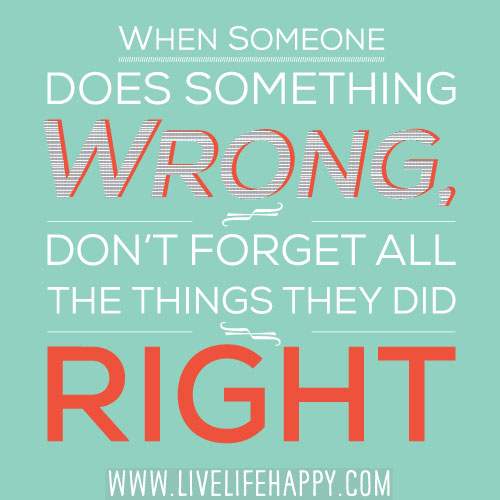
When Someone Does Something Wrong

How to Let Go of the Need for Approval to Start Thriving
“Criticism is something you can easily avoid by saying nothing, doing nothing, being nothing” ~Aristotle
via How to Let Go of the Need for Approval to Start Thriving | Tiny Buddha.
Reframing Rejection: Getting Rejected Doesn’t Always Have to Hurt
“Remember that sometimes not getting what you want is a wonderful stroke of luck.” ~Dalai Lama
Full story at: Reframing Rejection: Getting Rejected Doesn’t Always Have to Hurt | Tiny Buddha.


You must be logged in to post a comment.