“Yes” Doesn’t Count if you can’t say “No” – Why Clear Boundaries are Important in Intimate Relationships

English: A young woman and man embracing while...

I found this over at Psychology Today:

Most people think of an ideal romantic relationship as a union of two inseparable beings forged into one heart, one mind, and one dream. If either partner has a conflicting desire, he or she too often does not express it. They consciously or unconsciously choose to protect the fantasy of perfect compatibility, but may not realize the limitations that are wedded to that decision.
Eventual conflicts are not as noticeable early when relationships are new. The joy of new discovery and lustful connection often eclipse any disagreements that might arise. Newly-in-love partners too often do not want to know anything about each other that could threaten the perfection they cherish. Both may choose to leave well enough alone even if the result is incomplete or inauthentic communication. In the void of unexpressed conflicts, the partners often want to maintain the illusion of a perfect match.

“He finishes my sentences before I even know what I’m going to say.”

“She anticipates what I want before I tell her.”

“We agree on everything. It’s amazing.”

“It’s so easy to be together. We love all the same things.”

Sadly, those constructed realities of perfect compatibility cannot sustain over time. People cannot feel genuinely loved if their partners are not aware of the other’s core feelings and desires. They can only keep renewing their love if they can face their conflicts openly and work through them.

That requires that both partners are willing to follow these six principles:

They are able to say what they need from their partners

They know what they are able to offer

They honestly share those thoughts and feelings

They listen to their partner’s needs without becoming defensive

They have or are willing to learn the skills to negotiate their differences

They respect each other’s conflicting desires

To make these principles work, partners must be clear from the beginning of their relationship to set clear boundaries that they both agree to honor. Boundaries are like the borders between countries. They can be barriers to communication and cooperation, or viable interfaces for exchanging ideas and resources.

When beautifully used in intimate relationships, they are symbolic lines of demarcation that help partners understand their differences while they seek whatever ways are necessary to authentically connect. Only the acceptance of those known similarities and differences can keep partners truly validating their mutual needs.

Healthy boundaries should be fluid and openly susceptible to changes by either partner during any time in their relationship. They hopefully know or are willing to learn what is personally important to them and make every effort to share those thoughts with each other. By working together over time, they learn to quickly recognize when they are in agreement, when they need to negotiate, and when they must turn down a request that could destroy their personal integrity.” Get more here: “Yes” Doesn’t Count if you can’t say “No” – Why Clear Boundaries are Important in Intimate Relationships | Psychology Today.

Healthy Boundaries: A Good Practice

English: Slate fencing marking field boundarie...

Kristin Barton Cuthriell writes:

“Boundaries are those invisible lines that separate you from other people. When children grow up in families that practice healthy boundaries, these boundaries are typically passed down through generations. The same is true when individuals are raised in dysfunctional families that have no sense of healthy boundaries. These poor boundaries, too, are often passed down the generational line.

Poor boundaries are usually too rigid or too loose. Like a concrete wall, rigid boundaries keep people out. When a person is closed off with rigid boundaries, they do not allow themselves to become vulnerable, which makes true intimacy impossible.

People with loose boundaries have little fence or no fence at all. The separation between self and others is blurred. Individuals with loose boundaries do not have a clear sense of self. These people trust easily, disclose too much, have a difficult time setting limits, and often become enmeshed with others.

Healthy relationships require healthy boundaries. If you are aware that your personal boundaries are either too loose or too rigid, you can learn healthy boundaries.

The first step to change is recognizing that change is needed.  What you do not acknowledge, you do not change.

What is a healthy boundary? Take a look.” Get more here: Healthy Boundaries: A Good Practice – Let Life in Practices.

How to do an Ultimate GTD Weekly Review

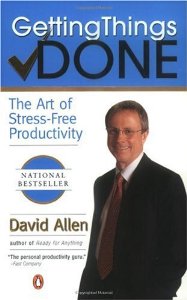
Cover of "Getting Things Done: The Art of...

Lifehacker is offering courses online; today they tackle the Getting Things Done weekly review:

You are only as good as your GTD system.

In the Getting Things Done system, without a solid weekly review, your productivity will not be at an optimum level. The weekly review is one of the most overlooked aspect of GTD, mostly because it seems to take too much time or may seem “overboard”. The fact is the GTD weekly review is essential to get more done with relaxed control.

In this Lifehack Lesson you will learn how to do one of the most thorough weekly reviews that will boost your productivity and get you one step closer to having a “mind like water”. Get the course here: How to do an Ultimate GTD Weekly Review.

If you’re not familiar with David Allen’s classic work on ‘Getting Things Done’ I strongly encourage you to look into his system!

Life Quotes From The Buddha For All

“We are what we think. All that we are arises with our thoughts. With our thoughts, we make the world.” Buddha. Get more here: Life Quotes From The Buddha For All | FinerMinds.

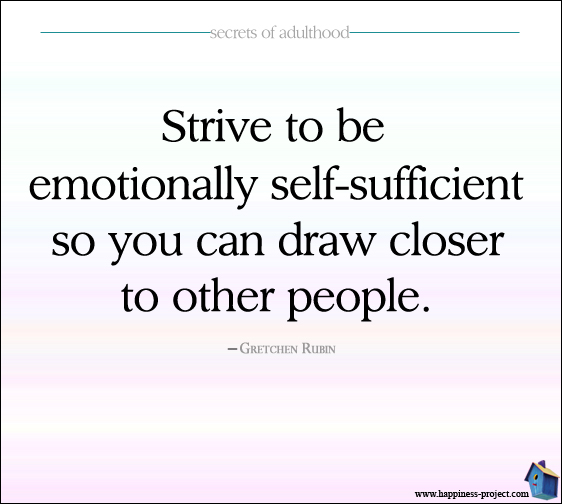
Be Emotionally Self-Sufficient So You Can Draw Closer to Other People


Get Gretchen Rubin’s perspective here: “Be Emotionally Self-Sufficient So You Can Draw Closer to Other People.” « The Happiness Project.

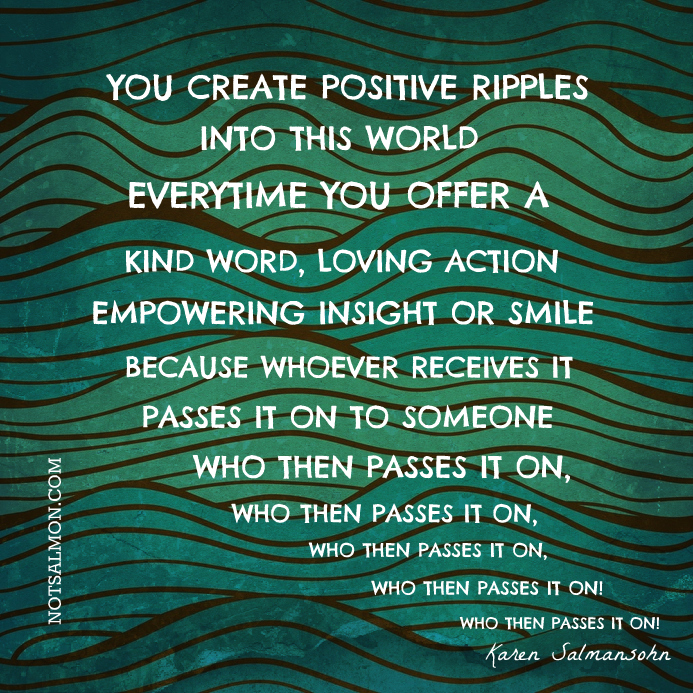
Be part of the positive ripple affect….

notsalmon via Be part of the positive ripple affect…..

The Grass Is Greener Somewhere Else . . . NOT!

Tony Meindl shares some great insight here:

The grass is greener syndrome.

If you suffer from it, it’s yet another way of postponing your life. Putting the things you desire on the back burner. When we covet another person’s journey, we think if only we had what they had, our life would be more fun. Or more exciting. Or more magical.

Your life already is magical.

We’re just not awake to it, so it feels as if we’re moving around in a monochromatic haze while everyone else seems to be living in Technicolor.

That’s the illusion.

The truth is that your grass is very green. It’s lush and tropical and exotic and fertile and full of possibilities. But it requires you to fully embrace it. All of it. Even the stuff you don’t like, because actually, that’s the stuff that becomes the catalyst for change.

That stuff is your grass’s fertilizer. It’s the essential stuff needed for your growth and expansion. And it holds the potential to unlock the doors you’ve shut to the things you’re seeking:  your joy, your passion, your peace of mind, your self-acceptance.

We can never get to where we’d like to be except by starting in the place we’re currently residing – emotionally, psychologically, spiritually. There’s no escaping you.

Wherever you are, there you are.

We can move to another city, or get another girlfriend or change jobs, but the common denominator in all these experiences is you.

So if you don’t like where you are, then change who you are. But don’t think that being somewhere else, or having a different lover or having a career like someone else is the answer.

The transformation occurs from the inside out. Not the outside in.

Start with your stuff. And watch how green your grass will grow.

Source: The Grass Is Greener Somewhere Else . . . NOT!

I’ve always heard that the grass is greener where you water it! Take care of your own lawn today…

Love Yourself First!

I don’t think you can accomplish much in a relationship if you aren’t bringing YOUR best every day. On the surface, self-love sounds ‘wrong’ but it’s the right thing to do! The Daily Love via Visual Inspiration: Love Yourself First!.

Insisting on the Best

Melody Beattie writes:

We deserve the best life and love has to offer, but we are each faced with the challenge of learning to identify what that means in our life. We must each come to grips with our own understanding of what we believe we deserve, what we want, and whether we are receiving it.

There is only one place to start, and that is right where we are, in our current circumstances. The place we begin is with us.

What hurts? What makes us angry? What are we whining and complaining about? Are we discounting how much a particular behavior is hurting us? Are we making excuses for the other person, telling ourselves we’re “too demanding”?

Are we reluctant, for a variety of reasons, especially fear, to tackle the issues in our relationships that may be hurting us? Do we know what’s hurting us and do we know that we have a right to stop our pain, if we want to do that?

We can begin the journey from deprived to deserving. We can start it today. We can also be patient and gentle with ourselves as we travel in important increments from believing we deserve second best, to knowing in our hearts that we deserve the best, and taking responsibility for that.

Today, I will pay attention to how I allow people to treat me, and how I feel about that. I will also watch how I treat others. I will not overreact by taking their issues too personally and too seriously; I will not under react by denying that certain behaviors are inappropriate and not acceptable to me.” Source: Language of Letting Go – July 16 – SoberRecovery : Alcoholism Drug Addiction Help and Information

Jeremiah 17:5-10

Cover for a NIV Bible

Trust in your higher power, not in the people around you!

5 This is what the Lord says:

“Cursed is the one who trusts in man,

who draws strength from mere flesh

and whose heart turns away from the Lord.

6 That person will be like a bush in the wastelands;

they will not see prosperity when it comes.

They will dwell in the parched places of the desert,

in a salt land where no one lives.

7 “But blessed is the one who trusts in the Lord,

whose confidence is in him.

8 They will be like a tree planted by the water

that sends out its roots by the stream.

It does not fear when heat comes;

its leaves are always green.

It has no worries in a year of drought

and never fails to bear fruit.”

9 The heart is deceitful above all things

and beyond cure.

Who can understand it?

10 “I the Lord search the heart

and examine the mind,

to reward each person according to their conduct,

according to what their deeds deserve.” via Jeremiah 17 NIV | YouVersion.

A poem and reminder for life’s stormy times…

notsalmon via A poem and reminder for life’s stormy times….

Be what you want to attract

notsalmon via Love This @SerenaDyer Quote!.

Stop Reading This (and Start Doing More)

Sorry, but sometimes when I start curating an article, I just can help but grab the whole thing! Justin Miller writes:

Nike’s slogan, Just Do It, goes far beyond the athletic field. It really can serve as a mantra for a successful life.

But in order to turn “Just do it” into a mission statement for living wisely, it’s important to get off the couch, take a hard look at your life and fix what’s broken – without beating yourself up about what might have been.

So wrap up your reading, grab a piece of paper to take down some notes and get ready to make some changes. It’s time for your new life, and that time starts NOW.

Forget regrets

Don’t let past mistakes rob you of your future. It’s easy to look back and see how our mistakes have creates bumps in our road of life, but that doesn’t mean they have to become a compete roadblock that robs us of our future. Regret provides an opportunity for growth. Stop shoulding all over your self. I should have done this. I should have done that. There’s plenty more to get done. Get started today!

Take a cue from their actions, and forget the regret, opening the doors to a different, brighter future.

Assess your needs

Take time to think hard about what  it really is you want to accomplish in your life, and look at what you’re doing that will make that possible. Also think about the things you may be doing right now that are holding you back.

Erase the things that prevent your dreams from seeing fruition, like the after-work drink that turns into ten and prevents you from being on top of your game the next day, and focus on what works.

Ask yourself this question every day. What is one thing I can do right now that will guarantee I have a great day? What is one thing I can stop doing right now that almost certainly guarantees a bad one.

Surround yourself with greatness

Make sure that the people you are hanging out with are people you admire, people who are living a life that you want for yourself. The close proximity to success is a great way to make it part of your own world. They say you are the average of the five people you spend the most time with.

The time is now

There’s never the perfect time for taking action. If you wait around for perfect conditions – when I lose weight I’ll do it, when the economy looks better I’ll try to branch out – that day will likely never come.

Try to look at today’s conditions as right, no matter what they are, and work with what you’ve been given. You always have the greatest resource available to you. That resource being choice. You choose to take action or not.

Break it down

If a task seems completely unmanageable, break it down into smaller parts.

If you want to write a book, but the idea of it is so overwhelming you can’t seem to get started, it pays to start small. Write a page a day, and within a year, you will have written 365 pages, bringing you that much closer to your goal.

No place for procrastination

Don’t put off until tomorrow what you can do today. Taking charge now will not only leave tomorrow free for tackling some other project, but will also erase the guilt you feel when you do procrastinate.

Just take a deep breath, grab the paperwork, and do it. Write the first page, sign up for the gym membership or send out a resume to the firm where you’ve always wanted to work. You can’t get the job if they don’t know who you are.

Focus on the essentials, and let the other things wait

Sure, you’d like to volunteer, plant a garden, get a degree, and take a vacation.  Eventually, you will do all those things. But in the hectic, stress-filled now, choose the most important and most pressing of your goals, and weed out those things that can wait.

Don’t be afraid to say no to the one-acre garden plot and plant a container garden or a few pots of herbs instead. Take a single class as you aim for a degree and plan a weekend away to Vegas with your partner or some friends, making it a temporary stand-in for that backpacking trip across Europe.” via Stop Reading This (and Start Doing More).

The 21 Best Organic Snacks

I’m not sure about the integrity of this list; there’s not a raw vegetable in sight! Seems to be mostly packaged foods but if that’s your thing, you can get more here: healthy snacks list | The 21 Best Organic Snacks | Rodale News.

Calvin on perspective

Calvin and Hobbes Comic Strip, July 15, 2012 on GoComics.com.

Find Out What Makes You Tick

Susan Krauss Whitbourne, Ph.D. writes:

If you’ve ever been asked the question “What makes you tick?” you may have found it harder to answer than you realized. After all, if you don’t know yourself, who does? The reason this question is so hard to answer is that we don’t often think about our basic thoughts, feelings, and behavior. By learning about psychology’s major personality theories, you’ll gain self-insights into why you do what you do and how, if you want, you can change.

You might think that psychology decided long ago how to define personality. After all, this is one of the basic concepts that psychologists study. It turns out that there are almost as many definitions of personality as there are psychologists. From Freudians to Skinnerians, and everything in between, psychologists offer definitions that reflect their basic philosophy about the fundamentals of human nature.

If you’re not given to philosophical debates and would just like to know how to understand yourself, there’s hope.  Most psychologists agree on a working definition of personality to guide them in their professional work, research, and even personal lives, that personality is an individual’s characteristic ways of feeling or behaving. Different psychologists emphasize feelings, behavior, and the underlying reasons that people feel and behave in certain ways. However, all psychologists view personality as a characteristic of the individual, meaning that it is the basis for differences from person to person.

Get the answer here: Find Out What Makes You Tick | Psychology Today

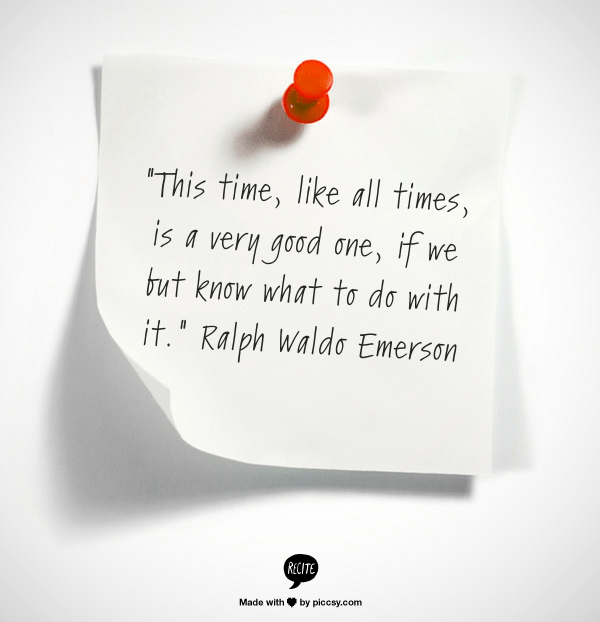
This time…

It’s A New Start!

The Daily Love via Visual Inspiration: It’s A New Start!.

Get the Guilt Stain Out

“Nagging guilt is like gray paint splashed over life’s sparkling moments” Sally Shannon. Get more here: Get the Guilt Stain Out « Positively Positive.

Family Buttons

Melody Beattie writes:

“I was thirty five years old the first time I spoke up to my mother and refused to buy into her games and manipulation. I was terribly frightened and almost couldn’t believe I was doing this. I found I didn’t have to be meant. I didn’t have to start an argument. But I could say what I wanted and needed to say to take care of myself. I learned I could love and honor myself, and still care about my mother – the way I wanted to – not the way she wanted me to.” –Anonymous

Who knows better how to push our buttons than family members? Who, besides family members, do we give such power?

No matter how long we or our family members have been recovering, relationships with family members can be provocative.

One telephone conversation can put us in an emotional and psychological tailspin that lasts for hours or days.

Sometimes, it gets worse when we begin recovery because we become even more aware of our reactions and our discomfort. That’s uncomfortable, but good. It is by beginning this process of awareness and acceptance that we change, grow, and heal.

The process of detaching in love from family members can take years. So can the process of learning how to react in a more effective way. We cannot control what they do or try to do, but we can gain some sense of control over how we choose to react.

Stop trying to make them act or treat us any differently. Unhook from their system by refusing to try to change or influence them.

Their patterns, particularly their patterns with us, are their issues. How we react, or allow these patterns to influence us, is our issue. How we take care of ourselves is our issue.

We can love our family and still refuse to buy into their issues. We can love our family but refuse their efforts to manipulate, control, or produce guilt in us.

We can take care of ourselves with family members without feeling guilty. We can learn to be assertive with family members without being aggressive. We can set the boundaries we need and want to set with family members without being disloyal to the family.

We can learn to love our family without forfeiting love and respect for ourselves.

Today, help me start practicing self care with family members. Help me know that I do not have to allow their issues to control my life, my day, or my feelings. Help me know it’s okay to have all my feelings about family members, without guilt or shame.

Source: Detachment – Cyber Recovery Social Network Forums – Alcohol and Drug Addiction Help/Support

Go to the source for additional self-care thoughts on attachment and detachment.

Does Gratitude Matter in Marriage?

Susan Heitler, Ph.D. writes:

“Please” and “thank you” often come out of our mouths automatically. How can we use true gratitude and thankfulness to cultivate healthy relationships?

Gratitude is “the quality of being thankful; readiness to show appreciation for and to return kindness.”

As children we’re taught to say “thank you” automatically in return for a favor. On this surface level, we are taught that gratitude is an appropriate social response.

At the same time, on a more complex level, gratitude is a way of being. When we truly feel gratitude, we experience heartfelt awe and appreciation for the goodness of something outside ourselves. Having gratitude towards someone or something means respecting its value and treasuring how unique, beautiful, or indispensable it is.

New studies support the idea that gratitude is an integral part of healthy relationships. As marriages move past the honeymoon stage, couples go from appreciating and loving every little detail about each other to taking each other for granted. Amie Gordon, a psychologist from U.C. Berkeley, blames this for the downfall of many relationships: ”You get used to having [your spouse] in your life and forget why you chose to be with them.” We become deadened to our spouse’s special qualities and instead focus on things that annoy us about them. These doldrums leave couples confused and discouraged: “Maybe the man they married isn’t so great after all…What happened to the spark in our relationship?…What do we do now?”

Dr. Gordon’s study in the Journal of Personality and Social Psychology explores the role of gratitude and appreciation in maintaining long and healthy relationships. In the study, 50 committed couples were given a week to fill out appreciation journals. On days when one partner reported feeling more appreciated, he or she tended to appreciate his or her partner more the next day.

Couples who had ongoing reciprocal appreciation were less likely to break up in the next nine months and even reported being more committed at the end of that time. The researchers concluded that a nourishing cycle of encouragement and appreciation provides extra incentive to maintain our relationships. In other words, when we appreciate our partners, we develop trust and respect. When we feel appreciated, we feel needed and encouraged.

In the second part of the study, Gordon’s researchers observed how couples of all ages–from 18 to 60–communicated appreciation. The team noticed that “highly appreciative” pairs tended to use body language and response skills to show that they valued their spouses. Foremost of these was a Power of Two favorite skill: active listening. When their partner spoke, appreciative spouses leaned in, made eye contact, and responded thoughtfully to what they were saying. They made it clear that they were listening to and digesting what their spouse said, thereby showing that they valued their spouse’s opinion. Appreciative couples also used touch and physical encouragement such as handholding or an encouraging pat on the leg.

This study observed the healthy relationships benefits of naturally appreciate couples. The flipside is that some couples are not naturally appreciative. It can be incredibly discouraging to not feel appreciated–you may even feel like your marriage is over. Luckily, our behavior and thoughts are malleable; just as we fell out of patterns of love and gratitude, we can grow back into them.

The key to sparking healthy relationships with gratitude is to take the initiative: “Instead of just waiting for the other person to make you feel good, you can jumpstart that cycle and take it into your own hands by focusing on what’s good in your relationship,” says Dr. Gordon. Start with small and easily achievable goals, such as giving your spouse five compliments a day, or simply smiling at her more often.

Gratitude is a skill that you cultivate—nurture it in yourself, and soon your will see positivity radiate back at you.

Source: Does Gratitude Matter in Marriage? | Psychology Today

Start a Blog at WordPress.com.

Up ↑